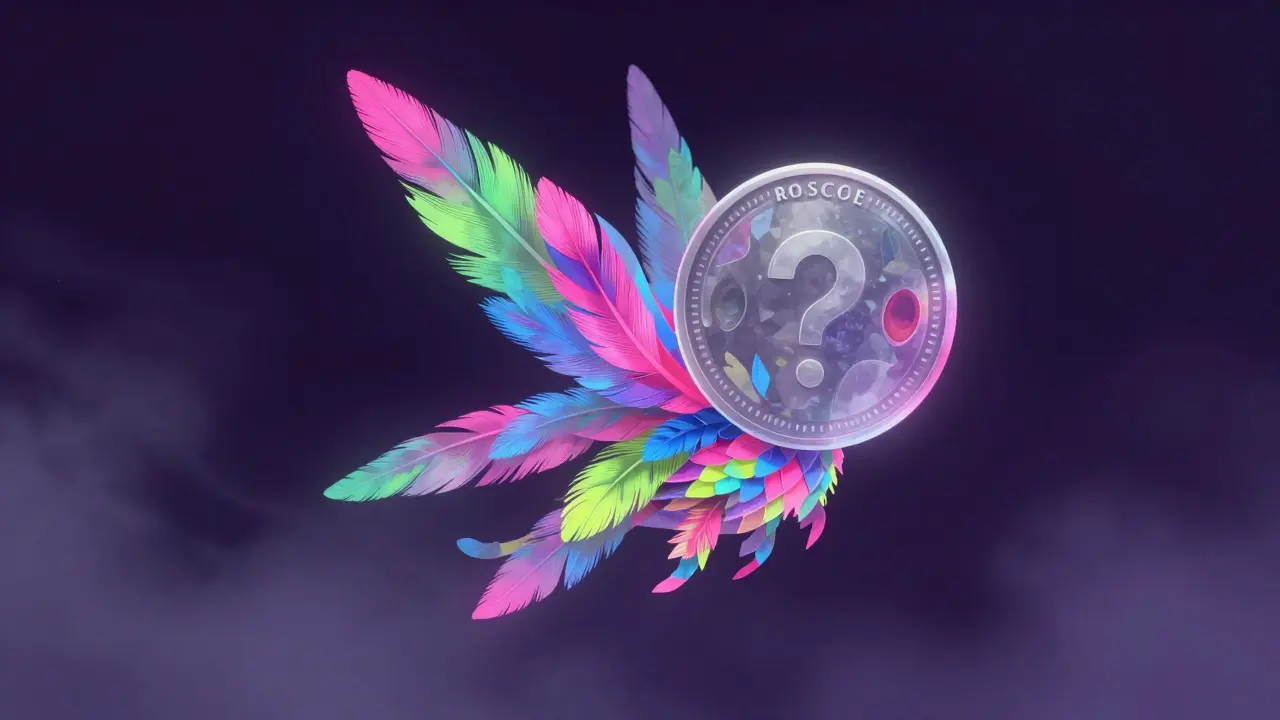

Have you ever stumbled upon a cryptocurrency ticker that sounds familiar but leaves you scratching your head? That’s exactly what happens when you look up Roscoe (ROSCOE), which is a low-capitalization speculative cryptocurrency token with conflicting network data and minimal public documentation. You might see it on price trackers like CoinMarketCap or Crypto.com, wondering if this is the next big thing or just another digital ghost town. The short answer? It’s likely the latter. ROSCOE is a classic example of a micro-cap asset that lacks the fundamentals, transparency, and liquidity required for serious investment.
If you are here because you saw a flash of green on a chart or heard a rumor about a "hidden gem," stop for a second. In the world of crypto, obscurity is often a warning sign, not an opportunity. This article breaks down exactly what ROSCOE is, where it lives on the blockchain, why the data looks so messy, and-most importantly-why you should probably keep your wallet closed unless you are prepared to lose everything.
The Basics: What Is Roscoe (ROSCOE)?
At its core, Roscoe is a fungible cryptocurrency token with a fixed maximum supply of one billion units. Unlike Bitcoin, which has a complex mining ecosystem, or Ethereum, which powers thousands of decentralized applications, ROSCOE appears to be a simple token with no documented utility. There is no whitepaper linked on major aggregators, no named founding team, and no clear roadmap.
Think of it like a penny stock from the 1990s, but without even the basic financial reports. The token exists primarily on price-tracking platforms. According to data from CoinMarketCap, the total supply is capped at 1,000,000,000 ROSCOE, and all of these tokens are reportedly in circulation. This means there are no locked-up tokens for developers or future vesting schedules-a common feature in more legitimate projects to align incentives. Here, everyone who wants to sell can sell, immediately.
The lack of a clear use case is the first red flag. Does ROSCOE govern a protocol? No. Does it provide access to a service? Unlikely. It seems to exist simply to be traded, which puts it firmly in the category of speculative assets or meme coins. These tokens rely entirely on community hype and market momentum rather than underlying technology or revenue generation.
The Identity Crisis: Ethereum vs. Solana
One of the most confusing aspects of ROSCOE is that it seems to live in two places at once, or perhaps, two different scams are using the same name. This is a critical detail for anyone trying to buy or hold the token.
On one hand, sources like CoinCarp and CoinMarketCap list ROSCOE as an ERC-20 token running on the Ethereum Virtual Machine (EVM). This version can be added to wallets like MetaMask by importing a specific contract address. If you are interacting with this version, you are dealing with Ethereum gas fees and the security model of the Ethereum network.
On the other hand, CoinSwitch lists a ROSCOE token built on Solana, described as a fast and scalable blockchain platform known for low transaction costs. This would be an SPL token, compatible with wallets like Phantom. Why does this matter? Because these are two completely different blockchains with different security risks, user bases, and technical architectures. If you buy the Ethereum version thinking you have the Solana version, you might end up with an illiquid asset on a chain you don't monitor.
This confusion suggests either a lack of professional marketing or, worse, a deliberate attempt to create multiple versions of the token to manipulate prices across different exchanges. Always verify the contract address before sending any funds. Never trust a ticker symbol alone.
Tokenomics and Price Volatility
Let’s talk numbers, because they tell a story of extreme fragility. As of recent data snapshots, the fully diluted valuation (FDV) of ROSCOE hovers around $141,720 USD. To put that in perspective, that is less than the cost of a mid-range sedan. For context, top-tier meme coins like Dogecoin or Shiba Inu have market caps in the billions. ROSCOE is operating in the shadows.
| Metric | Value | Implication |
|---|---|---|
| Max Supply | 1,000,000,000 | Fixed supply; no inflationary pressure from minting. |
| Circulating Supply | 1,000,000,000 | 100% available for trading; high sell-side risk. |
| All-Time High (ATH) | $0.001127 | Price has dropped ~87% from peak; significant loss of value. |
| 24-Hour Volume | ~$98,120 | Low liquidity; large trades can crash the price. |
| Market Rank | #4138+ | Obscure asset with minimal institutional interest. |
The volatility is staggering. In a single 24-hour period, the price range swung from $0.0001369 to $0.0002663. That is a nearly 100% swing in one day. While high volatility can mean profit for traders, it usually means disaster for holders. With a daily volume of only ~$98,000 against a market cap of $140,000+, the ratio is dangerously high. It indicates that a relatively small amount of selling could wipe out the entire day's buying pressure, causing the price to plummet.
Furthermore, data discrepancies between platforms are alarming. Crypto.com showed a price of $0.00002702 with zero volume change, while CoinMarketCap showed a higher price with active volume. This inconsistency suggests that data feeds are stale or that trading is happening on obscure, unregulated decentralized exchanges (DEXs) that aren't properly integrated into mainstream trackers.

The Missing Team and Lack of Audits
In the crypto industry, anonymity isn't always bad-Bitcoin's creator remains unknown. However, for a new, small-cap token, anonymity is a massive liability. Who created ROSCOE? Where are their GitHub repositories? Have the smart contracts been audited by firms like CertiK or PeckShield?
The answer to all these questions is: we don't know. Major aggregators do not list founders, company entities, or audit reports for ROSCOE. This absence is deafening. Without an audit, there is no guarantee that the code doesn't contain malicious functions. For instance, could the developers blacklist your wallet? Could they pause transfers? Could they print more tokens despite the stated max supply? Without verified source code, you are trusting strangers with your money.
This lack of transparency is typical of "rug pulls" or honeypot scams. A honeypot is a token you can buy but cannot sell because the code prevents outgoing transactions. Until you try to sell and fail, you won't know. Given ROSCOE's profile, this is a genuine possibility.
How to Buy (And Why You Should Think Twice)
If you are still considering buying ROSCOE, here is how the process typically works for such obscure tokens, along with the risks at each step.
- Set Up a Wallet: You will need MetaMask for the Ethereum version or Phantom for the Solana version. Ensure you have ETH or SOL to pay for gas fees.
- Find the Contract Address: Do not search by name. Copy the exact contract address from a trusted aggregator like CoinMarketCap. Be wary of fake links on social media.
- Use a Decentralized Exchange (DEX): ROSCOE is likely not on major centralized exchanges like Binance or Coinbase. You will probably use Uniswap (for Ethereum) or Raydium (for Solana).
- Swap Tokens: Connect your wallet, input the amount, and approve the transaction. Note that slippage may be high due to low liquidity.
However, consider this: if you spend $50 on gas fees to buy $10 worth of ROSCOE, you are already down 80%. And if the token is a honeypot, that $10 is gone forever. The barrier to entry is low, but the barrier to exit can be insurmountable.

Comparing ROSCOE to Established Meme Coins
To understand ROSCOE's position, let's compare it to established players in the meme coin space. This highlights why ROSCOE struggles to gain traction.
| Feature | Roscoe (ROSCOE) | Dogecoin (DOGE) | Shiba Inu (SHIB) |
|---|---|---|---|
| Market Cap | ~$140k | ~$10B+ | ~$5B+ |
| Liquidity | Very Low | High (Tier-1 Exchanges) | High (Tier-1 Exchanges) |
| Audits | None Public | Yes (Multiple) | Yes (Multiple) |
| Community Size | Obscure | Millions | Millions |
| Utility | None Documented | Tips, Payments | Ecosystem (Shibarium, etc.) |
The gap is enormous. DOGE and SHIB have survived bear markets because they have deep liquidity, massive communities, and brand recognition. ROSCOE has none of these. It is a speck in the cosmic dust of the crypto market.
Regulatory and Security Risks
From a regulatory standpoint, ROSCOE falls into a gray area. It is not registered with any financial authority, meaning there is no recourse if something goes wrong. In the United States, the SEC has cracked down on unregistered securities. While ROSCOE is too small to be a primary target, trading it could still complicate your tax situation. Every swap is a taxable event in many jurisdictions, and tracking gains/losses on a token with erratic pricing is a nightmare.
Security-wise, the risks are technical. Since there is no audit, the smart contract could have vulnerabilities that allow hackers to drain the liquidity pool. Or, the developers could retain a hidden admin key that lets them freeze transactions. Without open-source verification, you are flying blind.
Conclusion: Is ROSCOE Worth It?
So, what is Roscoe (ROSCOE)? It is a low-cap, high-risk cryptocurrency token with conflicting network information, no clear utility, and no transparent team. It serves no obvious function in the blockchain ecosystem beyond being a vehicle for speculation.
For the average investor, ROSCOE offers little more than danger. The potential for profit is outweighed by the probability of total loss due to rug pulls, honeypots, or simple market irrelevance. If you are curious about crypto, stick to assets with verifiable audits, active development, and strong community support. Leave the micro-cap mysteries to those who enjoy gambling with money they can afford to burn.
Is Roscoe (ROSCOE) a scam?
While there is no definitive proof that ROSCOE is a scam, it exhibits many characteristics of fraudulent projects, including anonymous creators, lack of audits, and conflicting blockchain data. The high risk of it being a honeypot or rug pull makes it extremely dangerous to invest in.
Which blockchain is ROSCOE on: Ethereum or Solana?
There appear to be two different tokens using the ROSCOE ticker. One is an ERC-20 token on Ethereum (or an EVM-compatible chain), and the other is an SPL token on Solana. You must verify the specific contract address for the version you intend to trade, as they are not interchangeable.
Can I buy ROSCOE on Binance or Coinbase?
No, ROSCOE is not listed on major centralized exchanges like Binance or Coinbase. It is primarily traded on decentralized exchanges (DEXs) like Uniswap or Raydium, which requires you to connect a personal wallet and accept higher risks.
What is the total supply of ROSCOE?
The maximum and circulating supply of ROSCOE is reported as 1,000,000,000 tokens. This means all tokens are currently in circulation, with no additional tokens expected to be minted.
Why is the price of ROSCOE so volatile?
ROSCOE has a very low market capitalization (around $140k) and low trading volume. This means that even small buy or sell orders can cause massive price swings. Additionally, inconsistent data across price trackers contributes to perceived volatility.