



Decentralized Finance (DeFi) promised a world where money moves without permission, without borders, and without asking for your ID. But that dream is colliding hard with reality. In 2026, the era of "code is law" is giving way to an era where code must obey laws from Brussels, Washington, and beyond. If you are running a protocol, investing in DeFi, or building tools for this space, you are no longer just fighting bugs; you are fighting regulators.
The landscape has shifted dramatically since the early days of anonymous swapping. Today, DeFi compliance is not a nice-to-have feature; it is the difference between surviving and being shut down. With frameworks like the European Union’s Markets in Crypto-Assets Regulation (MiCA) fully operational and the U.S. Securities and Exchange Commission (SEC) tightening its grip on custody rules, the technical and legal hurdles have never been higher. This article breaks down exactly what these challenges look like on the ground, why they matter for your wallet, and how the industry is adapting.
The Core Conflict: Permissionless Code vs. Permissioned Laws
At its heart, the problem is architectural. Traditional finance works because there is a middleman-a bank, a broker, an exchange-who can be held accountable. Regulators know who to call when something goes wrong. DeFi removes that middleman. You interact with smart contracts, which are immutable pieces of code living on the blockchain. Once deployed, they cannot easily be changed to add a new rule or block a specific user.
This creates a fundamental mismatch. Regulations demand identification, transaction monitoring, and the ability to freeze assets if necessary. DeFi provides pseudonymity, automated execution, and censorship resistance. How do you apply Know Your Customer (KYC) rules to a protocol that doesn’t store user data? How do you enforce Anti-Money Laundering (AML) standards when funds can move across chains in seconds?
For years, many protocols ignored this tension, hoping regulations would catch up or fade away. That window closed in 2025. Now, regulators are targeting the points of interaction-front-end interfaces, token issuers, and even decentralized autonomous organizations (DAOs)-forcing them to adopt compliance measures that were previously unthinkable in the DeFi ethos.
MiCA and DORA: The New Global Standards
If you operate anywhere near Europe, you already know about MiCA. It is the most comprehensive crypto regulatory framework in the world, setting strict rules for stablecoins, service providers, and market conduct. But MiCA is only half the story. The other half is the Digital Operational Resilience Act (DORA).
While MiCA focuses on financial stability and consumer protection, DORA targets cybersecurity and operational resilience. For DeFi projects, this means you cannot just write secure code; you must prove that your entire infrastructure-including third-party oracle providers, cloud hosting services, and governance mechanisms-can withstand cyberattacks and operational failures.
| Regulation | Primary Focus | Key Requirement for DeFi | Enforcement Body |
|---|---|---|---|
| MiCA | Market Integrity & Consumer Protection | Licensing for VASPs, transparency for asset issuers | European Supervisory Authorities |
| DORA | Cybersecurity & Operational Resilience | Incident reporting, third-party risk management | National Competent Authorities |
| FATF Travel Rule | Anti-Money Laundering (AML) | Sharing sender/receiver info for transfers above threshold | Global FATF members / Local FIUs |
| SEC Custody Rule | Investor Asset Protection | Qualified third-party custodians for client assets | U.S. Securities and Exchange Commission |
The challenge here is scale. Large centralized exchanges can hire armies of compliance officers. A small DeFi team might consist of five developers. Asking them to build enterprise-grade incident response plans and audit trails for every transaction is a massive burden. This is leading to consolidation, where smaller protocols struggle to survive while larger ones absorb the costs of compliance.
KYC in a Pseudonymous World
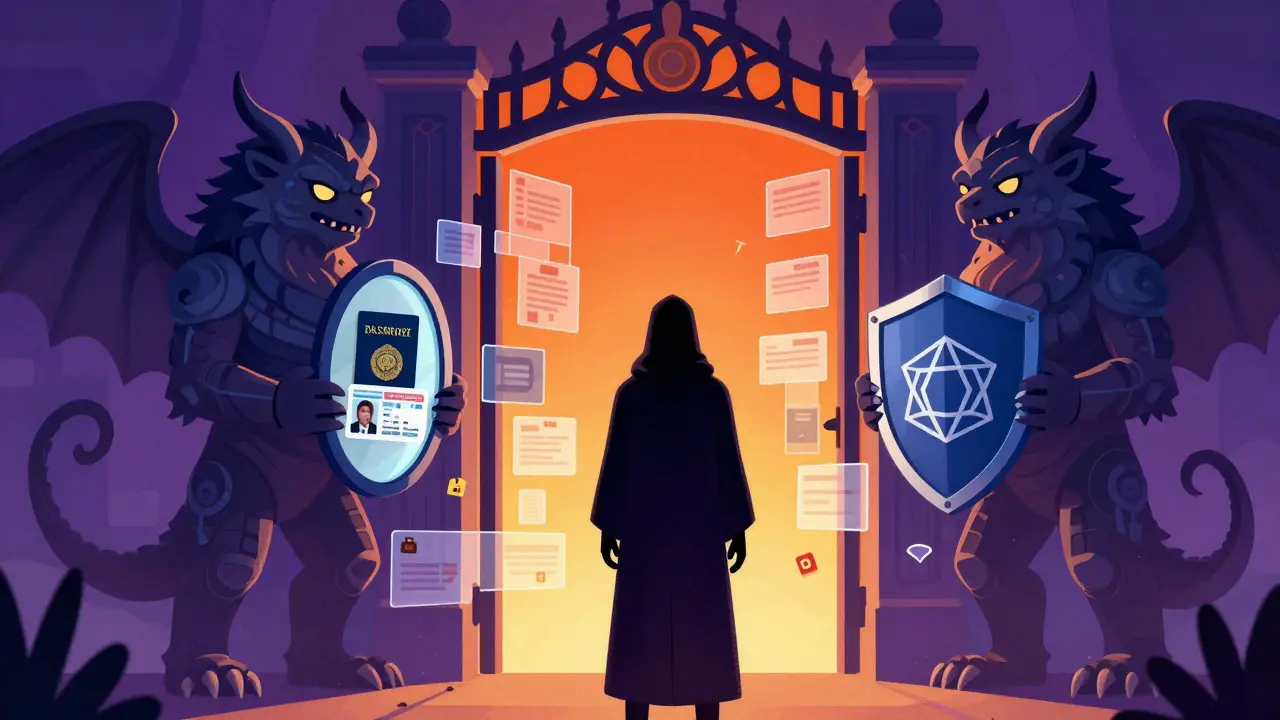
Know Your Customer (KYC) is the holy grail of traditional finance compliance. It links a real-world identity to a financial account. In DeFi, users connect via wallet addresses. There is no name, no phone number, no passport scan. So, how do you comply?
The industry is experimenting with several approaches, each with significant trade-offs:
- Front-End Gatekeeping: Protocols require users to pass through a compliant web interface that performs KYC before allowing access to the smart contracts. This preserves the decentralization of the backend but centralizes the entry point, creating a single point of failure and censorship.
- Account Abstraction (ERC-4337): This Ethereum standard allows wallets to embed social recovery and conditional spending limits. While not strictly KYC, it enables more sophisticated user verification flows that can integrate with identity providers.
- Zero-Knowledge Proofs (ZKPs): This is the technological dream. ZKPs allow a user to prove they meet certain criteria (e.g., "I am over 18," "I am not on a sanctions list") without revealing their actual identity. Projects like Worldcoin and various privacy-focused DAOs are exploring this, but widespread adoption remains limited by usability and regulatory acceptance.
Even with these tools, the FATF Travel Rule complicates things. Updated in 2025, it requires Virtual Asset Service Providers (VASPs) to share detailed sender and receiver information for transfers above a certain threshold. For DeFi, determining who counts as a VASP is still a legal gray area, but regulators are increasingly arguing that anyone providing a user interface or liquidity aggregation service falls under this definition.
Security as Compliance: Beyond Smart Contract Audits
In the past, DeFi security meant getting a smart contract audited by firms like OpenZeppelin or Trail of Bits. Today, compliance demands a much broader view of security. Regulators care about operational resilience, which includes protecting against social engineering, oracle manipulation, and cross-chain attacks.
Ahmed Yousuf, a financial author at CoinTime, notes that the threat landscape has shifted from simple code bugs to coordinated exploits involving AI-powered phishing and deepfakes. When a hacker uses a deepfake video to trick a DAO multisig signer into approving a malicious transaction, is that a security breach or a compliance failure? Under DORA, it’s both.
This means DeFi protocols must now implement:
- Multi-Signature Governance Controls: Ensuring that critical decisions require approval from multiple trusted parties, often with time locks to allow for community review.
- Oracle Security: Using decentralized oracle networks like Chainlink to prevent price manipulation, which can trigger liquidations and drain protocol funds.
- Real-Time Monitoring: Deploying AI-driven analytics tools to detect suspicious transaction patterns instantly, rather than relying on post-mortem analysis.
The cost of these measures is high. But the alternative is worse. The Galois Capital case, where the SEC imposed a $225,000 settlement for custody violations, serves as a stark warning. Even if you are not a traditional fund manager, if you hold client assets in a way that doesn’t meet regulatory standards, you are exposed.

The Institutional Hurdle: Custody and Trust
Institutional investors want exposure to DeFi yields, but they cannot touch unregulated protocols. Why? Because of the SEC Custody Rule (Rule 206(4)-2). This rule requires private fund managers to keep client assets with qualified third-party custodians. Most DeFi assets sit in self-custodied wallets or locked in smart contracts, which do not qualify as "qualified custodians" under current interpretations.
To bridge this gap, a new layer of infrastructure has emerged: institutional-grade custodians like Fireblocks and Coinbase Prime. These platforms offer multi-party computation (MPC) key management and insurance wrappers around DeFi interactions. They act as a shield, allowing institutions to participate in DeFi while maintaining a veneer of traditional compliance.
However, this introduces centralization back into the system. By routing institutional capital through these custodians, we lose some of the censorship resistance that makes DeFi valuable. It also creates dependency risks-if the custodian goes down or gets hacked, millions of dollars could be frozen.
What Comes Next? The Future of Compliant DeFi
We are entering a period of fragmentation. Users in the EU will face stricter KYC requirements due to MiCA. Users in the U.S. may find themselves blocked from certain protocols due to SEC enforcement actions. Meanwhile, jurisdictions with lighter regulations may become hubs for non-compliant DeFi activity.
Despite these challenges, innovation continues. We are seeing the rise of "compliance-as-a-service" APIs that allow developers to plug in AML checks and KYC verification with minimal effort. We are also seeing more DAOs adopting formal legal structures, such as the Wyoming DAO LLC, to gain legal recognition and liability protection.
The key takeaway is that DeFi is maturing. The wild west days are over. Success in 2026 and beyond will belong to those who can balance the twin demands of decentralization and compliance. It won’t be easy, and it certainly won’t be cheap. But for the sector to grow beyond niche enthusiasts and attract mainstream capital, it is the only path forward.
Does MiCA apply to all DeFi protocols?
Not automatically. MiCA primarily targets entities providing crypto-asset services to customers in the EU, known as Virtual Asset Service Providers (VASPs). Purely decentralized protocols with no identifiable operator may fall outside its direct scope, but regulators are increasingly looking at front-end interfaces and token issuers as potential VASPs. If you provide a user-friendly interface or issue a utility token that functions like a security, you likely need to comply.
How can a small DeFi project afford compliance?
Small projects should leverage modular compliance solutions. Instead of building custom KYC systems, use established APIs from providers like Sumsub or Jumio. For security, focus on rigorous auditing of core contracts and use decentralized oracles. Consider joining consortia or sharing compliance infrastructure with other projects to reduce costs. Prioritize transparency and clear documentation to build trust with regulators and users alike.
Is it possible to have KYC-free DeFi in 2026?
Technically, yes. You can still interact with smart contracts directly using raw transactions without any KYC. However, accessing these protocols through popular web interfaces or aggregators may require identity verification. Additionally, withdrawing funds to fiat currency through regulated exchanges will always require KYC. True anonymity is becoming harder to maintain at the points of entry and exit from the traditional financial system.
What is the FATF Travel Rule and how does it affect DeFi?
The FATF Travel Rule requires VASPs to collect and transmit sender and receiver information for cryptocurrency transfers above a certain threshold (often €1,000 or equivalent). For DeFi, this is challenging because transactions are peer-to-peer. Regulators are pushing for solutions where intermediaries, such as bridges or swap aggregators, capture this data. Failure to comply can result in heavy fines or loss of operating licenses in regulated jurisdictions.
How does DORA impact DeFi security practices?
DORA mandates that financial entities, including those in crypto, demonstrate robust digital operational resilience. This means DeFi projects must have formal incident response plans, conduct regular penetration testing, and manage risks associated with third-party providers (like cloud hosts or oracle services). It shifts the focus from just code security to overall system reliability and continuity planning.