
Imagine buying a cryptocurrency that doesn't just sit in your wallet but talks back to you on social media. That’s the pitch behind Duck AI, a project that tries to bridge the gap between internet memes and artificial intelligence. But before you rush to buy, you need to know what you’re actually holding. Is it the next big tech innovation, or is it just another speculative bet on the Solana blockchain?
Duck AI (ticker: DUCKAI) is a meme token built on the Solana network. It launched via Pump.fun, a platform known for letting anyone create tokens with minimal barriers. What sets it apart from thousands of other meme coins is its integration with an AI bot called @duckunfiltered. This bot interacts with holders, creating a community experience driven by automated responses rather than human moderators.
The Core Concept: Memes Meet AI Agents
To understand Duck AI, you have to look at how it differs from standard meme coins like Dogecoin or Shiba Inu. Traditional meme coins rely entirely on community hype and viral marketing. Their value comes purely from people believing others will pay more later. Duck AI attempts to add a layer of utility through automation.
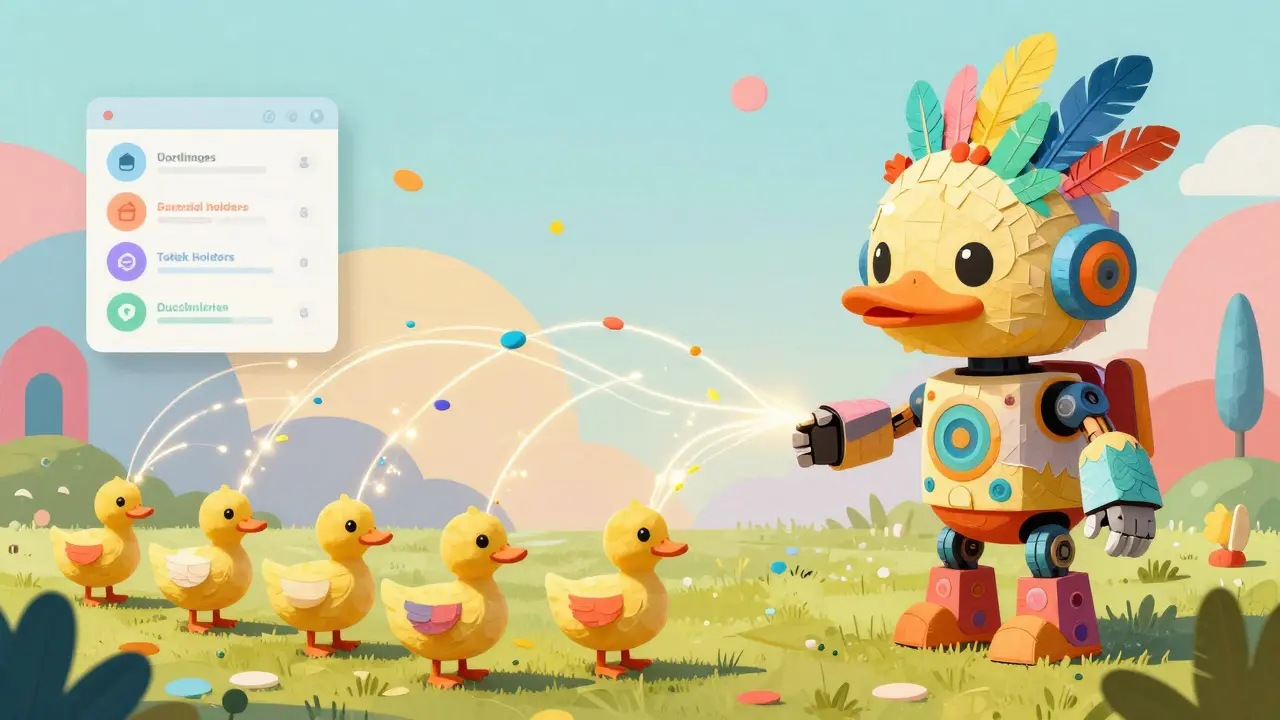
The central entity here is the @duckunfiltered AI bot. This isn’t just a chatbot that answers FAQs. The project’s stated goal was to build a "single-agent ecosystem." In simple terms, this means the AI acts as a coordinator within the community. It responds to prompts, engages in discussions, and can even execute certain on-chain actions based on user input. For a niche audience interested in the intersection of AI agents and blockchain, this sounds intriguing. For the average investor, it’s a novelty feature that hasn’t proven its long-term value yet.
Think of it this way: most crypto projects have a Discord server where humans answer questions. Duck AI replaces some of those humans with code. Whether that adds real economic value or just saves developer time is a question the market has already started answering.
Technical Foundation: Why Solana?
Duck AI exists exclusively on the Solana blockchain. This choice is critical for two reasons: speed and cost. Meme coin trading happens fast. Traders buy and sell in seconds, chasing pumps and avoiding dumps. If transactions take minutes or cost dollars in fees, the game breaks. Solana offers sub-second finality and fractions of a cent in fees, making it the preferred home for high-frequency meme speculation.
Because it lives on Solana, you can’t trade DUCKAI on Bitcoin wallets or Ethereum-based exchanges like Uniswap directly. You need a Solana-compatible wallet. Popular options include Phantom and Solflare. These wallets allow you to connect to decentralized exchanges (DEXs) where DUCKAI is listed. Without one of these tools, you literally cannot interact with the token.
| Attribute | Value |
|---|---|
| Blockchain | Solana |
| Ticker Symbol | DUCKAI |
| Total Supply | 999.99 Million |
| Circulating Supply | ~999.93 Million |
| Launch Platform | Pump.fun |
| Primary Feature | @duckunfiltered AI Bot Integration |
Tokenomics and Supply Dynamics
Let’s talk numbers, because they tell a stark story about Duck AI’s current state. The total supply of DUCKAI is fixed at approximately 999.99 million tokens. There is no inflation mechanism; no new tokens are being minted. This is common in meme coins to prevent dilution, but it also means the price movement depends entirely on demand shifting against a static supply.
As of mid-2026, nearly all of these tokens are in circulation-about 999,928,423 tokens. This massive supply results in a very low per-token price. We’re talking fractions of a penny. While seeing a price like $0.000015 might seem cheap, remember that owning 1,000 tokens still costs money, and the market cap reflects the true valuation, not the unit price.
The distribution is relatively broad but small-scale. Data shows around 2,570 unique holders. Compare this to major cryptocurrencies with millions of holders, and you see a concentrated community. This concentration increases risk. If a few large holders decide to sell, the price can collapse rapidly due to low liquidity.
Market Performance: From Hype to Reality
If you missed the initial launch, you likely entered during a period of significant decline. Duck AI hit its all-time high (ATH) of $0.034 USD on January 10, 2025. At that peak, the excitement around AI-integrated meme coins was at fever pitch. Investors were willing to pay premiums for novelty.
Fast forward to June 2026, and the picture looks different. The token has dropped roughly 99.95% from its peak. Current prices hover between $0.000015 and $0.000180, depending on which exchange data you trust. Market cap estimates vary wildly across platforms-from under $16,000 on CoinMarketCap to over $550,000 on CoinStats. This discrepancy itself is a red flag. It indicates low liquidity and inconsistent order books across different trading venues.
This volatility is normal for micro-cap meme tokens, but it’s dangerous for inexperienced traders. A 20% swing in a day can wipe out a portfolio if you’re leveraged or emotionally attached to the position. The lack of listings on major centralized exchanges like Coinbase or Binance limits accessibility and keeps volume low. Most trading happens on decentralized platforms like Raydium or directly on Pump.fun.
Risks and Regulatory Considerations
You need to be clear about what you’re risking. Duck AI is an unregulated asset. It was launched on Pump.fun, a platform designed for rapid, community-driven creation without venture capital oversight or legal compliance checks. There is no formal whitepaper, no public development team identity, and no regulatory registration.
In many jurisdictions, including parts of the United States and Europe, regulations around cryptocurrencies are tightening. Assets that offer no clear utility beyond speculation face higher scrutiny. If regulators classify such tokens as securities or ban certain types of automated trading bots, projects like Duck AI could face existential threats.
Furthermore, the reliance on an AI bot introduces technical risks. What happens if the @duckunfiltered bot goes offline? What if it’s hacked or manipulated to spread misinformation? Unlike traditional companies with customer service teams, there’s no clear recourse if things go wrong. You’re trusting code and anonymous developers.
How to Buy and Trade DUCKAI
If you’ve decided the risks are worth taking, here’s how you actually get involved. Since DUCKAI is a Solana token, you cannot buy it on standard fiat-to-crypto exchanges like Kraken or Gemini directly.
- Get a Solana Wallet: Download Phantom or Solflare. Secure your seed phrase offline. Never share it.
- Fund Your Wallet: Buy SOL (Solana’s native currency) on a major exchange and transfer it to your wallet address.
- Connect to a DEX: Go to a decentralized exchange like Jupiter, Raydium, or Pump.fun. Connect your wallet.
- Swap SOL for DUCKAI: Search for the DUCKAI contract address. Double-check it against official sources to avoid scams. Set your slippage tolerance appropriately (meme coins often require higher slippage due to volatility).
- Confirm Transaction: Approve the swap in your wallet. Pay attention to gas fees, though they should be minimal on Solana.
Always verify the contract address. Scammers create fake tokens with similar names. If you buy the wrong one, your money is gone forever.
Is Duck AI Worth It?
There’s no easy yes or no. If you’re looking for stable growth or dividend-like returns, Duck AI is not for you. It’s a high-risk, high-reward speculative asset. Its value proposition rests on the belief that AI-driven community engagement will become a dominant trend in crypto culture.
The fact that it’s down 99% from its peak suggests the initial hype cycle has passed. However, meme coins can revive unexpectedly if a new narrative takes hold. The AI angle remains relevant, but execution matters. Has the @duckunfiltered bot evolved? Is the community growing? Or is it stagnant?
Do your own research. Look at recent social media activity. Check if the AI bot is still active. Monitor trading volumes. Don’t invest more than you can afford to lose completely. In the world of meme coins, zero is a possible outcome.
What is the ticker symbol for Duck AI?
The ticker symbol for Duck AI is DUCKAI. It is important to distinguish it from other duck-themed tokens on different blockchains.
Which blockchain is Duck AI built on?
Duck AI is built exclusively on the Solana blockchain. This allows for fast transactions and low fees, which are essential for meme coin trading.
What is the @duckunfiltered bot?
The @duckunfiltered bot is an AI agent integrated into the Duck AI ecosystem. It interacts with token holders on social media and potentially executes on-chain actions, aiming to create an autonomous community management system.
Where can I buy DUCKAI tokens?
You can buy DUCKAI on Solana-based decentralized exchanges (DEXs) like Raydium, Jupiter, or Pump.fun. You will need a Solana-compatible wallet like Phantom or Solflare to facilitate the trade.
What is the total supply of DUCKAI?
The total supply of DUCKAI is fixed at approximately 999.99 million tokens. There is no additional inflation or minting scheduled.
Why has Duck AI’s price dropped so much?
Like many meme coins, Duck AI experienced a hype cycle followed by a correction. After reaching its all-time high in early 2025, interest waned, leading to a ~99.95% decline. Low liquidity and lack of major exchange listings contribute to continued volatility.
Is Duck AI a safe investment?
No, Duck AI is considered a high-risk speculative asset. It lacks regulatory oversight, has a volatile price history, and relies on experimental technology. Only invest funds you can afford to lose entirely.