
Imagine walking into a bank, a hospital, or a gaming platform and proving who you are - without handing over your Social Security number, driver’s license, or passport. No forms. No third parties holding your data. Just a quick, private, and verifiable signal that you’re you. That’s the promise of self-sovereign identity - and when you tie it to NFTs, things get even more interesting.
Self-sovereign identity, or SSI, isn’t science fiction. It’s a real system built on decentralized identifiers (DIDs) and verifiable credentials (VCs) that let you control your own digital identity. You store it in your wallet. You decide who sees what. And now, thanks to NFTs, your identity can also prove what you own - not just who you are.
What Exactly Is Self-Sovereign Identity?
SSI flips the script on how identity works. Instead of companies like Facebook, Google, or your government holding your personal data, you hold it. Your identity lives in your own digital wallet - on your phone or computer - not in some corporate database. When you need to prove you’re over 21, you don’t show your ID. You send a cryptographically signed proof that says, "I am over 21," without revealing your birthdate, address, or name.
This isn’t theory. Systems like Sovrin, Hyperledger Indy, and Trinsic are already running SSI networks. They use Decentralized Identifiers (DIDs) - unique, blockchain-anchored IDs you create yourself - and Verifiable Credentials issued by trusted sources like universities, governments, or employers. These credentials are stored in your wallet and can be shared selectively. You don’t have to give away everything to get access to something.
How Do NFTs Fit In?
NFTs are often thought of as digital art or collectibles. But they’re really just unique tokens on a blockchain that prove ownership. An NFT isn’t just a picture - it’s a certificate of ownership tied to a specific asset. That’s why they work so well for things like virtual land, game items, or concert tickets.
Now, imagine using an NFT not to prove you own a Bored Ape, but to prove you’re the verified creator of that Bored Ape. Or that you’ve completed a course from a university that issued you a credential as an NFT. That’s where SSI and NFTs start to merge.
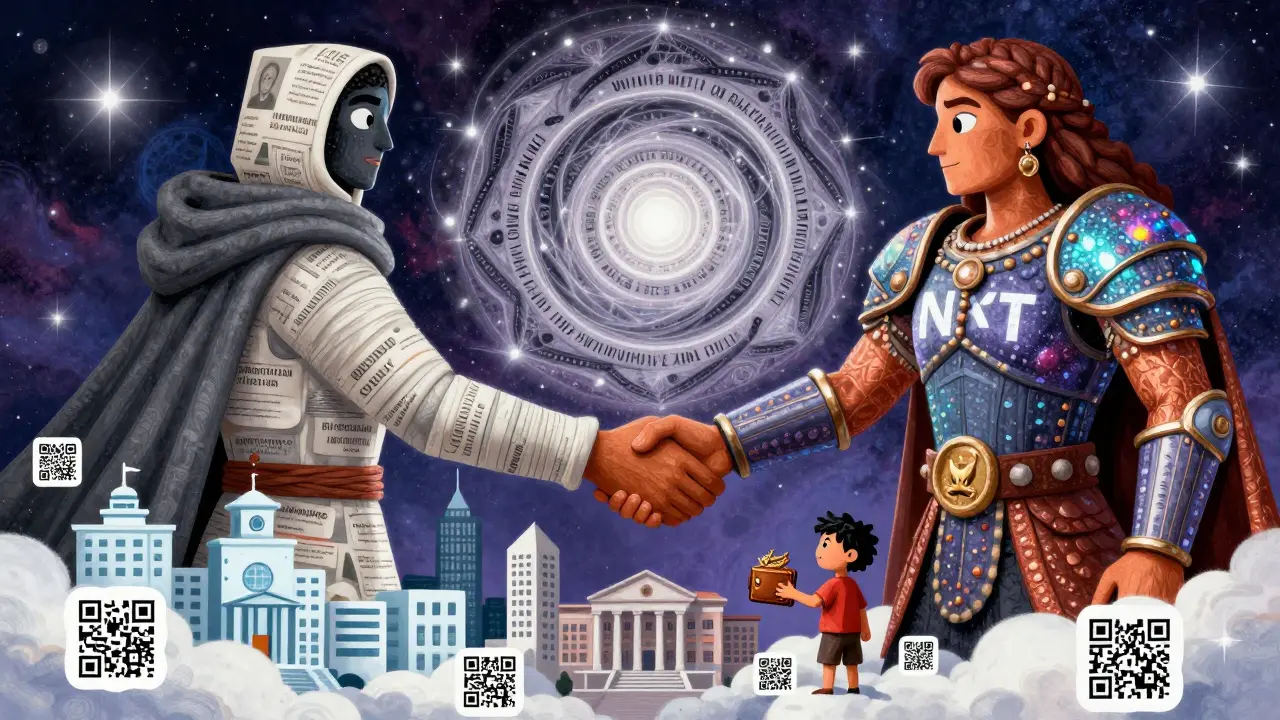
Walt.id put it simply: "SSI is for proving who you are. NFTs are for proving what you own." They’re different tools - but together, they’re powerful. Your SSI says you’re a licensed nurse. Your NFT says you own the digital badge that proves it. And because both are cryptographically signed and stored in your wallet, no one else can fake them.
Real-World Uses: Beyond the Hype
People aren’t just talking about this - they’re building it.
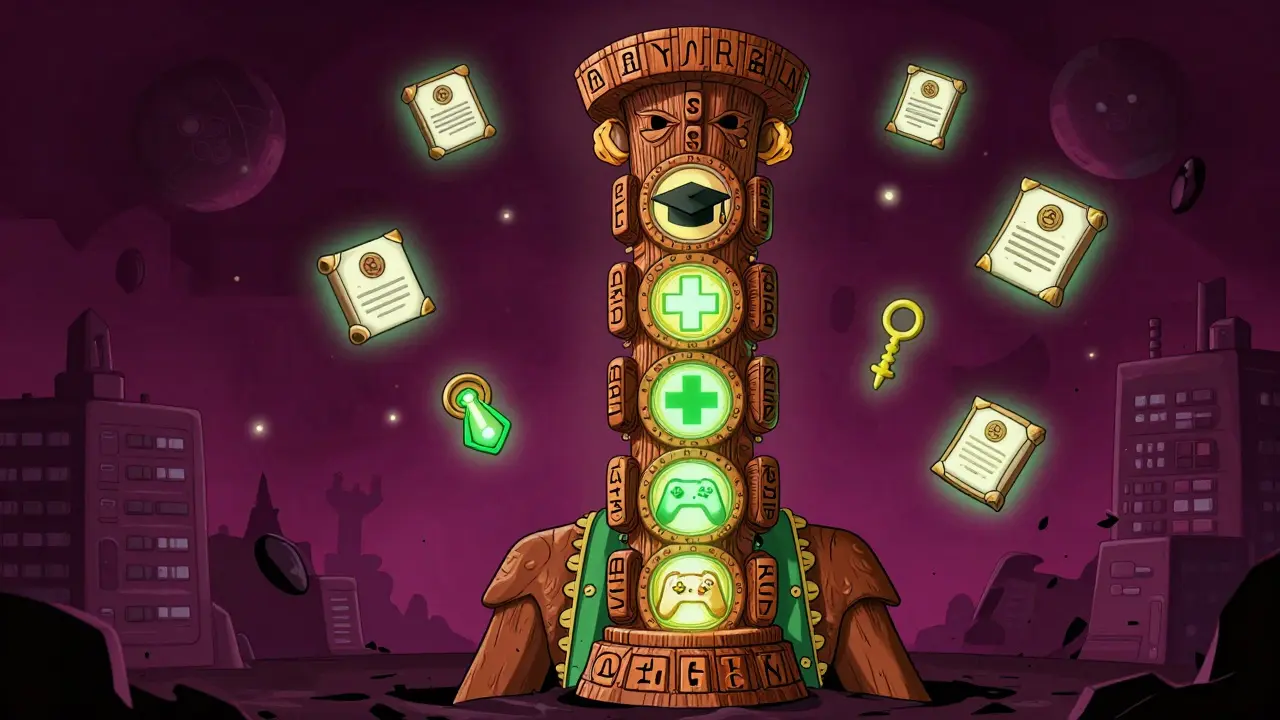
- Gaming: Major studios are using NFT-gated SSI to let players bring their identity across games. If you’ve earned a rare weapon in Game A, and you’ve proven your identity via SSI, Game B can recognize your skill level and unlock perks - without needing you to sign up again.
- Healthcare: Patients can store their medical history as verifiable credentials and share only what’s needed for a doctor’s visit - say, vaccination records - without exposing their full medical file.
- Finance: Banks are testing SSI-NFT hybrids for KYC. Instead of submitting documents repeatedly, you prove your identity once, store it as a credential, and use it across multiple institutions. NFTs can act as access tokens to premium services.
- Education: Universities like MIT and the University of Nicosia have issued diplomas as NFTs linked to SSI. Employers can verify your degree instantly, and you never have to request a transcript again.
On Reddit, a user named "IdentityNerd42" shared how they used SSI to prove ownership of a Bored Ape NFT to gain access to a private Discord server. It took three tries to get the credential format right, but once it worked, it was seamless. No username. No password. Just a cryptographic handshake between their wallet and the server.
Why This Is Harder Than It Looks
It’s not magic. There are real problems.
First, the tech is messy. SSI credentials follow W3C standards. NFTs follow ERC-721 or ERC-1155. Getting them to talk to each other isn’t automatic. Developers report that 61% of their time is spent fixing mismatched formats between blockchains.
Second, users get confused. Is this NFT my ID? Or is it my asset? If I sell my NFT, do I lose my identity? These are valid concerns. A 2024 ConsenSys survey found that 78% of users couldn’t tell the difference between a credential and a collectible.
Third, privacy clashes with transparency. SSI thrives on selective disclosure - you show only what’s needed. But NFTs live on public blockchains. Everyone can see who owns what. That’s a conflict. If your identity is tied to an NFT, and that NFT is publicly visible, your privacy is compromised.
Solutions are emerging. Zero-knowledge proofs (ZKPs) let you prove something is true without revealing the data behind it. Imagine proving you own a $10,000 NFT without showing its metadata or transaction history. That’s the future. The IETF is already drafting standards for ZK-SSI for NFT applications.
Who’s Building This? And Who’s Watching?
Big players are getting involved.
- Polygon launched a $20 million grant program in late 2024 to fund SSI-NFT projects.
- Microsoft partnered with Sovrin to connect Azure Active Directory with SSI wallets - meaning corporate logins could one day be replaced by user-controlled identities.
- Ethereum Name Service (ENS) now supports DID methods, so your .eth address can double as your digital ID.
Regulators are paying attention too. The EU’s eIDAS 2.0, coming in June 2026, will legally recognize SSI credentials. But it also says NFTs used for identity must meet strict privacy rules. In the U.S., 28 states have different rules - no national framework yet.
Meanwhile, experts are warning about risks. Dr. David Chaum, a pioneer in privacy tech, says tying identity to NFT ownership could exclude people who don’t own valuable digital assets. "You don’t want a world where your identity is worth only what your NFT collection is worth," he said in a January 2025 CoinDesk op-ed.
The Road Ahead: Soulbound Tokens and Beyond
The next big thing? Soulbound Tokens (SBTs).
Proposed by Ethereum co-founder Vitalik Buterin in 2022, SBTs are non-transferable NFTs that represent identity traits - your education, your job history, your community contributions. Unlike regular NFTs, you can’t sell them. They’re meant to be permanent, verifiable records of who you are in the digital world.
By 2026, 72% of SSI platform developers plan to integrate SBTs, according to Electric Capital’s 2025 Developer Report. Imagine a world where your digital resume is a chain of SBTs: one for your degree, one for your GitHub contributions, one for your volunteer work. Employers verify them instantly. No LinkedIn profile needed.
But adoption isn’t guaranteed. Forrester predicts SSI-NFT integration will become standard in Web3 by 2028. Deloitte is more skeptical - they think only 25% of current experiments will survive due to unresolved privacy and scalability issues.
What You Need to Know Right Now
If you’re curious about trying this out:
- Get a wallet that supports DIDs - like Trinsic, ION, or the upcoming MetaMask DID integration.
- Look for issuers of verifiable credentials - universities, employers, or government pilots.
- Don’t confuse NFTs with identity. An NFT proves ownership. A VC proves attributes. They work together, but they’re not the same thing.
- Be cautious about linking your identity to public NFTs. If your wallet address is tied to a high-value NFT, you’re exposing yourself to tracking and phishing.
- Watch for ZK-SSI tools. They’re the key to making privacy and transparency coexist.
This isn’t about replacing passwords. It’s about replacing the entire system of trust - from corporations and governments to platforms and apps - with something you control. And NFTs? They’re not the identity. They’re the key that unlocks what you own - and together, they make your digital life yours again.
Can I use my NFT as my digital ID?
Not directly. An NFT proves ownership of an asset - like a piece of art or a game item. Your digital identity needs to prove attributes - like your age, job, or education. Those are stored as Verifiable Credentials (VCs) in your wallet. But you can link an NFT to a VC. For example, an NFT could represent access to a private community, and the VC proves you’re eligible to own that NFT. They work together, but they’re not interchangeable.
Is self-sovereign identity only for crypto users?
No. While it’s built on blockchain tech, SSI doesn’t require you to buy or trade crypto. You can use it to store your driver’s license, university diploma, or medical records - all as encrypted credentials in your wallet. The goal is to give anyone control over their personal data, whether they use Bitcoin or not. Some governments and universities are already issuing SSI credentials to the public.
What happens if I lose my wallet?
If you lose your wallet and don’t have backups, you lose access to your credentials - just like losing your physical ID. That’s why recovery is critical. Most modern SSI wallets support backup phrases, multi-signature recovery, or trusted contacts. Some systems even let you designate a trusted party (like a family member or lawyer) to help you recover your identity if you’re locked out. Always back up your wallet - and test the recovery process before you rely on it.
Are SSI and NFTs secure?
The underlying cryptography is extremely secure - based on standards used by banks and governments. But security depends on how you use it. If you click a phishing link and give away your wallet seed phrase, your identity can be stolen - just like with any digital system. The difference is, with SSI, no central server holds your data, so there’s no single point of failure. That makes it more resilient than traditional systems, but only if you practice good digital hygiene.
Will governments adopt self-sovereign identity?
Yes - but slowly. The EU is leading with eIDAS 2.0, which will legally recognize SSI credentials by mid-2026. Estonia, Sweden, and Canada already have pilot programs. The U.S. is fragmented, with some states testing SSI for driver’s licenses and voting. The big hurdle isn’t tech - it’s politics. Governments are used to controlling identity data. Shifting that control to citizens is a major cultural and legal shift. But the cost savings and fraud reduction are too big to ignore.
By 2028, your digital identity might not be tied to your email or phone number. It might be tied to your wallet - and the credentials inside it. NFTs won’t be your ID. But they’ll help you prove you’re the right person to own something. And that’s a small change with a huge impact.
![What Is [Fake]COINBASE (COIN)? Understanding the Scam and Protecting Your Assets](/uploads/2026/03/thumbnail-what-is-fake-coinbase-coin-understanding-the-scam-and-protecting-your-assets.webp)
20 Comments
SSI and NFTs together are the quiet revolution no one’s talking about but everyone will need. I’ve been using Trinsic to store my nursing license as a VC, and when I applied for a remote med-tech job, they verified it in 90 seconds. No HR portal. No email chain. Just my wallet and a QR code. It felt like magic, but it’s just math.
And yeah, NFTs as access tokens? I got into a private Web3 health forum last month because my credential NFT proved I’d completed the HIPAA-compliant training. Not because I paid for it - because I earned it.
This is just the government and Big Tech’s way to track you under the guise of privacy. They know if you own an NFT they can link it to your real name through your wallet. Next thing you know they’ll tax your digital soul. I’m not giving them my identity even if it’s ‘mine’ - it’s still on a blockchain they control. #WakeUp
I’ve been reading up on this for months and honestly the whole thing is a mess. You think you’re in control but if you lose your seed phrase you’re toast. And if you link your SSI to an NFT that gets rug-pulled? You’re basically identityless. Also why does everyone ignore that 78% of users can’t tell the difference between a credential and a collectible? That’s not adoption - that’s confusion with extra steps.
i just tried to get a vc from my uni and it took 3 days because the portal kept crashing. i love the idea but the tech is still so clunky. also why do i need another thing to manage? my phone already has 17 apps i forgot i have
I know it sounds futuristic but I’ve been using SSI for my freelance work and honestly it’s changed everything. I don’t have to send my resume to every client anymore - I just share my verified skill credentials. One of my clients even used my SSI to verify I had the right certification before paying me. No escrow. No paperwork. Just trust built into the system.
And the part about Soulbound Tokens? That’s the future. Imagine if your volunteer hours, your open-source contributions, your community leadership - all that could be part of your digital identity. No more lying on LinkedIn. Just truth, verifiable and permanent.
From a systems architecture standpoint, the real bottleneck isn’t cryptography - it’s interoperability between DID methods and NFT standards. Most wallets don’t support W3C VCs natively, and even when they do, the schema alignment between issuers is a nightmare. ERC-721 metadata fields are not semantically compatible with Verifiable Credentials’ @context definitions. Until we standardize on a unified ontology - think JSON-LD + DIDComm + ZKP - this remains a fragmented prototype ecosystem.
Also, ZK-SSI is the only viable path forward. Without zero-knowledge proofs, public NFT ownership inherently violates the principle of selective disclosure.
This whole thing is just crypto bros trying to make their Bored Apes feel important. You think your NFT proves you’re a nurse? Nah. It proves you spent $500 on a JPEG and now you think you’re a tech visionary. Real identity isn’t stored in a wallet. It’s in your actions. Your words. Your community. Not some blockchain token that’ll be worthless in 18 months.
The philosophical underpinning here is radical: identity as property, not as social construct. We’ve spent centuries outsourcing our personhood to institutions - churches, states, corporations. Now we’re reclaiming it as sovereign data. But this isn’t just about tech - it’s about epistemology. Who gets to define truth? Who validates existence?
If my identity is tied to an NFT, and that NFT is publicly visible, then I am no longer sovereign - I am exposed. The blockchain doesn’t care about privacy. It only cares about consensus. And consensus is not the same as dignity.
America doesn’t need this. We have a system that works. Why are we letting tech bros from Silicon Valley dictate how we prove who we are? This is just another way for elites to lock out people who don’t own crypto. You think a single mom in Ohio is going to manage a wallet? No. She’s gonna get locked out and blamed for not being ‘tech-savvy.’ This isn’t empowerment. It’s exclusion dressed up as innovation.
It’s ironic. We’re told to ‘be your own bank’ - but now we’re told to be your own government, your own DMV, your own passport office. Where does the responsibility end? Who holds you accountable if you lie about your credentials? Who audits the issuer? If I can issue myself a ‘Harvard degree’ NFT and link it to my SSI, is that fraud - or just freedom?
The answer lies in trust networks, not tech. And we haven’t built those yet. We’ve built wallets. That’s not the same thing.
Hey I just wanted to say - if you’re even slightly curious about trying this, start small. Get a wallet. Find a university or employer that’s issuing a simple VC - like a completion badge for an online course. Don’t go for NFTs yet. Just feel what it’s like to prove something without handing over your whole life story.
I did this last year and now I don’t even think about passwords anymore. It’s like taking off a heavy coat you didn’t realize you were wearing. And yes, it’s still messy. But it’s worth it. You’re not late. You’re just early.
this sounds cool but honestly i dont get why i need to manage another thing. i already have 5 passwords and 2fa apps and now u want me to backup a 12 word phrase for my identity? give me a break. also why is everyone so excited about blockchain for identity when my bank still can’t fix their app?
so u say nfts prove ownership but what if i just copy the image? then i own it right? lol jk but seriously how is this diff from just using a pdf certificate? its just a digital file with a fancy name. and if i lose my wallet i lose my life? no thanks
I’ve been mentoring folks in rural communities on digital identity for years, and this is the first time I’ve seen something that could actually empower people without requiring them to be tech experts. The key is abstraction - make the wallet feel like an app, not a blockchain. Let them click ‘prove age’ and not think about DIDs or ZKPs.
One woman in Mississippi used a VC to get her Medicaid benefits faster because she didn’t have to mail her birth certificate. That’s the real win. Not the tech. The outcome.
Let’s be real - this isn’t about identity. It’s about freedom. The moment you stop needing permission to prove who you are, you stop being a user. You become a participant. And that’s terrifying to platforms that make money off your data.
I used to have to reapply for every crypto exchange. Now I have one wallet. One credential. One identity. And I’ve saved over 20 hours a year just not filling out forms. That’s not innovation. That’s liberation.
People are missing the forest for the trees. SSI+NFT isn’t about replacing passwords. It’s about replacing the entire trust model. We’ve been trained to believe institutions are the source of truth. But what if truth is distributed? What if your degree isn’t held by MIT - but verified by MIT, stored by you, and proven by math?
And yes, it’s messy. But so was email in 1995. We didn’t abandon it because it had spam. We built better tools. This is the same moment.
This is the new colonialism. Western tech billionaires are forcing their identity systems on the rest of the world. Who decided that blockchain is the only way? What about biometrics? What about local identity systems? You think a farmer in Nigeria needs an NFT to prove he’s 18? No. He needs clean water. This is rich people’s toy.
While the conceptual framework is theoretically intriguing, the operational feasibility remains profoundly compromised by the absence of a universally accepted semantic layer for credential interoperability. The ontological dissonance between W3C Verifiable Credentials and ERC-721 token metadata renders cross-platform validation non-trivial, if not incoherent. Moreover, the implicit assumption that user agency equates to systemic stability is a fallacy - without centralized governance, the system becomes vulnerable to sybil attacks and credential dilution.
One must also consider the epistemic hierarchy: who issues the issuers? The answer, regrettably, remains opaque.
I’ve watched this space for years. I’ve seen people get locked out of their identities, lose access to healthcare, get denied jobs because a wallet got hacked or a backup phrase was forgotten. This isn’t just tech. It’s human. And the people most at risk? The elderly. The disabled. The undocumented. We can’t build a system that demands perfection from those who barely have access to electricity.
If we’re going to do this, we do it with care. With grace. With fallbacks. With community. Not just code.
Okay, so I tried this. I got my university diploma as an NFT-linked VC. Then I tried to use it to get into a Discord server. It didn’t work. The server used a different blockchain. The wallet didn’t recognize the format. I spent two hours debugging. Then I just emailed them my PDF.
So yes, the tech is real. But the experience? Still broken. We’re building a Ferrari with a bicycle tire. We need better UX, better standards, better onboarding. Not more jargon.