

Block rewards are the heartbeat of Bitcoin and many other cryptocurrencies. They’re how new coins enter circulation, how miners get paid, and how the entire network stays secure. But more than that, they’re the single most powerful tool controlling inflation in a system designed to have none. Unlike central banks that print money on demand, Bitcoin’s inflation rate is written in code - and it’s getting lower every four years.
What Block Rewards Actually Do
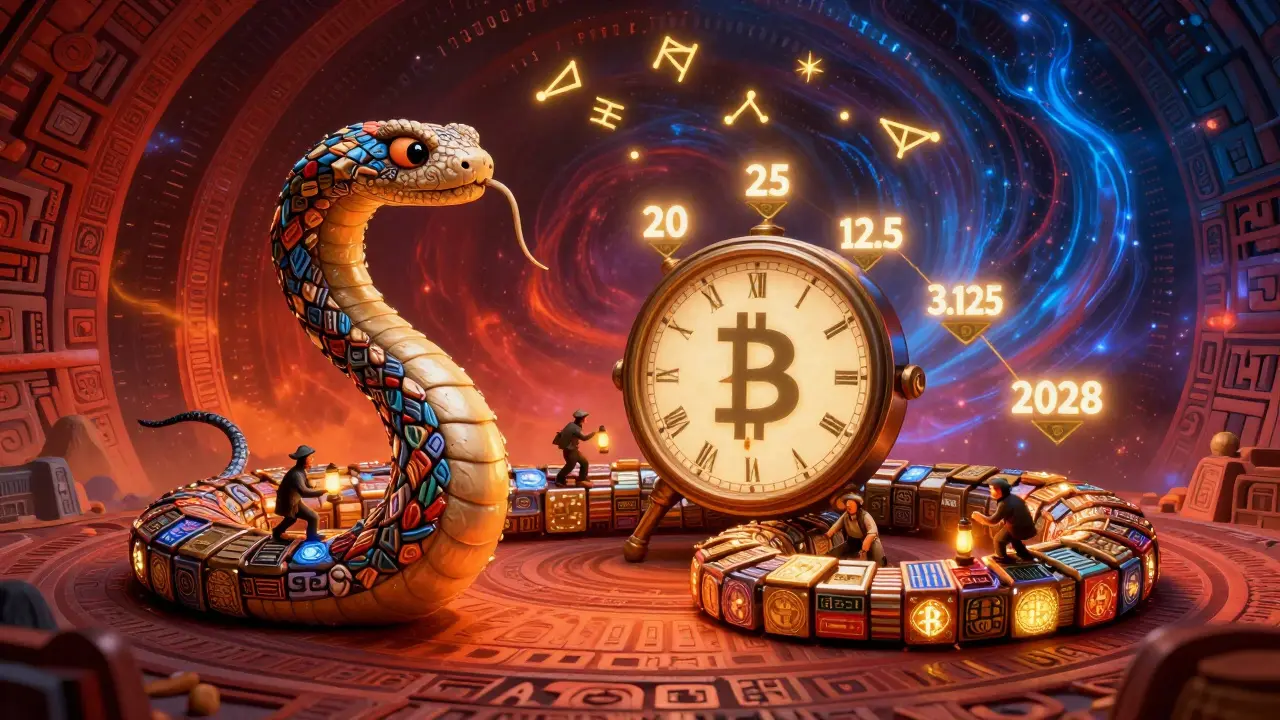
Every 10 minutes, a new Bitcoin block is added to the blockchain. The miner who solves the cryptographic puzzle gets paid. That payment? The block reward. In 2009, it was 50 BTC. Today, after four halvings, it’s 3.125 BTC. This isn’t arbitrary. It’s programmed. Every 210,000 blocks - roughly every four years - the reward cuts in half. This is called a halving. The next one is scheduled for August 2028.
Why does this matter? Because inflation in Bitcoin isn’t decided by a committee. It’s not influenced by political pressure, economic crises, or central bank meetings. It’s math. And that math is transparent. Anyone can check the blockchain and know exactly how many new Bitcoins will be created next year, the year after, and even in 2140.
By early 2024, about 19.5 million BTC had been mined. That leaves just 1.5 million left to be issued. At the current rate, the last Bitcoin won’t be mined until around 2140. That’s not a guess. It’s built into the protocol.
The Inflation Rate You Can Count On
Before the April 2024 halving, Bitcoin’s annual inflation rate was about 2.03%. Afterward, it dropped to 1.01%. That’s lower than the average inflation rate of most developed countries over the last decade. And it’s going lower. By 2028, it’ll be around 0.5%. By 2032, it could dip below 0.2%.
This is the opposite of fiat currencies. The U.S. dollar, for example, has averaged 3-4% inflation annually over the past 20 years. That means your $100 today might only buy $80 worth of goods in 10 years. With Bitcoin, the supply is capped. The growth rate is known. There’s no surprise.
Dr. Garrick Hileman from Blockchain.com put it simply: “Bitcoin’s halving mechanism creates a known, decreasing inflation schedule that is fundamentally different from any fiat currency in history.” Markets respond to predictability. And Bitcoin offers something no central bank ever has - perfect foresight into future money supply.
How Other Cryptocurrencies Compare
Not all coins follow Bitcoin’s script.
Ethereum stopped using block rewards for mining after its 2022 Merge. Now, new ETH is issued as staking rewards to validators. But unlike Bitcoin, Ethereum’s issuance rate isn’t halved. It adjusts dynamically based on how much ETH is staked. That means inflation can go up or down depending on user behavior.
Bitcoin Cash (BCH) mimics Bitcoin’s halving schedule, but its larger blocks mean more transactions per block - and more fees for miners. Still, the long-term inflation path is nearly identical.
Monero (XMR) is different. It never stops issuing coins. After May 2022, it settled into a “tail emission” of 0.6 XMR per minute. That’s about 1% annual inflation - permanent, not fading. It’s a design choice: keep rewards flowing forever to ensure miners stay incentivized.
And then there’s Bitcoin. It’s the only major cryptocurrency with a hard cap and a predictable decay schedule. That’s why it holds over 54% of the entire crypto market cap. Investors aren’t just buying a tech product. They’re betting on a monetary system that gets scarcer over time.
The Hidden Risk: What Happens When Rewards Vanish?
There’s a problem no one talks about enough: what happens when the block reward drops to zero?
Right now, miners earn 3.125 BTC per block. But that’s not their only income. They also collect transaction fees. In 2023, fees made up less than 10% of miner revenue. After the 2024 halving, that number jumped to nearly 15%. That’s still not enough.
By 2040, experts estimate miners will need to earn about $50 per transaction just to maintain today’s security levels. That’s not impossible - but it’s a huge leap. Bitcoin currently processes about 7 transactions per second. To hit $50 per transaction in fees, it would need to process 15 per second on average. That’s doable with upgrades like Taproot Assets and Layer 2 solutions. But it’s not guaranteed.
Professional miner “HashRatePro” on Bitcoin StackExchange warned: “After the 2028 halving, our operation projects revenue will drop 35% unless fees increase substantially.”
This is the Achilles’ heel of Bitcoin’s model. If fees don’t scale fast enough, miners will leave. Less mining = less security. And if the network gets less secure, trust breaks. That’s why the CFA Institute gave Bitcoin a 4.7/5 for inflation control, but only 3.2/5 for long-term security sustainability.

Real-World Impact: From Miners to Investors
The 2024 halving didn’t just change numbers. It changed behavior.
Transaction fees jumped 83% immediately after the halving. People were rushing to send Bitcoin. Why? Because they knew the block space was getting tighter. Miners were earning less from new coins, so they prioritized higher-fee transactions. Users who waited paid more.
On the investment side, institutions noticed. Fidelity’s 2024 report found that 78% of institutional investors cited Bitcoin’s “predictable, decreasing inflation schedule” as a top reason for investing. Compare that to Ethereum, where only 32% did. That’s not because Ethereum is worse. It’s because Bitcoin’s rules are clearer. You can model its future. You can’t do that with a central bank.
Grayscale launched a dedicated “Bitcoin Halving Fund” in January 2024. It raised $427 million before the event even happened. People weren’t betting on price. They were betting on the mechanism.
What Comes Next?
The next halving is in 2028. Then 2032. Then 2036. Each time, the reward halves. Each time, inflation drops. Each time, the network must prove it can survive on fees alone.
ARK Invest believes Bitcoin could hit $1.5 million per coin by 2030. Their model assumes scarcity will drive value. The Bank for International Settlements warns that “the transition to fee-based security remains Bitcoin’s greatest unsolved economic challenge.”
Both could be right. The market is watching. Miners are adapting. Developers are building. And users? They’re learning.
One early adopter on BitcoinTalk shared: “I bought 50 BTC for $0.10 each in 2010. I knew the halving was coming. I knew scarcity was the point. I didn’t care about the price then. I cared about the system.”
That’s the real story. Block rewards aren’t just about mining. They’re about trust. They’re about predictability. They’re about building a monetary system that doesn’t rely on people - but on code. And so far, the code has held.
How often does Bitcoin’s block reward halve?
Bitcoin’s block reward halves every 210,000 blocks, which happens approximately every four years. The first halving was in 2012, the second in 2016, the third in 2020, and the most recent in April 2024. The next one is scheduled for August 2028.
Why does Bitcoin have a fixed supply of 21 million coins?
The 21 million cap was set by Bitcoin’s creator, Satoshi Nakamoto, to create scarcity - a core feature meant to mimic gold. This limit ensures that inflation will eventually drop to zero, making Bitcoin a deflationary asset over time. It’s not arbitrary; it’s hardcoded into the protocol and enforced by every node on the network.
Do all cryptocurrencies have block rewards?
No. Bitcoin and Bitcoin Cash use block rewards with halvings. Ethereum switched to proof-of-stake in 2022 and now issues rewards to stakers, not miners. Monero uses a permanent tail emission with no halving. Some newer blockchains have no inflation at all, relying on transaction fees or other mechanisms to incentivize participation.
Can Bitcoin become deflationary?
Technically, Bitcoin’s supply is fixed, not decreasing. But it can become deflationary in practice. If coins are lost (due to forgotten keys or destroyed wallets) and no new coins are added, the total circulating supply shrinks. This reduces the money supply, making each remaining coin more valuable - which is the definition of deflation. Experts estimate over 20% of all BTC may be permanently lost.
What happens to miners after the last Bitcoin is mined?
After the last Bitcoin is mined around 2140, miners will rely entirely on transaction fees for income. The network will still function as long as users are willing to pay fees to have their transactions confirmed. Upgrades like Taproot and Layer 2 solutions (e.g., the Lightning Network) are designed to increase transaction volume and fee potential. The challenge is ensuring fees are high enough to keep miners secure - a problem still being solved.




17 Comments
This is why I bought BTC in 2017. Not for the tech, not for the hype. For the math. 🤑
Ah yes, the holy grail of "predictable inflation"... until the miners revolt and the network gets 51%ed by a rogue hedge fund. Then it’s just a glorified spreadsheet with a cult following. 😏
Scarcity + transparency = money that actually works. 🙌
I mean… like, who even cares about block rewards? It’s all just code, right? Like, I’ve seen better UX in my toaster. 🤷♀️
Let’s be real-this whole ‘halving’ thing is just a marketing gimmick wrapped in blockchain jargon. You’re telling me that a 1% inflation rate is somehow ‘better’ than 3%? That’s like saying a slow leak is better than a burst pipe. Both are bad. And let’s not forget that 20% of Bitcoin is already lost. So the ‘fixed supply’ is already a lie. Also, transaction fees? Ha. Good luck paying $50 to send $10. This system is a house of cards built on optimism and delusion. And don’t even get me started on Layer 2 solutions-those are just Ponzi schemes with better logos.
The real win here isn’t the halving-it’s that regular people finally have a way to protect their wealth from institutions that print money like it’s confetti. We’re not just talking about crypto. We’re talking about freedom.
USA > ALL CRYPTOS. We don’t need this fake money. Our dollar is sacred. 💪🇺🇸
I read this whole thing. Honestly? I’m not convinced. The math looks good on paper. But I’ve seen too many ‘revolutionary’ systems collapse. I’ll wait until it’s 2140 to decide if this was real or just a very long game of musical chairs.
The economic architecture of Bitcoin is fundamentally superior to any fiat system due to its algorithmic scarcity and decentralized enforcement mechanisms. However, the transition to fee-based mining requires robust on-chain scalability and off-chain transactional efficiency to maintain network security without compromising decentralization. This remains an open problem requiring further empirical validation.
blockchain? more like block-chain of bs. why do we need this? my bank dont halve my interest rate. lol
I just don’t get why people are so obsessed with this. Like, can’t we just… fix the real problems? Home prices? Student debt? Why are we all here arguing about a digital coin? I just want to feel safe. 😔
The halving… it’s not just a technical event. It’s a metaphysical one. Every time the reward drops, we’re reminded that scarcity is the only truth in a world of infinite lies. The miners are the priests. The blockchain, the altar. And we? We’re the faithful. Waiting. Watching. Believing.
Oh wow. Another one of these ‘Bitcoin is the future’ sermons. Let me guess-you also think gold is the answer and that central banks are evil? Congrats. You’ve unlocked Level 1 of the Bitcoin Cult. Now go buy some more BTC and don’t forget to tweet ‘HODL’ while you cry into your ramen. 😂
You talk about predictability. But what about the human element? What if the next halving triggers a mass exodus? What if miners sell off their coins to survive? What if the entire ecosystem collapses because people suddenly realize they’re betting on a dead protocol? This isn’t math. It’s a psychological experiment. And we’re all lab rats.
I don’t even understand why anyone would care about this. Like… I just want to buy coffee with my phone. Why do I need to know how many coins are mined every 10 minutes? It’s too much. I’m out.
To the guy who said ‘it’s just a glorified spreadsheet’-you’re right. But so is gold. And people still pay $70k for a bar of it. The difference? One’s physical. The other’s digital. Both are trust systems. One’s older. The other’s faster.
The notion that Bitcoin’s security depends solely on transaction fees is a fallacy. The incentive structure is not binary. It is a dynamic equilibrium shaped by macroeconomic forces, technological adoption, and network effects. The assumption that miners will abandon the network is predicated on a static model of human behavior. In reality, miners are rational actors who adapt. The transition to fee-based security is not a crisis-it is an evolution. And evolution requires patience. And perspective. And humility.