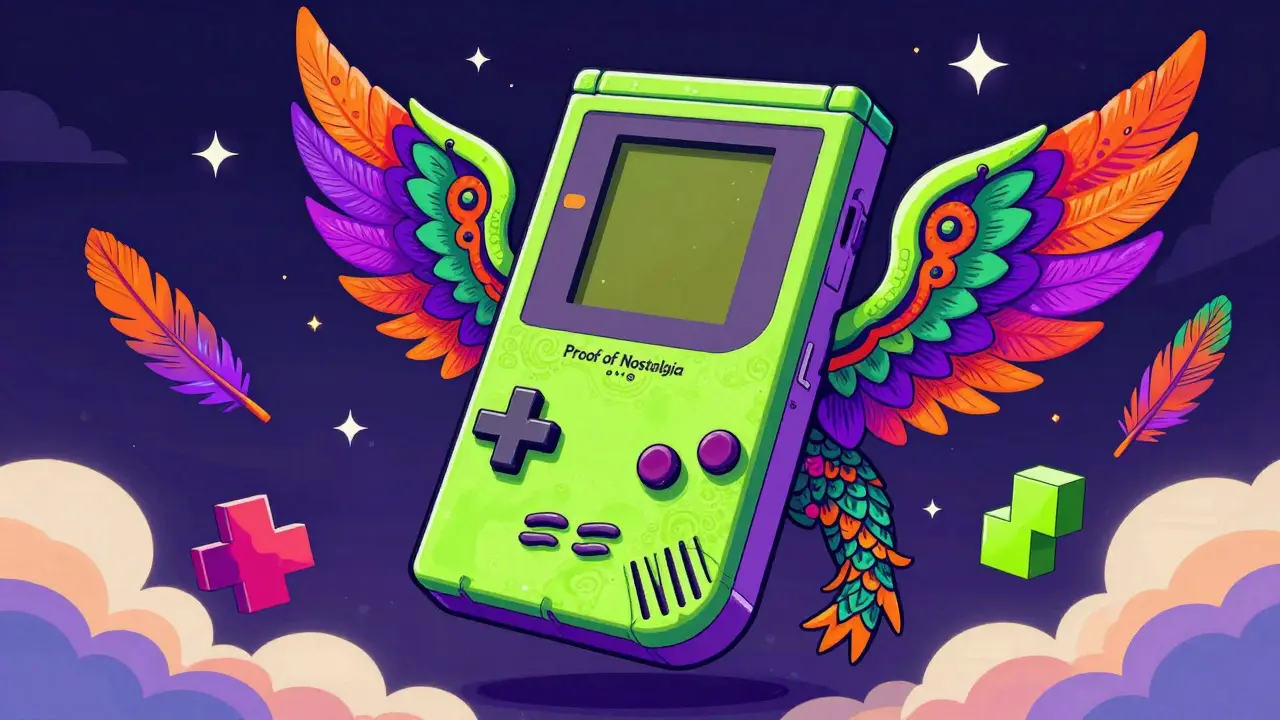


Remember the days when you huddled over a tiny green screen, pressing buttons until your thumbs cramped? That specific kind of 90s nostalgia is exactly what GameBoy ($GBOY) is trying to sell. It’s a cryptocurrency token built on the Solana blockchain, blending retro gaming aesthetics with modern meme culture. But before you rush to buy in based on pixel art vibes, you need to understand what this project actually is-and what it isn’t.
$GBOY started as a speculative memecoin but claims to be evolving into a functional gaming platform. The concept relies on something the creators call "Proof of Nostalgia." Instead of complex utility promises that often fail, they are betting on the emotional connection people have with classic handheld gaming. However, like many projects in this space, the reality involves significant risks, low liquidity, and a heavy dependence on community hype rather than established technology.
The Core Concept: Proof of Nostalgia
Most memecoins rely on funny dog pictures or viral internet trends. $GBOY takes a different angle by tapping into generational memory. The project positions itself not just as a currency, but as a cultural artifact for those who grew up with the original Nintendo Game Boy. This "Proof of Nostalgia" framework suggests that shared memories can drive value, similar to how vintage toys or retro consoles hold worth today.
The token operates entirely on Solana. Why Solana? Because it offers fast transaction speeds and low fees, which are essential for micro-transactions in gaming. If you’re playing a quick round of Tetris against a friend, waiting ten minutes for a confirmation isn’t fun. Solana handles these interactions almost instantly. However, being on Solana also means $GBOY shares the network’s vulnerabilities. If Solana goes down or faces congestion, $GBOY transactions halt too.
The project was originally founded by an anonymous developer who left early. This is a red flag for many investors. Without a known team, accountability vanishes. Since then, it has become a community-driven initiative. While decentralization sounds ideal, it often leads to slow decision-making and unclear direction. You aren’t buying into a company with a CEO; you’re buying into a group chat’s consensus.
How the Gaming Utility Actually Works
The biggest promise of $GBOY is its roadmap toward actual gaming utility. They aren’t just talking about it; they have launched Phase 1, which features a lightweight release. Here is how it works right now:
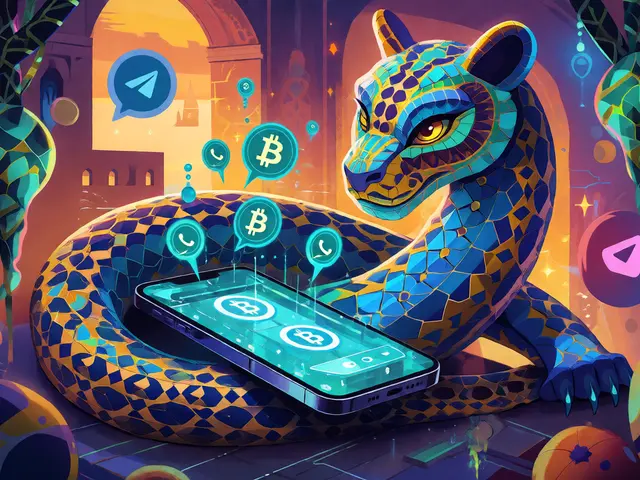
- Telegram Integration: The primary game is a Solana-powered Tetris PvP (Player vs. Player) match accessible directly through Telegram. You don’t need to download a separate app.
- Wallet Connection: Players connect their Solana wallets via Telegram bots. This links your crypto holdings to your gaming profile.
- Betting Mechanism: Both players put funds into a pool. The winner of the Tetris match takes the pooled funds. It’s essentially a skill-based bet using crypto.
- Leaderboards: Winners climb ranks, adding a competitive layer beyond just winning money.
This model targets the "shill and chill" culture prevalent in crypto communities. People love chatting and trading on Telegram; adding a quick game keeps them engaged. Phase 2 plans to expand this into a standalone platform with more classic Nintendo-style games. The goal is to move from simple bets to a full ecosystem where tokens are used for in-game purchases, skins, and access.
There is also an NFT component. These digital assets combine retro designs with Web3 memes. Holding certain NFTs might offer discounts on gameplay fees or revenue sharing. This creates a secondary market where users trade collectibles, hoping the rarity drives value up.
Market Reality: Price, Supply, and Liquidity
Let’s look at the hard numbers because nostalgia doesn’t pay bills if the token is worthless. As of late 2025 and moving into 2026, $GBOY remains a micro-cap asset. This is crucial context. We are not talking about Bitcoin or even major altcoins like Cardano or Polkadot.
| Metric | Value | Implication |
|---|---|---|
| Current Price Range | $0.000014 - $0.000016 | Extremely low unit cost, high volatility risk |
| Market Cap | ~$14,000 - $17,000 | Micro-cap status; easily manipulated |
| Total Supply | 996 Million | Fixed supply; no inflation, but massive dilution potential |
| 24h Volume | $3 - $4 | Critical lack of liquidity; hard to exit large positions |
| All-Time High | $0.00183 (March 2024) | Down >99% from peak; severe depreciation |
The most alarming stat here is the daily trading volume. With only a few dollars changing hands per day, liquidity is non-existent. What does this mean for you? If you buy $100 worth of $GBOY, you might not be able to sell it without crashing the price further. There simply aren’t enough buyers waiting on the other side. This makes $GBOY a terrible store of value and a highly risky speculative play.
The price history tells a story of decline. After hitting an all-time high in March 2024, the token has dropped over 99%. Technical indicators show it trading below both its 50-day and 200-day Simple Moving Averages. The Relative Strength Index (RSI) hovers around 37, suggesting it is approaching oversold territory but lacking the momentum to bounce back. Analysts predict continued downward pressure, with forecasts pointing to lower lows in late 2025 and 2026.
Risks and Red Flags
You wouldn’t invest your life savings in a penny stock without checking the fundamentals. $GBOY requires even more scrutiny because it lacks regulatory oversight and traditional financial reporting. Here are the specific risks you face:
- Liquidity Trap: As mentioned, low volume means you can get stuck. In crypto, "paper gains" mean nothing if you can’t cash out.
- Founder Abandonment: The original creator left. Who is securing the smart contracts? Who is fixing bugs? Community governance is noble but often ineffective in crises.
- Regulatory Uncertainty: Play-to-earn models are under scrutiny globally. If regulators classify $GBOY as an unregistered security, exchanges could delist it overnight.
- Competition: The gaming crypto space is crowded. Giants like Axie Infinity, The Sandbox, and Decentraland have billions in market cap and professional teams. $GBOY is competing with them while having a market cap smaller than a small business’s annual revenue.
- Smart Contract Risk: Any bug in the code could allow hackers to drain the pool. Without a reputable audit firm backing the project, this risk remains high.
Who Is This For?
Not every crypto project is for everyone. $GBOY fits a very specific profile. It is likely suitable for:
- Nostalgia Seekers: People who want to support a project that celebrates 90s gaming culture, regardless of profit potential.
- High-Risk Speculators: Traders willing to lose 100% of their investment in exchange for a chance at a 10x return if the project suddenly goes viral.
- Solana Enthusiasts: Users deeply embedded in the Solana ecosystem who want to experiment with new dApps (decentralized applications).
It is not suitable for long-term investors, conservative portfolios, or anyone unfamiliar with wallet security. Do not treat this as a savings account. Treat it as buying a lottery ticket that also lets you play Tetris.
How to Get Started (If You Choose To)
If you’ve weighed the risks and still want to participate, here is the practical path. First, you need a Solana-compatible wallet like Phantom or Solflare. Never share your seed phrase. Next, fund your wallet with SOL (Solana’s native token) to cover transaction fees. Then, use a decentralized exchange (DEX) like Raydium or Jupiter to swap SOL for $GBOY. Be aware that slippage will be high due to low liquidity-you might pay significantly more than the listed price.
To play the games, join the official Telegram channel. Connect your wallet to the bot. Start with small amounts to test the mechanics. Remember, the "winner takes all" model means you can lose your stake in seconds if you lose the game. It’s gambling wrapped in pixels.
Future Outlook: Can It Survive?
The survival of $GBOY depends on execution. Phase 2 must deliver a genuinely fun, standalone platform. If the games are buggy or boring, users will leave. The transition from meme to utility is notoriously difficult. Many projects promise metaverses and deliver empty websites. $GBOY needs to prove it can retain users beyond the initial novelty of the retro theme.
Community retention is key. Since the founder is gone, the community must self-sustain. Active development, regular updates, and transparent communication are vital. If silence falls, the token likely dies. Keep an eye on social media activity and GitHub commits. Real code changes indicate progress; empty tweets do not.
Is GameBoy ($GBOY) a good investment?
$GBOY is an extremely high-risk speculative asset, not a traditional investment. With a market cap under $20,000 and negligible trading volume, it carries significant risk of total loss. Only allocate funds you can afford to lose completely.
What blockchain is GameBoy built on?
GameBoy operates on the Solana blockchain. This allows for fast transactions and low fees, which are necessary for its real-time gaming features.
Can I earn money playing GameBoy games?
Yes, but it involves risk. The current model is PvP betting where winners take the pooled funds. You can win tokens, but you can also lose your stake if you lose the game. It functions more like gambling than passive income.
Why is the trading volume so low?
Low volume indicates limited interest and liquidity. Few people are buying or selling $GBOY daily. This makes it difficult to enter or exit large positions without drastically affecting the price.
What happened to the original founder?
The anonymous founder departed early in the project's lifecycle. The project is now community-driven, which raises concerns about long-term development consistency and accountability.
18 Comments
the whole proof of nostalgia thing is just a marketing hook to sell you on a rug pull waiting to happen. nobody cares about retro gaming anymore unless they are trying to scam the next gen into buying worthless pixels. its all controlled by insiders who dump on the retail bags when volume spikes. i see the smart money moving out while you guys talk about tetris. its a trap.
I have to say that I really appreciate the detailed breakdown provided in this article because it helps clarify some of the confusion surrounding these types of speculative assets, and while I understand the skepticism expressed by others regarding the low liquidity and anonymous founders, I think there is still value in understanding how community-driven projects attempt to build utility through engagement mechanisms like the Telegram integration mentioned here, which seems to be an interesting experiment in combining social interaction with micro-transactions even if the financial metrics look precarious at the moment. It is important for us as a community to educate ourselves on the risks involved so that we can make informed decisions rather than just reacting emotionally to price charts or hype cycles, and perhaps we can learn from the failures of similar projects in the past to better support those that actually deliver on their promises over time. The concept of using Solana for fast transactions does make sense theoretically for gaming applications, so I remain cautiously optimistic that some form of sustainable model might emerge from this chaos eventually.
Listen up folks, the data doesn't lie and neither should your expectations. This token is down 99% and has less volume than a lemonade stand on a rainy day. If you are looking for a place to park your life savings, look elsewhere immediately. However, if you want to gamble with money you can afford to lose, go ahead, but don't come crying to me when you get rekt. Wake up and smell the coffee.
The technical architecture relies heavily on Solana's throughput capabilities, yet the lack of robust smart contract audits poses a significant vulnerability vector for potential exploits. We need to analyze the tokenomics distribution more closely because the massive supply dilution combined with negligible liquidity creates a perfect storm for market manipulation. It is crucial for developers to implement stricter governance protocols to ensure that the community-driven aspect does not devolve into chaotic decision-making paralysis. Without clear leadership or transparent development roadmaps, the project remains highly susceptible to external shocks and internal discord. I urge everyone to scrutinize the GitHub commits rather than relying on social media hype which is often fabricated by bots designed to pump the price temporarily before a massive dump event occurs.
It is imperative to consider the regulatory landscape when evaluating such instruments. The absence of a known founding team introduces substantial liability issues. One must approach this with extreme caution and rigorous due diligence.
I agree with the assessment that liquidity is the biggest issue here. You cannot trade effectively without enough buyers and sellers. It makes the chart meaningless for anyone serious. Stick to established coins if you want stability.
I find the idea of integrating games directly into Telegram quite fascinating from a user experience perspective. It lowers the barrier to entry significantly since users do not need to download separate applications or navigate complex interfaces. This accessibility could potentially attract a broader demographic beyond traditional crypto enthusiasts. However, I am concerned about the sustainability of the betting model and whether it will face legal challenges in various jurisdictions. It would be beneficial to see more transparency regarding the revenue sharing mechanism for NFT holders.
another american dream crushed by foreign scams lol. why do we keep falling for this garbage? its pathetic. stay safe kids dont buy the dip its a cliff :)
boring. another memecoin with no substance. the writing style is pretentious and the analysis is shallow. i expected better from this platform. typical crypto bro nonsense.
You need to understand that sentiment drives these markets more than fundamentals in the short term. But long term, only utility survives. This project is struggling to define its utility beyond gambling. Be careful what you invest in.
The philosophical underpinning of 'Proof of Nostalgia' is intriguing but ultimately flawed because memory is subjective and fleeting. Value derived solely from shared past experiences lacks the tangible anchor required for sustained economic activity. It is a house built on sand.
I feel for the people who lost money on this. It is heartbreaking to watch communities fall apart when the promise of wealth turns to dust. The emotional toll is real and often overlooked in these cold financial analyses. Please take care of yourselves.
Oh look, another 'innovative' project that fails to innovate anything except new ways to lose money. Truly inspiring. Not.
This is a classic example of a failed project. The metrics are abysmal. The team is nonexistent. The future is bleak. Do not waste your time reading further. It is trash.
Let's keep the discussion respectful please 🙏. While the risks are high, dismissing the entire Solana ecosystem based on one micro-cap token is unfair. There is innovation happening everywhere. Just do your own research 📊💡.
In my region, we see many such projects rise and fall quickly. The cultural attachment to retro gaming is strong globally, but translating that into crypto utility is a challenge few succeed at. It requires deep localization and trust building which is missing here.
Precisely. The risk profile is unacceptable for any rational investor.
I get that it feels risky, but learning from these mistakes is part of the journey. If you decide to participate, start small and never invest more than you can lose. Stay focused on your goals and protect your capital first and foremost.