
Iran doesn’t use Bitcoin to buy coffee or pay for Netflix. It uses it to import medicine, machinery, and spare parts-things its economy can’t get through traditional banking. Since 2020, the country has quietly built a system where mined Bitcoin becomes a lifeline for trade, bypassing U.S. and European sanctions that have frozen its access to dollars and SWIFT. This isn’t speculation. It’s happening right now, on a massive scale.
How Bitcoin Became Iran’s Trade Workaround
Iran’s central bank doesn’t let citizens pay for anything with Bitcoin. You can’t buy a phone or send money to family abroad using crypto. But here’s the twist: the government allows licensed miners to sell their Bitcoin to state-approved entities, who then use those coins to pay foreign suppliers. It’s a closed loop. Miners produce Bitcoin. The state collects it. The state uses it to buy what the country needs. The first documented import paid with crypto happened on August 9, 2023-a $10 million order for industrial equipment. Since then, Iranian firms have processed over $8 billion in transactions through Binance alone, according to blockchain analysis firms. These aren’t random individuals. They’re state-linked companies, some tied to the Islamic Revolutionary Guard Corps (IRGC), using crypto as a shield against financial isolation. The strategy is simple: generate Bitcoin domestically, then trade it for goods. Iran doesn’t need to sell oil for dollars anymore. It sells electricity for Bitcoin. And because Bitcoin moves outside the traditional banking system, it slips past sanctions.The Mining Machine: Electricity, Power, and Profit
Iran has one of the cheapest electricity rates in the world-thanks to massive gas and oil reserves. That’s why it became a global mining hotspot. By 2022, over 10,000 mining farms were licensed. Some are small. Most are huge. The 175-megawatt farm in Rafsanjan, run by an IRGC-linked firm and Chinese partners, is just one example. It runs 24/7, consuming as much power as a small city. The government didn’t just allow this. It encouraged it. In 2018, mining was classified as an industrial activity. Miners got access to subsidized electricity. The Ministry of Energy allocated power quotas. The Central Bank of Iran (CBI) controlled where the Bitcoin went after it was mined. But there’s a cost. Iran’s power grid is collapsing. Cities go dark for hours daily. Factories shut down. Hospitals run on generators. Investigators say state-backed mining operations are the main reason. These farms don’t pay bills. They’re protected by armed guards and political influence. Religious foundations like Astan Quds Razavi, which controls billions in assets, run massive mining centers with direct power lines from state plants. This isn’t entrepreneurship-it’s state-sponsored energy theft.How the System Actually Works
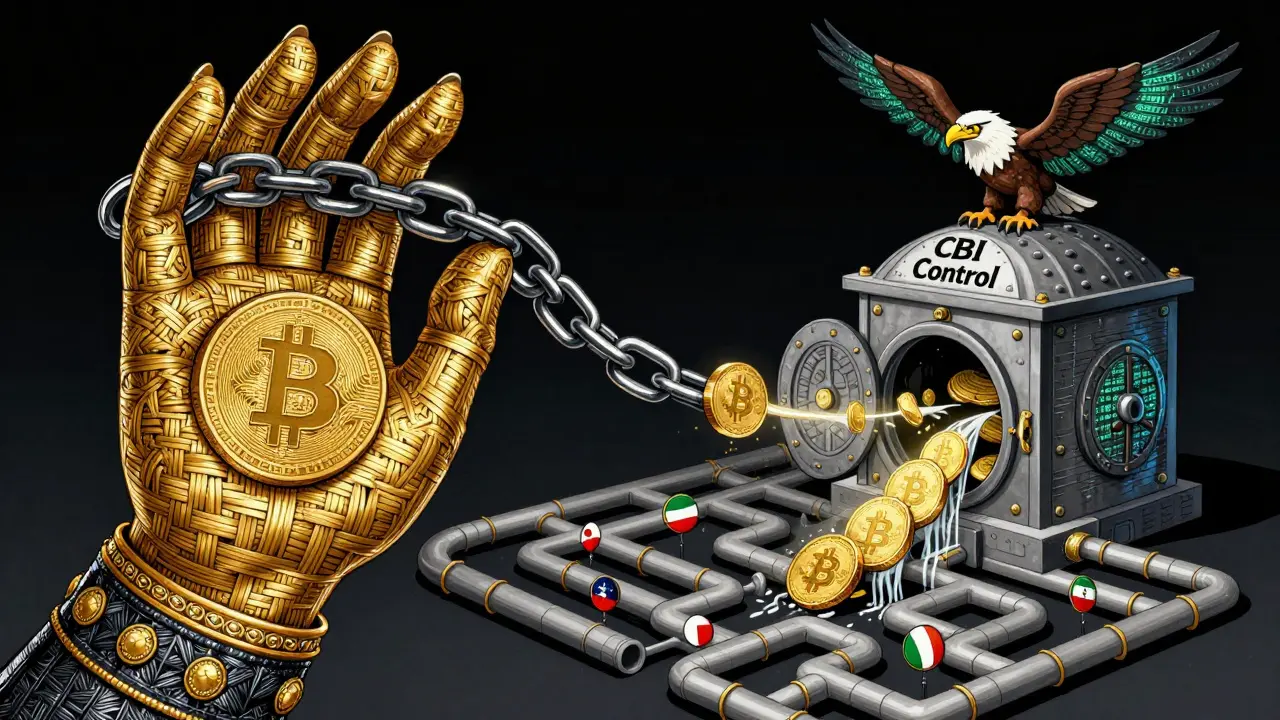
Here’s how a real import transaction works today:- A state-approved mining farm produces Bitcoin using cheap, government-allocated electricity.
- The mined Bitcoin is transferred to a licensed exchange approved by the CBI.
- The exchange sells the Bitcoin to a state-controlled trading entity-often linked to the IRGC or Ministry of Industry.
- The entity uses the proceeds to pay foreign suppliers in Bitcoin or stablecoins.
- The supplier receives the crypto, converts it to fiat via offshore exchanges, and ships the goods.
Who’s Really in Charge?
The IRGC didn’t just get involved in mining-it took over. By 2020, reports showed the IRGC and entities loyal to Supreme Leader Ali Khamenei controlled the majority of large-scale mining operations. These weren’t startups. They were military-industrial complexes with access to secure facilities, unlimited power, and zero oversight. Why? Because the IRGC needed a way to fund its operations without U.S. sanctions blocking its bank accounts. Bitcoin became its offshore treasury. And unlike oil exports-which can be tracked and targeted-crypto transactions are harder to trace, especially when routed through decentralized exchanges like Binance or Bybit. Iran also signed bilateral crypto agreements with Russia in 2018. Since then, both countries have built parallel trade systems using crypto to exchange grain, weapons, and technology. Other nations like Venezuela, Syria, and North Korea have watched closely. Iran is proving it can work.The Downside: Volatility, Risk, and Power Crises
This isn’t a perfect system. Bitcoin’s price swings wildly. A $10 million import order today could cost $12 million next week. That’s risky for businesses trying to budget. Iran’s government absorbs most of that risk-but it still hurts. There’s also the technical barrier. Not every supplier accepts crypto. Many still demand dollars. So Iran uses stablecoins like USDT to smooth out the edges. But even then, exchanges freeze accounts. Regulators crack down. Binance has blocked Iranian wallets before. The system is fragile. And then there’s the power problem. Iran’s grid can’t handle this. The country’s energy demand has jumped 30% since 2020, mostly due to mining. In 2024, Tehran imposed emergency power cuts for 12 hours a day in 14 provinces. The government blames drought. But satellite data and energy audits point to mining farms as the real culprit.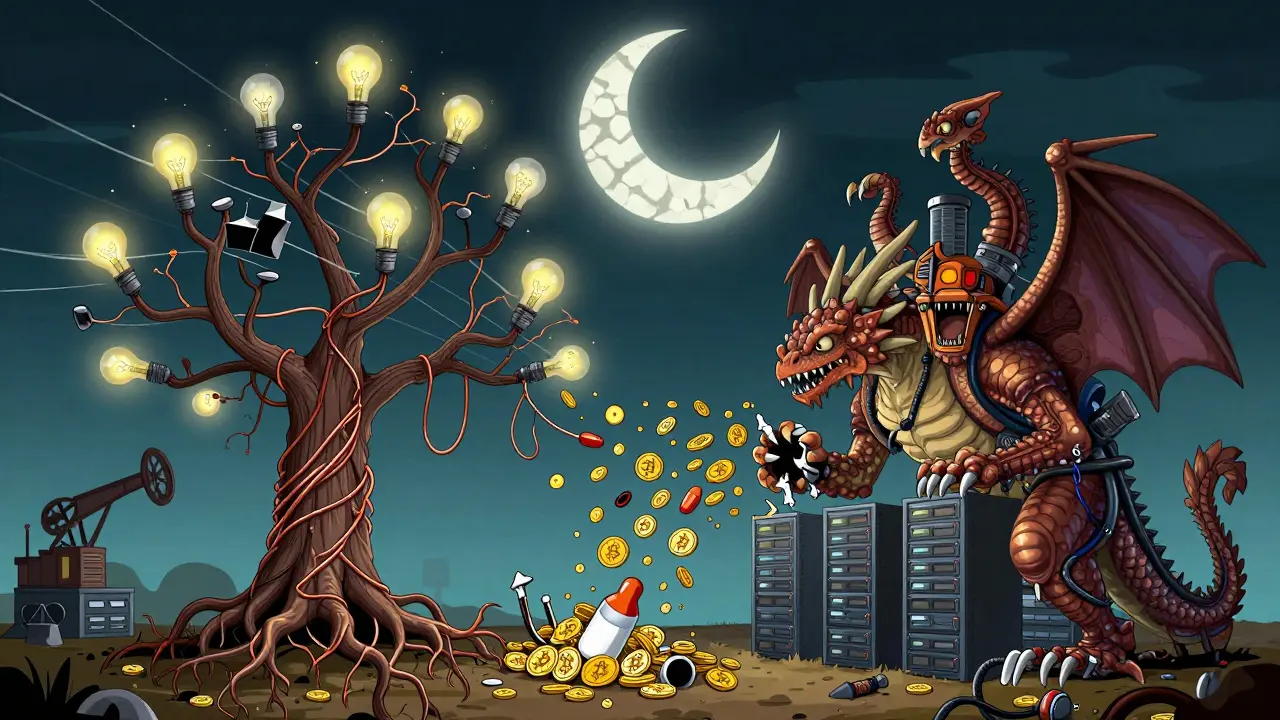
Is This Sustainable?
Iran’s crypto trade model is a survival tactic, not a long-term solution. It’s working now-but only because the government controls every layer: mining, power, exchanges, and trade. As soon as global regulators tighten crypto oversight, or as power shortages worsen, the system could buckle. Still, the numbers don’t lie. In 2024, $4.18 billion in cryptocurrency left Iran. That’s a 70% jump from the year before. Mining revenue is projected to hit $1.9 billion by 2025. Iran is turning its energy surplus into digital currency-and using that currency to keep its economy alive. The world still calls it sanctions evasion. Iran calls it economic sovereignty. Either way, it’s changing how trade works under pressure. Other sanctioned nations are watching. And if Iran can keep the lights on, it might just become the blueprint.What This Means for Global Trade
Iran’s experiment shows that Bitcoin isn’t just digital gold. It’s a tool for economic resistance. When traditional finance shuts you out, you build your own. You use what you have-cheap power, technical know-how, political will-to create a parallel system. This isn’t about decentralization. It’s about control. Iran didn’t adopt crypto to empower its people. It adopted it to empower its state. And that’s the real lesson. Crypto can be used to break sanctions-but it can also be used to reinforce authoritarian power. The future of global trade may not be in dollars or euros. It could be in blockchain-based systems run by nations that refuse to play by Western rules. Iran is leading the way. Whether that’s a threat or a breakthrough depends on who you ask.Can ordinary Iranians use Bitcoin to buy imports?
No. The Central Bank of Iran bans personal use of cryptocurrency for payments. Only state-approved entities can use mined Bitcoin for import transactions. Regular citizens can’t legally buy foreign goods with crypto, even if they own it.
Why does Iran allow Bitcoin mining but not use it for payments?
Iran allows mining because it turns cheap electricity into foreign currency. But it blocks domestic crypto payments to prevent capital flight and maintain control over the rial. The government wants the Bitcoin, not the chaos of a decentralized economy.
How much Bitcoin does Iran mine each day?
Iran produces nearly 5% of all new Bitcoin globally. That’s roughly 100-150 BTC per day, depending on network difficulty. Most of this is collected by state-linked mining pools and used for trade, not sold on public exchanges.
Is Iran’s crypto trade system legal under international law?
It violates U.S. and EU sanctions targeting Iran’s financial system. The U.S. Treasury has sanctioned Iranian exchanges and mining operators linked to the IRGC. But enforcement is difficult because crypto transactions are decentralized and often routed through offshore platforms outside Western jurisdiction.
What happens if Iran’s power grid collapses completely?
If the grid fails, Iran’s crypto trade system collapses too. Mining requires constant, massive electricity. Without it, Bitcoin production stops. The entire import mechanism relies on mining output. The government may prioritize power for critical sectors, but that would mean halting crypto trade-something it can’t afford to do.


13 Comments
This is wild! I never thought Bitcoin could be used like this-like a secret trade currency! Iran’s basically turning electricity into life-saving medicine, and it’s genius, honestly. I mean, who knew mining could be a humanitarian act?!
One cannot help but observe the irony inherent in the utilization of decentralized technologies to reinforce centralized control. The dialectic of liberation and subjugation is, perhaps, the most profound paradox of our digital age. The state, in its infinite wisdom, has weaponized the very tools designed to dismantle it.
Let me break this down for folks who think crypto is just for speculators. Iran’s not using Bitcoin to buy NFTs-they’re using it to keep hospitals running. They’ve got cheap power, they’ve got miners, and they’ve got zero access to the global banking system. So they built their own pipeline. It’s not pretty, but it’s working. And honestly? If your country was under sanctions, wouldn’t you do the same? This is real-world problem-solving, not crypto bro fantasy.
Also-100-150 BTC per day? That’s like $6-9 million in value every 24 hours, just from one country. And they’re not even selling it on Coinbase. It’s all going straight to trade partners. That’s a whole new kind of economic sovereignty.
And yes, the power grid is crumbling. But here’s the kicker: the state’s mining farms aren’t even paying for their electricity. That’s not innovation-that’s theft. But it’s theft that’s keeping the country alive. Moral dilemma? Absolutely. Practical reality? Also absolutely.
Don’t get me wrong-this isn’t ideal. But it’s not a failure. It’s adaptation. And if the U.S. or EU thought sanctions would crush Iran, they’re waking up to a new world where the rules don’t apply the same way anymore.
Other countries are watching. Russia’s already doing it. Venezuela’s trying. North Korea? They’re probably mining in underground bunkers right now. This is the new sanctions evasion playbook. And it’s terrifying. And brilliant. And real.
It’s fascinating how human ingenuity finds a way-even when the world tries to lock you out. Bitcoin here isn’t about freedom or decentralization. It’s about survival. And that’s a powerful shift in perspective. We talk about crypto as a tool for the individual, but Iran’s showing us it can also be a shield for the state. Maybe the real revolution isn’t in who controls the money… but in who gets to decide what counts as ‘legitimate’ use.
Kinda makes you wonder… if the U.S. got sanctioned tomorrow, would we do the same? Build our own crypto pipeline? Mine with solar panels? Trade stablecoins for food? I’m not saying we should-but I’m saying we might. And that’s the real threat here: the idea that no country is too big to be forced into this. 🤔
wait so regular people cant use btc but the government mines it and buys medicine?? that’s so messed up but also… kind of smart?? i mean, if my city had blackouts every day and my dad needed cancer meds, i’d take btc from a mining farm too 😅
Let’s be clear: this isn’t innovation-it’s institutionalized energy theft disguised as economic resilience. The IRGC isn’t ‘leveraging crypto’-they’re siphoning state resources to fund paramilitary operations under the guise of ‘national necessity.’ The fact that Binance is being used as a de facto clearinghouse for sanctioned entities is a regulatory failure of epic proportions. We’re witnessing the commodification of desperation, and it’s being enabled by lax oversight and the blind faith in blockchain’s ‘immutability.’ This isn’t a workaround-it’s a systemic corruption engine.
It’s impressive how Iran has turned a disadvantage into a strategic advantage. While the world focuses on sanctions, they’ve built a parallel economy. It’s not perfect, but it shows that when you’re cornered, you adapt. I hope the global community starts seeing this not just as evasion, but as a new model for economic resilience in isolation. Perhaps one day, we’ll need such systems ourselves.
This is a textbook case of how technology can be repurposed by those outside the dominant power structures. Bitcoin was meant to decentralize finance-but here, it’s being used to centralize control. The irony is thick. Still, the result is undeniable: people are getting medicine. That’s not nothing. Maybe the real question isn’t ‘is this legal?’ but ‘is this ethical?’
They mine 150 BTC/day? That’s 5% of global output? That’s not a coincidence-that’s a coordinated state operation. And yes, the grid’s collapsing. But guess what? The IRGC’s farms don’t get cut off. That’s not a bug-it’s the feature. Sanctions didn’t break Iran. Their own government did. And now they’re blaming the power cuts on drought. Lmao. 🤡
So let me get this straight… the government lets people starve for electricity so they can buy weapons with Bitcoin? And you call this ‘economic sovereignty’? 😭 This isn’t resistance. It’s tyranny with a blockchain logo. I’m sick of people romanticizing this. People are dying. And the state is mining.
It is imperative to note that the assertion of Bitcoin’s utility as a sanction-circumvention mechanism presumes the ontological legitimacy of decentralized digital assets as sovereign mediums of exchange. However, such a premise is predicated upon a neoliberal epistemological framework that fundamentally misunderstands the nature of monetary sovereignty, which is, by definition, a state prerogative. The Iranian state, in adopting this mechanism, is not subverting the system-it is merely reconfiguring its own apparatus within the constraints of a global financial hierarchy it cannot escape. Thus, the entire enterprise remains a derivative of the very system it purports to defy.
Man, this is wild. I’m from India, and we’ve got power issues too-but we don’t mine Bitcoin to buy medicine. Still, I can’t help but admire the hustle. If I were in Iran, I’d probably be mining too. Not for the state… but just to keep my fridge running. 😅