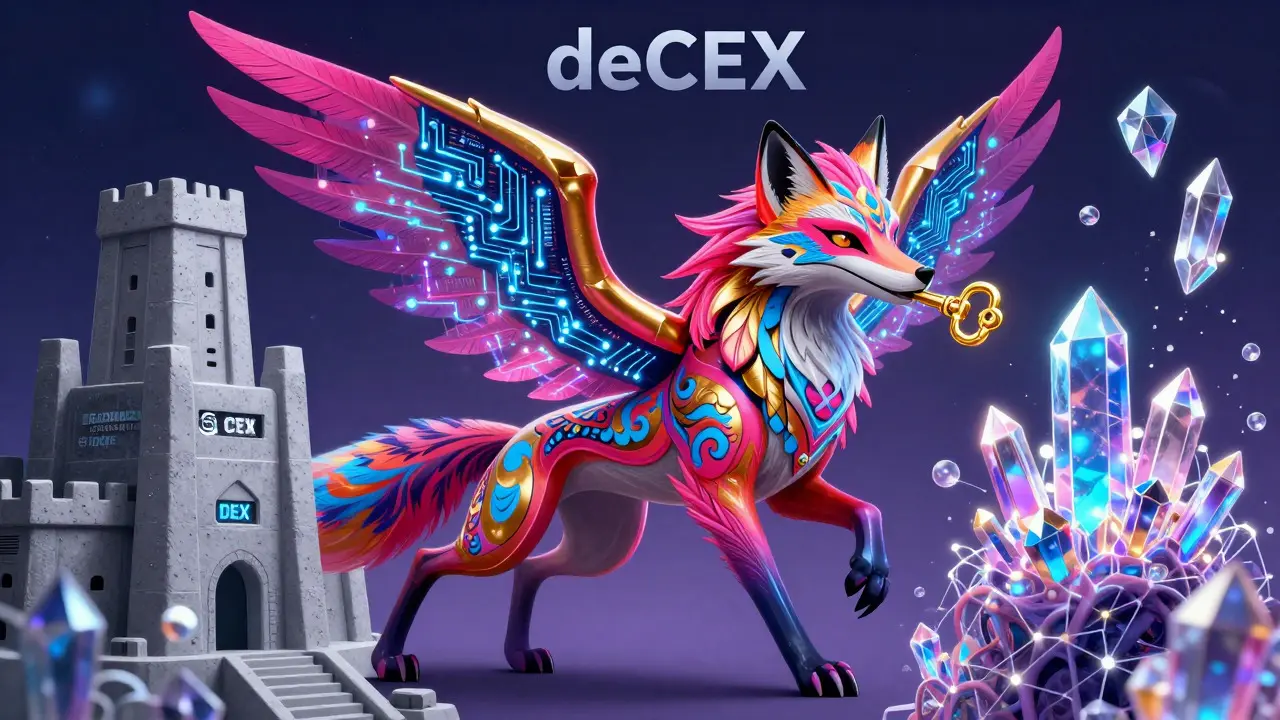




Imagine trading on Binance, KuCoin, and PancakeSwap simultaneously without opening three separate accounts or managing three different sets of API keys. That is the promise of Orion Protocol, a platform that calls itself a "deCEX" (decentralized centralized exchange). It claims to bridge the gap between the speed of traditional exchanges and the security of blockchain.
But here is the hard truth you won't find in their marketing brochures: Orion Protocol is not your typical exchange. You don't deposit funds into it. Instead, it acts as an aggregator, scanning multiple platforms to find you the best price. While the technology sounds impressive, the reality for the average trader in 2026 is mixed. With low traffic metrics and significant regulatory questions, is this niche tool worth your time? Let's break down exactly how it works, where it fails, and who actually benefits from using it.
What Exactly Is a deCEX?
To understand Orion, you have to unlearn what you know about standard crypto exchanges. Most platforms are either Centralized Exchanges (CEXs) like Coinbase, where they hold your money, or Decentralized Exchanges (DEXs) like Uniswap, where smart contracts handle everything. Orion sits awkwardly but innovatively in the middle.
Founded by Alexey Koloskov (a former architect at Waves DEX) and Kal Ali, Orion launched its mainnet in 2021. Its core function is liquidity aggregation. When you want to buy Bitcoin, Orion checks prices across connected CEXs and DEXs via a single API. It then executes the trade on the platform offering the best rate. This means you get the deep liquidity of big exchanges with the non-custodial safety of DeFi-you keep control of your private keys throughout the process.
The technical backbone making this possible is something called Virtual Order Books (VOBs). Traditional order books can be slow and prone to latency issues. VOBs execute matching off-chain, which speeds up the process significantly. According to technical reviews from CoinCodex, this represents a major leap from older Automated Market Maker (AMM) models that often suffer from high slippage and complex fee structures.
The User Experience: Smooth Tech, Rough Edges
If you log onto Orion today, the interface looks clean and modern. Atomic Wallet’s academy notes that Orion offers one of the more user-friendly experiences in the market. For a tech-heavy protocol, this is a win. You aren't forced to interact with raw smart contract addresses immediately. However, "user-friendly" stops being true the moment you hit a problem.
Here is the catch: Orion relies heavily on its native token, ORN. To access premium features, lower fees, or certain staking rewards, you need to hold ORN. This creates friction. If you just want to trade ETH for USDT quickly, having to first acquire and stake another token feels like an unnecessary hurdle. CoinCodeCap highlights this as a major con, noting that the necessity to buy the primary token alienates casual traders who just want to move assets.
Furthermore, the support experience is widely criticized. Multiple reviews point to "poor customer support" as a consistent weakness. In the world of crypto, where bugs happen and transactions fail, good support is a lifeline. Without it, you are largely on your own. The data backs this up: Orion sees only about 2,938 monthly visits, with an average visit duration of 4.44 seconds. That bounce rate suggests users arrive, see the complexity or lack of immediate clarity, and leave.

Fees and Revenue: The 18-Stream Model
Let's talk money. One of Orion's biggest selling points is its pricing structure. CashbackForex reports taker and maker fees at 0.00% for many basic operations. How do they survive? By leveraging a complex business model with eighteen distinct revenue streams.
This includes arbitrage opportunities, profit-sharing mechanisms, and staking rewards through their Delegated Proof of Broker (DPoB) consensus mechanism. DPoB allows professional brokers to use high-volume trading accounts on exchanges to benefit from institutional-grade fees, passing some savings back to the ecosystem. It’s clever economics, but it also means the platform is optimized for volume and sophisticated players rather than the occasional retail buyer.
| Feature | Orion Protocol (deCEX) | Standard CEX (e.g., Binance) | Standard DEX (e.g., Uniswap) |
|---|---|---|---|
| Custody | Non-Custodial (You hold keys) | Custodial (Exchange holds keys) | Non-Custodial (Smart Contracts) |
| Liquidity Source | Aggregated (CEX + DEX) | Internal Order Book | Liquidity Pools |
| Trading Fees | Often 0% (with ORN) | 0.1% - 0.5% | Variable (Network Gas + Protocol Fee) |
| Regulation | Unregulated | Varies (Often Licensed) | Unregulated |
| User Base Size | Niche (~3k monthly visits) | Massive (Millions) | Growing (High Volume) |
Security and Regulation: The Elephant in the Room
In 2026, regulation is no longer a buzzword; it is a survival requirement. Here is the stark reality: Orion Protocol does not appear to be regulated by any government authority. CashbackForex explicitly flags this status. For many traders, this is a red flag. If the platform goes down, or if there is a bug in the Virtual Order Book code, there is no insurance fund or regulatory body to call.
However, because it is non-custodial, the risk profile is different from a FTX-style collapse. Your assets never sit in Orion's wallet. They remain in your connected wallet or are swapped directly during the transaction. This reduces counterparty risk but increases technical risk. You are trusting the code, not the company. Given the low adoption rates, the code has seen less real-world stress testing compared to giants like Curve Finance or Stripe’s crypto integrations.

Who Should Use Orion Protocol?
Not every tool fits every job. Based on the current landscape, Orion Protocol serves specific niches effectively while failing others.
It is for you if:
- You are an advanced trader looking to minimize slippage by accessing aggregated liquidity from both CEXs and DEXs.
- You prioritize non-custodial security but hate the poor UX of most DEX frontends.
- You are interested in the ORN token ecosystem and want to participate in the DPoB staking rewards.
It is NOT for you if:
- You are a beginner who needs hand-holding or reliable 24/7 customer support.
- You want to trade highly obscure tokens that aren't listed on major aggregators.
- You require regulatory compliance for tax or institutional reporting purposes.
Final Verdict: A Promising Prototype, Not a Mainstream Solution
Orion Protocol is technically fascinating. The idea of bridging CEX and DEX liquidity via Virtual Order Books is sound and addresses real pain points in the crypto space. However, execution lags behind innovation. The low traffic, poor support reputation, and lack of regulation make it a risky choice for everyday trading.
Think of Orion as a specialized tool in your shed, not your daily hammer. It might offer the best price for a large, complex swap involving multiple chains, but for buying your weekly allowance of Bitcoin, established, regulated exchanges still offer better peace of mind. Until Orion scales its user base and improves its support infrastructure, it remains a niche experiment rather than a industry leader.
Is Orion Protocol safe to use in 2026?
Safety depends on your definition. Technically, it is safer than custodial exchanges because you retain control of your private keys (non-custodial). However, it lacks regulatory oversight, meaning there is no legal recourse if the platform suffers a critical software failure. Always use a hardware wallet when interacting with DeFi protocols.
Do I need ORN tokens to trade on Orion?
While basic trading may not strictly require them, holding ORN tokens is necessary to access premium features, reduced fees, and staking rewards. Many users find this requirement adds unnecessary friction compared to other aggregators.
How does Orion differ from a regular DEX like Uniswap?
Uniswap relies solely on decentralized liquidity pools. Orion aggregates liquidity from both centralized exchanges (like Binance) and decentralized ones. This allows Orion to potentially offer better prices and deeper liquidity for major pairs by tapping into CEX reserves.
Why is Orion Protocol's traffic so low?
Metrics show only ~2,938 monthly visits. This is likely due to its niche positioning, the complexity of setting up non-custodial trading, and reported issues with customer support. Major competitors have larger marketing budgets and established trust.
What are Virtual Order Books (VOBs)?
VOBs are Orion's proprietary technology that matches orders off-chain to reduce latency and improve efficiency. Unlike traditional on-chain order books which can be slow and expensive due to gas fees, VOBs provide a smoother trading experience similar to centralized exchanges.