


Yield Farm Sustainability Calculator
How Sustainable Is This Farm?
This tool evaluates whether a yield farm is sustainable based on the key metrics from the article. Enter your farm's data to see if it's built on real revenue or just token emissions.
Sustainability Assessment
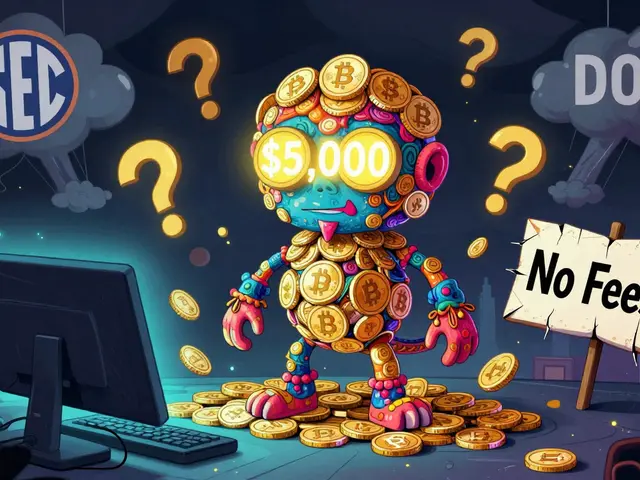
Yield farming isn’t just about earning crypto rewards anymore. It’s about whether your strategy is helping the ecosystem thrive-or draining it dry. Back in 2020, everyone was chasing 100% APYs. Liquidity pools exploded. Tokens multiplied. But now, in 2025, the same farms that once paid out like slot machines are either dead, drained, or quietly collapsing under their own weight. Why? Because most of them were built on unsustainable yield farming-a model that burns through capital, inflates token supply, and leaves users holding worthless assets when the incentives vanish.
What Is Sustainable Yield Farming?
Sustainable yield farming is when rewards come from real economic activity-not just new token emissions. Think of it like a business that earns money by selling products, not by printing cash to pay employees. In DeFi, that means protocols generate fees from trading, lending, or insurance services-and those fees are distributed to liquidity providers. The more users interact with the protocol, the more revenue it makes. And the more revenue it makes, the more it can pay out without needing to dilute its token supply.
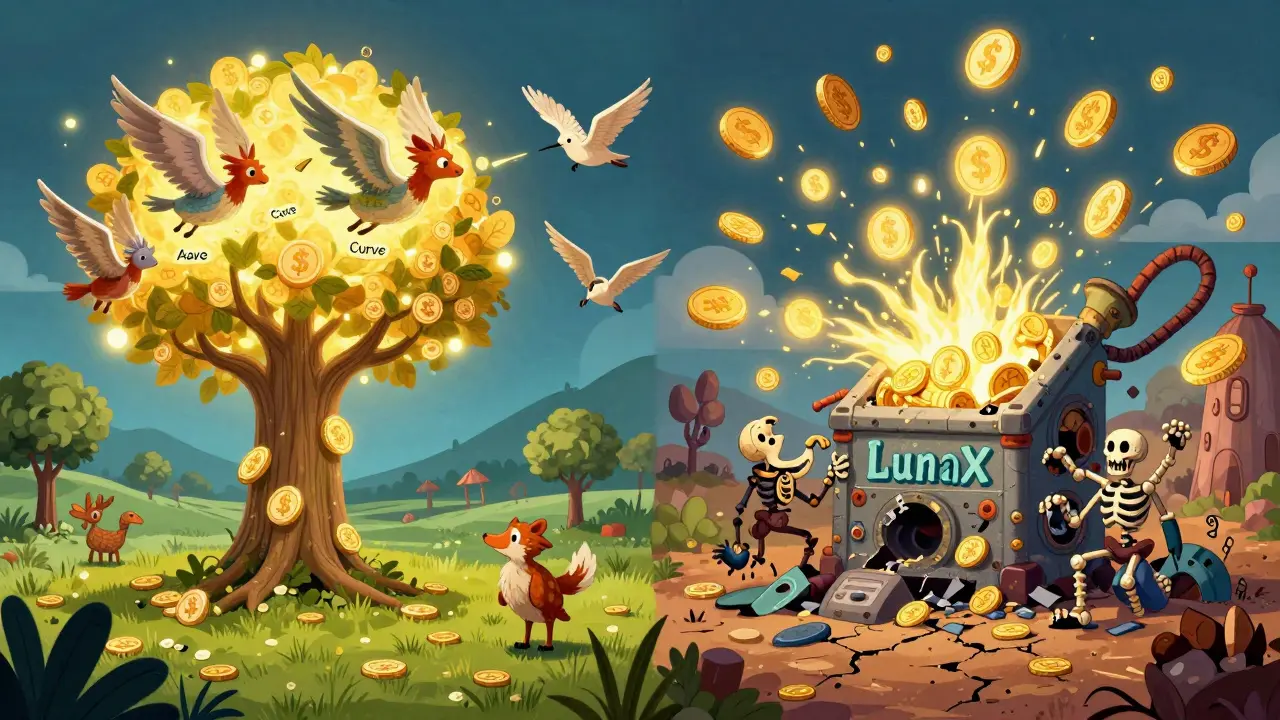
Take Aave or Compound. They don’t give out new tokens just to attract users. They charge interest on loans, and that interest flows directly into liquidity pools. Users earn a share of actual transaction volume. That’s sustainable. The APY might be lower-say 3-8% instead of 50%-but it doesn’t vanish when the hype dies. The protocol survives because it’s earning real value, not just burning through investor capital.
What Makes Yield Farming Unsustainable?
Unsustainable yield farming is a Ponzi in disguise. It starts with a big airdrop. Then comes a massive token emission schedule-millions of tokens dumped into liquidity pools every week. The goal? Get as many people as possible to lock up their crypto, create fake demand, and inflate the token price. Once the price rises, early investors cash out. The protocol keeps paying out rewards… but only because it’s printing more tokens. No real fees. No real users. Just a numbers game.
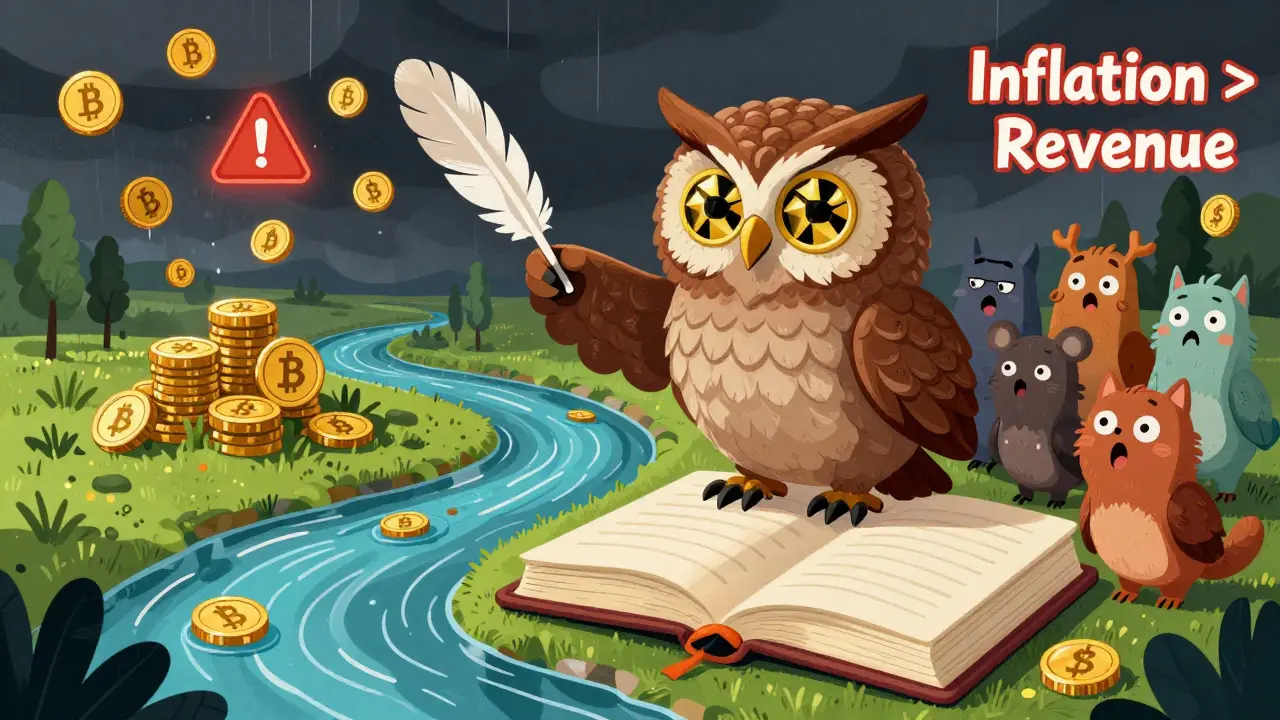
Remember the 2021 farm-and-dump projects? SushiSwap clones, meme-token liquidity pools, and farms that promised 200% APY for 7 days? Most of them are gone now. Why? Because their token supply was growing faster than their revenue. When the new token emissions slowed-or stopped-the APY collapsed overnight. Users who stayed behind were left with tokens worth pennies. That’s not finance. That’s gambling with blockchain mechanics.
Here’s the math: If a protocol emits 10,000 tokens per day and only generates $5,000 in daily fees, it’s spending $15,000 in token value to pay out rewards (assuming $1.50/token). That’s a net loss. It can’t last. The only way it survives is if new investors keep buying in to prop up the price. When they stop? The whole thing implodes.
Real-World Examples: Sustainable vs Unsustainable
Let’s compare two real protocols from 2025.
Sustainable: Curve Finance
- Generates fees from low-slippage stablecoin swaps
- Revenues: $2-5 million per day
- CRV token emissions: Reduced by 80% since 2022
- APY for liquidity providers: 2-6% (stable, long-term)
- Still profitable after 5+ years
Unsustainable: LunaX Finance (2024 collapse)
- Launched with 500M $LUNAX tokens allocated to yield farms
- Initial APY: 120%
- Revenue from fees: $0
- Token emissions: 15M tokens per week
- Price crashed 98% in 14 days after emissions dropped
- TVL fell from $420M to $8M in 3 weeks
Curve survived because it solved a real problem: efficient stablecoin swaps. LunaX solved nothing. It just printed money and called it yield.
How to Spot an Unsustainable Farm
You don’t need a finance degree to tell if a yield farm is about to die. Here’s what to check before you stake:
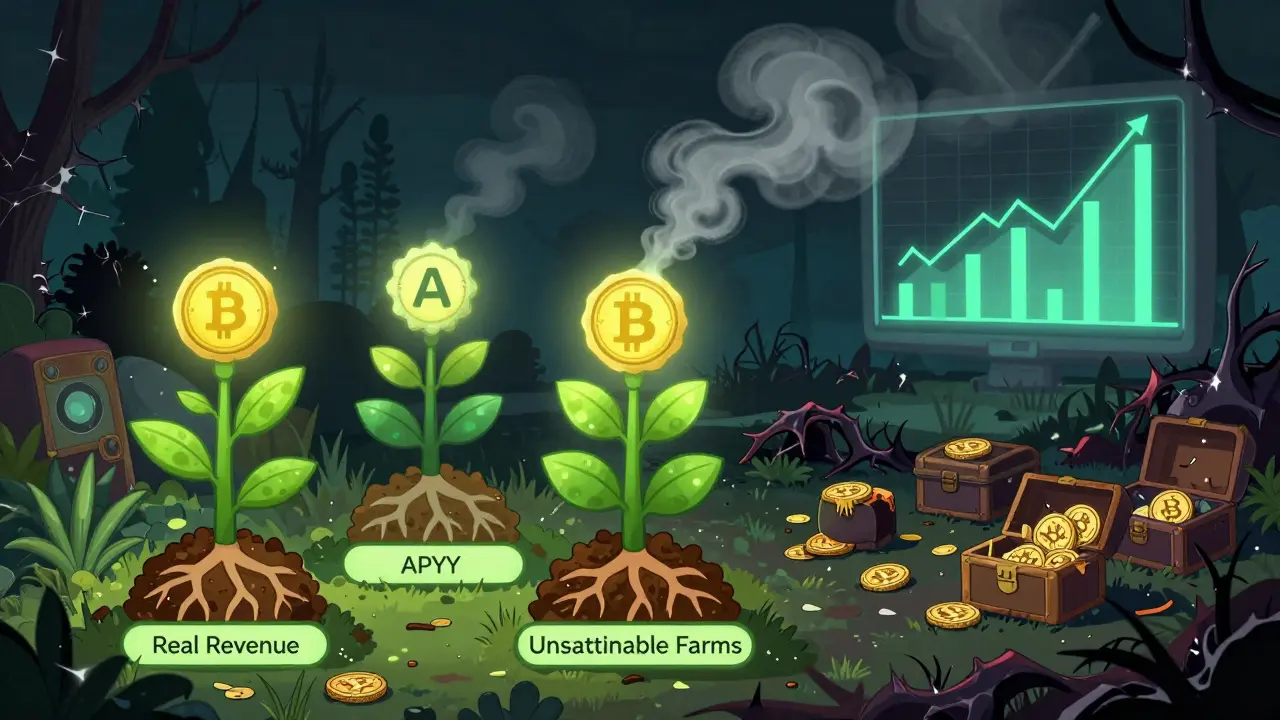
- Where do the rewards come from? If it’s 90%+ token emissions, walk away. Look for revenue breakdowns in the protocol’s dashboard.
- Is the token supply capped? Unsustainable farms have infinite emission schedules. Sustainable ones reduce emissions over time.
- What’s the TVL-to-revenue ratio? If the protocol’s daily revenue is less than 1% of its total locked value, it’s burning through capital.
- Who’s behind it? Anonymous teams with no audit history or public roadmap? Red flag. Legit projects have transparent teams and regular updates.
- How long has it been running? If it’s under 6 months and still paying 30%+ APY, it’s likely unsustainable.
One quick trick: Check the token’s inflation rate on DeFiLlama. If it’s over 20% per month, it’s not a farm-it’s a money printer.
The Hidden Cost of Unsustainable Farms
It’s not just your money that’s at risk. Unsustainable yield farming damages the entire DeFi ecosystem.
When a farm collapses, it drags down the price of the underlying tokens. That hurts everyone holding them-even people who didn’t farm. It creates panic. It makes regulators take notice. And it pushes institutional investors away from DeFi because they see it as a casino, not a financial system.
Worse, these farms often use the same liquidity pools as legitimate protocols. When a fake farm drains a pool, it causes slippage and price impact for real traders. That’s like a fake restaurant setting up next to a real one, stealing all the customers with free food, then closing down-leaving the real restaurant with empty tables and no income.
Why Sustainable Farming Is the Future
DeFi is maturing. In 2025, users aren’t chasing the highest APY anymore. They’re looking for reliability. They want to know their assets will still be earning in 6 months, not just 6 days.
Protocols that focus on sustainable yield are winning. They’re attracting institutional capital, integrating with traditional finance, and building real user bases. They don’t need to bribe users with tokens-they earn trust by delivering consistent value.
Regenerative yield farming is emerging too-where protocols reinvest a portion of fees into security audits, developer grants, or community treasury growth. That’s the next level: not just sustainability, but growth through responsible stewardship.
How to Farm Sustainably in 2025
If you want to earn yield without getting burned, here’s your action plan:
- Stick to top 20 protocols by TVL on DeFiLlama. They’ve survived multiple cycles.
- Look for protocols with on-chain revenue tracking. If they don’t show it, they’re hiding something.
- Use yield aggregators like Yearn or Beefy that automatically move funds to the safest pools.
- Never stake more than you can afford to lose-even in "safe" farms.
- Track token emissions. If they’re increasing, it’s a warning sign.
- Withdraw rewards regularly. Don’t compound if the APY is unstable.
The goal isn’t to get rich overnight. It’s to build long-term crypto wealth without getting wiped out by the next rug pull.
Final Thought: It’s Not About Yield. It’s About Value.
Yield farming was supposed to be the future of decentralized finance. But too many projects treated it like a fireworks show-bright, loud, and gone in seconds. The real winners aren’t the ones who chased the highest APY. They’re the ones who waited, watched, and staked where real value was being created.
Sustainable yield farming isn’t sexy. It doesn’t trend on Twitter. But it lasts. And in a market that’s seen hundreds of projects vanish overnight, that’s the only thing that matters.

17 Comments
Been in this space since 2020 and honestly the only thing that surprises me is how slow some people are to catch on. The farms that lasted were the ones with actual revenue, not just airdrop hype. I remember staking in one that paid 800% APY and it died in 12 days. Learned the hard way.
I think what's really interesting is how the shift from chasing APY to valuing sustainability mirrors what happened in traditional finance after the 2008 crash. People got burned, they got scared, and now they're looking for stability over flashy returns. It's not just about crypto anymore-it's about building systems that don't collapse under their own weight. I've been watching Curve for years and the fact that they reduced emissions by 80% while keeping liquidity stable is just brilliant. It shows they trust their users enough to not bribe them with tokens. That’s rare.
LMAO this post is so basic. You think people don't know this? Every single rug pull in 2021 had a whitepaper that said "sustainable yield" but the tokenomics were a dumpster fire. The real issue is that DeFi is still a wild west and regulators are too slow. And don't even get me started on how these "sustainable" protocols still pump their own tokens on twitter with bots. It's all theater. I've seen the same teams behind 3 different "revolutionary" protocols-all collapsed. The system is rigged and you're just feeding the machine.
Check DeFiLlama's revenue-to-TVL ratio before staking. If it's below 1%, it's a red flag. Also look at the token emission schedule-any increase over 3 months means it's unsustainable. Simple as that.
Bro I was there when SushiSwap went from 0 to $1B TVL in 2 weeks. It felt like magic. Then it vanished. But here’s the thing-those early days taught us something valuable: yield farming isn’t about getting rich fast. It’s about learning how to spot real value. Now I use Yearn to auto-move my funds. I don’t chase APY anymore. I chase longevity. And honestly? My portfolio’s healthier than ever. You don’t need to be a genius. You just need to be patient. And maybe stop refreshing your wallet every 10 minutes.
While I appreciate the sentiment expressed herein, I must respectfully contend that the very premise of yield farming-regardless of its purported sustainability-is anathema to the foundational ethos of decentralization. The reliance upon economic incentives to attract liquidity constitutes a form of centralized manipulation, albeit algorithmically mediated. One cannot, in good conscience, advocate for a system predicated upon the artificial inflation of asset values, even if such inflation is ostensibly "backed" by protocol revenue. The moral hazard is inherent. One might as well argue that a Ponzi scheme is ethical if it pays dividends for six months.
I remember watching LunaX collapse. I had $5k in it. Didn’t panic sell-I just watched the chart drop 98% over 3 days. It was surreal. But here’s what I learned: the real test isn’t how fast you make money. It’s how calmly you watch it disappear. I still hold some CRV. Not because it’s going to moon. But because it’s still there. Still earning. Still working. That’s worth more than any 100% APY ever was.
Oh wow another "sustainable yield" sermon. You people are so naive. Every single protocol that survives is just better at hiding the fact that it’s printing tokens. You think Curve doesn’t pump its own token? Please. They just do it slower and with more PR. The only difference between LunaX and Curve is that Curve has lawyers. That’s it. Stop pretending this isn’t a casino with a whitepaper.
AMERICA IS THE ONLY PLACE WHERE REAL FINANCE HAPPENS. Why do you think all these "sustainable" farms are US-based? Because we don’t play games. Other countries? They’re all just trying to scam each other with meme coins. I saw a farm from India last week promising 300% APY in INR. BRO. That’s not finance. That’s a scam with a flag. Stay away from non-US DeFi. It’s not worth your time. 🇺🇸🔥
Yield farming used to be wild. Like, midnight oil, adrenaline, heart pounding, watching your APY spike and then crash like a dropped iPhone. Now it’s… boring. Like watching paint dry but with more gas fees. But you know what? I’ll take boring over bankruptcy any day. I used to chase 200% APY. Now I chase sleep. And my portfolio thanks me.
I think the real story here is how much the community has changed. Back in 2021, if you said "check the token emissions" people laughed at you. Now it’s common sense. That’s progress. Not flashy. Not viral. But real. I’ve been in this since 2018 and I’ve seen waves come and go. The ones that stick are the ones that stop trying to be a startup and start acting like a utility. That’s what sustainable farming is. Not the numbers. The mindset.
It’s funny how we talk about sustainability like it’s some new idea. But really, it’s just returning to the basics. Value isn’t created by printing tokens. It’s created by solving problems. Curve solves slippage. Aave solves lending. LunaX solved nothing. And that’s the truth. We got distracted by the noise. The flashing lights. The hype. But the quiet ones-the ones that just keep working day after day-they’re the ones that matter. It’s not about being the loudest. It’s about being the most reliable.
Big respect to everyone who’s still in this space after all the chaos. I used to think yield farming was a get-rich-quick scheme. Now I see it as a test of patience. I don’t even check my wallet daily anymore. I just leave it. And guess what? I’m doing better than when I was chasing 50% APY every week. Also, if you’re new-use Beefy. It’s like having a friend who knows what they’re doing. And don’t forget to withdraw your rewards. Compounding is great… until it’s not.
As someone who’s lived in both the US and Canada, I’ve seen how differently DeFi is perceived. In Canada, people ask "Is this legal?" before they stake. In the US, they ask "What’s the APY?" But honestly, the sustainable models are thriving in both places. It’s not about geography-it’s about education. I’ve started teaching my friends how to read tokenomics. One of them just pulled $12k out of a farm that was about to collapse. She didn’t know what she was doing. But she listened. That’s the future.
They say sustainable yield farming is the future. I say the future is just people who didn’t get rug pulled. Congrats on surviving. Now go buy a house.
It’s not about the yield. It’s about the peace of mind. I used to stress over every price drop. Now I just know: if the revenue is higher than emissions, I’m good. If not? I’m out. Simple. No drama. No FOMO. Just quiet confidence. And yeah, I use emojis now. 🌱💸
Everything you’re saying is a lie. This is all a government plot to control crypto. The "revenue" numbers are fake. DeFiLlama is owned by the Fed. Curve is a front for the CIA. They want you to think "sustainability" is safe so you don’t run for the hills when the real collapse comes. I’ve got my Bitcoin in a safe. That’s the only real yield. Everything else is a simulation.