



Tinyman Fee Calculator: See Your Savings
Tinyman Total Cost
$0.00
Ethereum Total Cost
$0.00
Your Savings
$0.00
Note: Tinyman charges 0.3% trading fee + $0.0001 network fee per swap. Ethereum fees vary based on network congestion.
When you're tired of paying $10 in gas fees just to swap a few tokens on Ethereum, Tinyman offers a real alternative. Built on the Algorand blockchain, Tinyman is the most used decentralized exchange (DEX) on Algorand - and it’s not just another copy of Uniswap. It’s faster, cheaper, and designed specifically for users who want to trade without the overhead of legacy blockchains.
What Exactly Is Tinyman?
Tinyman is a decentralized exchange that lets you swap Algorand Standard Assets (ASAs) directly from your wallet. No sign-up. No KYC. No middleman. It runs on smart contracts on the Algorand network, which means trades settle in under a second and cost less than a penny. Founded in 2021 by Kaan Eryilmaz, Tinyman was created to bring DeFi to Algorand users who were tired of Ethereum’s congestion and high costs.
Unlike centralized exchanges like Binance or Coinbase, Tinyman doesn’t hold your funds. You trade directly from your Algorand wallet - whether it’s Pera, Pera Wallet, or Pera Wallet Mobile. Your private keys stay yours. That’s the whole point of decentralized finance.
How Tinyman Works: AMMs and Liquidity Pools
Tinyman uses an Automated Market Maker (AMM) model, just like Uniswap or SushiSwap. But here’s the difference: Algorand’s consensus algorithm makes everything faster. Swaps happen in under 0.8 seconds. Liquidity pools are created instantly. And because Algorand doesn’t use proof-of-work, there’s no energy waste or high fees.
When you swap ALGO for USDT on Tinyman, you’re not trading against another person. You’re trading against a pool of funds locked in a smart contract. Anyone can add liquidity to these pools and earn a share of the trading fees. For example, if you put $1,000 worth of ALGO and USDT into a pool, you’ll earn a portion of every trade made in that pool - usually around 0.3% per swap.
Tinyman currently supports 35 different tokens and offers 86 trading pairs. That’s not as many as Uniswap, but it’s more than enough for the Algorand ecosystem. Popular pairs include ALGO/USDT, ALGO/DAI, and ALGO/wBTC. You won’t find obscure meme coins here - Tinyman focuses on stablecoins and major ASAs with real utility.
Tinyman v2: What’s New?
The original Tinyman (v1) worked fine, but v2, launched in early 2024, is a major upgrade. It’s not just a tweak - it’s a full rebuild.
- New contract architecture: Smarter, more secure, and easier to audit.
- Improved UI: Cleaner interface, fewer clicks, better mobile support.
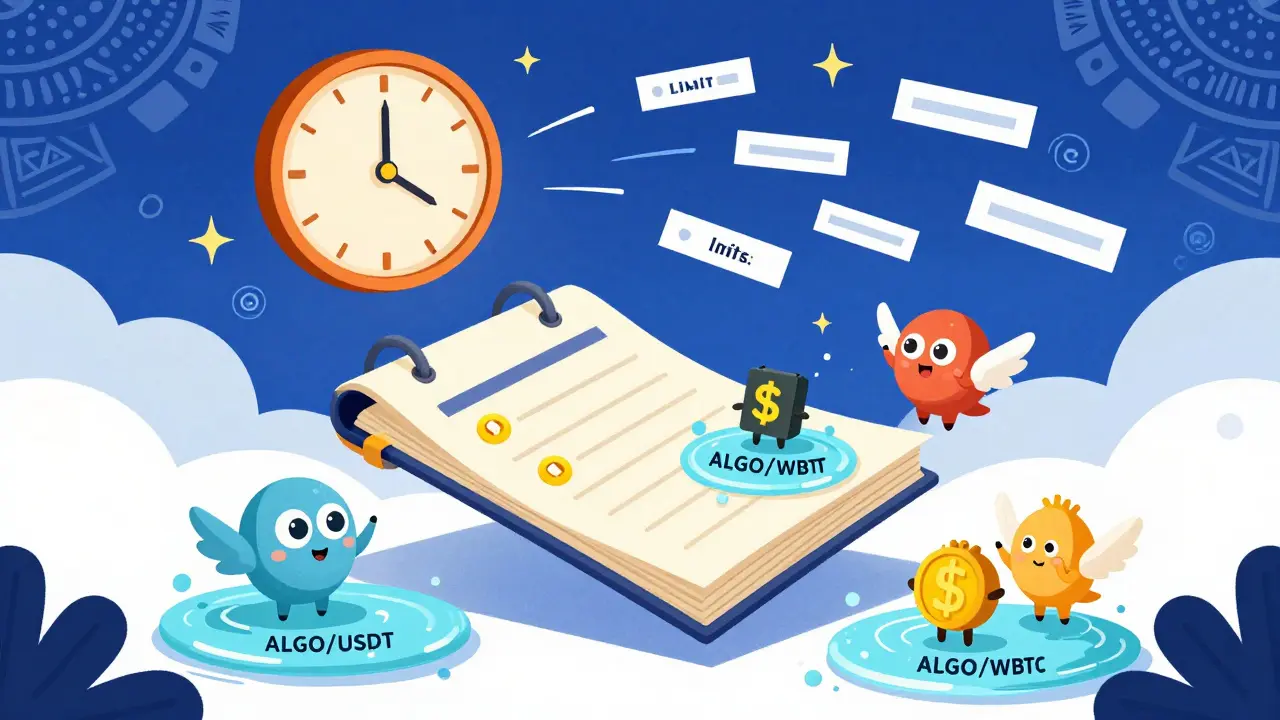
- Limit orders: Set a price target and let Tinyman execute your trade automatically. No more refreshing the page.
- Dollar Cost Averaging (DCA): Schedule recurring buys - great for long-term holders.
- Enhanced $TINY token utility: The native token now powers governance, fee discounts, and staking rewards.
Most importantly, v2 lets you earn rewards by providing liquidity without locking up your assets. That’s called liquid staking. You stake your ALGO, get xALGO in return, and still use xALGO to trade on Tinyman. You earn staking rewards plus trading fees - all at once.
Trading Fees and Costs
Tinyman charges a flat 0.3% fee on every swap. That’s standard for AMMs. But here’s the kicker: Algorand transaction fees are $0.0001. So even if you swap 10 times a day, you’re still paying less than a cent in network fees.
Compare that to Ethereum, where one swap can cost $5-$15 in gas. Tinyman makes frequent trading feasible. If you’re a day trader or just like to rebalance your portfolio, Tinyman is one of the few places where it doesn’t eat into your profits.
The bid-ask spread on Tinyman averages 0.649% - lower than many centralized exchanges for small-cap tokens. That means tighter pricing and less slippage. For most users, this translates to better execution.
Liquidity Mining and $TINY Rewards
Tinyman incentivizes liquidity providers with $TINY tokens. If you add liquidity to a pool, you get $TINY rewards on top of trading fees. The rewards are distributed weekly, and the amount depends on your share of the pool.
There are two types of farming:
- Permissionless Farms: Anyone can create a liquidity pool and start earning $TINY.
- Farming V2: More efficient, with better APRs and reduced impermanent loss risk.
As of late 2025, the best-performing pools (like ALGO/USDT) offered annual yields between 8% and 15%, depending on market conditions. That’s not insane compared to DeFi’s peak, but it’s sustainable - and you’re not risking your principal like in high-yield scams.
Security and Trust
Tinyman has been audited by two independent firms: CertiK and Hacken. Both gave it a clean bill of health. The code is open-source and publicly available on GitHub. No rug pulls. No hidden backdoors.
Algorand itself is a pure proof-of-stake blockchain with built-in finality. That means once a transaction is confirmed, it’s final - no reorgs, no 51% attacks. Tinyman inherits this security. It’s one of the safest DEXes you can use.
There’s no centralized team controlling funds. The treasury is governed by $TINY holders. If you own $TINY, you can vote on proposals like fee changes, new token listings, or treasury allocations.
Who Is Tinyman For?
Tinyman isn’t for everyone. If you’re new to crypto and just want to buy Bitcoin with a credit card, stick with Coinbase. Tinyman is for people who:
- Own ALGO or other ASAs and want to trade them
- Want to earn passive income from liquidity provision
- Are tired of high gas fees on Ethereum
- Prefer self-custody over centralized exchanges
- Want limit orders and DCA without paying extra
If you’re already in the Algorand ecosystem, Tinyman is the natural next step. It’s the most mature DeFi app on the network, with the most liquidity, the most users, and the most active development.
How to Get Started
Here’s how to use Tinyman in five simple steps:
- Get an Algorand wallet. Pera Wallet is the most popular and easiest to use.
- Buy ALGO on a centralized exchange like Kraken or Binance and send it to your Pera Wallet.
- Go to app.tinyman.org and connect your wallet.
- Click "Swap" to trade tokens, or "Liquidity" to add funds to a pool.
- Start earning fees and $TINY rewards.
That’s it. No forms. No waiting. No verification. You’re trading in under 60 seconds.
How Tinyman Compares to Other DEXes
Here’s how Tinyman stacks up against other popular decentralized exchanges:
| Feature | Tinyman | Uniswap (Ethereum) | SushiSwap (Multi-chain) | Tezos DEXes |
|---|---|---|---|---|
| Blockchain | Algorand | Ethereum | Multi-chain | Tezos |
| Avg. Swap Fee | 0.3% | 0.3% | 0.3% | 0.25-0.5% |
| Network Fee per Swap | $0.0001 | $5-$15 | $0.10-$2 | $0.005 |
| Trade Speed | <1 second | 15-60 seconds | 10-30 seconds | 3-5 seconds |
| Liquidity Pools | 86 pairs | 10,000+ pairs | 5,000+ pairs | 200+ pairs |
| Limit Orders | Yes | No (via third parties) | No | Yes |
| DCA Functionality | Yes | No | No | No |
| Liquid Staking | Yes | No | No | Yes |
Tinyman doesn’t try to beat Uniswap on volume. It beats it on cost and speed for Algorand users. If you’re on Algorand, there’s no better option.
The Future of Tinyman
Tinyman’s roadmap includes cross-chain swaps - meaning you’ll soon be able to trade ALGO for ETH or SOL directly on the platform, without needing a bridge. This is huge. It turns Tinyman from an Algorand-only tool into a multi-chain gateway.
The team is also building analytics dashboards for liquidity providers, so you can see your earnings, impermanent loss, and risk exposure in real time. Governance is being expanded, with more voting power given to long-term $TINY holders.
With the Algorand Foundation’s $300 million DeFi fund, Tinyman is likely to get even more support. It’s not just a DEX - it’s becoming the financial backbone of the Algorand ecosystem.
Final Verdict: Is Tinyman Worth It?
If you’re holding ALGO or other Algorand tokens, Tinyman is the best place to trade them. It’s fast, cheap, secure, and packed with features most DEXes still don’t offer - like limit orders and DCA.
For liquidity providers, it’s one of the most reliable ways to earn passive income without risking your assets. The $TINY token isn’t a hype coin - it’s tied to real utility: governance, discounts, and rewards.
Is it the biggest DEX? No. Is it the most efficient for Algorand? Absolutely. If you’re serious about DeFi on Algorand, Tinyman isn’t just an option - it’s the default.
Is Tinyman safe to use?
Yes. Tinyman has been audited by CertiK and Hacken, and its code is open-source. It runs on Algorand, a secure, finality-based blockchain with no history of major hacks. You never give up control of your funds - everything stays in your wallet.
Do I need to stake ALGO to use Tinyman?
No. You can swap tokens without staking. But if you want to earn extra rewards, you can stake ALGO to get xALGO and use it in liquidity pools. This lets you earn both staking rewards and trading fees.
Can I trade Bitcoin or Ethereum on Tinyman?
Not directly yet. But you can trade wrapped versions like wBTC and wETH on Algorand. Cross-chain swaps (directly trading ALGO for ETH, for example) are coming in 2026.
How do I get $TINY tokens?
You earn $TINY by providing liquidity to Tinyman pools. You can also buy it on supported exchanges like Pera Swap or AlgoFi. The token is used for governance, fee discounts, and staking rewards.
Is Tinyman better than a centralized exchange?
For Algorand users, yes. Centralized exchanges charge higher fees, have slower withdrawals, and require KYC. Tinyman is faster, cheaper, and gives you full control. If you’re trading ALGO or ASAs, there’s no reason to use a centralized exchange.

15 Comments
Just swapped ALGO for USDT. Took 0.4 seconds. Paid $0.0002. Life is good.
This is why people lose money in crypto. You think low fees = smart investing? Bro, you're just gambling with a cheaper deck.
You say 'no KYC' like it's a feature. Meanwhile, I just got ripped off by a fake liquidity pool because no one was watching. Self-custody isn't freedom if you're too lazy to read the contract.
The Algorand blockchain, in its elegant, stateless perfection, renders the very notion of gas fees as a relic of a bygone era of computational excess. Tinyman, as an emergent artifact of this paradigm, does not merely facilitate exchange-it reconfigures the ontological relationship between capital and consensus.
i love how tinyman just... works. no drama. no stress. i just open my pera wallet and swap. sometimes i forget im even using defi. its like air. you dont think about it until you need it. <3
Oh wow, another 'Algorand is the future' cultist. Let me guess-your wallet is full of $TINY and you think you're a pioneer? Newsflash: no one outside your echo chamber cares. Ethereum still moves $20B a day while you're trading ALGO for DAI like it's 2017.
I don't need a DEX to tell me how to trade. I need a broker who answers my calls. This whole 'no middleman' thing is just a way for devs to avoid responsibility when your trade fails.
The 0.3% trading fee is standard, but the network fee of $0.0001 is the real innovation. Algorand's consensus mechanism enables this at scale without sacrificing decentralization. The liquid staking implementation via xALGO is particularly elegant-it decouples yield generation from asset immobilization, a significant advancement over traditional staking models.
They say 'audited by CertiK' but did you see the team's Discord? Five guys in hoodies. One of them posted a meme of a dragon eating a wallet. That's not security, that's a TikTok trend.
You people act like this is some revolution. I used to trade on MtGox. At least they had customer service. Now you get a smart contract and a prayer. Pathetic.
The $TINY token is a classic rug-pull bait. 8-15% APY? That's what they call 'sustainable' now? You're not earning yield-you're funding the dev team's Lambo fund. Check the treasury wallet. I bet it's 70% owned by insiders.
The architectural elegance of Tinyman v2 cannot be overstated. By integrating limit orders and DCA directly into the AMM layer, it transcends the transactional paradigm of earlier DEXes and evolves into a true financial orchestration layer. The liquid staking mechanism-wherein xALGO functions as both collateral and liquidity-represents a non-trivial leap in capital efficiency, effectively collapsing two distinct DeFi primitives into a single, atomic operation.
The bid-ask spread of 0.649% is impressive for a DEX with under 100 pairs. Most of the liquidity is concentrated in ALGO/USDT and ALGO/DAI, which is smart. No need to dilute focus on meme coins. This is DeFi with discipline.
I've used Tinyman for over a year now. I started with just $50 in ALGO. Now I'm earning enough in fees and $TINY to cover my coffee habit. It's not flashy, but it's consistent. I appreciate that the team doesn't chase hype. They just build. And the UI on mobile? Finally, something that doesn't make me want to throw my phone.
Thank you for writing this. I was hesitant to try a DEX, but your breakdown made it feel approachable. I just added my first liquidity pool last night and already feel like I'm part of something real. 💛