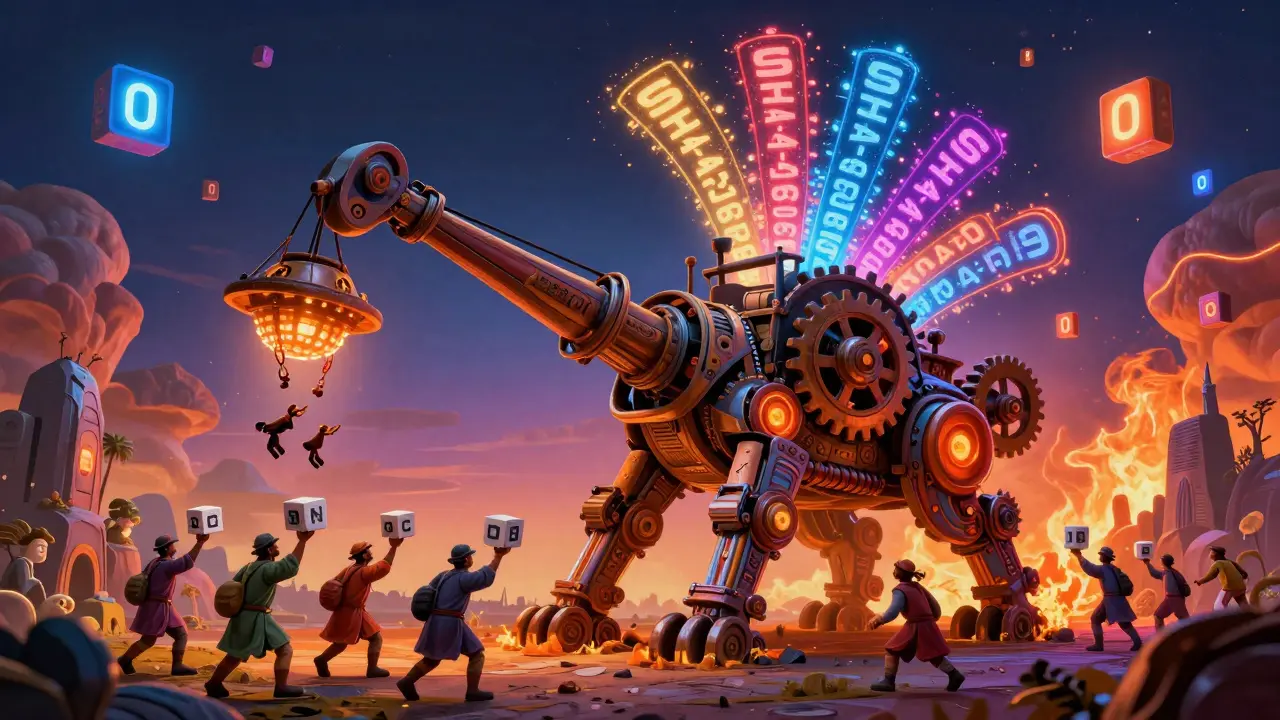





Bitcoin doesn’t run on banks, governments, or middlemen. It runs on Proof of Work. And if you’ve ever wondered how a decentralized network of strangers agrees on who owns what - without a single authority - this is how.
Every ten minutes, a new block of Bitcoin transactions gets added to the blockchain. Someone wins the right to add it. That someone is a miner. And they didn’t just get lucky. They solved a math problem so hard that trillions of guesses per second are needed just to have a shot. This isn’t magic. It’s math. And it’s the reason Bitcoin has stayed secure for over 15 years.
What Proof of Work Actually Is
Proof of Work (PoW) is a system that forces miners to prove they’ve done real work before they can add a new block. It’s not about being smart or having connections. It’s about spending electricity, time, and computing power. The more you spend, the better your chances. But even then, it’s still a lottery.
The core of Bitcoin’s PoW is a cryptographic hash function called SHA-256 a secure hashing algorithm that takes any input and turns it into a fixed-length string of characters. It’s deterministic - same input, same output. But it’s also one-way. You can’t reverse it. And even a tiny change in input - like adding a period - gives you a completely different output.
Miners take a block of transactions, add a random number called a nonce, and hash the whole thing. If the output hash starts with enough zeros - below a target number set by the network - they win. If not? They change the nonce and try again. And again. And again. Billions of times per second.
The Mining Process Step by Step
Here’s what actually happens when you mine Bitcoin:
- Transactions pile up. People send Bitcoin. These unconfirmed transactions sit in a public waiting room called the mempool.
- Miners grab transactions. They pick the ones with the highest fees (to maximize profit) and bundle them into a candidate block.
- They start guessing. The miner takes the block header - which includes the list of transactions, the previous block’s hash, and a timestamp - and starts trying different nonce values. Each try produces a new hash.
- The network sets the bar. The target hash isn’t fixed. It changes every 2016 blocks (roughly every two weeks). If miners are solving blocks too fast, the network makes the target harder (more leading zeros). If they’re too slow, it gets easier. This keeps Bitcoin’s block time at 10 minutes on average, no matter how many miners join.
- One miner hits it. When a miner finds a hash that meets the target, they broadcast the block to the network.
- Everyone checks. Other nodes verify the solution. They don’t have to guess. They just hash the same data with the nonce the winner provided. If it matches, they accept the block.
- The chain grows. Once verified, the block is added to the blockchain. The miner gets rewarded: 3.125 BTC (as of 2026) plus all transaction fees from that block.
This isn’t a race against other miners - it’s a race against probability. Your chance of winning is proportional to how much computing power you contribute to the network. If you control 1% of the total hash rate, you’ll find roughly 1 in 100 blocks over time.
Why It’s So Secure
Imagine trying to rewrite the last 100 blocks. To do that, you’d need to redo the Proof of Work for each one - faster than the rest of the network can add new blocks. That means you’d need more than 50% of the entire Bitcoin network’s computing power. That’s not just expensive. It’s nearly impossible.
The network’s total hash rate is over 1,000 exahashes per second. That’s 1 quintillion calculations every second. To outpace it, you’d need a factory full of the most advanced ASIC miners, consuming gigawatts of electricity. The cost? Billions. And even then, the community would likely fork the chain to reject your fraudulent blocks.
This is why Bitcoin’s security isn’t based on trust. It’s based on cost. The more energy and hardware you have to spend to attack it, the less likely anyone will try.
Energy Use and the Real Cost
Yes, Bitcoin mining uses a lot of electricity. The Cambridge Bitcoin Electricity Consumption Index estimates it uses more than Argentina annually. But here’s what most people miss: that energy isn’t wasted.
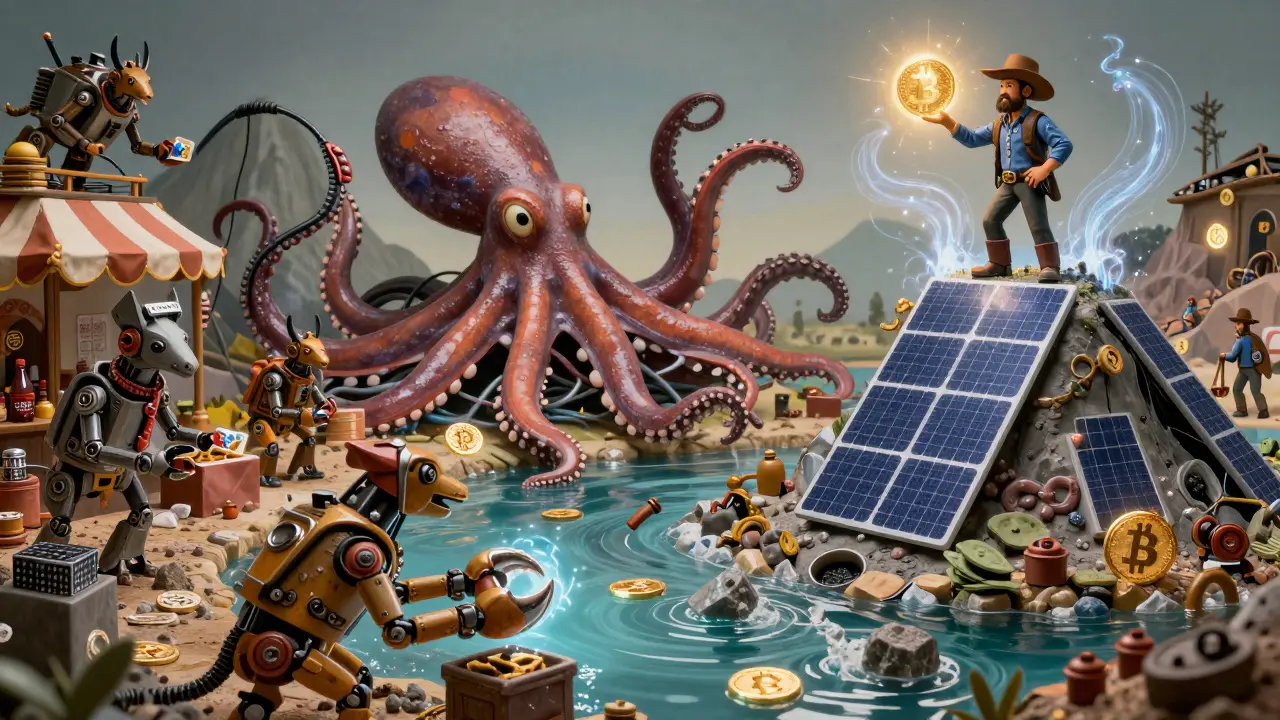
Miners don’t just run machines for fun. They’re businesses. They chase the cheapest power - hydro in Norway, geothermal in Iceland, flared gas in Texas, excess solar in California. Many now use renewable energy that would otherwise go unused.
The electricity isn’t spent on idle servers or data centers. It’s spent on a global security system that runs 24/7, protects trillions in value, and operates without a single company or government in control. Compared to traditional banking - which uses more energy for physical branches, ATMs, and paper trails - Bitcoin’s footprint is more efficient than you think.
Miners Today: Big Players and Solo Gamblers
In 2026, mining isn’t something you do on your laptop. It’s a capital-intensive industry. A single ASIC miner costs $3,000-$5,000 and uses 3,000 watts. It’s designed for one thing: hashing SHA-256 as fast as possible.
Most mining happens in large pools. These are groups of miners who combine their computing power. When one wins, the reward is split based on contribution. This gives small miners a steady, if smaller, income.
But solo mining still exists. In 2025, a miner in rural Montana found a block alone - the first in over a year. He didn’t have a data center. Just a garage full of ASICs and a solar array. His reward? $200,000. It’s rare. But it’s still possible.
Proof of Work vs. Other Systems
Other blockchains use Proof of Stake (PoS), where validators are chosen based on how much crypto they own. It’s faster and uses less energy. But it’s also less battle-tested. Ethereum switched to PoS in 2022. Bitcoin hasn’t.
Why? Because PoW has never been hacked. Not once. Not even close. It’s been attacked, prodded, and tested for 15 years. And it’s still standing.
PoW doesn’t just secure Bitcoin. It creates economic incentives. Miners buy hardware, pay for power, and build infrastructure. That infrastructure becomes a public good - a global, decentralized security layer that anyone can rely on.
The Future of Bitcoin Mining
The next halving is expected in 2028. After that, miners will earn only transaction fees. Will that be enough? Maybe. But Bitcoin’s design has always been about long-term incentives. As usage grows, fees will rise. As hardware gets more efficient, costs will fall.
There’s no plan to replace Proof of Work. The Bitcoin community sees it as the foundation. Not a flaw to fix, but a feature that makes Bitcoin what it is: uncensorable, trustless, and permanent.
Proof of Work isn’t elegant. It’s brute force. But it works. And for now, that’s all that matters.
Can anyone mine Bitcoin today?
Yes, technically anyone can. But unless you have access to very cheap electricity and modern ASIC miners, you’ll likely lose money. Most solo miners today are hobbyists or those with surplus renewable energy. For most people, joining a mining pool is the only realistic way to earn Bitcoin through mining.
How long does it take to mine one Bitcoin?
You don’t mine one Bitcoin - you mine one block. Each block gives 3.125 BTC (as of 2026). On average, a block is found every 10 minutes. But no individual miner finds a block every 10 minutes. Your chance depends on your share of the total network hash rate. A small miner might wait months or years for a single reward.
Why does Bitcoin’s mining difficulty change?
To keep block times at 10 minutes. If more miners join, blocks are found faster. So the network makes the puzzle harder - requiring more leading zeros in the hash. If miners leave, the difficulty drops. This adjustment happens every 2016 blocks, automatically, without human input.
Is Bitcoin mining still profitable?
It depends. In 2026, profitability requires low-cost electricity (under $0.05 per kWh), efficient ASIC miners, and careful management of cooling and maintenance. Large mining farms in regions like Texas, Kazakhstan, and Canada dominate. For individuals without cheap power, mining is usually not profitable - but joining a pool can still offer steady, small returns.
What happens when all Bitcoin is mined?
Bitcoin’s supply is capped at 21 million. The last coin is expected around 2140. After that, miners won’t get new coins as rewards. They’ll rely entirely on transaction fees. The network is designed so that as Bitcoin becomes more widely used, fees will rise enough to keep miners secure. This transition is built into the protocol and has been planned since day one.
Proof of Work is messy, loud, and power-hungry. But it’s also the most reliable security system ever built for digital money. And until something better proves itself over 15 years - without breaking - Bitcoin will keep mining.







17 Comments
I love how this breaks down PoW without fluff. Seriously, most explanations make it sound like wizardry, but this? It’s just math + electricity. And yeah, the energy use gets bashed, but if you’re using stranded renewables, it’s not waste-it’s utilization.
My cousin runs a small farm in Idaho with excess wind power. He mines on it. Makes sense.
How quaint. You speak of "efficiency" while consuming more energy than a small nation. The environmental cost is not a footnote. It is the headline.
Dude. This is the most beautiful thing ever built. Not because it’s elegant. Because it’s *real*. No bank can shut it down. No government can devalue it. And yes, it uses power-but that power is creating a global, censorship-resistant ledger.
Think about that. You’re not mining coins. You’re mining trust. And it’s working. 15 years. No hacks. No failures. Just pure, stubborn, electricity-fueled consensus. That’s not a bug. That’s the feature. Go mine.
While I appreciate the technical depth, I must emphasize that the societal implications of energy consumption cannot be ignored. The environmental burden of Bitcoin mining disproportionately affects vulnerable communities, particularly in regions where electricity infrastructure is already strained. We must consider not only functionality, but also equity.
bro the whole thing is just computers guessing numbers. like imagine if your job was to roll dice till you got 20 in a row. that’s mining. no cap.
and yeah the energy? whatever. if you got a solar panel on your roof and your AC is broke, why not let the rig run? its not like the grid’s gonna explode.
I’ve been mining since 2021. Started with a single Antminer. Lost money for 18 months. Then the price jumped. Now I’m breaking even. It’s not a get-rich-quick scheme. It’s a long game. And honestly? The fact that I can sit in my garage and help secure a global network? That’s worth more than the BTC I mine.
POW is the ultimate trustless infrastructure. Think of it as a distributed firewall for value. Every hash is a vote. Every ASIC is a sentinel. And the difficulty adjustment? That’s the network’s immune system.
When you’re running a mining pool, you’re not just hashing-you’re participating in a decentralized security protocol that’s more resilient than any military-grade system. This isn’t crypto. This is civilization-grade tech. And it’s running on solar panels in Texas right now. Wild.
It’s not magic. It’s math. And it works.
I think people forget that PoW isn’t just about security-it’s about decentralization. PoS lets the rich get richer. PoW lets anyone with cheap power and a rig have a shot. I know a guy in West Virginia who mines with leftover coal plant power. He’s not rich. But he’s part of the network. That’s powerful.
i just feel so tired. like why does it have to be so loud? so energy hungry? i just want to send a transaction. why do we need all this? i just want peace.
Ah yes, the noble miners of Texas-heroic stewards of the blockchain, turning flared gas into digital gold. How poetic.
Meanwhile, in the Global South, children breathe the smoke from coal plants powering ASIC farms. But hey, at least it’s "renewable" if you squint. Truly, the future of finance.
The SHA-256 algorithm’s cryptographic properties are precisely why PoW remains unbroken. The deterministic, irreversible nature of hash functions ensures that any alteration to transaction data would require recomputing the entire chain from the point of modification. This is not merely theoretical-it has been empirically validated over 15 years of continuous operation under adversarial conditions.
The energy argument is so overblown. Miners are just using what no one else wants. Hydro in Norway. Geothermal in Iceland. Flared gas in Texas. It’s not waste. It’s recycling. And if you think banks are clean you’re delusional
PoW is an archaic relic of early blockchain naivety. The computational redundancy is staggering. PoS, by contrast, achieves consensus with orders of magnitude lower overhead. Bitcoin’s adherence to PoW is less a virtue and more a dogmatic fetishization of obsolete engineering principles.
It is imperative to recognize that the security model of Bitcoin is predicated upon the economic disincentive of attack. The cost of acquiring and deploying sufficient computational resources to execute a 51% attack exceeds the potential returns, thereby rendering such an endeavor irrational. This is not merely a technical safeguard; it is a behavioral equilibrium grounded in rational economic self-interest.
so you’re telling me the whole world’s money is secured by people in a warehouse yelling at computers? wow. revolutionary.
mining is just a giant lottery with a power bill 😅💸