

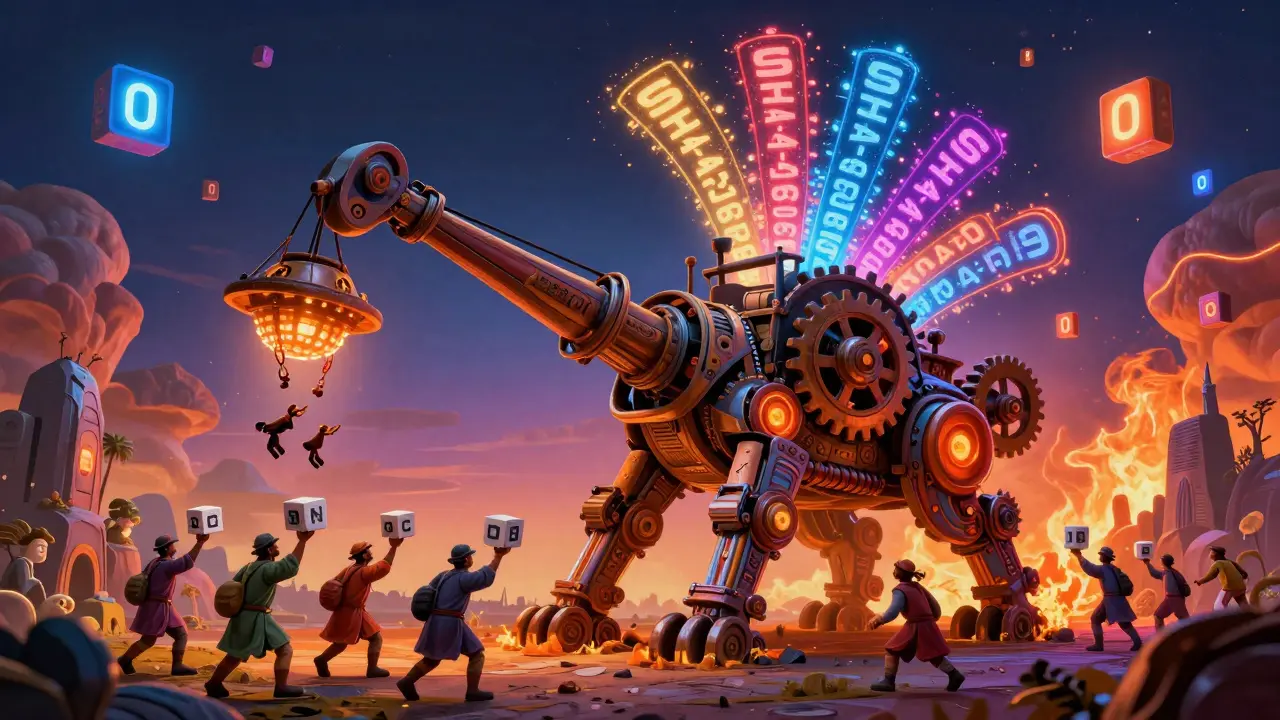



Bitcoin doesn’t have banks. It doesn’t have a central authority. So how does it know which transactions are real? How does it stop someone from spending the same bitcoin twice? The answer lies in Proof of Work - a system so simple in concept, yet so brutal in execution, that it’s kept Bitcoin secure for over 15 years.
What Proof of Work Actually Does
Proof of Work (PoW) is Bitcoin’s way of saying, “I didn’t just make this up.” When a group of transactions needs to be added to the blockchain, miners compete to prove they did the hard work to validate them. It’s not about trust. It’s about math. And the math is designed to be expensive to solve but easy to check. The core idea? Find a number - called a nonce - that, when combined with the block’s data and hashed using SHA-256, produces a result lower than a specific target. That target changes over time. The lower it is, the harder it becomes to find a valid hash. Miners don’t guess once. They guess billions of times per second.The Mining Process Step by Step
It starts with transactions. When you send someone bitcoin, that transaction gets broadcast to the whole network. It sits in a holding area called the mempool - a messy queue of unconfirmed deals waiting to be picked up. Miners grab transactions from the mempool, bundle them into a candidate block, and start hashing. Each block includes:- A list of transactions
- The hash of the previous block (linking it to the chain)
- A timestamp
- A nonce (the number they’re trying to guess)
Why SHA-256? Why Not Something Easier?
SHA-256 isn’t special because it’s fast. It’s special because it’s unpredictable. Change one letter in the input, and the output becomes completely different. There’s no way to reverse-engineer it. You can’t look at the target and figure out the right nonce. You just have to keep trying. That’s the whole point. If it were easy to guess, someone could fake blocks. If it were too slow, the network would stall. SHA-256 strikes a balance: hard to compute, instant to verify. That’s why it’s been used since day one.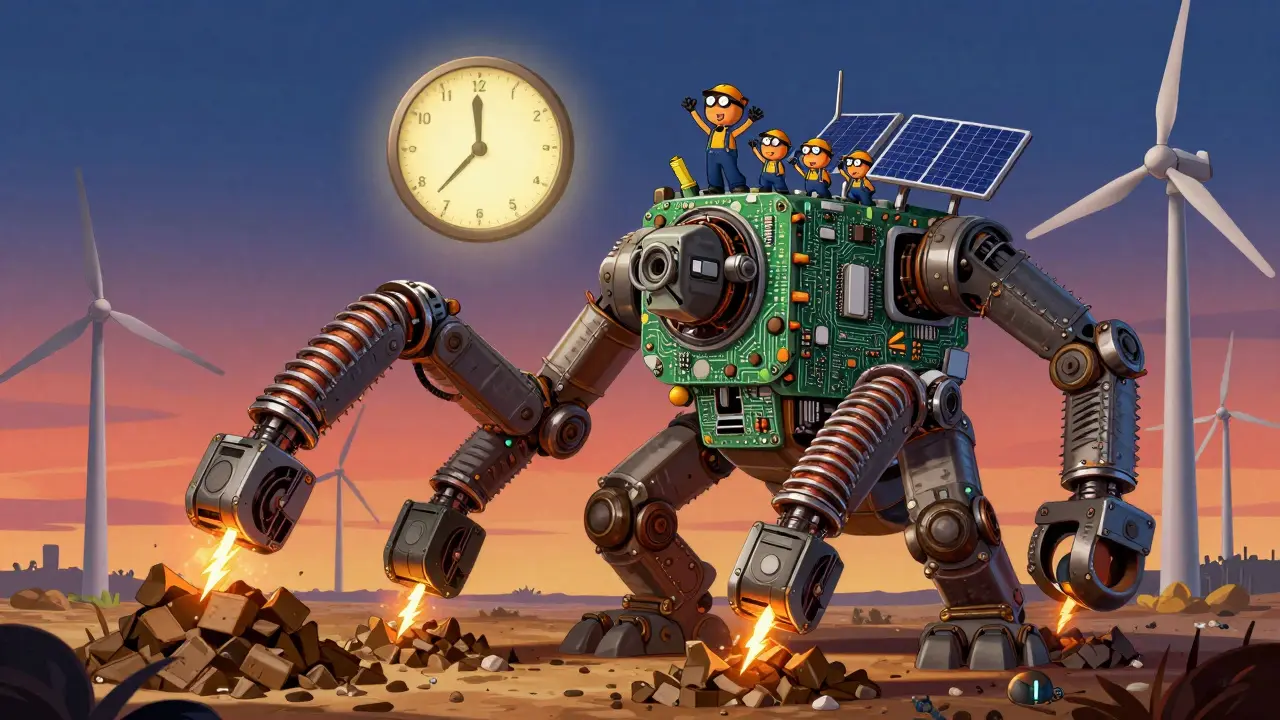
The 10-Minute Rule
Bitcoin doesn’t care how many miners are online. It doesn’t matter if 100 people are mining or 10 million. The network adjusts automatically every 2,016 blocks - roughly every two weeks - to keep the average block time at 10 minutes. If miners get faster (because of new ASICs), the target gets lower. If miners go offline (because electricity prices spike), the target gets higher. It’s a self-correcting system. No human steps in. No committee votes. The math does it. This is why Bitcoin mining is so predictable. You can’t game it. You can’t rush it. You can only invest more computing power.Who Wins? And What Do They Get?
The first miner to find a valid hash broadcasts it to the network. Other nodes check the answer in milliseconds. If it’s correct, they accept the block. The winner gets two things:- Newly minted bitcoin - currently 3.125 BTC per block (as of 2024, halved from 6.25)
- All transaction fees from the block
Security Through Energy
This is where Proof of Work gets its power. Every hash attempt uses electricity. Every ASIC chip costs money. Every mining farm needs cooling, space, and maintenance. To attack Bitcoin, you’d need to control more than half of the network’s total computing power - known as a 51% attack. That’s not just hard. It’s economically impossible. As of 2026, the Bitcoin network’s hash rate exceeds 1.2 exahashes per second. To match that, you’d need billions of dollars in hardware and access to gigawatts of cheap power. And even if you did, you’d destroy the value of Bitcoin - making your investment worthless. Professor William J. Knottenbelt from Imperial College London put it simply: “PoW turns electricity into trust.” You don’t trust the miner. You trust the cost they paid to earn that trust.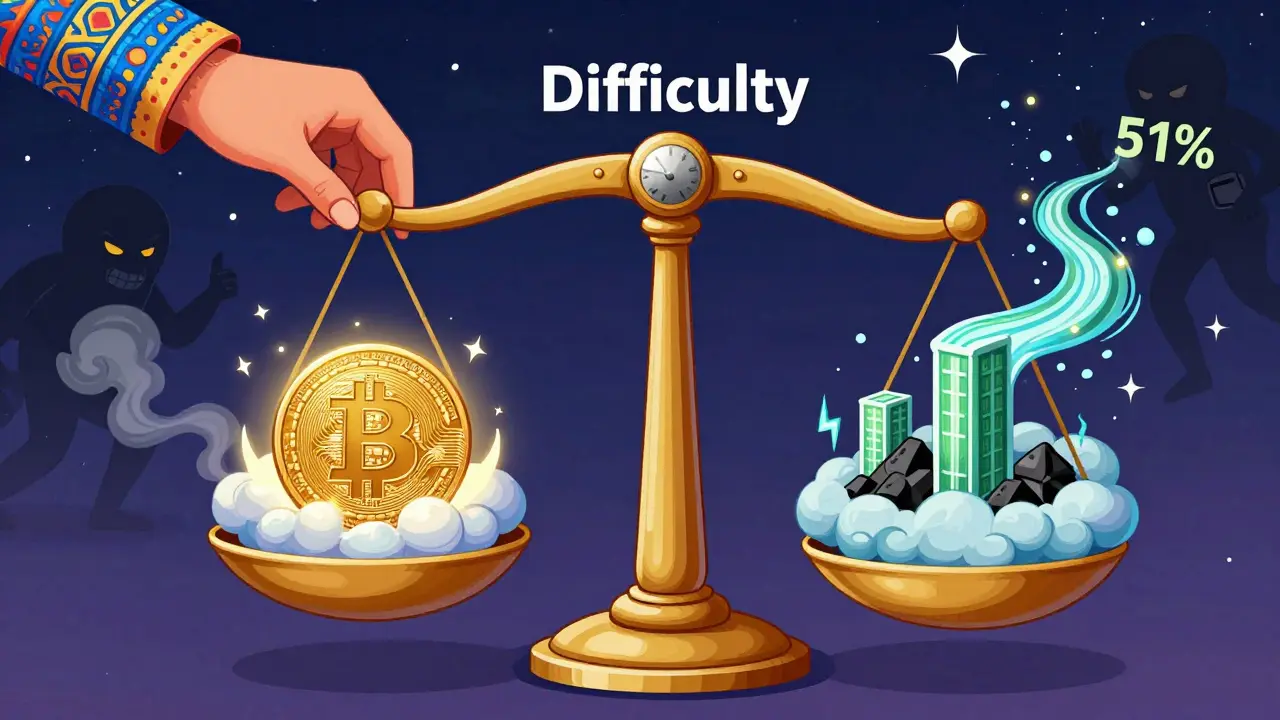
Miners: From Hobbyists to Corporations
In 2009, you could mine Bitcoin on a laptop. Now, you need specialized hardware called ASICs - Application-Specific Integrated Circuits - built only for SHA-256 hashing. These machines cost thousands of dollars and sip power like a refrigerator. Solo mining is nearly dead. The odds of one miner finding a block alone are like winning the lottery every 10 minutes. That’s why most miners join pools - groups that combine computing power and split rewards proportionally. The biggest mining operations are now in places like Texas, Kazakhstan, and Georgia, where electricity costs under 4 cents per kilowatt-hour. A single large facility can consume as much power as a small city. But they’re profitable - because they’re efficient.Why Not Switch to Proof of Stake?
Ethereum switched to Proof of Stake in 2022. It uses 99% less energy. So why doesn’t Bitcoin? Because Bitcoin’s community values security and decentralization more than efficiency. Proof of Stake relies on validators holding large amounts of coin - which can lead to centralization. The rich get richer. The powerful get more control. Proof of Work? Anyone with enough hardware and electricity can join. No gatekeepers. No staking requirements. No voting. Just raw computational power. It’s messier. It’s louder. It’s dirtier. But it’s also the most battle-tested system ever built.What’s Next?
Bitcoin’s PoW hasn’t changed since 2009. No major upgrades. No redesigns. Just steady, relentless operation. The difficulty adjusts. The hardware evolves. The energy debate continues. But the core idea remains: work proves truth. If you want to add to the blockchain, you pay. Not with money. Not with votes. With energy. That’s why Bitcoin still works. Not because it’s perfect. But because it’s stubborn. And in a world full of shortcuts, that’s worth something.How long does it take to mine one Bitcoin?
You don’t mine one Bitcoin - you mine a block. Each block currently rewards 3.125 BTC, and it takes about 10 minutes on average to find one. So if you mined a full block alone, you’d get 3.125 BTC in 10 minutes. But no individual miner finds blocks alone anymore. Most earn tiny fractions over time through mining pools.
Can I mine Bitcoin with my home computer?
Technically, yes. But practically, no. Modern Bitcoin mining requires ASIC miners - machines designed only for SHA-256 hashing. A regular CPU or GPU is millions of times slower. Even if you ran one 24/7, you’d spend more on electricity than you’d earn in a year. Mining at home today is only viable if you have free or extremely cheap power.
Why does Bitcoin mining use so much electricity?
Because it has to. The more energy miners use, the more secure the network becomes. Every hash attempt requires electricity. The system is designed so that attacking Bitcoin costs more than the value of the coins it protects. It’s not a bug - it’s a feature. The energy isn’t wasted. It’s converted into trust.
What happens if all Bitcoin is mined?
The last Bitcoin will be mined around the year 2140. After that, miners won’t get new coins. But they’ll still earn transaction fees. As Bitcoin usage grows, fees are expected to rise enough to keep miners motivated. The security model doesn’t rely on new coins - it relies on the cost of attacking the network. That cost will still be high.
Is Bitcoin mining legal everywhere?
No. Some countries ban it outright (like China, which cracked down in 2021). Others tax it heavily. Some, like the U.S. and Germany, treat it as legal but regulated. The legality depends on local energy policy, financial regulations, and attitudes toward cryptocurrency. Always check local laws before setting up a mining operation.
How does the difficulty adjustment work?
Every 2,016 blocks (about two weeks), Bitcoin checks how long it took to mine those blocks. If it took less than 20,160 minutes (14 days), the difficulty goes up. If it took longer, the difficulty goes down. The goal is always to keep the average block time at 10 minutes. It adjusts automatically - no human input needed.
What’s the difference between a miner and a node?
A node verifies transactions and blocks - it watches the network and enforces rules. Every full node can do this. A miner is a special kind of node that tries to solve the cryptographic puzzle to create new blocks. Not all nodes mine. But all miners are nodes. Nodes keep the network honest. Miners add new blocks.
Can Bitcoin mining be done with renewable energy?
Yes - and increasingly, it is. Studies show over 50% of Bitcoin mining now uses renewable sources like hydro, wind, and solar. Miners follow cheap power, and renewables are often underutilized. In Texas, miners use excess wind power at night. In Iceland, they use geothermal. Mining doesn’t cause energy waste - it often uses surplus energy that would otherwise go unused.







17 Comments
I love how this breaks it down without fluff. PoW isn't magic - it's just math that's expensive to cheat. That's why it works. No trust needed, just electricity and persistence.
Also, the fact that it self-adjusts is genius. No committee, no politics. Just code doing its thing.
This is why I find Bitcoin fascinating. You don't need to believe in a person. You believe in the cost of electricity. Brilliant. And yet, people still think it's a pyramid scheme. Sigh.
You guys are underestimating how revolutionary this is. PoW isn't just about security - it's about creating a new kind of social contract. One where trust is baked into physics, not paperwork. This isn't tech. This is civilizational infrastructure. And we're just getting started.
Anyone who says 'it's a bubble' hasn't looked at the hash rate growth curve. It's exponential. And it's not slowing down.
The elegance lies in its simplicity. No central authority. No intermediaries. Just a global network of machines competing to solve a puzzle that no one can cheat. It's not perfect, but it's honest. And in a world of spin, honesty is rare.
I appreciate how the system rewards participation without discrimination. If you have the hardware and power, you're in. No gatekeepers. No permission.
Lmao at people who think mining is a waste. Bro it's literally turning electricity into trust. You can't fake it. You can't hack it. You gotta spend real money. And that's the whole damn point. If you think it's dumb, you're just mad you don't own an ASIC.
I used to mine on my gaming rig back in 2017. Lost like $800 on electricity. Learned real quick that if you don't have free power, you're just donating to the network. Now I just buy BTC. But I still respect the hell out of PoW. It's the only thing that's held up for 15 years. No other crypto can say that.
Let’s talk about the economics of trust. PoW transforms energy into verifiable history. Every hash is a vote. Every ASIC is a stake. And the network? It’s the ultimate decentralized consensus engine. This isn’t just a ledger - it’s a new form of digital property rights.
And yes, the energy is real. But so is the security. You can’t attack what costs more than the asset itself. That’s not a bug. That’s a feature.
Work proves truth. Simple. Clean. Unbreakable.
I’ve read so many takes on PoW, but this one actually made me feel something. Not hype. Not fear. Just… respect. The fact that it’s been running unchanged since 2009? That’s not luck. That’s design. And honestly? It’s the only crypto thing I still believe in. Everything else feels like a demo. This feels like a cathedral.
I just don’t get why people are so attached to this. It’s like… why not just use a database? Why do we need a global power plant to verify payments? It feels like a solution to a problem we didn’t even have.
Ah yes. The holy grail of digital scarcity. A system so energy-intensive it could power a small nation. And yet, we call it "innovation." How quaint. I suppose if you're allergic to efficiency, this is your dream.
Meanwhile, Ethereum runs on less power than my toaster. But sure. Keep mining.
The SHA-256 algorithm is not chosen for its speed, but for its collision resistance and deterministic output. The nonce-based brute-force mechanism ensures that no prior knowledge can reduce computational effort. This is fundamental to Byzantine fault tolerance in permissionless systems. The 10-minute block interval is mathematically optimal for propagation delay and network consensus under current infrastructure constraints.
PoW is just electricity turned into blockchain. No magic. No trust. Just math. And if you think that's dumb you're just mad you didn't buy a mining rig in 2012
The notion that PoW is "inefficient" is a product of centralized economic thinking. Bitcoin’s energy consumption is not waste - it’s capital expenditure on immutable security. The cost of securing $1 trillion in value with PoW is orders of magnitude lower than traditional financial infrastructure. We’re not comparing apples to apples - we’re comparing a nuclear reactor to a candle.
While the technical merits of Proof of Work are undeniable, one must also consider the environmental and regulatory implications. The global energy footprint of Bitcoin mining, though increasingly offset by renewables, remains a matter of public policy concern. A balanced discourse requires acknowledging both its cryptographic robustness and its societal externalities.
Yeah but what if we just used a database? Like… why? Why do we need a 10-minute wait for a transaction? Why not just… fix it? This feels like building a castle out of sand because you don’t trust water.
mining is just a power bill with a side of hope 😅⚡