


While we often talk about them as a "solved" piece of tech, Merkle Trees are currently undergoing a massive evolution. We are moving away from just using them to verify blocks and toward using them to shrink the entire footprint of the internet's financial layer. The goal is no longer just security-it is extreme efficiency.
The Core Engine: How It Actually Works
Before we look at where this is going, we have to understand the current plumbing. A Merkle Tree is a binary tree of hashes. It starts at the bottom with the data-like a list of transactions. Each piece of data is hashed (turned into a unique fingerprint). Then, those fingerprints are paired up and hashed again. This process repeats, climbing up the tree until only one hash remains at the very top: the Merkle Root.
The real magic is the "Merkle Path." If you want to prove a specific transaction is part of a block, you don't need the whole tree. You only need the hashes of the "cousin" nodes along the path to the root. In Bitcoin, this reduces the data needed for verification from roughly 1.4MB down to just 80 bytes per transaction proof. That is a staggering difference in bandwidth, especially for mobile users.
The Leap to Verkle Trees and Statelessness
As blockchains grow, traditional Merkle Trees hit a wall. The "witness" data (the proof you need to verify something) grows as the dataset grows. For a billion-item dataset, a Merkle proof requires about 4KB of data. That sounds small, but when you have millions of transactions, it adds up. This is where Verkle Trees come in. an evolution of Merkle Trees that uses polynomial commitments instead of simple hashes to create even smaller proofs.
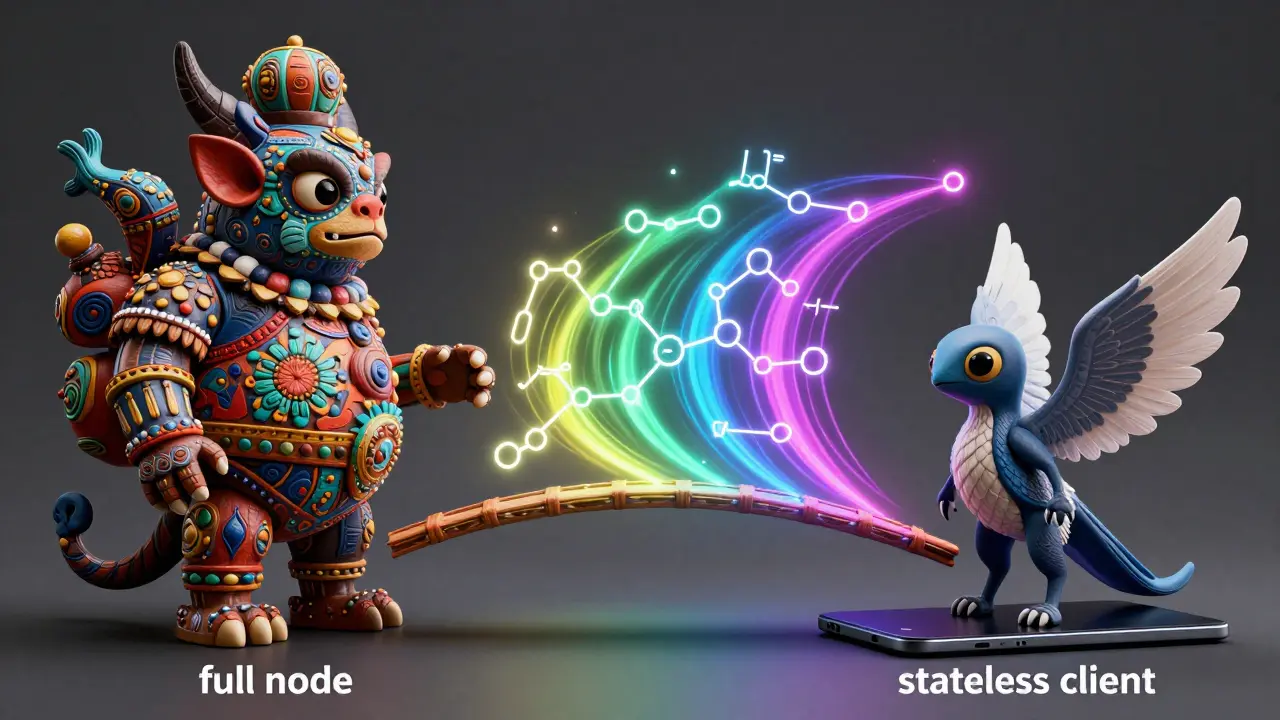
Verkle Trees are a game-changer for stateless clients. Right now, running a full Ethereum node requires massive hardware because the node has to store a huge state dataset-sometimes over 1.2TB. With Verkle Trees, nodes can verify transactions without storing that entire state. This could drop the cost of running a validator from a $3,000 enterprise server down to a $300 consumer device. We are essentially democratizing the network by making the hardware requirements negligible.
| Feature | Merkle Trees | Verkle Trees |
|---|---|---|
| Proof Size (Billion Items) | ~4KB | <150 Bytes |
| Bandwidth Usage | 100% (Baseline) | ~3.75% of Merkle usage |
| Implementation Complexity | Low (Simple Hashing) | High (Advanced Math) |
| Primary Benefit | Data Integrity | Extreme Scalability |
Solving the Trust Crisis with Proof-of-Reserves
If you've followed crypto news over the last few years, you know that "trust me, bro" doesn't work for exchanges. The future of financial auditing is moving toward real-time, cryptographic proof. This is where Proof-of-Reserves (PoR) systems use Merkle Trees to let users verify that their funds actually exist without the exchange revealing everyone's private balance.
For example, JPMorgan's Onyx division is already using these systems to verify billions in digital assets. Instead of waiting for a quarterly audit from an accounting firm, a bank or user can check a single hash to confirm their assets are backed. The SEC has already pushed for this, requiring exchanges to implement these systems to protect trillions in customer assets. It turns the audit process from a manual, slow human task into a mathematical certainty that happens in milliseconds.

New Frontiers: AI Optimization and Quantum Resistance
We are also seeing a strange but powerful convergence between AI and cryptography. ConsenSys Labs has been experimenting with AI to optimize how Merkle Trees are constructed in real-time. By adjusting the branching factors based on current network traffic, they've seen proof sizes drop by nearly 19% in volatile environments. It is like having a smart highway that adds lanes exactly where the traffic is heaviest.
But there is a looming shadow: quantum computing. Most current trees rely on SHA-256 or Keccak-256. While strong today, a powerful quantum computer could theoretically find collisions in these hashes. To fight this, researchers are developing lattice-based cryptographic alternatives. The goal is to create quantum-resistant Merkle variants by 2030 that keep the current speed and efficiency but can withstand attacks from machines that don't even fully exist yet.
Practical Tips for Developers
If you are building with these structures, don't try to write your own hashing logic from scratch unless you are a PhD in cryptography. Most bugs in blockchain repositories-about 34% of them-stem from incorrect proof generation. Use battle-tested libraries like Bitcoin Core's implementation or Ethereum's mpt.js.
- Handle Odd Numbers: One of the most common pitfalls is dealing with an odd number of leaf nodes. Ensure your library handles the "duplicate last node" logic correctly to keep the tree balanced.
- Optimize for Mobile: If you're building a wallet, look into Merkle Mountain Ranges (MMR). Developers have reported 30-40% faster sync times for mobile users by using MMRs to reduce bandwidth.
- Watch Your Hash Length: If you're dealing with petabyte-scale data, move to 512-bit hashes. It adds a tiny bit of overhead but drastically reduces the chance of a collision.
What is the main difference between a Merkle Tree and a Verkle Tree?
The main difference is how they create proofs. Merkle Trees use simple cryptographic hashes, which results in proof sizes that grow as the dataset gets larger. Verkle Trees use polynomial commitments, which allow for significantly smaller proofs (often 20-30x smaller), making them ideal for stateless blockchain architectures.
Can Merkle Trees really prevent exchange fraud?
Yes, via Proof-of-Reserves. By placing all user balances in a Merkle Tree, an exchange can publish the Merkle Root. Users can then use their specific "path" to verify their balance is included in that root without the exchange having to leak the entire database to the public.
Will quantum computers break Merkle Trees?
Potentially. Standard hash functions like SHA-256 could become vulnerable to quantum attacks. However, the industry is already developing lattice-based cryptography and increasing hash lengths to ensure that the next generation of Merkle Trees remains secure.
How do Merkle Trees improve mobile wallet speed?
They allow for "Light Clients." Instead of downloading the whole blockchain, a mobile wallet only downloads the block headers (which contain the Merkle Root). It then requests specific Merkle Paths to verify transactions, drastically reducing the amount of data the phone needs to download.
Are Merkle Trees used outside of blockchain?
Absolutely. They are used in distributed systems like Git for version control and in NoSQL databases to synchronize data between servers efficiently. They are essentially used anywhere that large-scale data integrity needs to be verified quickly.







10 Comments
Absolutely phenomenal breakdown of the tech! It is just mind-blowing how we are moving from these massive server requirements to something you can run on a basic consumer device. This is the kind of democratization that actually changes the world for developers everywhere!
funny how they mention quantum resistance like its a safety net... probably just another way for the elites to keep the backdoors open while we think we are secure in our little digital bubbles
sure the math works but the ethics of centralizing these proofs in a few hands is where this falls apart 🙄 honestly just another tool for surveillance disguised as efficiency
I've actually spent a lot of time digging into the mpt.js implementation and honestly most people don't even realize how inefficient the current state trie is. The jump to Verkle is long overdue because the state bloat in Ethereum is literally unsustainable at this point. If you aren't thinking about statelessness you're basically ignoring the only way we actually scale to a billion users without turning every node into a data center. It is basic computer science really, once you get past the hype of the polynomial commitments, it is just about reducing the witness size so the network doesn't choke on its own data.
I really appreciate the mention of Merkle Mountain Ranges for mobile sync. I wonder if there are other ways to further reduce that bandwidth for users in regions with really poor connectivity
the government is just using this stuff to track every single cent we spend in real time so they can shut us down when we stop obeying their rules. it is all a trap
Imagine actually thinking that a 'Proof-of-Reserves' makes an exchange trustworthy when the people running the code are the same ones who stole the money in the first place. It is absolute delusion to believe math solves human greed.
The comparison table is a bit simplistic, but I suppose it serves for the casual reader who can't grasp the underlying complexity of polynomial commitments.
pretty standard stuff for anyone in the field
It is interesting to see how these global standards are being adopted across different financial institutions in different countries