



Before June 30, 2025, some crypto exchanges could operate from Singapore while serving customers overseas-no license needed. That loophole is gone. Now, if you’re running a crypto exchange out of Singapore, even if you only deal with foreign clients, you must get licensed by the Monetary Authority of Singapore (MAS). The rules changed fast. No grace period. No exceptions. And if you didn’t apply in time, you’re no longer allowed to operate here.
Why Singapore Changed the Rules
Singapore didn’t make this move because it hates crypto. It’s because of scandals. The collapse of Three Arrows Capital and Terraform Labs in 2022 sent shockwaves through global markets. Both had ties to Singapore. Neither was properly supervised. And both left investors with massive losses. MAS realized something dangerous: a crypto firm could set up shop in Singapore, use its reputation as a financial hub, and then serve clients in countries with weak rules-while avoiding oversight entirely. MAS made it clear: Singapore won’t be a haven for unregulated crypto operations. The goal isn’t to kill innovation. It’s to protect the country’s financial reputation. As Chengyi Ong from Chainalysis put it, "Financial integrity is a red line."The Two Laws That Control Crypto Licenses
Two laws now govern crypto exchanges in Singapore: the Payment Services Act 2019 (a law that regulates payment services, including crypto transactions) and the newer Financial Services and Markets Act 2022 (a comprehensive overhaul that expanded MAS’s authority over digital asset services). Together, they created the Digital Token Service Provider (DTSP) framework. The DTSP rules cover any business that:- Allows users to buy, sell, or trade digital tokens
- Manages custody of digital assets
- Operates a crypto trading platform
Three Types of Licenses
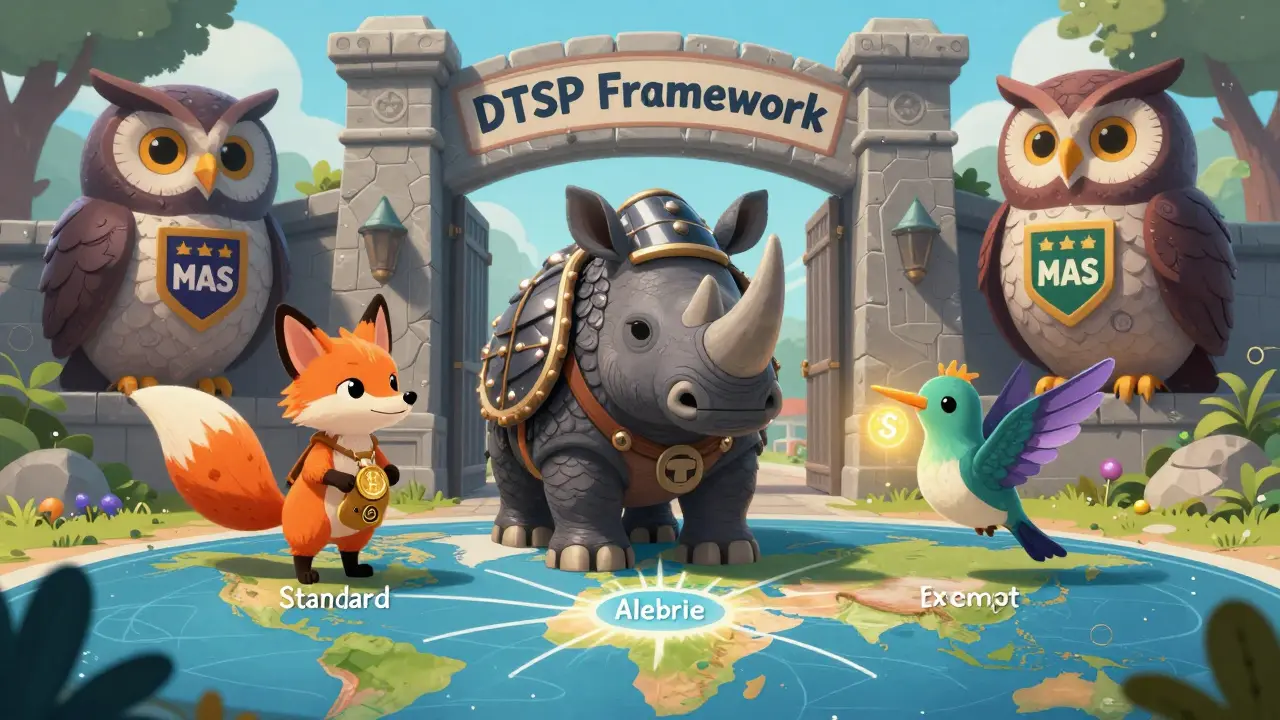
There are three paths to legal operation under the Payment Services Act:- Standard Payment Institution License - For smaller exchanges. You must process less than SGD 3 million in monthly transactions. Minimum capital: SGD 100,000. You need basic KYC, AML policies, and regular reporting.
- Major Payment Institution License - For larger platforms. Monthly volume exceeds SGD 3 million. Minimum capital: SGD 250,000. You’ll face stricter audits, advanced transaction monitoring, and detailed risk controls.
- Exempt Payment Service Provider - Only for very limited activities, like facilitating small peer-to-peer transfers under strict conditions. No capital requirement, but you must notify MAS and follow tight rules.
What MAS Demands in Your Application
Getting licensed isn’t about filling out a form. It’s about proving you’re a serious, secure, and compliant business. MAS expects:- A full business plan: Your strategy, target market, revenue model, and growth roadmap. No vague statements. Be specific.
- Compliant KYC and AML policies: You must show how you verify every user’s identity, monitor transactions for suspicious behavior, and report red flags to authorities.
- Internal risk controls: How do you protect user funds? What happens if a hack occurs? How do you handle market volatility? You need documented procedures for everything.
- Annual audits: Both internal and external audits are mandatory. MAS will review them.
- Proof of capital: You must show you have the funds to cover operations. This isn’t just a number on paper. MAS checks bank statements, investor commitments, or financial backing.
How Long Does It Take?
There’s no quick path. The timeline depends on your license type:- Standard License: 3 to 6 months with expert help.
- Major License: 6 to 12 months. MAS digs deeper into your systems, team, and financial health.
How Singapore Compares to Other Places
Compared to other major markets, Singapore’s rules sit in the middle:| Region | Minimum Capital | Implementation Speed | Scope |
|---|---|---|---|
| Singapore | SGD 100,000-250,000 | Immediate (no grace period) | Global clients covered |
| Switzerland | CHF 2-5 million | Gradual rollout | Focus on domestic clients |
| European Union (MiCA) | Varies by country | Phased over 2 years | EU-wide standard |
| United States | Varies by state (up to $10M) | Fragmented | State-by-state rules |
| Hong Kong | HKD 1-2 million | Recent launch | Strict, but slower rollout |

Who’s Struggling? Who’s Winning?
Smaller exchanges are feeling the pressure. Many didn’t have legal teams or compliance budgets. Some shut down. Others moved operations overseas. Larger platforms like Coinbase and Binance have adapted. They already had global compliance teams. For them, Singapore’s rules are a hurdle, not a wall. They see value in being licensed: it builds trust with institutional investors and banks. Reddit threads and crypto forums are full of complaints. Users report spending over $50,000 on legal consultants just to submit an application. One exchange founder said it took 11 months and four revisions to get approved. Others gave up after the first rejection. But those who made it? They’re now more stable. Their bank accounts aren’t frozen. Their payment processors still work. They can hire talent without fear of sudden shutdowns.The Future: More Rules, Not Fewer
MAS has signaled this is just the beginning. They’ve said they’ll "generally not issue a license" to firms that serve only overseas clients. That means even if you’re licensed, you can’t ignore your local responsibilities. Expect tighter rules soon:- More frequent reporting (quarterly instead of annual)
- Real-time transaction monitoring
- Stricter rules on stablecoin issuance
- Requirements for insurance coverage on custodied assets
What Should You Do?
If you’re running a crypto exchange from Singapore:- If you haven’t applied yet - stop operating. You’re breaking the law.
- If you’re applying - get a lawyer who’s done this before. Don’t try to do it yourself.
- If you’re planning to launch - start now. The process takes months.
- If you’re based overseas - don’t use Singapore as a "shell" to avoid rules. MAS will find you.
Do I need a license if I only serve foreign customers from Singapore?
Yes. Since June 30, 2025, any crypto exchange operating from Singapore - regardless of where its customers are located - must hold a license from MAS. The previous loophole allowing offshore-only operations has been closed.
What happens if I operate without a license?
You risk criminal charges, fines, and asset freezes. MAS can shut down your operations immediately and refer your case to law enforcement. Even if you’re not based in Singapore, if you’re targeting users there or using local infrastructure, you can still be prosecuted.
How much does it cost to get licensed?
The application fee itself is minimal. But legal, compliance, and audit costs typically range from $30,000 to $150,000 depending on your size and complexity. You also need to maintain minimum capital: SGD 100,000 for Standard licenses, SGD 250,000 for Major licenses.
Can I apply for a license if I’m not a Singaporean citizen?
Yes. MAS doesn’t require ownership by Singaporeans. But you must have a legal entity registered in Singapore, a local compliance officer, and a physical office or registered address here. Foreign companies can apply as long as they meet all regulatory requirements.
Is the DTSP license permanent?
No. Licenses are granted for a fixed term (usually 2-3 years) and must be renewed. MAS can revoke or suspend a license at any time if you violate rules, fail audits, or show signs of financial instability.









16 Comments
So let me get this straight - you can’t run a crypto exchange outta Singapore anymore unless you’ve got a whole legal team on retainer? Bro, that’s not regulation, that’s a tax on ambition.
i just applied for the standard license and they asked for 17 more docs 😭 i thought this was crypto not corporate america
This is actually kind of brilliant. Singapore isn’t trying to be the next crypto paradise - it’s trying to be the most reliable one. Think of it like a five-star hotel: no one wants to stay in a place that looks fancy but has mold in the walls. You want trust? You build systems. And yeah, it’s expensive. But so is losing everything.
The fact that you’re even debating this shows how naive the retail crowd is. The DTSP framework isn’t about licensing - it’s about jurisdictional sovereignty. MAS is enforcing AML/CFT standards under FATF Recommendation 16, and any entity operating a VASPs without full traceability is a systemic risk vector. You think this is about money? No. It’s about preventing the next Terra collapse from being laundered through a Singapore-registered entity with a Swiss bank account and a Nigerian KYC shell.
I used to think Singapore was just a place to park money but now i see they're building something real here like a digital fortress with clean floors and no loopholes honestly i respect it even if it's a pain in the ass
USA could’ve done this in 2018. We’re still arguing if Bitcoin is a commodity or a currency. Meanwhile Singapore just said ‘nope’ and moved on. We’re not a financial hub - we’re a theme park for regulators.
As someone who has worked in international finance across five jurisdictions, I must say Singapore’s approach is refreshingly coherent. The DTSP framework aligns with Basel III principles and the EU’s MiCA in spirit, even if the implementation is more abrupt. This isn’t hostility toward innovation - it’s institutional maturity. The world needs more of this, not less.
I’ve seen 300+ crypto applications in my career. 95% of them were copy-pasted from CoinGecko’s FAQ. MAS doesn’t reject because they’re mean - they reject because they’re tired of being the global dumping ground for regulatory arbitrage. If your business plan says ‘we’ll make money from trading fees’ without a single line on risk mitigation - you’re not a fintech founder. You’re a rent-seeker.
So now you have to pay $150k to play in Singapore but in Dubai you just send a selfie and a bank statement? This isn’t regulation. It’s discrimination against small operators. I’m starting a DAO in the Caymans and I’m never looking back. 🤷♀️
I just got approved after 9 months and 3 revisions 🥹😭 literally cried when they emailed me the license number. my lawyer said i was lucky. most people give up. but now my bank won’t freeze my account and i can actually hire devs without fear. this pain? worth it.
To anyone considering this path: please, do not go it alone. Find a compliance officer with MAS experience. Not a general lawyer. Not a consultant who does Shopify stores. Someone who has submitted 10+ applications and knows which forms are red herrings. The difference between approval and rejection is often one paragraph in your AML policy. This isn’t a hurdle - it’s a rite of passage.
I used to think Singapore was cold and corporate. But now I see they’re just trying to build something that lasts. Like a cathedral instead of a pop-up shop. I don’t love the rules. But I respect the vision. Maybe we need more places like this - even if it hurts at first.
no license no problem
just got my major license approved. spent 6 months on audits and still have 3 minor issues to fix. but the best part? my bank finally gave me a business account. after 4 rejections. this whole thing is insane but i’m glad i stuck it out.
The fact that you’re calling this ‘regulation’ is hilarious. This is rent-seeking disguised as public service. MAS isn’t protecting investors - they’re protecting Singapore’s reputation as a financial center by forcing out the riffraff. The real winners? The law firms and compliance consultants who made $200k off this mess. The losers? The founders who didn’t have VC backing. This isn’t innovation - it’s a gatekeeping scheme.
i read this whole thing and still think it’s a scam. if you’re so serious about security why not just ban crypto? why make us spend 6 months and 100k to play by rules that change every quarter? i’m out.