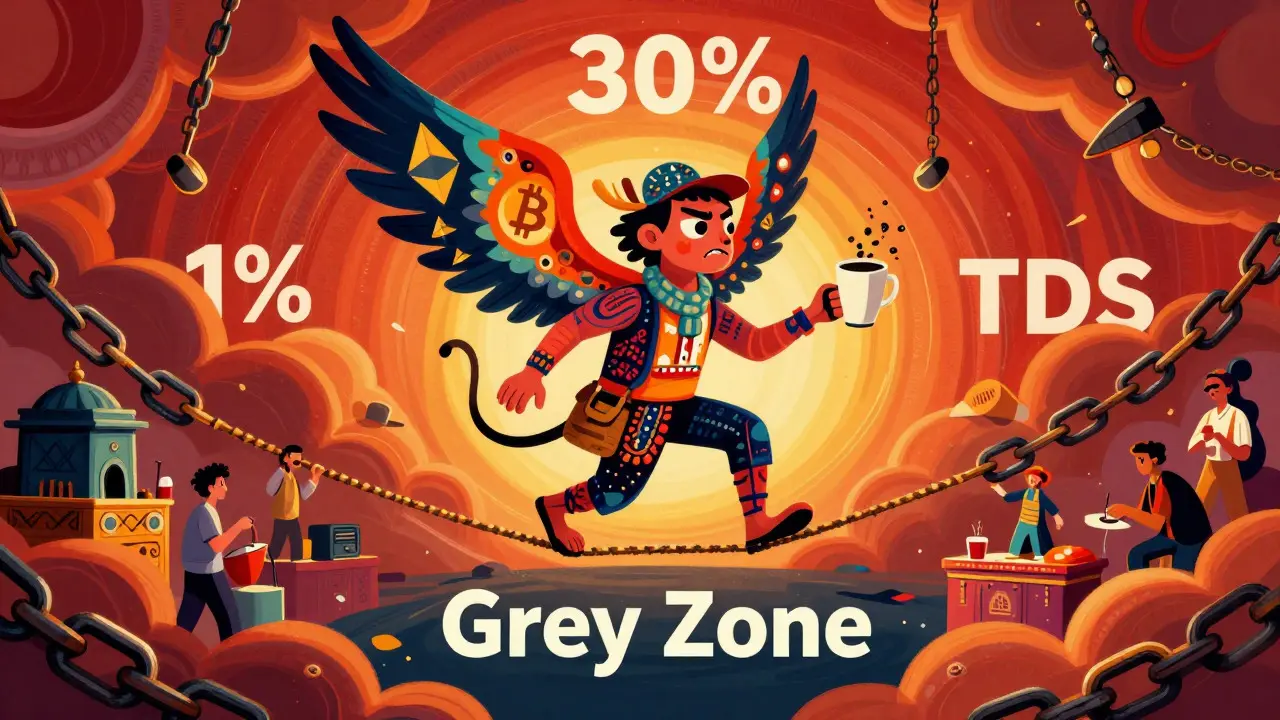



You buy Bitcoin. You sell Ethereum. You check your portfolio on a Sunday morning, coffee in hand, feeling like you’re playing by the rules. But in India, the rulebook is still being written-and sometimes, it’s being rewritten while you read it.
As of August 2026, cryptocurrency trading in India exists in a high-stakes legal grey area. It isn’t banned, but it certainly isn’t embraced. The government taxes it heavily, the central bank watches it warily, and traders navigate a landscape where policy shifts can happen overnight. This ambiguity creates a unique environment: massive opportunities for those who understand the terrain, and severe risks for those who don’t.
The Current Reality: A Taxation-First Approach
Unlike countries that have issued clear licenses to exchanges or defined cryptocurrencies as securities, India has chosen a different path. The primary regulatory tool is the tax code. If you’ve traded crypto in India recently, you know the numbers well: a flat 30% tax on all profits from virtual digital assets (VDAs), plus a 1% tax deducted at source (TDS) on transactions above certain thresholds.
This framework was introduced to bring some order to the chaos without granting full legitimacy. The logic is simple: if the government collects its share, it acknowledges the activity exists, but it doesn’t necessarily endorse it. However, this approach has created a heavy burden for traders. Unlike traditional stock markets where losses can offset gains, crypto losses in India cannot be adjusted against other income sources. You pay 30% on your net profit, regardless of how much you lost elsewhere in the market.
| Factor | Current Status (2026) | Impact on Trader |
|---|---|---|
| Tax Rate | 30% flat on profits + 1% TDS | High cost basis; no loss adjustment |
| Legal Tender Status | Not recognized | No consumer protection under banking laws |
| Exchange Licensing | None currently | Reliance on self-regulation by platforms |
| Banking Access | Permitted but cautious | Some banks may freeze accounts informally |
The RBI’s Stance: Caution Over Clarity
The Reserve Bank of India (RBI) remains the most influential voice in this debate, and its tone is consistently cautious. For years, the RBI argued that cryptocurrencies pose systemic risks to financial stability. While the Supreme Court struck down the RBI’s 2018 circular that banned banks from servicing crypto businesses, the central bank’s skepticism hasn’t faded.
In fact, recent internal documents suggest the RBI fears that comprehensive regulation could legitimize the sector too quickly. Instead of embracing private crypto, the RBI is focused on its own project: the Digital Rupee, a Central Bank Digital Currency (CBDC). The message is subtle but clear: the state wants control over digital money, not competition from decentralized networks.
For traders, this means navigating a system where the top financial authority views your asset class with suspicion. It doesn’t mean you’ll be arrested for holding Bitcoin, but it does mean there’s little institutional support if things go wrong. If an exchange fails, there’s no deposit insurance fund to fall back on. You’re on your own.
The COINS Act 2025: A Glimmer of Structure?
Amidst the uncertainty, the proposed COINS Act 2025 represents the most significant attempt to formalize the sector. Although still in the proposal stage as of late 2025 and early 2026, this legislation signals a shift from pure taxation toward structured oversight.
The COINS Act aims to address several critical gaps:
- Clear Definitions: Establishing what constitutes a "virtual digital asset" to reduce legal disputes.
- Mandatory Licensing: Requiring exchanges to obtain licenses, likely overseen by the RBI or a dedicated regulator.
- Consumer Protection: Introducing safeguards against fraud, Ponzi schemes, and operational failures.
- Tax Clarity: Potentially allowing deductions for trading fees and clarifying TDS rules.
If passed, the COINS Act would move India closer to models seen in Europe (MiCA) or Japan, where regulation fosters innovation rather than stifling it. However, experts warn that implementation timelines remain vague. Until then, traders must operate under the current ambiguous framework, balancing hope for future clarity with the reality of present-day risks.

Practical Risks for Traders
What does this mean for you, the individual trader? The risks are multifaceted and often overlooked until they bite.
1. Regulatory Whiplash
Policy changes can happen rapidly. One day, trading is smooth; the next, new guidelines restrict withdrawals or impose stricter KYC norms. Without a stable regulatory foundation, exchanges may react defensively, freezing funds or limiting features to comply with emerging expectations.
2. Banking Friction
Although the Supreme Court ruling allows banks to service crypto businesses, many institutions remain hesitant. Some banks continue to flag crypto-related transactions as suspicious, leading to account freezes or lengthy verification processes. This informal restriction adds a layer of unpredictability to fiat-to-crypto conversions.
3. Lack of Recourse
If an exchange hacks your wallet or goes bankrupt, who do you call? In regulated markets, investors have ombudsmen or compensation funds. In India’s current setup, you rely on the exchange’s internal dispute resolution mechanisms, which vary widely in effectiveness. Platforms like CoinDCX and WazirX have implemented robust security measures, but their status as unlicensed entities means they operate without external audits mandated by law.
Opportunities in the Grey Area
Despite the risks, the Indian crypto market is booming. Why? Because the demand for alternative assets is real, and the lack of strict barriers allows for rapid experimentation.
Early Mover Advantage
Traders who enter now are positioning themselves ahead of potential regulatory legitimization. Historically, sectors that transition from grey areas to regulated frameworks see increased institutional participation and price appreciation. By building portfolios now, you’re betting on India’s eventual adoption of clearer rules.
Diverse Ecosystem
Indian exchanges offer localized solutions, including rupee pairs, customer support in regional languages, and integration with UPI (Unified Payments Interface). This accessibility lowers the barrier to entry for millions of first-time investors, particularly in tech hubs like Bangalore, Mumbai, and Delhi.
Global Arbitrage
Price discrepancies between Indian exchanges and global platforms can create arbitrage opportunities. While transaction costs and taxes eat into margins, savvy traders use these inefficiencies to generate alpha.

Navigating Compliance: A Trader’s Checklist
To survive and thrive in this environment, you need a disciplined approach to compliance. Here’s what you should do today:
- Keep Impeccable Records: Track every transaction-buy, sell, swap, and transfer. Use accounting software designed for crypto to automate this process. The Income Tax Department requires detailed records for audit purposes.
- Understand TDS Implications: Be aware that 1% TDS is deducted on transfers above ₹50,000 (or ₹10,000 for non-KYC users). This reduces your immediate liquidity, so plan your withdrawal strategies accordingly.
- Choose Reputable Exchanges: Stick to platforms with strong track records, transparent fee structures, and active community engagement. Avoid obscure exchanges promising unrealistic returns.
- Consult a Tax Professional: Given the complexity of VDA taxation, seek advice from a chartered accountant familiar with crypto. They can help optimize your tax liability and ensure accurate filing.
- Monitor Policy Updates: Follow news from the Ministry of Finance, RBI, and SEBI. Regulatory shifts can impact market sentiment and pricing dynamics significantly.
Comparing India’s Path with Global Models
How does India compare to other major jurisdictions? The contrast is stark.
| Country/Region | Approach | Key Feature |
|---|---|---|
| India | Taxation-first, fragmented oversight | 30% tax, no exchange licensing yet |
| European Union | Comprehensive regulation (MiCA) | Uniform rules across member states |
| United States | Securities-based enforcement | SEC scrutiny, case-by-case rulings |
| Japan | Licensed exchanges, consumer focus | Strict custody requirements |
| Singapore | Progressive sandbox | Innovation-friendly, clear MAS guidelines |
India’s model sits somewhere between the restrictive stances of China and Nigeria and the open frameworks of Switzerland and Singapore. It’s a middle path that prioritizes revenue collection over immediate structural reform. For traders, this means operating in a space that is neither fully hostile nor fully welcoming-a delicate balance that requires constant vigilance.
Looking Ahead: What’s Next?
The trajectory suggests movement toward more structured regulation. India’s role in the G20 and its advocacy for global standards like the Crypto-Asset Reporting Framework (CARF) indicate a desire to align with international best practices. However, domestic political considerations and the RBI’s cautionary stance slow the pace of change.
Expect incremental updates rather than sweeping reforms. The COINS Act may pass in modified form, introducing licensing requirements and consumer protections. Meanwhile, the tax regime could see adjustments to make it more competitive globally. Until then, traders must adapt to the current reality: high taxes, limited recourse, and evolving rules.
The key takeaway? Don’t let fear paralyze you, but don’t let ignorance blind you either. Understand the risks, manage your compliance, and stay informed. In India’s crypto landscape, knowledge is your best hedge against uncertainty.
Is cryptocurrency illegal in India?
No, cryptocurrency is not illegal in India. Trading and holding digital assets are permitted, but they are not recognized as legal tender. The government imposes a 30% tax on profits and 1% TDS on transactions, treating them as taxable events rather than banned activities.
What is the COINS Act 2025?
The COINS Act 2025 is a proposed legislation aimed at regulating virtual digital assets in India. It seeks to introduce mandatory licensing for exchanges, define cryptocurrencies legally, enhance consumer protection, and clarify tax rules. As of 2026, it remains in the proposal stage without a confirmed implementation timeline.
Can I claim losses on crypto trades in India?
Currently, no. Under the existing tax regime, losses from cryptocurrency transactions cannot be adjusted against other income sources or even against gains from other crypto trades in the same financial year. You pay 30% tax on your net profit only.
Are Indian crypto exchanges safe?
Safety varies by platform. Major exchanges like CoinDCX and WazirX implement robust security measures and KYC procedures. However, since there is no mandatory regulatory licensing, safety relies on the exchange’s internal practices rather than government-backed guarantees. Always research platforms thoroughly before depositing funds.
Will the RBI ban cryptocurrency again?
Unlikely in the near term. The Supreme Court struck down the RBI’s 2018 ban, and subsequent policy has focused on taxation rather than prohibition. While the RBI remains cautious about systemic risks, the trend is toward structured regulation (like the COINS Act) rather than outright bans.
How does TDS affect my crypto trading?
A 1% Tax Deducted at Source (TDS) is applied to crypto transfers above ₹50,000 (or ₹10,000 for non-KYC users). This amount is deducted automatically by the exchange when you sell or transfer assets. You can claim this TDS as credit against your final tax liability when filing your return.
Which banks allow crypto transactions in India?
Most major banks permit crypto transactions following the Supreme Court’s 2020 ruling. However, some institutions maintain informal restrictions due to internal risk policies. It’s advisable to check with your specific bank branch or customer service to confirm their stance before making large transfers.
What is the Digital Rupee?
The Digital Rupee is India’s Central Bank Digital Currency (CBDC), issued by the RBI. It is a digital form of fiat currency, backed by the government, distinct from private cryptocurrencies like Bitcoin. The RBI promotes the Digital Rupee as a safer, regulated alternative to volatile digital assets.









17 Comments
omg finally someone explained the tax thing properly 😭 like i thought i was gonna go to jail for trading on sunday mornings lol. but seriously the 30% is no joke right??
the coins act is just a trojan horse for rbi control mechanism. they want to kill privacy via cbdc integration while pretending to regulate. watch your wallets.
This is such a helpful breakdown! 🙌 I always feel so confused about the banking side of things. Do you think HDFC will freeze my account if I withdraw too much? 😬
Great analysis here. The distinction between taxation and regulation is crucial. While the 30% tax is steep, it at least provides a layer of legal recognition that wasn't there before. It's a step forward, even if it feels like a stumble sideways. Keep documenting these nuances because clarity is power in this market.
It is absolutely disgraceful how the government treats honest traders like criminals while letting banks slip up with millions in fraud without consequences. The lack of consumer protection is a moral failing of the highest order. We are paying taxes on assets that have no inherent value because the state refuses to acknowledge reality. It is greed disguised as policy.
The philosophical underpinning of the RBI's stance is fascinating. It represents a clash between decentralized trust models and centralized authority. By pushing the Digital Rupee, they aren't just regulating money; they are attempting to redefine the social contract of value exchange. It makes one wonder if true financial freedom can exist within a nation-state that views autonomy as a threat.
u know what the real issue is its not the tax its the uncertainty. like walking on thin ice every day. my cousin lost access to his wallet because his bank got scared. its madness total chaos out there. we need rules not just taxes. why do they hate us so much??
I think the early mover advantage mentioned here is key. Sure, it's messy now, but look at where tech stocks were in the 90s. Volatility creates opportunity for those who stay calm. The COINS act might actually clean up the bad actors, which is good for long-term holders. Stay positive!
Boring read but accurate. My portfolio is down anyway so who cares. 📉
The arbitrage opportunities sound juicy until you factor in the TDS eating your lunch. It’s like trying to drink from a firehose with a straw. Still, the localized UPI integration is a game changer for adoption in tier-2 cities. It’s wild to see how fast this is spreading despite the red tape.
One often overlooked aspect is the technical debt incurred by exchanges operating without clear licensing frameworks. They are essentially building castles on sand. When the COINS Act drops, expect a massive consolidation event where smaller players vanish overnight. Smart money is already rotating into platforms with deeper compliance teams. It is not just about price action; it is about survival architecture.
let's talk about the psychological toll of this grey zone living in limbo is exhausting. the cognitive dissonance of being taxed as a citizen but treated as a suspect by your bank is draining. we are basically guinea pigs for their regulatory experiments. wake up sheeple
You guys are doing great! Don't let the noise distract you. Focus on your strategy and keep learning. The market rewards patience and discipline. Keep pushing forward! 💪
Observe the subtle manipulation of narrative by the establishment. The 'grey zone' is a fabrication designed to keep the populace compliant while elites accumulate digital assets offshore. The COINS Act is merely a surveillance tool. Trust no one. Verify everything. The system is rigged against the individual.
The comparison with European MiCA regulations highlights India's lagging institutional maturity. However, one must consider the unique demographic challenges India faces. Implementing strict KYC and AML protocols across a population with varying levels of digital literacy requires a nuanced approach that perhaps explains the cautious pace. It is a complex balancing act.
Why are we listening to foreign experts?! Our own RBI knows best! The digital rupee is superior to these scammy coins! Support Indian innovation! Stop importing western crypto culture! 🇮🇳
Indeed; the situation is quite dire, yet full of potential! One must remain vigilant, yes? The tax implications are severe, certainly! But hope springs eternal, does it not? Let us proceed with caution, shall we?