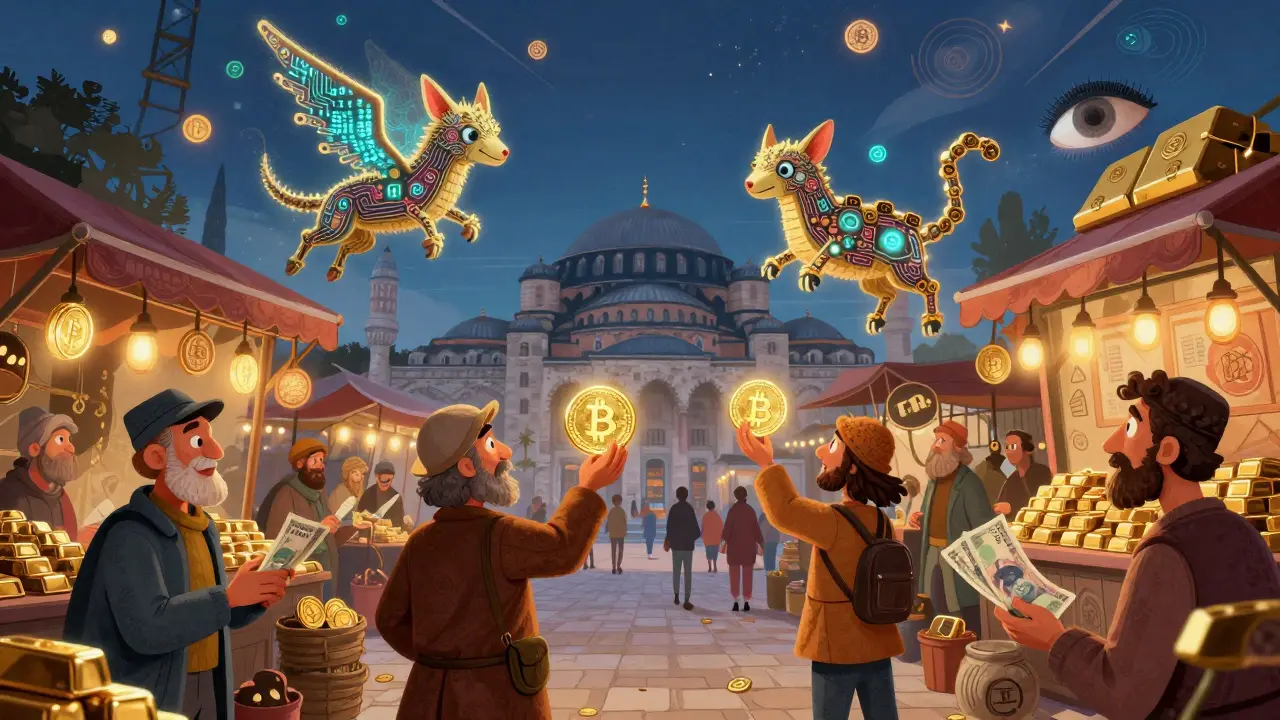


On April 30, 2021, Turkey made a move that shocked the global crypto community: it banned the use of cryptocurrencies for payments. Not trading. Not holding. Just paying with Bitcoin, Ethereum, or any other digital coin. You could still buy and sell crypto all you wanted - but if you tried to use it to buy coffee, pay your rent, or order food online, you were breaking the law.
This wasn’t a full ban on crypto. It was a surgical strike. The Central Bank of the Republic of Turkey (CBRT) didn’t want to kill the market. It just wanted to stop crypto from becoming a payment tool. Why? Because they saw real dangers: wild price swings, anonymous transactions, stolen wallets, and no way to reverse a mistake. The official statement listed five risks - and they weren’t making them up.
Here’s the truth most people miss: Turkey didn’t shut down crypto. It just made it useless for everyday spending. And that created a weird, frustrating reality for millions of Turks.
What the 2021 Ban Actually Banned
The regulation didn’t say you couldn’t own Bitcoin. It didn’t say you couldn’t trade it on Binance or KuCoin. It didn’t even say you couldn’t mine it. What it said was clear: no merchant, no payment processor, no bank - no one - can accept crypto as payment for goods or services.
That means if you run a restaurant in Istanbul, you can’t let customers pay with USDT. If you sell clothes online, you can’t add a ‘Pay with Ethereum’ button. If you’re a freelancer and someone tries to send you Bitcoin for your work, you can’t legally cash it out through a Turkish payment gateway. The ban targets the flow of crypto into the real economy - not the crypto itself.
Think of it like this: You can own a gold bar. You can trade it. You can even store it in a vault. But if you walk into a grocery store and try to pay for milk with it, the cashier will say no. Turkey treated crypto the same way.
Why They Did It - And Who Agrees
The CBRT didn’t act on a whim. They were reacting to a surge in crypto use during 2020 and early 2021. With inflation hitting 20% and the lira losing value, people turned to crypto as a store of value. That’s understandable. But when people started using it to pay for things, the bank got nervous.
Here’s what worried them:
- Volatility: Bitcoin could drop 20% in a day. A merchant accepting it could lose money overnight.
- Anonymity: Crypto transactions can’t be traced like bank transfers. That makes money laundering easier.
- Irreversible payments: If you send crypto to the wrong address? No refund. No chargeback. No recourse.
- Wallet theft: People lost funds to hacks and scams. No government safety net.
- No oversight: Crypto platforms weren’t regulated. No licenses. No accountability.
Legal firms like Baker McKenzie and Norton Rose Fulbright backed the CBRT’s reasoning. They called it a ‘prudent’ move - especially for a country with a history of currency instability.
What Was Still Allowed - And How People Adapted
The ban didn’t stop trading. In fact, it exploded.
By 2023, nearly 1 in 5 Turks - 19.3% of the population - were actively using cryptocurrency. That’s one of the highest rates in the world. People bought Bitcoin to protect their savings. They traded altcoins for profit. They used peer-to-peer apps like LocalBitcoins and Paxful to convert crypto to cash.
But here’s the catch: you couldn’t use it to pay for anything. So people got creative.
Instead of paying rent with ETH, you’d sell it on a P2P platform, get lira, then pay your landlord. Instead of buying a phone with USDT, you’d trade it for cash, then use that cash to buy the phone. It added steps. It cost time. It cost fees. But it worked.
Reddit threads like r/CryptoTurkey are full of posts like this: ‘I can trade freely but can’t use my USDT to pay for dinner - that’s the Turkish crypto paradox.’

The New Rules: Licensing, KYC, and Crackdowns
By 2024, the government realized letting crypto trade freely without oversight was risky too. So they upgraded the system.
In July 2024, Turkey passed the Law on Amendments to the Capital Markets Law. Now, every crypto exchange, wallet provider, or custodian operating in Turkey must get a license from the Turkish Capital Markets Board (CMB). No license? You’re blocked.
The requirements are tough:
- Exchanges need at least TRY 150 million ($4.1 million) in capital.
- Custodians need TRY 500 million ($13.7 million).
- All users must verify their identity for transactions over TRY 15,000 ($425).
- Unregistered wallet addresses are flagged as ‘risky’ - transactions can be frozen.
- Every transaction, even canceled ones, must be logged.
In March 2025, the CMB shut down 46 crypto platforms, including DeFi apps like PancakeSwap, because they didn’t meet local licensing rules. That’s not just enforcement - it’s a warning: if you want to serve Turkish users, you play by our rules.
Businesses Are Struggling - And So Are Users
For businesses, the dual system is a nightmare. You can accept crypto for investment. You can’t accept it for sales. So how do you manage it?
Payment processors now need AI tools to scan transactions and block any crypto-related activity. Compliance teams have grown by 30-40% at major exchanges, according to Deloitte Turkey. That’s expensive. That’s slow.
And users? They’re stuck in a gray zone. Trustpilot reviews for Binance Turkey average 3.8/5. The top complaint? ‘Great for trading. Useless for payments.’
Only 2% of Turkish businesses accept crypto, according to TÜİK’s 2024 survey. Compare that to Georgia - just across the border - where 14% of businesses take crypto. Turkey’s ban isn’t just about risk. It’s about missed opportunity.

The Legal Challenge: Can the Ban Be Stopped?
Not everyone agrees the ban makes sense.
Sima Baktaş, a Turkish lawyer and founding partner of GlobalB, is taking the government to court. Her case, set for May 28, 2025, argues that the payment ban is harming innovation, stifling fintech growth, and pushing businesses overseas.
She points to data: crypto users in Turkey grew 11 times in 2021. Even after the ban, usage kept rising. People didn’t stop using crypto - they just found workarounds.
‘Lifting the ban would foster financial sector development, make payments more effective, and increase Turkey’s attractiveness for blockchain businesses,’ she told MiTrade in March 2025.
If she wins, it could mean a major shift. Maybe crypto payments will be allowed under strict rules. Maybe licensed platforms will be allowed to process them. Maybe Turkey will finally catch up with the rest of the world.
If she loses? The ban stays. And Turkey’s crypto scene becomes even more of a parallel economy - powerful, but disconnected from the real financial system.
Where Turkey Stands Today
As of early 2026, Turkey has one of the most complex crypto environments in the world.
You can trade. You can hold. You can even earn interest on crypto through licensed platforms.
But you can’t pay for anything with it.
The market is huge - estimated at $170 billion in 2024. The rules are strict. The enforcement is real. And the tension between control and innovation is growing.
Unlike China, which banned everything, or El Salvador, which made Bitcoin legal tender, Turkey chose a middle path. It’s not perfect. But it’s intentional.
Whether that middle path leads to stability - or stagnation - depends on what happens after May 28, 2025.
Can I still buy and sell crypto in Turkey?
Yes. You can buy, sell, trade, and hold cryptocurrencies legally in Turkey. The 2021 ban only prohibits using crypto as payment for goods and services. Exchanges like Binance Turkey, Paribu, and Bitci are fully operational and licensed under the 2024 regulations.
Is it illegal to use crypto to pay for things in Turkey?
Yes. It’s illegal for any merchant, payment processor, or financial institution to accept cryptocurrency as payment for goods or services. This includes online stores, restaurants, and even freelance payments processed through Turkish platforms. Violations can lead to fines and license revocation.
What happens if I send crypto to a Turkish business?
If a Turkish business accepts crypto, they’re breaking the law - not you. But if you send crypto to a business that doesn’t comply with CMB licensing rules, your transaction might be flagged, delayed, or frozen by the exchange. Always use licensed platforms to avoid risk.
Do I need to verify my identity to trade crypto in Turkey?
Yes. Since February 25, 2025, all users must complete identity verification for transactions over TRY 15,000 (about $425). This applies to both buying/selling crypto and converting it to lira. Unverified users face transaction limits and account restrictions.
Are DeFi platforms like Uniswap or PancakeSwap banned in Turkey?
Yes. In March 2025, the Turkish Capital Markets Board blocked 46 decentralized finance platforms, including PancakeSwap, because they didn’t meet local licensing requirements. Accessing them from Turkey is technically possible, but using them may trigger compliance flags or account freezes on licensed exchanges.
Is there a chance the crypto payment ban will be lifted?
There’s a real possibility. A landmark legal case led by lawyer Sima Baktaş is scheduled for May 28, 2025. If the court rules in favor of lifting the ban, Turkey could introduce a regulated payment system for crypto - similar to how some European countries handle it. Until then, the ban remains in full effect.








19 Comments
Bro, I can buy Bitcoin but not a burrito with it? That’s like owning a Ferrari but only being allowed to park it. 😅
It’s not about banning crypto-it’s about protecting people from themselves. The lira’s been crumbling for years. People turned to Bitcoin like it was a life raft. But when you use a life raft to build a raft house, you forget it’s meant to keep you alive, not to host dinner parties.
Turkey didn’t kill innovation. It just refused to let chaos masquerade as progress. There’s a difference between freedom and recklessness.
Imagine if every time someone lost money in a bad trade, the government had to bail them out. That’s what unregulated payments would’ve created. Not a revolution. A financial free-for-all.
People say it’s stifling-but look at the data. Usage exploded. People adapted. They didn’t stop. They just got smarter.
Maybe the real question isn’t ‘why ban payments?’ but ‘why did we ever think we could treat volatile digital assets like cash?’
Currency needs stability. Crypto needs freedom. Trying to fuse them? That’s like trying to make a candle out of lightning.
I love how people act like this is some dystopian nightmare. In the US, we can’t even use crypto to pay taxes, and no one’s crying. Turkey’s just trying to keep its economy from imploding.
Let people trade. Let them hold. But don’t pretend a coin that swings 30% in a day belongs next to your grocery receipt.
Also-19% of the population using crypto? That’s wild. And honestly? Kinda inspiring.
It is a matter of profound economic prudence. The Central Bank of the Republic of Turkey has enacted a regulation that is both legally sound and economically rational.
The volatility of cryptocurrencies renders them fundamentally incompatible with the function of a medium of exchange. A currency must maintain relative stability to facilitate economic calculation.
Furthermore, the absence of a centralized authority to reverse fraudulent or erroneous transactions poses systemic risks to consumer protection.
The licensing regime introduced in 2024 aligns Turkey with international standards of financial oversight, particularly those promulgated by the Financial Action Task Force.
It is regrettable that some perceive this as repression, when in fact it is a necessary safeguard against financial instability.
Moreover, the rise in peer-to-peer activity demonstrates not resistance to regulation, but the resilience of the market under constraint.
One may not agree with the policy, but one cannot deny its coherence.
I get why they did it but holy shit it’s such a pain
I sold my ETH last month to pay rent. Took three days. Lost 8% in fees.
And now my landlord says he’s moving to Georgia because ‘at least there I can just get paid in crypto.’
They’re not stopping crypto. They’re just making it a second-class citizen.
And the worst part? Everyone knows it’s dumb.
This is exactly what happens when a society abandons sound monetary policy in favor of speculative fantasy. Cryptocurrencies are not money. They are digital gambling chips with no intrinsic value.
Allowing them to be used for transactions would be tantamount to permitting counterfeit currency to circulate. The Turkish government has acted with moral clarity.
Those who complain are either naive or profiting from the chaos. Either way, their complaints are illegitimate.
Let them move to El Salvador if they want to be financial fools. Turkey will not be the laboratory for reckless experimentation.
Just a quick note: the 2024 licensing rules actually helped reduce scams. I used to get DMs from ‘Turkish crypto brokers’ offering 20% daily returns. Now? Zero.
Also, the KYC requirement over TRY 15k? That’s what stopped a lot of money laundering. I’ve seen friends get blocked trying to send crypto to offshore wallets-turned out they were being scammed.
It’s not perfect, but the system’s cleaner than it was in 2022.
And yes, the payment ban is annoying-but if you’re using crypto to pay for coffee, you’re probably not thinking about the 3% fee, the 15% slippage, or the fact that the merchant might get fined.
It’s a workaround economy. Not a failure.
The irony is that Turkey’s approach is more thoughtful than most. The U.S. has no clear rules. Europe is drowning in bureaucracy. China banned everything.
Turkey said: ‘We won’t stop you from owning this, but we won’t let it touch our real economy until it’s safe.’
That’s not authoritarian. That’s responsible.
And the fact that 19% of the population still uses it? That’s not rebellion. That’s innovation finding cracks in the wall.
Maybe the ban isn’t the problem. Maybe the problem is we expect crypto to be both a currency and a speculative asset. It can’t be both.
Like trying to make a Swiss watch out of bubble wrap.
India also has strict rules on crypto payments 😊
But we still trade like crazy! 😎
Turkey is not alone. The world is learning: hold and trade = fine. Pay with it = risky.
Also, 150 million TRY capital? That’s a lot. But it keeps the bad guys out.
Good move 🇹🇷👍
Let me get this straight-Turkey lets its citizens buy Bitcoin but won’t let them buy a sandwich with it? That’s not regulation. That’s humiliation.
And now they’re shutting down DeFi platforms like they’re shutting down dissent? This isn’t financial policy-it’s digital authoritarianism.
They’re scared. Scared that people might find a way out of their broken economy.
So they ban the tool. They ban the freedom. They ban the future.
And then they wonder why everyone’s leaving.
Pathetic.
I think people are missing the beauty of this. Turkey didn’t try to kill crypto. They just said: ‘Let it grow, but don’t let it infect the system yet.’
It’s like letting a child play with fire-but only in a controlled space.
They’re giving crypto time to mature. To become stable. To earn trust.
And honestly? That’s more responsible than the U.S. just letting Coinbase do whatever it wants.
There’s hope here. Not fear.
Wow what a groundbreaking take. Crypto payments bad. Lira good. Got it.
Also, ‘19% of Turks use crypto’? That’s like saying 19% of Americans use duct tape. It’s not a feature, it’s a workaround for a broken system.
And don’t even get me started on ‘licensed’ exchanges. That’s just the government giving itself a cut.
Next they’ll require a permit to hold a wallet. With a QR code.
Did you know the CMB is owned by the same people who ran the banks that crashed the lira in the first place? 😏
They’re not protecting you. They’re protecting themselves.
And those ‘licensed’ exchanges? They’re the ones who got the government contracts to build the surveillance systems.
Meanwhile, your crypto gets frozen because you sent 1000 lira worth to a ‘risky’ address.
That’s not regulation. That’s control.
And yes, I’ve been blocked twice. I know how this works.
They don’t want you to be free. They want you to be dependent.
They’re not banning crypto. They’re banning freedom.
Every time you need to cash out to pay rent? That’s a tax. Every time you lose 5% in fees? That’s theft.
And now they’re tracking every transaction? Even canceled ones? That’s not oversight. That’s surveillance.
They want you to be broke and obedient.
Meanwhile, Georgia’s laughing all the way to the bank with crypto-friendly businesses.
Turkey’s not protecting its economy.
It’s burying it.
Oh wow. So Turkey’s the hero of crypto regulation now?
Let me guess-next they’ll make us wear crypto-themed uniforms and recite the CBRT charter every morning.
‘No, you cannot buy a kebab with ETH. But you may admire its volatility from afar, citizen.’
What a tragicomic masterpiece.
Meanwhile, in the real world, people are paying for rent with Bitcoin. And it’s working.
So why are we pretending this is a policy and not a prison?
I just moved to Istanbul last year. The crypto scene here is wild. People trade like it’s a sport.
But paying with it? Nah. Everyone just uses P2P.
It’s clunky. But it’s real.
And honestly? I kind of like that it’s not forced. No one’s pushing it. It just… happens.
That’s how real adoption works.
It’s not about payments. It’s about power.
They want to control the flow of money. Not because crypto is dangerous. But because it makes control impossible.
So they made a law that sounds reasonable.
But every rule has a shadow.
The shadow is this: if you can’t pay with crypto, you can’t challenge the system.
And that’s the real ban.
Oh please. The CBRT is terrified of losing control. So they made a rule that sounds smart but is just a power play.
And now they’re calling it ‘prudent’? Please.
They’re not protecting the economy. They’re protecting their own salaries.
Meanwhile, people are using crypto to survive inflation.
So who’s really the criminal here?
It’s not the users.
It’s the people who think they own the money.
Let’s cut through the noise: this isn’t about regulation. It’s about transition.
Turkey’s financial system is in a state of flux. They’re trying to move from a cash-heavy, inflation-prone economy to something digital-but they’re terrified of the disruption.
So they created a sandbox: trade here, hold here, but don’t touch the real economy yet.
It’s not perfect. But it’s a phase.
Think of it like a beta test for a financial OS.
And honestly? The fact that 19% of the population is already on it? That’s not a bug.
That’s the future knocking.