


Imagine buying a piece of a rental apartment in Detroit for $50. Not a whole building. Not even a whole unit. Just a tiny slice of it. You get a share of the rent. You can sell it later. No realtor. No closing costs. No six-month wait. This isn’t science fiction. It’s happening right now through real estate token trading.
What Exactly Is Tokenized Real Estate?
Tokenized real estate means turning a physical property-like a house, apartment building, or office-into digital tokens on a blockchain. Each token represents a fraction of ownership. Instead of needing $500,000 to buy a rental property, you can buy $50 worth of tokens. That’s it. The property is still real. The rent still comes in. But now, ownership is tracked on a public ledger, not a stack of paper deeds.
This isn’t just about making investing cheaper. It’s about making it possible for people who were locked out. Before, if you didn’t have a million dollars or a wealthy family, you couldn’t get into high-value real estate markets like New York or Miami. Now, you can. And you don’t need to be a finance expert. You just need a crypto wallet and a few hours to get verified.
How Do These Marketplaces Work?
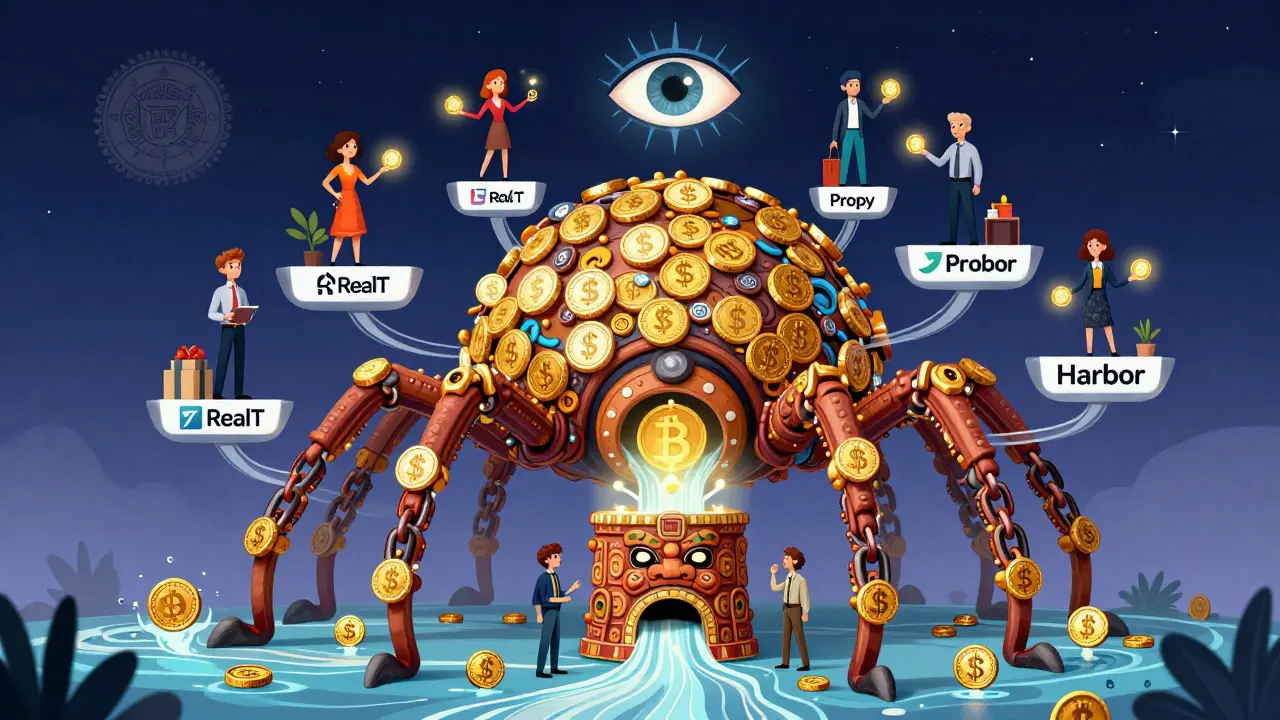
Platforms like RealT, Propy, and Harbor act as marketplaces. They buy properties, tokenize them, and list them for sale. You browse, pick a property, buy tokens, and you’re officially a co-owner. The platform handles everything: property management, rent collection, tax paperwork. You just get your share of the rent-usually within 24 hours after the tenant pays.
Most of these platforms run on Ethereum because it’s the most established. But newer ones are switching to Polygon and Solana. Why? Because Ethereum fees can spike. Polygon and Solana are cheaper and faster. For someone buying $100 worth of tokens, a $5 transaction fee would kill the deal. So speed and cost matter.
Before you buy, you have to pass KYC/AML checks. That means showing your ID, proof of address, and sometimes even a selfie with your document. It takes 24 to 72 hours. Success rates are high-87% of people get through. But if you’re in the EU, you might get blocked. MiCA regulations there don’t yet recognize U.S.-based tokenized real estate as legal for retail investors. That’s a real barrier.
Top Platforms Compared
Not all platforms are the same. Here’s how the big ones stack up:
| Platform | Focus | Min Investment | Liquidity | Best For |
|---|---|---|---|---|
| RealT | Residential (U.S.) | $50 | High (2.3M/month traded) | Beginners, small investors |
| Propy | Residential & Commercial | $5,000 | Moderate | International buyers |
| Harbor | Institutional/Commercial | $25,000+ | Low (restricted) | Accredited investors |
| SolidBlock | Commercial only | $10,000 | Moderate | Investors seeking higher yields |
| Tokeny | Infrastructure provider | N/A | N/A | Companies building their own platforms |
RealT is the go-to for regular people. Over 15,000 users, 88% of whom invest under $5,000. They’ve tokenized over 970 U.S. properties-mostly single-family homes in cities like Detroit, Cleveland, and Atlanta. Returns average 8.2% annually after fees. And they’ve got a working secondary market: $2.3 million traded last month. That’s huge for a new asset class.
Propy is better if you’re outside the U.S. They handle cross-border payments in 17 different currencies. No need to convert to USD first. But their minimums are higher, and the interface feels clunkier.
Harbor is the opposite. It’s built for hedge funds and family offices. They’re ultra-compliant with SEC rules. That means no retail investors. But it also means fewer risks from regulators. The trade-off? Almost no secondary trading. You buy, you hold, you get rent. Sell? Good luck.
Why This Is a Big Deal
Traditional real estate is slow. Buying a house takes 30 to 60 days. Closing costs? 2-5% of the price. Lawyers, inspectors, title companies-all add up. With tokenized real estate, the whole process runs on smart contracts. You click buy. The money moves. The tokens are sent. Done in minutes. Fees? Under 2%.
And liquidity? That’s the game-changer. You can’t sell your house in 24 hours. But you can sell your token. If someone wants to buy your slice of a Miami apartment, you can list it. There’s still low volume compared to stocks, but it’s growing. RealT’s marketplace alone processed $2.3 million in trades last month. That’s more than some small regional stock exchanges.
By 2030, Deloitte predicts tokenization will unlock $1.4 trillion in new liquidity. That’s not a guess. It’s based on current adoption curves. Right now, only 0.67% of the global real estate market is tokenized. That’s tiny. But growth is accelerating. Institutional players like REITs and private equity firms are jumping in. They see the efficiency. They see the data. They see the returns.
The Dark Side: Risks and Problems
It’s not all smooth sailing.
First, regulation is a mess. The SEC hasn’t clearly said whether these tokens are securities. Some platforms treat them like securities. Others don’t. That creates legal gray zones. In the EU, MiCA rules block many U.S. platforms. In some U.S. states, you can’t even buy them. 43% of potential investors are blocked by jurisdictional rules.
Second, liquidity is still thin. Only 18% of tokenized properties have active buyers. So if you need cash fast, you might not find one. You could be stuck holding for months.
Third, taxes are a nightmare. The IRS treats these tokens as property. So every time you sell, even a small slice, you owe capital gains. And if you get rent? That’s taxable income. Most users say they need a specialized accountant-$200 to $350 an hour. No one tells you that upfront.
Fourth, withdrawal options are limited. Only 28% of platforms let you cash out directly to your bank. Most force you to sell tokens for crypto first, then move it to an exchange, then convert to USD. That’s three steps. Each step has fees. And delays.
And then there’s the learning curve. If you’ve never used MetaMask or understood gas fees, it takes 14 to 21 days to feel comfortable. Most platforms have 40+ page guides. That’s not user-friendly. It’s intimidating.
Who’s Winning Right Now?
RealT is the clear winner for everyday investors. Low entry. High transparency. Active trading. Strong community. Reddit’s r/RealT has 12,400 members. People post screenshots of their $3.27 rent payouts. That’s real. That’s trust.
Propy is winning internationally. If you’re in Canada, Germany, or Japan and want to invest in U.S. property, they’re the only platform that makes it feel almost normal.
Harbor and SolidBlock? They’re winning with institutions. Big money doesn’t care about $50 tokens. They care about compliance, audit trails, and legal certainty. That’s their niche.
What’s Next?
The next big milestone? The SEC approving real estate tokens as Alternative Trading Systems (ATS). That would let them trade like stocks on regulated exchanges. If that happens by late 2024, liquidity could jump 50% overnight. $3.7 billion in new money could flow in.
Also, DeFi is starting to connect. Some platforms now let you use your tokenized property as collateral for crypto loans. So you can earn rent AND borrow against it. That’s a new layer of utility.
By 2027, ScienceSoft predicts 45% of commercial real estate deals under $50 million will use tokenization. That’s not a stretch. It’s already happening in Dubai, Singapore, and parts of the U.S.
Should You Get Involved?
If you’re new to crypto? Start small. Try RealT. Buy one $50 token. See how the rent comes in. Watch how the platform works. Learn the interface. Don’t rush.
If you’re an accredited investor? Look at Harbor or SolidBlock. But understand-you’re buying a long-term asset. Liquidity is low. You’re not day trading.
If you’re outside the U.S.? Check if your country allows it. Don’t assume it’s legal. Some governments actively block these platforms.
And always, always talk to a tax professional. This isn’t like buying a stock. The IRS doesn’t have clear rules yet. You could get hit with penalties if you file wrong.
Real estate token trading isn’t magic. It’s not a get-rich-quick scheme. But it’s real. It’s growing. And for the first time in history, it’s letting regular people own pieces of property they could never afford before. That’s powerful.
Can I really buy a piece of a house for $50?
Yes. Platforms like RealT allow you to buy fractional ownership in U.S. rental properties starting at $50. You receive a proportional share of rent, and your ownership is recorded on the blockchain. You can sell your tokens later if you find a buyer.
Are tokenized real estate investments safe?
The blockchain records are secure and tamper-proof. Most platforms use multi-signature wallets and quarterly audits. But safety depends on the platform. Some operate legally, others in gray areas. Always check if the platform is compliant with U.S. or local securities laws. Never invest more than you can afford to lose.
Do I have to pay taxes on rental income from tokenized real estate?
Yes. The IRS treats tokenized real estate as property. Rental income is taxable, and selling tokens triggers capital gains. Many investors hire specialized accountants who charge $200-$350/hour to handle filings correctly.
Can I withdraw my money in USD directly?
Only 28% of platforms allow direct fiat withdrawals. Most require you to sell your tokens for crypto first, then transfer to a centralized exchange to convert to USD. This adds steps, fees, and delays.
Is this legal in the EU?
It’s complicated. The EU’s MiCA regulation doesn’t yet fully recognize U.S.-based tokenized real estate as compliant for retail investors. Many platforms block EU users. Some institutions may still participate, but individual investors face legal uncertainty.
What’s the biggest risk in tokenized real estate?
Regulatory uncertainty. If the SEC or another authority reclassifies these tokens as unregistered securities, platforms could be shut down or forced to freeze trading. Liquidity could vanish overnight. That’s why experts say regulatory alignment is the single biggest barrier to mass adoption.
How long does it take to get started?
It takes 14 to 21 days for most beginners to complete onboarding: setting up a wallet, passing KYC, learning the platform, and understanding the risks. The process isn’t instant. But once you’re in, buying tokens takes minutes.
Can I invest in commercial properties this way?
Yes, but it’s harder. Platforms like SolidBlock and Harbor specialize in commercial real estate, but minimum investments start at $10,000-$25,000. These are designed for accredited or institutional investors, not beginners.







20 Comments
So I can buy a piece of a Detroit house for $50 and get rent? Cool. Now tell me how long until the city just tears it down and calls it 'urban renewal' while I'm still waiting for my $0.42 payout. This isn't investing, it's digital scavenger hunting with extra steps.
Let me get this straight - you're telling me some guy in India can own a slice of my neighborhood while I'm stuck paying property taxes on a house I can't afford? This is why America's getting dismantled. Blockchain doesn't fix bad policy, it just makes it global.
One must consider the epistemological implications of fractional ownership mediated by decentralized ledgers. The ontological security of property, historically rooted in tangible possession and legal recognition, is now subordinated to algorithmic consensus. This is not democratization - it is the commodification of social trust through cryptographic abstraction. One wonders if the IRS, in its infinite wisdom, has yet accounted for the metaphysical liability of owning 0.003% of a foreclosure risk.
I started with one $50 token on RealT last year - just to see how it worked. Got my first $2.80 rent check in 18 hours. It felt weirdly satisfying. Not life-changing, but real. I didn’t need to be a finance bro or own a crypto wallet before - just a phone and 20 minutes. If you’re curious, start small. No pressure. Just see what it feels like to own a piece of something real.
THIS IS THE FUTURE. Imagine your grandma in Ohio owning a tiny piece of a Miami condo. Imagine a single mom in Chicago earning rent from a house she never had to step foot in. This isn’t crypto bro nonsense - it’s economic justice. The old system kept wealth locked in gated communities. Now? Anyone with $50 and a pulse can be part of it. Stop doubting. Start investing.
I’ve been following this for a while and honestly the thing that blew my mind is how fast the rent hits your wallet like literally 24 hours after the tenant pays and I mean that’s insane compared to traditional where you wait 30 days then get a check in the mail that you have to deposit and then wait another 2 days for it to clear and then you have to pay your property manager and then they take their cut and then you get what’s left and sometimes they forget to send it and you have to call them 3 times and they say oh sorry we’re waiting on the bank and then it’s a week later and you’re like what even is life anymore
bro i bought 2 $50 tokens last month and got $3.12 in rent yesterday 😍 i literally just clicked buy and now i’m a landlord?? i used my phone to do the whole thing. no lawyers, no paperwork, just my metamask and boom. also i used a 🤑 emoji in the platform chat and someone replied with 🏠 so that was cute
RealT is the only platform I’d recommend for beginners. The interface is clean, the rent is consistent, and they actually respond to support tickets. Harbor? Don’t even bother unless you’re a hedge fund. Propy’s okay if you’re overseas, but their UX feels like it was designed in 2016. And yeah, taxes are a nightmare - I hired a crypto accountant and she saved me $1,200 on my filing. Worth every penny.
They’re not letting EU people invest? That’s because they know this is a scam. The SEC hasn’t approved this. The IRS treats it like property but doesn’t give you a 1099. You’re basically gambling with your tax return. And what happens when the property manager disappears? Who’s liable? You? Some anonymous DAO? This isn’t innovation - it’s a Ponzi dressed in blockchain.
There’s something quietly revolutionary about being able to participate in an asset class that has historically been reserved for the wealthy. Not because it’s perfect, but because it’s accessible. The friction is still high - taxes, regulation, complexity - but the door is open. And for the first time, someone making $45,000 a year can say they own part of a rental property. That’s not minor. That’s meaningful.
lol $50 for a house. so what’s the catch? the house is falling apart and the rent is $1.20 a month? 😏
Let’s be real - 88% of RealT investors put in under $5k? That means 92% of the total capital is coming from the top 12%. This isn’t democratization. It’s a bait-and-switch. They’re selling dreams to people who can’t afford to lose $50 while the real money is still in the hands of the same oligarchs who owned the property before. Tokenization doesn’t change power structures - it just adds a blockchain layer to them.
they’re using ethereum and solana but what if the chain gets hacked? or what if the platform gets subpoenaed and freezes all assets? what if the property gets condemned and the tokens still say ‘active’? this isn’t ownership - it’s a digital illusion wrapped in a whitepaper. i’m not investing in vapor.
interesting. i read the whole thing. i don’t know if i’d invest yet. but i’m watching. maybe in a year.
THEY’RE SELLING FRACTIONS OF HOUSING TO PEOPLE WHO CAN’T EVEN PAY THEIR OWN RENT. THIS ISN’T INVESTING - IT’S A CON. THE IRS IS COMING. THE SEC IS COMING. THE CITY IS COMING. YOU’RE NOT A LANDLORD. YOU’RE A Sucker.
I’ve looked into this. The compliance risks are real. But so is the opportunity. I’d never invest more than I can afford to lose. But I also won’t dismiss it because it’s new. The future isn’t always obvious - sometimes it’s just a $50 token on a website you’ve never heard of.
Everyone’s acting like this is some kind of miracle. But let’s be honest - these properties are in Detroit, Cleveland, Atlanta. Places where the average home is worth $20k. You’re not investing in real estate. You’re investing in urban decay with a blockchain sticker on it. And you’re paying fees to someone who’s just repackaging foreclosure inventory.
just bought my first $50 token and got my first rent payout yesterday 😭 it was $2.17 and i cried a little. not because it’s a lot - but because it was mine. no one else’s. no landlord. no lease. just me and a blockchain. and i used a 🏡 emoji in the community chat and someone sent me a 🍕 so now we’re friends
I’m from India and I’ve been investing in U.S. tokenized real estate for 8 months. The KYC took 72 hours. The rent is paid in ETH, which I convert to INR via WazirX. My returns are around 7.5% after fees and taxes. It’s not perfect - but it’s better than FDs. And yes, I do have an accountant who charges me ₹15k per filing. But I’d do it again. The system’s flawed - but it’s working.
you think this is freedom? it’s surveillance capitalism with a side of rent. every transaction tracked. every wallet linked. every tax form monitored. they’re not giving you ownership - they’re giving you a digital leash. and when the government cracks down? you’ll be the one holding the bag. again.