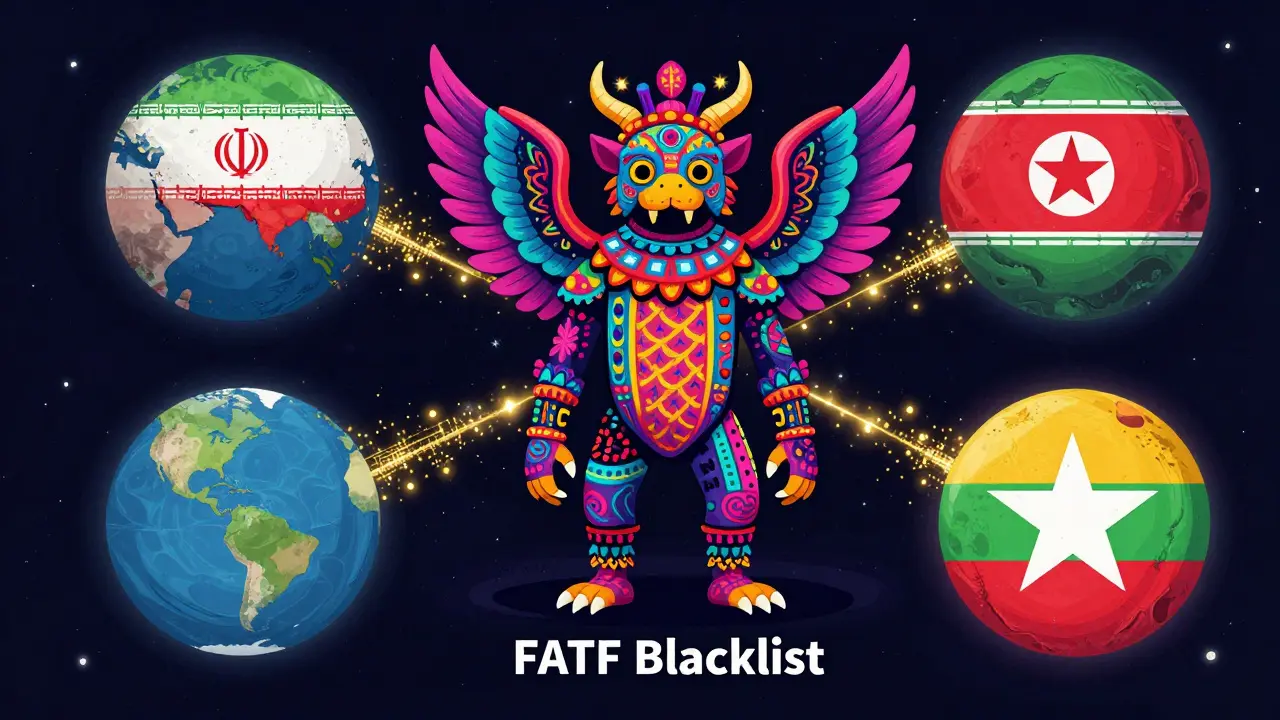


Imagine a financial "no-fly zone" where almost no legitimate bank in the world will touch your money. For most of us, that sounds like a nightmare, but for three specific countries, it's their daily reality. The FATF blacklist is the ultimate warning label for the global financial system, marking jurisdictions that are essentially "black holes" for anti-money laundering (AML) and counter-terrorism financing (CFT) efforts. When a country lands here, it isn't just a slap on the wrist; it's a signal to every bank and exchange on earth to apply severe countermeasures. But here's the twist: while traditional banks are shutting their doors, these nations are turning to cryptocurrency to keep their economies-and their regimes-alive.
The Heavy Hitters: Who is Actually on the Blacklist?
The Financial Action Task Force (or FATF) is the global watchdog that decides who is too risky to do business with. Currently, the blacklist is an exclusive, dreaded club consisting of Iran, the Democratic People's Republic of Korea (North Korea), and Myanmar. These three are classified as "High-Risk Jurisdictions Subject to a Call for Action."
But not all blacklisted countries are treated the same. For Iran and North Korea, the FATF calls for full-scale countermeasures. This means countries aren't just suggested to be careful; they are urged to actively block financial ties. Myanmar is in a slightly different boat-it's subject to "enhanced due diligence." Essentially, if you're doing business with Myanmar, you have to prove you've done every possible background check to ensure the money isn't funding something illegal.
| Country | FATF Status | Primary Risk Factor | Primary Crypto Use Case |
|---|---|---|---|
| North Korea | Call for Action | State-sponsored cybercrime | Funding regime via thefts |
| Iran | Call for Action | Terror financing / Weak AML | Capital flight & Sanction evasion |
| Myanmar | Enhanced Due Diligence | Money laundering / Political instability | Cross-border illicit transfers |
North Korea: The State-Sponsored Crypto Heist
If Iran uses crypto for survival, North Korea uses it as a weapon. The regime has essentially turned cyber-attacks into a national industry. They don't just mine coins; they execute sophisticated raids on virtual asset service providers (VASPs) and exchanges. Take the February 2025 hit on the ByBit exchange-a staggering $1.5 billion was stolen in a single operation. This isn't just a few hackers in a basement; it's a disciplined, military-grade effort to bypass global sanctions.
Once they steal the funds, they don't just send them to a bank. They use crypto mixers-tools that scramble the trail of a transaction-to make the money untraceable. This makes the job of investigators incredibly difficult, as the "clean" coins are eventually cashed out into fiat currency in jurisdictions with lax rules.
Iran: A Digital Lifeboat in a Financial Storm
In Iran, the story is different. The government certainly uses crypto, but the people are using it to survive. When your local currency crashes and the Office of Foreign Assets Control (OFAC) makes it impossible to send a wire transfer, Bitcoin becomes a lifeline. Because Bitcoin is censorship-resistant and self-custodial, an Iranian citizen only needs a seed phrase to move their wealth across borders.
Throughout 2024, we saw a massive spike in outflows from Iranian centralized exchanges. People aren't necessarily trying to commit crimes; they're engaging in capital flight. They are moving their savings into digital assets to hedge against inflation and economic isolation. This creates a paradox: the same tools that allow a citizen to protect their life savings also allow the Islamic Revolutionary Guard Corps (IRGC) to move money for prohibited activities.
The Global Game of Cat and Mouse
Regulators aren't just sitting back. The U.S. Treasury and FinCEN (the Financial Crimes Enforcement Network) have stepped up their game. In 2024 alone, OFAC issued 13 different designations targeting specific cryptocurrency addresses. This is a shift in strategy: instead of just banning a person or a company, they are now banning the actual digital wallets where the money sits.
However, the system has a massive leak. According to FATF data from early 2024, about 75% of the countries in the FATF Global Network are either completely noncompliant or only partially compliant with virtual asset rules. This means that while the U.S. or the Netherlands might have tight controls, there's always a "weak link" country where a sanctioned actor can exchange their crypto for cash without asking any questions.

Why Traditional Bans Often Fail
You might wonder why a simple "ban" doesn't work. The problem is that cryptocurrency is designed to be permissionless. In a traditional bank, the bank is the gatekeeper. If the government says "no," the bank closes the account. With a decentralized wallet, there is no one to ask for permission. If you have the private keys, you have the money.
This is why the focus has shifted toward the "on-ramps" and "off-ramps"-the exchanges where crypto is swapped for dollars or euros. By targeting these gateways, regulators try to choke the flow of funds. But as soon as one exchange implements a strict KYC (Know Your Customer) policy, illicit actors move to peer-to-peer (P2P) markets or use privacy-focused coins that hide the sender and receiver entirely.

The Bigger Picture: 2026 and Beyond
The data from 2024 shows a worrying trend: sanctioned jurisdictions received about $15.8 billion in crypto, accounting for nearly 40% of all illicit crypto transactions globally. We are seeing a shift where entire nations, rather than just individual criminals, are the primary users of illicit crypto infrastructure.
As we move further into 2026, expect the pressure to mount on "mid-tier" jurisdictions. The FATF recently added the British Virgin Islands and Bolivia to its monitoring list, showing that they are looking beyond just the "Big Three" to find where the money is leaking. For the average user, this means more stringent verification processes at exchanges and a higher likelihood that your account could be frozen if your transaction history touches a high-risk region.
What happens if a country is on the FATF blacklist?
When a country is blacklisted, the FATF calls on all member nations to apply countermeasures. This usually means severe restrictions on financial transactions, increased scrutiny for any business dealings, and in extreme cases (like North Korea and Iran), a near-total ban on financial relations to prevent money laundering and terrorism funding.
How does North Korea make money through cryptocurrency?
North Korea utilizes state-sponsored cyber warfare to steal funds from cryptocurrency exchanges and DeFi protocols. They then use mixing services to hide the origin of these funds before converting them into usable currency to fund the regime's weapons programs.
Can an ordinary person in Iran use Bitcoin legally?
While the international community imposes sanctions on the Iranian state, many individuals use Bitcoin as a hedge against inflation and as a way to move money across borders. However, using centralized exchanges that are linked to sanctioned entities can lead to account freezes by international regulators like OFAC.
What are crypto mixers and why are they a problem?
Mixers are services that pool cryptocurrency from many users and then distribute it back to them at different times and addresses. This breaks the link between the sender and the receiver, making it the primary tool for sanctioned nations to hide the "paper trail" of stolen or illicit funds.
Does the FATF blacklist change frequently?
Yes, the FATF regularly updates its lists. While the "high-risk" blacklist (Iran, North Korea, Myanmar) is more stable, the "grey list" (Jurisdictions Under Increased Monitoring) changes often as countries improve their regulations. For example, in June 2025, Croatia and Mali were removed, while Bolivia and the British Virgin Islands were added.
Next Steps and Troubleshooting
If you are a business owner or a crypto investor, staying clear of these high-risk zones is critical. Here is how to handle different scenarios:
- For Exchange Users: Always check if your counterparty is operating from a sanctioned jurisdiction. A sudden transfer from a high-risk region can trigger an automatic freeze on your account via FinCEN's monitoring tools.
- For Compliance Officers: Implement "Travel Rule" solutions that require the identification of both the sender and receiver for every transaction. Relying on simple address screening is no longer enough to satisfy FATF standards.
- For those in volatile regions: Understand the difference between custodial and non-custodial wallets. While centralized exchanges can freeze your funds, a hardware wallet gives you total control, though it puts the burden of security entirely on you.




11 Comments
its wild how crypto just bypasses everything lol. definitely a game changer for people stuck in bad econ situations
Spot on! The P2P markets are absolute goldmines for agility when centralized systems crash and burn!
Imagine thinking a few wallet bans stop a whole country 🙄 total joke 🤡
This is exactly how the globalists want it. They pretend to fight the bad guys while actually building a system to track every single cent we spend. The FATF is just a front for a one-world financial surveillance state and these "blacklist" countries are just the test subjects for the tools they'll eventually use on us at home. Wake up. It's not about terrorism; it's about total control over the individual's ability to hold wealth without permission from some bureaucrat in a suit.
We really need to push for better education on non-custodial wallets so people don't lose everything in a freeze! 🚀 Let's keep the knowledge flowing!
my heart breaks for the innocent people in iran just trying to save their money while the world closes in on them so unfair
There is a profound ethical tension here that we must examine if we ever hope to reach a global equilibrium. On one hand, the necessity of stopping the financing of violence is an undeniable moral imperative for the protection of millions of innocent lives across the globe. On the other hand, the blanket application of financial warfare often creates a collective punishment scenario where the most vulnerable citizens, who have no say in their government's actions, are the ones who suffer most. When we strip away the ability of a family to save for their children's education because of a state's political alignment, we are essentially arguing that the individual's right to economic survival is secondary to the geopolitical goals of the powerful. We must ask ourselves if the architecture of the future financial system can ever truly be inclusive if it relies on the same exclusionary logic that the traditional banking system used for decades. This shift toward decentralized finance isn't just a technical loophole; it's a philosophical rebellion against the idea that a small group of nations should decide who is allowed to participate in the global economy based on a list.
It's actually quite hopeful that technology can provide a safety net for people in such tough spots!
I completely agree with the point about the paradox of these tools because while it is wonderful that a regular person can protect their savings from hyperinflation, we cannot ignore the fact that the same technology allows bad actors to hide their tracks. It's like giving everyone a lock for their door; most people just want privacy and security, but the criminal uses that same lock to hide evidence of a crime. We need to find a way to support the individual without giving the regime a free pass to fund weapons, which is a incredibly difficult balance to strike when the technology is designed specifically to be invisible to the authorities. I believe the answer lies in more community-led verification rather than just top-down government bans that usually just push the problem into deeper, darker corners of the web where it's even harder to track.
Actually, most of those mixers are geting hit hard by the US gov lately so the trail isnt as clean as people think. Jus check the latest chainalysis reports and you'll see they are tracking the jumps better than before.
Fair point, though I feel like it's always a step behind. The cat and mouse game just keeps evolving!