


Despite official warnings and no legal framework for cryptocurrencies, over 4 million Saudis-about 11.4% of the population-own digital assets. This isn’t accidental. It’s the result of a quiet, widespread workaround that bypasses restrictions, not because the law allows it, but because the system has gaps people have learned to use.
Why Saudi Arabia Doesn’t Ban Crypto (Even Though It Says It Does)
In 2018, a Saudi government committee declared cryptocurrency "illegal and unlicensed." But that wasn’t a law. It was a statement. And statements can be ignored. By December 2024, the official stance had shifted: virtual currencies aren’t legal tender, but they’re also not explicitly banned. The Saudi Central Bank (SAMA) still tells banks they can’t touch crypto unless they get special permission. Yet, no one has been arrested for owning Bitcoin. No exchange has been shut down. No bank has frozen accounts for crypto deposits-unless the transaction looked suspicious under anti-money laundering rules. This ambiguity is the key. It’s not permission. It’s silence. And silence creates space.The Three Main Ways Saudis Get Into Crypto
There are three clear paths most Saudis use to access crypto exchanges, and they all avoid the banking system entirely.- International Exchanges (45%): Users sign up directly on platforms like Binance, Bybit, and OKX using their Saudi national ID. These sites don’t require a local license, so they don’t need Saudi approval. KYC verification works if your ID is clear and your selfie matches. Around 68% of applicants get approved this way. No bank involvement. No red flags. Just a passport-style photo and a selfie.
- Peer-to-Peer (P2P) Trading (37%): This is the most popular method. Saudis use LocalBitcoins, Paxful, and local platforms like SaudiCrypto to trade SAR for USDT or BTC. Sellers accept bank transfers from Alinma, Al Rajhi, or STC Pay. Buyers send money, wait for confirmation, and get crypto sent to their wallet. Fees are low-around 1.8% on average-and transactions often complete in under 10 minutes. Reddit threads like the one from March 15, 2025, with over 2,800 upvotes, detail how to do it safely.
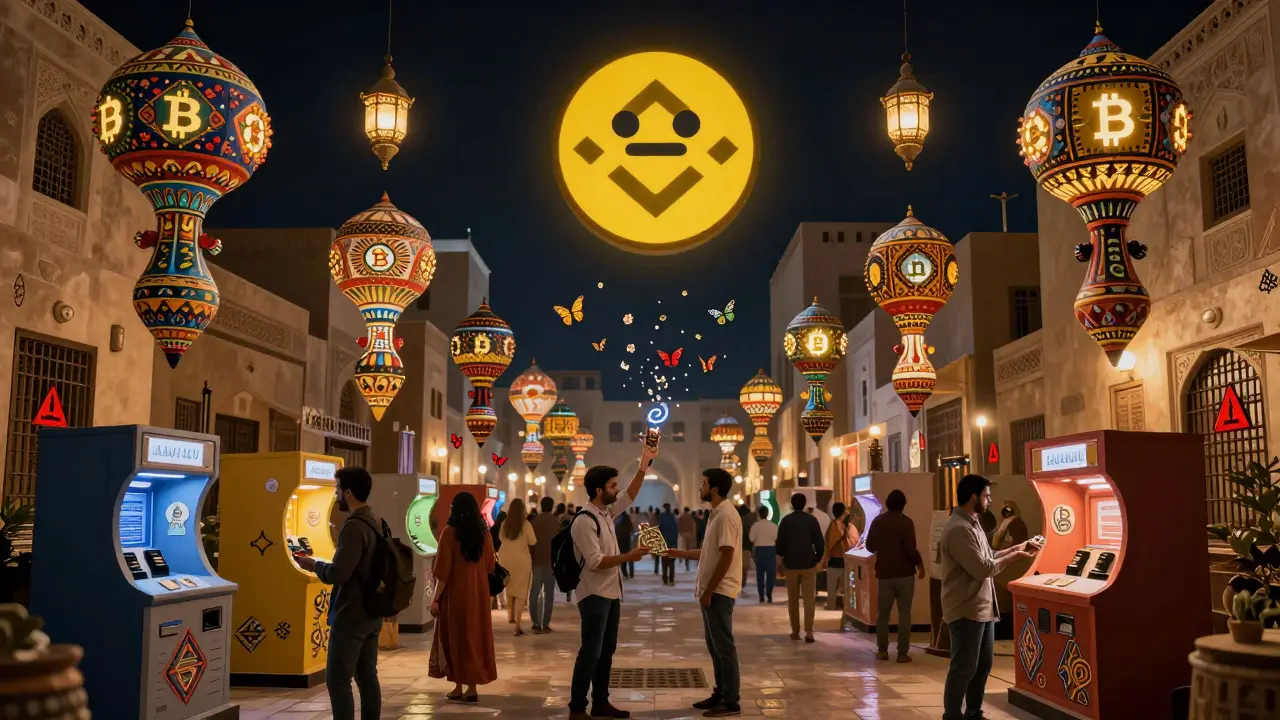
- Cryptocurrency ATMs (127 total): There are now 127 crypto ATMs across Riyadh, Jeddah, and Dammam. You can buy Bitcoin or Ethereum with cash. No ID needed for small amounts. For larger purchases, you’ll need to verify your identity, but the process is faster than opening a bank account. CoinATMRadar confirmed these numbers in September 2024.
How They Pay Without Banks
Banks won’t process crypto purchases. So Saudis don’t try. Instead, they use workarounds:- Payment processors: NOWPayments handles 58% of all crypto-to-fiat transactions in Saudi Arabia. It accepts bank transfers, e-wallets, and even gift cards.
- Gift cards: 22% of users buy Amazon or Apple gift cards with cash or bank transfers, then sell them on P2P platforms for crypto. It’s indirect, but it works.
- International remittance apps: Wise and Revolut are used to send money abroad, then converted into crypto on overseas exchanges. This isn’t legal under SAMA rules, but it’s hard to trace.
VPNs, Mobile Apps, and the Younger Generation
Internet restrictions aren’t enforced like in some countries. But some users still use VPNs-NordVPN reported a 28% jump in Saudi subscriptions in 2024, mostly for crypto access. The real story? Mobile apps. Sixty-three percent of Saudis under 30 use crypto apps as their main tool. That’s not surprising. Over 63% of the country’s population is under 30. They grew up with smartphones. They don’t trust banks. They don’t care about regulations. They care about returns. A 2025 YouGov survey found that 89% of users aged 18-24 successfully accessed crypto, compared to just 47% of those over 40. The divide isn’t just tech-savviness-it’s generational trust. Older Saudis remember the 2018 warnings. Younger Saudis see crypto as the new stock market.Why Binance Dominates
Binance alone handles $850 million in daily trading volume from Saudi users. Why? Because it’s the only exchange that offers:- Arabic interface (barely adequate, but better than nothing)
- Support for SAR deposits via P2P
- Low fees and high liquidity
- A mobile app that works even on slow networks

The Hidden Risks
There’s no safety net. No deposit insurance. No legal recourse. In 2024, Saudi authorities recorded 1,842 cases of crypto fraud totaling SAR 1.2 billion ($320 million). Accounts get frozen. Exchanges disappear. Scammers pose as traders. One user on Trustpilot reported a $40,000 account freeze after SAMA inquired about their activity. It took 87 days to get the money back-after hiring a lawyer. And while a 2023 fatwa confirmed that Bitcoin trading is Sharia-compliant (a major factor for 78% of users), that doesn’t protect you from the law. The Anti-Money Laundering Law still applies. If SAMA decides to act, your assets could be seized.What’s Coming in 2025 and Beyond
SAMA is expected to release draft crypto regulations in Q3 2025. The Capital Market Authority (CMA) has already started discussions on classifying digital assets. Three crypto-related apps have been accepted into SAMA’s fintech sandbox, including a blockchain KYC provider. The real game-changer? The mBridge CBDC project. Saudi Arabia is working with China, Thailand, Hong Kong, and the UAE to build a cross-border digital currency system that settles transactions in under 10 seconds. This isn’t crypto. But it’s blockchain. And it’s a signal: the government isn’t against digital money. It just wants to control it. Goldman Sachs predicts Saudi crypto adoption will hit 15.2% by 2027. That’s 6 million more users. And if regulations finally arrive, they’ll likely follow the UAE model-licensed exchanges, regulated wallets, tax reporting. But until then? The system runs on silence.What New Users Should Do
If you’re new to crypto in Saudi Arabia:- Start with P2P. Use SaudiCrypto or Paxful. Buy small amounts first.
- Use your Saudi ID to verify on Binance or OKX. Don’t use fake documents.
- Set up two-factor authentication. Every exchange requires it.
- Never send money to strangers. Use escrow on P2P platforms.
- Join local Telegram groups like "Saudi Crypto Traders"-they offer real-time help.
- Keep records. If your account gets frozen, you’ll need proof of transactions.
Is it legal to use Binance in Saudi Arabia?
There is no specific law banning Binance or any other international exchange. However, the Saudi Central Bank (SAMA) prohibits banks from facilitating crypto transactions. Using Binance isn’t illegal, but it’s not protected. If SAMA decides to enforce its 2019 warning, your assets could be seized under the Anti-Money Laundering Law. Most users operate under the assumption that as long as they don’t use local banks for direct deposits, they’re outside enforcement.
Can I use my Saudi bank account to buy crypto?
No. Saudi banks like Al Rajhi, SABB, and Alinma are explicitly prohibited by SAMA from processing crypto-related payments. If you try, your transaction will be blocked or flagged as suspicious. Instead, Saudis use P2P platforms where sellers accept bank transfers as payment for crypto. The bank sees it as a regular money transfer-not crypto. This is why P2P is the most common method.
Are crypto profits taxed in Saudi Arabia?
No, individuals do not pay capital gains tax on cryptocurrency. The General Authority of Zakat and Tax confirmed this in January 2024. However, businesses that trade crypto are subject to a 15% capital gains tax and must pay 2.5% zakat on profits. This creates a gray area: if you’re trading frequently, authorities may classify you as a business, especially if you’re earning significant income.
Why do Saudis use VPNs for crypto?
VPNs aren’t required to access crypto exchanges, but they’re used by some to bypass potential future restrictions or to access region-locked features on exchanges. NordVPN reported a 28% increase in Saudi subscriptions in 2024, mostly for crypto access. Most users don’t need one-exchanges like Binance and Bybit are accessible without a VPN. But in areas with unstable internet or if users fear future crackdowns, a VPN adds a layer of precaution.
Is it safe to use cryptocurrency ATMs in Saudi Arabia?
Yes, for small purchases. There are 127 crypto ATMs in major cities, and most are operated by reputable providers. For transactions under SAR 2,000, no ID is required. Above that, you’ll need to verify your identity using your national ID. The risk is low, but like any ATM, scams can happen. Always check the machine’s operator, use it during daylight hours, and avoid machines with tampered screens or card readers.
What happens if my crypto account gets frozen?
If an exchange like Binance freezes your account due to a SAMA inquiry, you’ll need to provide documentation proving the source of your funds. This can take weeks or months. One user reported an $40,000 freeze that took 87 days to resolve. To reduce risk, keep records of all transactions, use P2P with escrow, and avoid large, sudden deposits. Community groups like "Saudi Crypto Traders" on Telegram often share advice on how to respond to exchange inquiries.





10 Comments
Honestly, the fact that Saudis are using Binance like it's a public utility is peak late-stage capitalism. 🤡 The regulatory ambiguity? That's not a loophole-it's a feature. Capitalism thrives on gray zones. Also, 127 crypto ATMs? Bro, that's more than some US cities have. We're living in the future, and it's Saudi Arabia.
This is such a fascinating case study in decentralized adoption. People aren't breaking the law-they're just operating outside the system's design. P2P trading with Al Rajhi transfers? Genius. It's not about evasion, it's about *adaptation*. And the fact that 78% of users cite Sharia compliance as a factor? That’s cultural innovation meeting financial tech. We need more narratives like this, not fear-mongering.
bro i just used a crypto atm in jeddah last week and got 0.02 btc with cash. no id. no questions. the dude behind the counter was like 'you good?' and i said 'yea man' and he nodded. that's it. no bank. no drama. just crypto. 🤷♂️
Lmao you americans act like this is some revolutionary hack. In India we've been doing this since 2017. P2P, gift cards, hawala networks. The Saudis are just late to the party. Also, Binance? Pfft. Try WazirX. At least we have local support. And don't even get me started on 'Sharia-compliant' crypto-what a joke.
So we’ve created a system where the state says ‘no’ but doesn’t enforce it… and people just… go ahead anyway?
That’s not freedom. That’s institutional decay.
The silence isn’t space. It’s neglect.
And when the system finally wakes up, it won’t be polite. It’ll be brutal.
P2P works because trust is local. Saudis use trusted sellers, not anonymous bots. That’s why fraud rates are lower than expected. Also, 22% using gift cards? Classic. Same as Nigeria. Smart workaround.
This is all a CIA psyop. Crypto is a weapon. They’re letting Saudis use it so they can track every transaction. Next thing you know, SAMA will be feeding data to the NSA. And those ‘crypto ATMs’? They’re just cameras with Bitcoin dispensers. Wake up. This isn’t innovation-it’s surveillance with a smile.
I cried when I read about the 63% under 30 using crypto apps. 💥
That’s not just adoption. That’s a revolution.
They’re not rebels. They’re just tired of being told what to do by people who don’t understand their lives.
This generation? They don’t want permission. They want access.
And they’re building it themselves.
I’m so proud. I’m so emotional. I’m so inspired.
I’ve been following this for a while, and what’s really interesting is how much of this is organic. No government, no corporation-just people figuring it out. The fact that Saudis are using Wise and Revolut to route money abroad? That’s not evasion. That’s globalization in action.
And the 3.7% average fee? That’s better than Western remittance services. Maybe the real story isn’t crypto-it’s how people bypass broken systems with creativity.
The regulatory silence is the most powerful policy decision here. Not because it’s intentional, but because it’s passive. Institutions often don’t realize how much power they lose when they refuse to act. The Saudis didn’t outsmart the system. The system just… stopped trying. And that’s how change happens.