
You might have stumbled upon Polkamarkets, a project that promised to revolutionize how we bet on real-world events using blockchain technology. But if you look at the numbers today, July 2026, the reality looks very different from the hype of 2021. The POLK token trades for fractions of a cent, down over 99% from its all-time high. So, what exactly is Polkamarkets? Is it still a viable platform for making money on predictions, or is it a relic of an earlier crypto cycle?
At its core, Polkamarkets is a decentralized protocol designed for creating and trading prediction markets. Instead of betting with a traditional bookie, users trade shares of possible outcomes on events like sports matches, political elections, or cryptocurrency price movements. If your prediction comes true, you redeem your shares for profit. If not, they become worthless. It’s essentially a casino where the house rules are written in code, not managed by a central company.
The Core Concept: Decentralized Prediction Markets
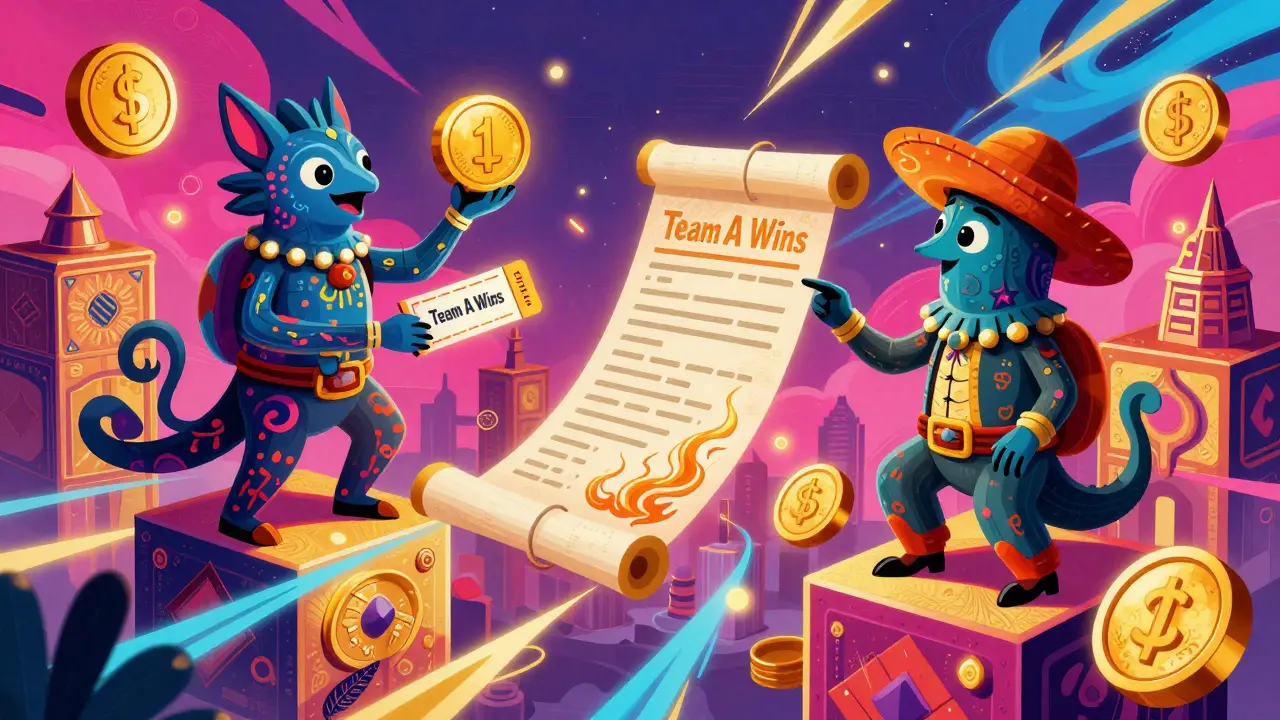
To understand Polkamarkets, you first need to grasp the idea of a prediction market. These platforms allow people to monetize their knowledge or opinions. For example, if you believe Team A will win a football match, you buy "Team A wins" shares. As the match progresses and odds shift, you can sell those shares for a profit before the game even ends. This creates a liquid market for information.
Traditional betting sites hold your money and decide the odds. In contrast, Polkamarkets uses smart contracts on the blockchain. Your funds stay in your wallet until you decide to trade or settle a bet. This removes the risk of the platform shutting down and refusing to pay out-a common fear in centralized gambling apps. However, this decentralization comes with a trade-off: complexity. You need a Web3 wallet, you need to manage gas fees, and you need to trust the code rather than a customer support agent.
| Feature | Centralized (e.g., Bet365) | Decentralized (e.g., Polkamarkets) |
|---|---|---|
| Custody of Funds | Platform holds your money | You hold your money (non-custodial) |
| Accessibility | Restricted by country/regulations | Global access (if internet available) |
| User Experience | Simple, app-based, familiar | Complex, requires MetaMask/WalletConnect |
| Transparency | Opaque odds setting | On-chain, verifiable smart contracts |
| Risk | Platform insolvency or bans | Smart contract bugs or low liquidity |
How the POLK Token Works
The POLK token is the fuel that keeps the engine running. It’s an ERC-20 utility token, meaning it was originally built on the Ethereum network but now operates across multiple chains. But what do you actually *do* with it? Holding POLK isn’t just about hoping the price goes up; it grants specific permissions within the ecosystem.
First, you need POLK to create new markets. If you want to open a betting pool on whether Bitcoin will hit $100k by December, you must stake POLK. This acts as a security deposit to ensure you’re serious and helps prevent spam markets. Second, POLK is used for governance and curation. Holders help resolve disputes when event outcomes are unclear. Third, it powers the incentive structure. Liquidity providers-who put up the cash so traders can buy and sell shares-earn POLK rewards. Similarly, successful forecasters might earn tokens through yield farming mechanisms.
The total supply of POLK is fixed at 100 million tokens. There are no more tokens being minted. By late 2022, all tokens were distributed and unlocked. This means the tokenomics are static. Unlike projects that inflate supply to pay teams or investors, POLK’s scarcity is baked in. However, scarcity alone doesn’t drive value. Demand does. And currently, demand for POLK is driven primarily by niche traders and developers integrating the protocol, rather than mass adoption.
Technical Architecture: Multi-Chain Flexibility
One of Polkamarkets’ biggest technical selling points is its flexibility. Launched initially on Ethereum in early 2021, the protocol quickly realized that Ethereum’s high gas fees made small bets unprofitable. Who wants to pay $20 in transaction fees to bet $5 on a tennis match?
To solve this, Polkamarkets adopted a multi-chain strategy. The protocol is deployed on various EVM-compatible networks, including Polygon, Moonbeam, Gnosis Chain, and Arbitrum. This allows users to choose a chain with lower fees. For instance, on Gnosis Chain, a transaction might cost less than $0.01, making micro-betting viable. This interoperability is crucial for a prediction market, where frequency of trades matters more than holding periods.
For developers, Polkamarkets offers a JavaScript SDK and open-source smart contracts. This means any business can build their own prediction dApp using Polkamarkets as the backend infrastructure. They don’t need to write complex Solidity code from scratch. They can simply integrate the existing modules for market creation, trading, and resolution. This "infrastructure-as-a-service" model positions Polkamarkets not just as a consumer app, but as a toolkit for other Web3 projects.
The Harsh Reality: Market Performance in 2026
Let’s talk numbers, because they tell a stark story. When Polkamarkets launched in February 2021, the crypto market was euphoric. The POLK token soared to an all-time high of around $4.18 in March 2021. At that peak, the market cap was substantial, and excitement ran high.
Fast forward to July 2026. The price of POLK hovers around $0.0027. That’s a drop of approximately 99.9%. The market cap has shrunk to roughly $270,000. Daily trading volume often stays below $1,000. In the world of crypto, this classifies POLK as a micro-cap asset. It’s not that the project is dead-the website works, the contracts are live, and updates continue-but it has lost significant momentum.
Why did this happen? Several factors contributed:
- Competition: Platforms like Polymarket emerged as dominant players in the prediction space, offering smoother user experiences and deeper liquidity.
- Regulatory Pressure: Prediction markets walk a fine line between financial instruments and gambling. Regulatory crackdowns in major jurisdictions chilled investor enthusiasm.
- User Friction: Despite improvements, interacting with DeFi protocols remains difficult for average users. Connecting wallets, swapping tokens, and managing slippage are barriers that centralized apps easily overcome.
- Liquidity Fragmentation: Spreading the protocol across many chains diluted liquidity. Thin order books mean high slippage, discouraging large bets.
If you bought POLK during its peak, you’ve likely written off the investment. If you’re looking to buy in now, you’re speculating on a turnaround in a highly competitive niche. Price prediction models for 2026-2030 suggest further stagnation or decline, reflecting the broader market’s skepticism toward older DeFi projects that haven’t captured mainstream attention.
Who Should Use Polkamarkets Today?
Given its current state, who is Polkamarkets actually for? It’s not for the casual gambler looking for a quick thrill. Those users flock to centralized exchanges or established giants like Polymarket. Instead, Polkamarkets serves two specific groups:
1. Developers and Businesses: If you’re building a social media app, a fan community, or a news platform and want to add interactive prediction features, Polkamarkets’ open-source SDK is valuable. You can deploy your own branded prediction markets without dealing with the complexities of smart contract development. The cost of integration is low, and the flexibility is high.
2. Niche Traders and Speculators: Some traders enjoy hunting for undervalued assets in the DeFi space. With a market cap under $300k, POLK is cheap. If the project gains renewed traction through partnerships or viral events, the percentage gains could be significant. However, this is high-risk speculation. The likelihood of returning to $4 levels is virtually zero given the dilution of market share.
For the average retail investor, POLK offers little utility beyond speculative trading. The lack of deep liquidity means you might struggle to exit large positions without moving the price against yourself. Always check the depth of the order book before placing a trade.

Security and Risks
Security in DeFi is never guaranteed. While Polkamarkets’ smart contracts have been audited, audits are snapshots in time. Bugs can emerge, and exploits can happen. Because the protocol is non-custodial, if you lose your private keys or send funds to the wrong address, there is no customer support to call. Your money is gone forever.
Another risk is oracle manipulation. Prediction markets rely on external data sources (oracles) to determine event outcomes. If an oracle feeds incorrect data, the settlement process fails. Polkamarkets uses decentralized reporting mechanisms to mitigate this, but it’s not foolproof. Always verify how outcome data is sourced for the specific market you’re trading.
Regulatory risk looms large too. Depending on your location, participating in prediction markets may violate local gambling or securities laws. Polkamarkets operates globally without geo-blocking, which puts the onus on you to comply with your jurisdiction’s regulations. Ignorance of the law is not a defense.
Conclusion: Is POLK Worth Your Attention?
Polkamarkets represents an interesting experiment in decentralized finance. It proved that prediction markets could run on-chain, offer cross-chain compatibility, and provide tools for developers. Technically, it’s robust. Economically, however, it has struggled to find product-market fit in a crowded field.
If you’re a developer, explore their SDK. It’s a powerful tool for adding engagement layers to your apps. If you’re a trader, treat POLK as a high-risk, micro-cap play. Don’t invest more than you can afford to lose. And if you’re just looking to bet on sports or politics, you’ll likely find better liquidity and easier interfaces elsewhere.
The dream of decentralized prediction markets is alive, but Polkamarkets is no longer the leader of that charge. Its legacy lies in its open-source contributions and its role in educating the market about the potential-and pitfalls-of on-chain betting.
Is Polkamarkets safe to use?
Like any DeFi protocol, Polkamarkets carries risks. Smart contracts have been audited, but vulnerabilities can exist. Since it is non-custodial, you are responsible for securing your wallet. Never share your private keys. Additionally, regulatory risks vary by country, so ensure participation is legal in your jurisdiction.
Can I make money with POLK token?
You can potentially earn POLK by providing liquidity or creating markets, but profits are not guaranteed. Trading the token itself is highly speculative due to its low liquidity and historical price decline. Most users lose money in such volatile micro-cap assets. Treat any earnings as bonus income, not reliable revenue.
What is the difference between Polkamarkets and Polymarket?
Polymarket is a centralized interface backed by decentralized infrastructure, known for high liquidity and ease of use. Polkamarkets is fully decentralized and focuses on providing open-source tools for developers to build their own markets. Polymarket dominates consumer volume; Polkamarkets targets niche developer integrations.
Do I need ETH to use Polkamarkets?
Not necessarily. While POLK originated on Ethereum, the protocol is deployed on multiple chains like Polygon, Gnosis, and Arbitrum. You only need the native gas token of the specific chain you are using (e.g., MATIC for Polygon). This reduces costs significantly compared to using Ethereum mainnet.
Where can I buy POLK token?
POLK is listed on several decentralized exchanges (DEXs) like Uniswap and centralized exchanges such as Gate.io and KuCoin. To buy on a DEX, you’ll need a Web3 wallet like MetaMask. Be cautious of fake tokens; always verify the official contract address from the Polkamarkets website.
10 Comments
Polymarket ate their lunch years ago. Liquidity is king.
The sheer audacity of calling this a 'protocol' when it's basically digital dust is staggering. You're not trading shares; you're donating to the gas fees of a ghost town. It’s a monument to hubris, really. A shiny, empty shell where dreams go to die in the ether. Most people here are too busy chasing the next moonshot to realize they’re standing in a graveyard of bad code and worse economics. The multi-chain strategy wasn’t innovation; it was desperation disguised as flexibility. They scattered their liquidity like breadcrumbs hoping some algorithmic bird would follow them back to life. Spoiler alert: birds don’t eat crumbs on Gnosis Chain. They fly elsewhere. This isn’t an investment opportunity; it’s a forensic accounting exercise for masochists who enjoy watching numbers bleed out slowly. The SDK might be useful for developers building niche apps that nobody uses, but for traders? It’s a trap. A beautiful, open-source trap. Don’t fall for it. Walk away while your wallet still has enough ETH to buy a coffee.
Oh my god, can we talk about how absolutely TRAGIC this is?! 😱💔 I remember when everyone was screaming POLK to the moon! Now look at it! Fractions of a cent! It’s literally dead! 📉🚫 How do you even sleep at night holding this bag? It’s giving major rug pull energy without even the decency to actually rug! 😡🔥 Just burn it all and move on! Stop pretending it’s viable! It’s a relic! A dusty old fossil! 🦖💀
One must consider the ethical implications of promoting such a dilapidated financial instrument. The author presents a balanced view, yet the underlying premise remains fundamentally flawed. To suggest that any rational actor should engage with a platform exhibiting such profound liquidity fragmentation is, quite frankly, irresponsible. Furthermore, the comparison to Polymarket is apt; however, it serves only to highlight Polkamarkets’ obsolescence. We ought to demand higher standards from our decentralized ecosystems. Allowing zombie projects to persist merely clutters the informational landscape. It is a disservice to the community to continue discussing this token as if it possesses any tangible utility beyond speculative gambling. Let us instead focus on protocols that demonstrate actual product-market fit and sustainable economic models. Silence on this matter would be preferable to further noise.
Look, I get it, it’s down 99%. But have you seen the architecture? 🤯✨ It’s genuinely elegant code. The multi-chain deployment on Arbitrum and Polygon is super smooth now. Gas fees are practically nothing! 💸 I’ve been playing around with the SDK for a side project, and honestly? It’s a goldmine for devs who want to add prediction features without reinventing the wheel. 🛠️🚀 The retail crowd doesn’t get it because they just want easy money, but the tech is solid. Don’t let the price action fool you. Sometimes the best gems are hidden in plain sight. Keep your eyes open, friends! 👀💎
The fundamental flaw lies in the misalignment of incentives between liquidity providers and market creators. By fragmenting liquidity across multiple chains, Polkamarkets effectively diluted its own value proposition. The assumption that low gas fees equate to user adoption is naive. Users seek depth, not just speed. Without critical mass, the order books remain thin, leading to excessive slippage that renders arbitrage impossible. This is not a technical failure; it is a strategic one. The project failed to understand that prediction markets are network effects businesses. Once the network effect dies, no amount of SDK integration will revive it. The data clearly supports this conclusion. Any attempt to argue otherwise ignores basic microeconomic principles regarding market efficiency and liquidity provision. It is a textbook case of failure due to poor capital allocation.
I think we need to look deeper into what this means for the future of trust in digital systems. When we place our bets on these platforms, we are essentially placing our trust in lines of code that were written by humans who are imperfect. The fact that Polkamarkets is struggling shows us that technology alone cannot solve the human desire for simplicity and security. People want to know that their money is safe, and they want an easy way to use it. When you make them connect wallets and worry about gas fees, you are adding friction to their lives. Friction is bad. It slows things down. It makes people angry. And when people are angry, they leave. So maybe the problem isn’t the code, but the way we think about using code to handle money. We need to ask ourselves if we really want a world where every small bet requires a complex setup. Maybe the answer is no. Maybe we need simpler solutions. Or maybe we need better education. But right now, it feels like we are running in circles.
I’ve spent considerable time analyzing the tokenomics of various DeFi protocols, and Polkamarkets stands out as a particularly interesting case study in static supply dynamics. While the fixed supply of 100 million tokens suggests scarcity, it fails to account for the lack of demand drivers. In most successful ecosystems, token utility is tied to revenue generation or governance power that influences significant outcomes. Here, governance seems largely ceremonial given the low participation rates. The incentive structure for liquidity providers, while theoretically sound, has failed to attract sustained capital due to the aforementioned liquidity fragmentation issues. I find it fascinating how the project pivoted to a developer-focused model, attempting to become infrastructure rather than a consumer product. This shift acknowledges the reality of their position but also highlights their inability to compete in the consumer space. It is a retreat disguised as evolution. One wonders if other legacy DeFi projects will follow suit, abandoning the dream of mass adoption for the quieter, less profitable path of backend services. It is a somber reflection on the current state of the industry.
It’s okay to feel disappointed if you held this token. Many people did. However, it’s important to learn from the experience. The crypto space moves very fast, and projects rise and fall quickly. Instead of focusing on the loss, perhaps we can look at what this teaches us about risk management. Always diversify. Never invest more than you can afford to lose. And always check the liquidity before you trade. There are many other opportunities out there that are healthier and more active. Don’t let this one setback stop you from exploring new technologies. Stay positive and keep learning. You’ll do great! 🌟
its so sad how ppl keep falling for these scams. its morally wrong to promote gambling like this. the whole thing is rigged against the little guy. why do u guys even bother? its just greed. shame on u all for supporting this trash. 🙄