

You’ve likely seen the ticker BUILD pop up on a tracker or heard whispers about it in niche DeFi circles. But what exactly is this token? Unlike Bitcoin or Ethereum, which you can buy at any corner store with a crypto wallet, BUILD isn’t a standalone currency you use to pay for coffee. It is a specific utility token embedded within a complex decentralized finance (DeFi) architecture known as Starfish Topology.
If you are looking for a quick flip or a high-volume trading asset, you might want to pause. Current data shows BUILD trading around $0.00004394 USD with effectively zero 24-hour volume. That silence is loud. It suggests either extreme dormancy, highly fragmented liquidity, or a very specialized user base that doesn't trade on public exchanges.
To understand if BUILD has any value for your portfolio, we need to peel back the layers of its underlying technology. This isn't just another meme coin; it’s a component of a four-tier system designed to solve one of DeFi’s biggest headaches: liquidity fragmentation. Here is everything you need to know about BUILD, its role in the Multi-Tier Starfish Topology (MTST), and whether it deserves a spot in your research notes.
The Core Concept: Starfish Topology vs. Traditional AMMs
Most decentralized exchanges rely on Automated Market Makers (AMMs) like Uniswap. In those systems, if you want to swap Token A for Token B, there needs to be a dedicated pool containing both. If you want to swap Token C for Token D, you need another pool. This creates "liquidity dispersion." Capital gets spread thin across hundreds of pools, making each individual pool less efficient and more prone to slippage.
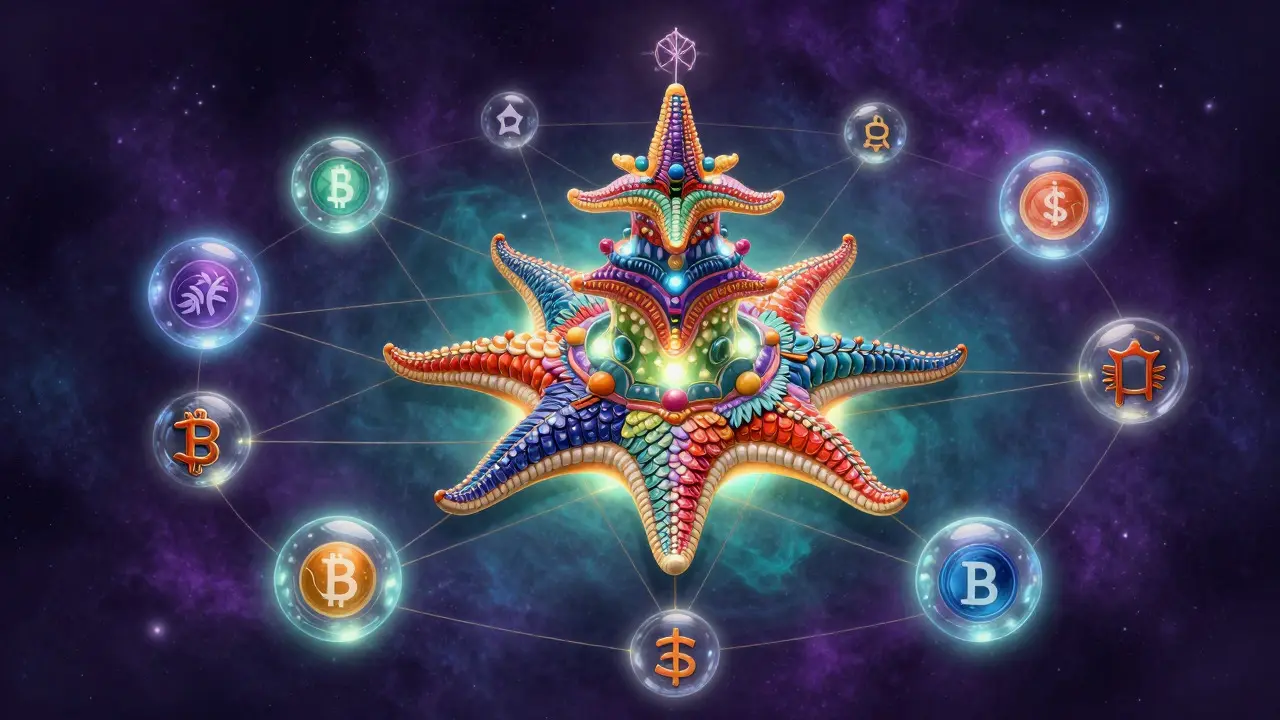
Starfish Topology attempts to fix this by centralizing liquidity through a hierarchical structure. Instead of isolated pools, it uses a multi-tiered approach where tokens are grouped by risk and volatility. The key advantage here is TVL (Total Value Locked) utilization. By reducing the number of required pairs, the protocol claims to make capital work harder.
Furthermore, this architecture allows for "zero collateral" onboarding for new tokens. Traditionally, launching a new token requires someone to deposit stablecoins (like USDC) to create initial liquidity. With Starfish Topology, new tokens can integrate into the existing tiers without needing fresh external liquidity injections, relying instead on the protocol's internal structure. This is a significant technical differentiator, but it comes with complexity that average users often overlook.
Understanding the Four-Tier Hierarchy
The heart of the BUILD ecosystem is the Multi-Tier Starfish Topology (MTST). This system divides assets into four distinct tiers based on volatility and maturity. Understanding which tier BUILD sits in is crucial for assessing risk.
| Tier | Protocol Token | Risk Profile | Paired Assets | Examples |
|---|---|---|---|---|
| Tier 1 | RADIO | Low / Stable | Stablecoins & Native Chains | USDC, DAI, ETH, MATIC |
| Tier 2 | SHACK | Medium-Low | Blue-Chip Cryptos | LINK, LUNA, AAVE |
| Tier 3 | BUILD | Medium-High / Volatile | Mid-Stage Protocols | MANA, GRT, ENJ |
| Tier 4 | DREAM | High / Speculative | Startup Tokens | Early-stage projects |
BUILD operates specifically in Tier 3. This places it squarely in the "mid-stage" category. It is paired with tokens like Decentraland (MANA), The Graph (GRT), and Enjin Coin (ENJ). These are established projects, but they are not yet considered "blue-chip" safe havens like Chainlink (LINK) or Aave (AAVE), which sit in Tier 2.
Being in Tier 3 means BUILD is characterized as "quite volatile over time." If you hold BUILD, you are exposed to the price swings of mid-cap metaverse and infrastructure tokens. It is neither as safe as RADIO (Tier 1) nor as wildly speculative as DREAM (Tier 4). It occupies a middle ground that appeals to traders who believe in the growth potential of these specific sectors but want slightly more stability than startup coins offer.
Tokenomics and Utility: What Does BUILD Actually Do?
In many crypto projects, tokens serve multiple purposes: governance, staking rewards, fee discounts, and medium of exchange. For BUILD, the primary utility is structural. It acts as a cornerstone component within the MTST system. Its value is derived from its ability to facilitate swaps between mid-stage protocols without requiring additional external collateral.
However, transparency remains a major issue. Comprehensive data on BUILD’s total supply, circulating supply, inflation rate, and vesting schedules for the founding team is scarce. In the world of DeFi, unknown tokenomics is a red flag. Without knowing how many tokens exist or when early investors unlock their holdings, it is difficult to model future price pressure.
Additionally, there is no clear information on governance. Does holding BUILD give you voting rights on protocol upgrades? Can you propose changes to the Starfish Topology parameters? Currently, the documentation focuses heavily on the technical architecture rather than community governance, suggesting a more centralized development approach or an immature DAO structure.

Market Reality: Liquidity, Volume, and Accessibility
Let’s talk numbers, because they tell a stark story. As of August 2026, BUILD trades at approximately $0.00004394 USD. More importantly, the 24-hour trading volume is reported as $0 USD. In crypto terms, this is effectively dead water.
This lack of volume raises several questions:
- Liquidity Depth: Can you actually sell a large amount of BUILD without crashing the price? With near-zero volume, the answer is likely no. Slippage would be enormous.
- Exchange Listings: Is BUILD listed on major centralized exchanges (CEXs) like Binance or Coinbase? Most evidence suggests it is only available on niche decentralized exchanges (DEXs) or perhaps not even there actively.
- Data Integrity: Sometimes, $0 volume indicates a reporting error on aggregators like CoinMarketCap or CoinGecko. However, combined with low search interest and limited community discussion, it points to genuine low adoption.
For a retail investor, this presents a barrier to entry. You can’t just click "buy" on an app. You would need to navigate a DEX, connect a Web3 wallet, approve transactions, and potentially deal with high gas fees relative to the tiny value of the token. This friction filters out all but the most dedicated DeFi enthusiasts.
Risks and Red Flags to Consider
Before adding BUILD to your watchlist, consider these critical risks:
- Concentration Risk: Since BUILD is tied to a specific architectural design (Starfish Topology), its fate is linked to the success of that protocol. If the MTST model fails to gain traction against competitors like Uniswap V3 or Curve Finance, BUILD loses its primary utility.
- Volatility Exposure: Being in Tier 3 means you inherit the volatility of MANA, GRT, and ENJ. If the metaverse sector crashes, BUILD likely follows, regardless of its own fundamentals.
- Lack of Information: The absence of a whitepaper, detailed roadmap, or active social media presence is concerning. In 2026, successful DeFi projects have massive communities. Silence often signals abandonment.
- Smart Contract Risk: Complex architectures like Starfish Topology require robust smart contracts. Have they been audited? By whom? Without public audit reports, you are trusting code that hasn't been verified by independent security firms.

Who Should Care About BUILD?
Is BUILD a scam? Not necessarily. It appears to be a legitimate attempt to solve liquidity fragmentation using novel topology. However, "legitimate" does not mean "profitable" or "liquid."
This token is relevant for:
- DeFi Developers: Those interested in alternative AMM designs and how hierarchical topologies can improve capital efficiency.
- Niche Traders: Individuals who already hold MANA, GRT, or ENJ and want to explore deeper liquidity layers within specialized protocols.
- Researchers: Analysts studying the evolution of DeFi infrastructure beyond standard swap models.
For the average investor looking for passive income or easy trading, BUILD offers little value right now. The barriers to entry, lack of liquidity, and opaque tokenomics make it a poor choice for general portfolio allocation.
Conclusion: Proceed with Extreme Caution
BUILD represents an interesting theoretical experiment in DeFi liquidity management. Its integration into the Multi-Tier Starfish Topology shows innovation in how tokens can be structured to reduce collateral requirements. However, theory does not equal market reality.
With negligible trading volume, unclear tokenomics, and limited accessibility, BUILD remains a fringe asset. If you decide to interact with it, treat it as high-risk speculation. Start small, verify the contract address yourself to avoid scams, and ensure you understand the volatility implications of Tier 3 assets. Always do your own research (DYOR) and never invest more than you can afford to lose in such illiquid markets.
Where can I buy BUILD crypto coin?
Due to extremely low liquidity and lack of major exchange listings, BUILD is likely only available on specific decentralized exchanges (DEXs) supporting its native blockchain. You will need a Web3 wallet (like MetaMask) and sufficient gas tokens to execute swaps. Always verify the official contract address from the project's verified sources before connecting your wallet.
Is BUILD a safe investment?
Currently, BUILD carries high risk. It trades in Tier 3 of the MTST system, meaning it is paired with volatile mid-stage tokens. Combined with near-zero trading volume and limited public information about its team and audits, it should be considered a speculative asset rather than a safe investment.
What is the difference between BUILD and RADIO?
RADIO operates in Tier 1 of the Starfish Topology, paired with stablecoins and native chains like ETH and USDC, making it the least volatile. BUILD operates in Tier 3, paired with mid-stage protocols like MANA and GRT, exposing it to higher market volatility and price swings.
Why is the trading volume for BUILD $0?
A $0 volume indicates that no trades occurred in the last 24 hours on tracked exchanges. This could be due to extremely low user activity, liquidity being concentrated on untracked platforms, or the protocol being dormant. It signals high illiquidity, meaning buying or selling large amounts could significantly impact the price.
Does BUILD have governance rights?
Public documentation regarding BUILD's governance structure is sparse. While many DeFi tokens allow holders to vote on proposals, there is currently no clear evidence that BUILD provides direct governance powers. Investors should look for official announcements regarding DAO implementation or voting mechanisms.
What is Starfish Topology?
Starfish Topology is a decentralized finance architecture designed to optimize liquidity. Unlike traditional AMMs that create separate pools for every pair, it uses a hierarchical system (MTST) to group assets by risk. This aims to reduce liquidity fragmentation and allow new tokens to onboard without needing external collateral deposits.