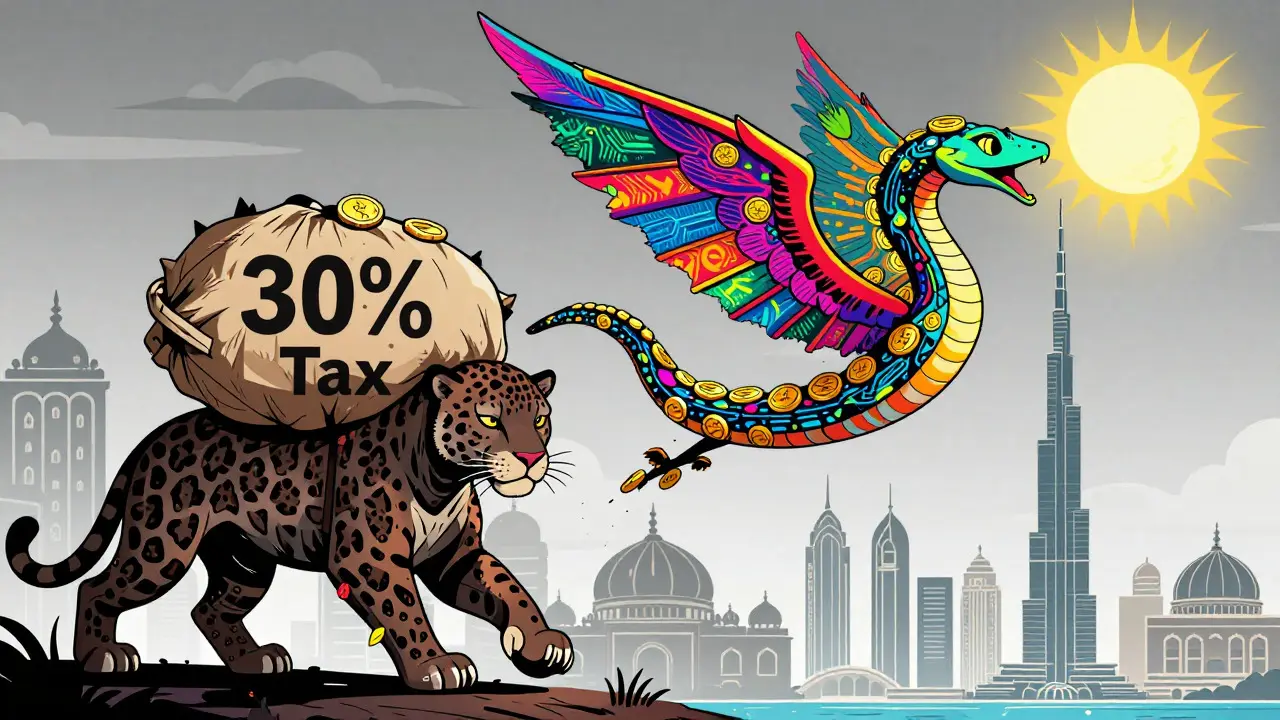


Imagine making $100,000 in profit from trading Bitcoin. In India, you hand over $30,000 to the government immediately, with no deductions for fees or losses. Now imagine living in Dubai, where that same profit stays entirely in your pocket. This stark contrast is driving a massive wave of Indian crypto traders relocating to Dubai to escape India's heavy taxation and embrace a zero-tax environment for digital assets. It is not just about saving money; it is about finding a place where the rules actually make sense for how modern finance works.
This migration trend has exploded since India introduced its strict crypto tax laws in 2022. Meanwhile, the United Arab Emirates (UAE) has aggressively positioned itself as the global capital for blockchain innovation. For many traders, moving to Dubai is no longer a luxury-it is a financial necessity to keep their businesses viable. But before you book a flight, you need to understand exactly how this works, what the hidden costs are, and whether the new regulatory changes will change the game.
The Real Cost of Trading Crypto in India
To understand why people are leaving, you have to look at the numbers. India’s current framework for cryptocurrency is one of the most punitive in the world. The government imposes a flat 30% tax on all profits from selling, trading, or spending cryptocurrencies. That sounds high enough, but the devil is in the details.
There are no deductions allowed. If you paid transaction fees, software subscriptions, or incurred losses on other trades, none of that counts. You pay 30% on the gross profit. Furthermore, there is a 1% Tax Deducted at Source (TDS) on every crypto asset sale exceeding INR 50,000 (about $608). This means your cash flow gets locked up constantly because the exchange withholds money before you even see the profit. For active traders, this liquidity crunch can be devastating.
Let’s break down a realistic scenario. A trader makes $100,000 in annual gains. Under Indian law, they owe $30,000 in income tax. On top of that, if they traded frequently, they likely had 1% TDS deducted throughout the year, which ties up capital until they file their returns. There is no long-term capital gains benefit either; holding Bitcoin for five years doesn’t lower your tax rate. It remains 30%. This structure effectively treats crypto like a speculative gamble rather than an investment class, pushing serious professionals to look elsewhere.
Dubai’s Zero-Tax Advantage for Individuals
Cross the border to Dubai, and the landscape shifts dramatically. The UAE currently imposes zero personal income tax on individuals’ cryptocurrency profits, capital gains, and wealth accumulation. Whether you trade Bitcoin, Ethereum, or NFTs, if you are an individual resident, you keep 100% of your profits. There is no capital gains tax. There is no wealth tax. This applies regardless of how much you trade or how much you earn.
This is not a loophole; it is official policy. The UAE government wants to attract talent and capital, and removing tax barriers is their primary tool. For a high-net-worth individual making millions in crypto gains, the savings are life-changing. Instead of losing nearly a third of their earnings to taxes, they can reinvest that capital into more trades, real estate, or business ventures. This compounding effect is what truly drives wealth creation in the crypto space.
However, "zero tax" does not mean "no rules." While individuals enjoy this freedom, the system relies on transparency. You must prove your residency and ensure your activities are legally structured. Simply flying in for a week and claiming residency won’t work. You need to establish a genuine presence, which leads us to the corporate structures available in Dubai.
Setting Up a Business Structure in Free Zones
For professional traders who want more than just personal residency, setting up a company in a Dubai Free Zone is the standard move. These zones offer 100% foreign ownership, no physical office requirements for many licenses, and a clear path to obtaining a UAE residence visa. Popular choices include the Dubai Multi Commodities Centre (DMCC), a free zone specializing in commodities and crypto trading with robust infrastructure, the International Free Zone Authority (IFZA), and Meydan Free Zone.
Here is where it gets interesting. If you register a proprietary trading company in these zones, you can potentially achieve zero corporate tax as well, provided your annual revenue stays below AED 375,000 (approximately $102,000). Above that threshold, the UAE’s standard 9% corporate tax applies. Even at 9%, this is significantly lower than India’s combined burden of 30% plus TDS complications. Plus, you get access to international banking services and a recognized legal entity that enhances your credibility with exchanges and partners.
The process involves registering the company, opening a dedicated UAE bank account, and routing your trading operations through this entity. This ensures legal compliance while maximizing tax efficiency. Many traders hire local consultants to handle the paperwork, ensuring they meet all regulatory requirements without getting bogged down in bureaucracy.
| Feature | India | Dubai (UAE) |
|---|---|---|
| Personal Income Tax on Crypto | Flat 30% | 0% |
| Capital Gains Tax | 30% (no long-term benefit) | 0% |
| TDS (Withholding Tax) | 1% on sales > INR 50k | N/A |
| Deductions Allowed | None | Yes (for corporate entities) |
| Corporate Tax Rate | Up to 40%+ depending on slab | 0% under AED 375k revenue; 9% above |
| Regulatory Clarity | Uncertain/Evolving | Clear via VARA |

Regulatory Clarity: VARA vs. Indian Uncertainty
Taxes are only half the story. Regulatory certainty is equally important for any serious trader. In India, the regulatory environment has been shaky. The Reserve Bank of India (RBI) has issued circulars restricting bank accounts for crypto firms, and the Supreme Court has had to step in to lift bans. This uncertainty creates operational risks. Will your bank freeze your account tomorrow? Will a new law retroactively penalize past trades?
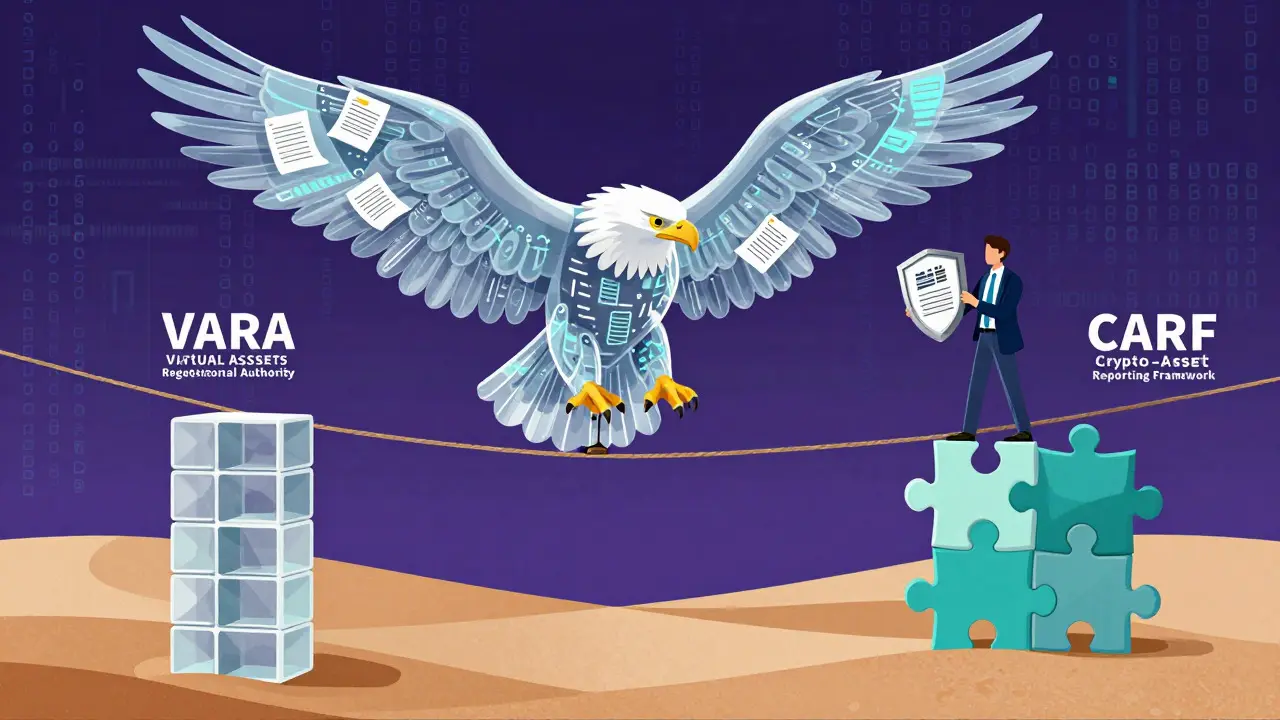
In contrast, Dubai operates under the Virtual Assets Regulatory Authority (VARA), the independent regulator overseeing virtual assets in Dubai, providing clear licensing and compliance guidelines. VARA provides detailed frameworks for different types of crypto businesses, from exchanges to wallet providers. Major global players like Binance, Coinbase, and Kraken have established regional headquarters in Dubai because they trust the regulatory stability. For individual traders, this means working with licensed entities that are less likely to face sudden shutdowns or banking restrictions.
This ecosystem effect is powerful. When you live in a hub where everyone is talking about crypto, attending conferences, and networking with industry leaders, you gain access to information and opportunities that are simply unavailable in restrictive markets. Dubai has become a magnet for blockchain startups, venture capital, and institutional investors, creating a vibrant community that supports growth.
The Looming Shadow of CARF
Just when you think the picture is perfect, new developments emerge. The UAE announced the implementation of the Crypto-Asset Reporting Framework (CARF), an international standard for reporting crypto transactions to tax authorities, similar to CRS for traditional finance. Starting September 20, 2025, with full rollout by January 1, 2027, CARF requires crypto service providers to collect and share data on customer identities, transaction volumes, and residency status.
Does this mean Dubai is ending its tax haven status? Not necessarily. CARF is primarily about transparency, not taxation. It aims to prevent tax evasion by sharing data between countries. However, for Indian residents moving to Dubai, this introduces a layer of complexity. If you are still considered a tax resident of India, the Indian government could theoretically use CARF data to claim taxes on your global income. Therefore, establishing true tax residency in the UAE-by physically living there for more than 182 days a year and severing economic ties with India-is crucial. You cannot just hold a visa; you must live there.
Experts warn that the first automatic exchange of data is scheduled for 2028. This gives traders a window to solidify their residency status and ensure their documentation is impeccable. Ignoring CARF could lead to double taxation or penalties later. Professional advice is essential here to navigate the nuances of dual residency and treaty obligations.
Practical Steps for Relocation
If you are considering the move, here is a practical roadmap based on current best practices:
- Assess Your Residency Status: Consult with a tax advisor to determine if you qualify as a non-resident in India. This usually involves spending less than 182 days in India per year and reducing economic dependencies.
- Choose the Right Free Zone: DMCC is ideal for commodity and crypto trading due to its specialized licenses. IFZA is cost-effective for smaller setups. Evaluate based on your budget and business scope.
- Register Your Company: Hire a local agent to handle the registration process. Ensure your activity description aligns with VARA regulations if you plan to offer services beyond personal trading.
- Open a Bank Account: UAE banks are strict about compliance. Prepare detailed proof of funds, source of wealth documents, and your trading history. Corporate accounts are harder to open than personal ones, so start early.
- Establish Physical Presence: Rent an apartment, get a health insurance policy, and spend significant time in Dubai. Keep records of flights, utility bills, and lease agreements to prove residency.
- Comply with VARA and CARF: Stay updated on regulatory changes. Register with VARA if required by your business model. Prepare for CARF reporting by maintaining clean, auditable records of all transactions.
Is It Worth the Hassle?
Moving countries is never easy. You leave behind family, friends, and familiar systems. The cost of living in Dubai, particularly housing and schooling, is high. Visa renewals require ongoing fees. And now, with CARF, the era of complete anonymity is over. So, why do thousands still choose to go?
Because the math works. For someone earning substantial profits in crypto, the 30% tax hit in India is a drag on growth that cannot be ignored. Dubai offers not just tax savings, but a lifestyle aligned with the future of finance. You are surrounded by innovators, protected by clear laws, and empowered to build wealth without arbitrary government interference. As long as you maintain proper residency and comply with emerging reporting standards, Dubai remains the smartest play for serious crypto traders worldwide.
Do I need to give up my Indian citizenship to live in Dubai?
No, you do not need to renounce your Indian citizenship. You can hold both passports. However, to avoid being taxed as an Indian resident, you must meet the criteria for non-resident status under Indian tax law, which primarily depends on the number of days spent in India and your economic interests there.
What is the minimum investment to set up a crypto trading company in Dubai?
The cost varies by free zone. For example, setting up in IFZA might cost around AED 10,000-15,000 ($2,700-$4,000) including visa fees, while DMCC may cost more due to higher license fees. Additional costs include office space (virtual or physical), bank account setup fees, and annual renewal charges.
Will CARF affect my ability to keep my profits tax-free in Dubai?
CARF itself does not impose taxes. It shares data. If you are a true tax resident of the UAE and a non-resident of India, the shared data will show you owe no tax in India. The risk arises if you fail to properly establish UAE residency, allowing India to claim you are still taxable there. Proper documentation is key.
Can I trade crypto from Dubai using Indian exchanges?
Technically yes, but it complicates your tax residency status. To maximize benefits, you should trade through UAE-based or international exchanges linked to your UAE bank accounts. Using Indian exchanges may trigger TDS and signal ongoing economic ties to India, jeopardizing your non-resident status.
How long does it take to get a UAE residence visa through a Free Zone company?
The entire process, from company registration to visa stamping, typically takes 2-4 weeks. This includes medical fitness tests, biometrics, and document verification. Having a professional agency handle the process can speed this up significantly.









18 Comments
You are ignoring the fundamental economic reality that capital flows to where it is treated best. The Indian tax structure is not merely high; it is punitive in a way that stifles innovation and rewards stagnation. By imposing a flat 30% tax with zero deductions for losses or fees, the government effectively treats sophisticated financial instruments as mere gambling chips. This lack of nuance drives away the very talent needed to build a robust digital economy. Dubai offers clarity, stability, and a regulatory framework that understands the mechanics of modern finance. It is not about escaping responsibility; it is about seeking rationality.
It is absolutely disgusting how these wealthy traders just pack up and leave when things get tough for everyone else. They talk about 'financial necessity' while the rest of us struggle to pay our bills under the same laws. It is selfishness wrapped up in corporate jargon. If they loved India so much, they would stay and fight for better policies instead of running to a desert dictatorship to hoard their money. Shame on them for abandoning their duty to the society that allowed them to succeed in the first place. 🙄
I have friends who made this move last year, and the transition was smoother than expected. The key is understanding that Dubai is not just a tax haven but a cultural hub for blockchain technology now. You meet people from all over the world who share your interests. It is less about hiding money and more about being in an environment that encourages growth and networking. The community aspect is surprisingly strong.
The sheer audacity of thinking you can just 'move' to escape fiscal obligations is laughable. CARF is coming, folks. The global net is tightening. You think VARA’s pretty little licenses protect you from the IRS or the Indian Income Tax Department? Please. Data sharing is inevitable. You are playing a game of whack-a-mole with international compliance algorithms. Your 'zero-tax' paradise is a mirage built on sand that will wash away when the automatic exchange of information kicks into full gear. Wake up.
While the tax benefits are undeniable, one must consider the philosophical shift required. Moving from a collectivist society like India to an individualist hub like Dubai changes your social fabric. However, if the current system in India is truly breaking your business model, then adaptation is necessary. It is not betrayal; it is survival. Just ensure your residency status is ironclad before you make the leap.
This is huge! Imagine keeping 100% of your gains. That is pure fuel for compounding wealth. I am looking into IFZA right now because the costs seem manageable for a solo trader. Has anyone here successfully opened a bank account through IFZA recently? The banking part seems to be the biggest hurdle mentioned everywhere. Let’s crush those goals! 💪🚀
Typical Western bias. India is building its own ecosystem. Why run away? Stay and contribute. The TDS is temporary pain for long-term gain. These traders are cowards who cannot handle discipline. India will thrive without them.
The comparison table provided in the article is quite illuminating. It highlights not just the tax difference but the structural uncertainty in India versus the regulated clarity in Dubai. For any serious investor, predictability is worth more than short-term savings. The ability to plan five years ahead without fearing retroactive legislation is a luxury that Dubai provides.
Oh great, another guide on how to legally avoid paying taxes. Sure, let’s pretend the 1% TDS is the main issue. It is the principle of it. But hey, if you want to burn bridges with your home country, go ahead. Just don’t come crying when you realize you have no roots anywhere. Good luck with your 'business venture' in the sand. 😒
I love seeing people take control of their financial futures! ✨ It is inspiring to see the crypto community finding new ways to grow. Just remember to keep your records tidy for CARF. Transparency is the new black! 🖤💸
The strategic implications of CARF are often underestimated by retail traders. One must analyze the timeline: September 2025 implementation, January 2027 full rollout. This creates a narrow window for establishing irrefutable non-resident status in India. Failure to sever economic ties during this period invites catastrophic double taxation. Act now, or regret later.
Man, moving countries sounds exhausting. I can barely handle moving apartments. But I guess if you are making six figures in crypto, the stress is worth it. Just hope you find good friends there too. Loneliness in a gold-plated cage is still loneliness, you know?
Why do we always let foreign rules dictate our lives? India has rights too! These traders should be ashamed. Stay put and pay your fair share! 🇮🇳😡
I read the section on DMCC. It seems expensive for beginners. Maybe start small?
honestly dubai is hot af tho. maybe i should go. tax free money sounds nice even if i dont trade crypto lol.
Oh, darling, please. Do you really think the elite in Dubai care about your little trading profits? They are laughing at you while you scramble for a visa. It is a gilded cage, my dear. A very expensive, very lonely cage. But by all means, go spend your life savings on a virtual office. How quaint. ;)
The article fails to mention the psychological toll of living in a transient society. Dubai is a city of expats, none of whom truly belong. You are renting your life. Is the tax saving worth the existential dread of having no permanent home? Probably not, but I suppose greed blinds most people to such nuances.
They want your data. CARF is just the beginning. The globalists are tracking every satoshi. Move to Dubai and you are just swapping one master for another. The deep state knows where you are. Nothing is private anymore. Wake up sheeple.