

Imagine trying to get a margin loan for your crypto portfolio without handing over your keys to a centralized bank. That’s the core promise of Oxygen Protocol, a decentralized finance platform built on Solana that acts like a digital prime broker. If you’ve ever wondered how hedge funds manage complex collateral and leverage, Oxygen aims to bring those same tools to everyday traders using smart contracts instead of middlemen.
But here’s the catch: while the tech sounds impressive, the token itself has had a rough ride. As of September 2026, OXY trades at micro-cap levels, heavily impacted by the collapse of FTX, which once held significant portions of its supply. This article breaks down exactly what Oxygen is, how its unique "pool" architecture works, and why its tokenomics are so controversial right now.
The Core Concept: Non-Custodial Prime Brokerage
Traditional finance uses prime brokers to help active traders and institutions borrow money against their assets. Oxygen replicates this in the crypto world but removes the custodian. You keep control of your assets via smart contracts. Unlike simple lending platforms where you lend one asset to get another, Oxygen uses a system called "Pools." These are baskets of assets that collectively provide liquidity and take on risk together.
This design allows for features that standard AMMs (Automated Market Makers) can’t easily handle:
- Cross-collateralization: Use Bitcoin as collateral to borrow USDC, even if they aren’t directly paired.
- Portfolio Margining: The protocol looks at your entire position, not just individual trades, to determine borrowing power.
- On-Chain Order Books: It integrates with Serum, Solana’s central limit order book DEX, giving traders price precision similar to traditional exchanges.
By leveraging Serum, Oxygen avoids the slippage issues common in pool-based swaps. Traders get better execution prices, which is critical when you’re managing leveraged positions across multiple assets.
How the OXY Token Works
The OXY token isn’t just a governance coin; it’s the economic engine of the protocol. Every single net fee generated by Oxygen-from lending interest to trading profits-is directed back to the OXY ecosystem. This happens through buy-and-burn mechanisms or direct yield distributions to holders.
Holding OXY gives you three main benefits:
- Fee Discounts: Active traders pay lower commissions based on how much OXY they hold and their monthly volume.
- Governance Rights: One token equals one vote. Holders decide on protocol parameters, such as which assets to list or how to adjust risk factors.
- Revenue Sharing: Because 100% of net fees flow to the token ecosystem, long-term holders theoretically capture the value created by user activity.
It’s a multi-chain token, existing as both an SPL token on Solana and an ERC-20 token on Ethereum. This dual representation was designed to maximize interoperability, allowing users to move value between ecosystems seamlessly.
Tokenomics and the FTX Crisis Impact
To understand Oxygen’s current market status, you have to look at its launch history. In March 2021, Oxygen conducted an Initial Exchange Offering (IEO) on FTX, BitMax, and Gate.io. They sold only 6 million tokens out of a massive maximum supply of 10 billion. That means early public buyers grabbed less than 0.1% of the total pie.
| Metric | Value / Detail |
|---|---|
| Maximum Supply | 10,000,000,000 OXY |
| Initial Sale Amount | 6,000,000 OXY (at $0.125 USD) |
| Circulating Supply (Est.) | ~40.7 Million (per CoinMarketCap, Sept 2026) |
| Primary Revenue Model | 100% Net Fees to Token Ecosystem |
| Blockchain | Solana (SPL) & Ethereum (ERC-20) |
The low circulating supply-hovering around 0.4% of the max supply according to some trackers-is largely due to the FTX collapse. Many OXY tokens were locked up or stranded on FTX-related entities when the exchange went bankrupt in late 2022. This created a severe liquidity crunch. While the protocol remains functional, the lack of freely tradable tokens has kept volume extremely low.
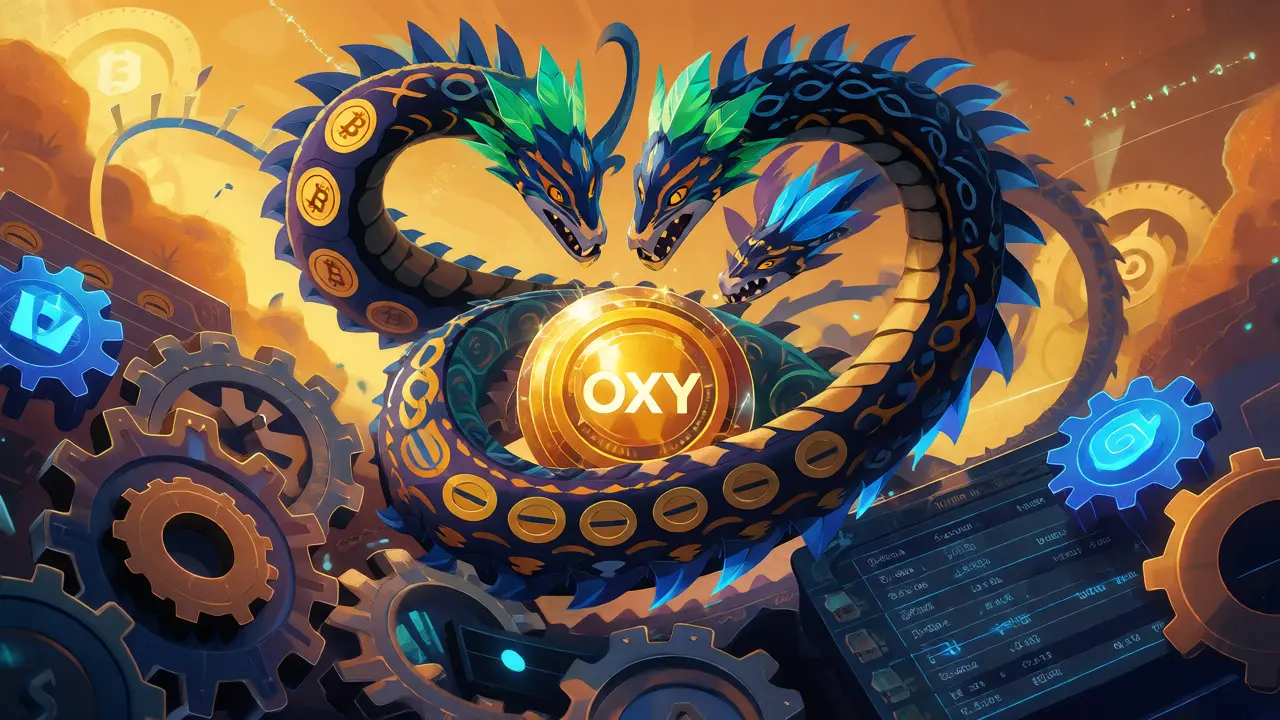
Market Performance and Liquidity Risks
If you’re looking at charts, you’ll see a steep decline. From trading near $0.25 in early 2024, OXY dropped to sub-millidollar levels by late 2025 and into 2026. As of September 2026, major aggregators like CoinGecko and CoinMarketCap show prices between $0.00055 and $0.00071 USD.
More concerning than the price is the volume. On Raydium, the most active Solana DEX for OXY, daily trading volume often sits under $200. Total tracked volume across all markets can be as low as $78 per day. This thin liquidity means large buys or sells can drastically move the price, making it risky for anyone other than small-scale speculators.
Data discrepancies also exist. Some platforms report a market cap of roughly $22,000, while others cite figures in the millions, depending on whether they count locked tokens as part of the circulating supply. Always verify the source methodology before trusting a market cap number.
Who Should Use Oxygen?
Oxygen isn’t for the casual investor buying and holding on Coinbase. It’s designed for sophisticated DeFi users who understand margin trading and want non-custodial control. If you are already active on Solana and use Serum, Oxygen adds a layer of financial engineering that lets you optimize capital efficiency.
However, the learning curve is steeper than swapping tokens on Uniswap. You need to understand collateral factors, liquidation thresholds, and pool mechanics. For beginners, the complexity combined with low liquidity makes it a challenging entry point.

Frequently Asked Questions
Is Oxygen (OXY) a good investment in 2026?
This depends on your risk tolerance. OXY is currently a micro-cap asset with very low liquidity. While the technology offers unique prime brokerage features, the token's value is heavily suppressed by the legacy issues from the FTX collapse. It is considered a high-risk speculative play rather than a stable blue-chip crypto investment.
Why is the circulating supply of OXY so low?
A large portion of the OXY supply was distributed during an IEO on FTX. When FTX collapsed, many tokens remained locked or inaccessible within the bankruptcy estate. Additionally, vesting schedules for team and investors mean that a vast majority of the 10 billion max supply has yet to enter circulation.
How do I earn rewards with OXY?
You can earn rewards by providing liquidity to Oxygen pools or by holding OXY. Holders receive a share of 100% of the protocol's net fees through buy-backs or direct distributions. There are also tiered fee discounts for active traders who hold significant amounts of OXY.
Can I trade OXY on Ethereum?
Yes. OXY exists as an ERC-20 token on Ethereum in addition to its native SPL form on Solana. This allows for cross-chain interoperability, though most trading activity and protocol functionality remain concentrated on the Solana network due to lower fees and faster settlement.
What is the difference between Oxygen and Aave?
Aave is primarily a lending and borrowing market where users isolate specific assets. Oxygen functions more like a prime broker, using pooled assets to allow for cross-collateralization and portfolio-level margining. Oxygen also relies on Serum's order book for trading, whereas Aave typically uses oracle-based pricing for loans.
Final Thoughts on Oxygen Protocol
Oxygen represents an ambitious attempt to bring institutional-grade financial tools to decentralized rails. Its integration with Serum and its revenue-sharing model are technically sound and attractive to advanced users. However, the shadow of the FTX crisis looms large, restricting liquidity and suppressing price discovery.
If you believe in the long-term viability of Solana's DeFi infrastructure and can tolerate extreme volatility, Oxygen might offer asymmetric upside. But for most, the current lack of volume and clear path to unlocking trapped supply makes it a watchlist candidate rather than a core portfolio holding.






14 Comments
Bro this is actually insane that we are talking about a protocol with $78 daily volume like its some kind of hidden gem. I saw OXY hit sub-millidollar levels and honestly thought the project was dead. But then you read about the prime brokerage stuff and it's like... wait, they still have code running? It feels like watching a zombie walk around a mall after everyone left. The FTX thing really nuked everything for these Solana tokens. If you buy now you are basically catching a falling knife that has already hit the floor and bounced off into another dimension. I'm scared to even look at my portfolio because if I hold anything related to Serum or Oxygen I might just cry.
The official narrative regarding the FTX collapse and the subsequent liquidity crunch in Oxygen Protocol is a masterclass in obfuscation designed to distract the unwary masses from the true machinations of centralized finance entities masquerading as decentralized saviors. We must recognize that the low circulating supply is not merely an accident of bankruptcy proceedings but rather a deliberate mechanism employed by insiders to maintain control over the tokenomics while retail investors were left holding worthless paper. The so-called "buy-and-burn" mechanisms serve little purpose other than to create an illusion of value accrual for those who remained loyal during the darkest hours of the market crash which was clearly orchestrated by regulatory bodies working in tandem with exchange operators to consolidate power. One cannot help but feel a sense of righteous indignation when observing how the community was led to believe in the promise of non-custodial prime brokerage only to be betrayed by the very custodians they sought to escape. This situation exemplifies the inherent fragility of DeFi projects that rely heavily on centralized exchanges for initial distribution and liquidity provision. The moral hazard created by such dependencies undermines the foundational principles of decentralization and exposes participants to risks that are fundamentally incompatible with the ethos of blockchain technology. Furthermore the discrepancy in reported market cap figures across various aggregators suggests a lack of transparency that should concern every serious investor who values integrity above hype. We must demand greater accountability from protocols that fail to provide clear pathways for unlocking trapped supply and restoring genuine market confidence. Until such measures are implemented we remain vulnerable to manipulation by those who profit from confusion and uncertainty. :-(
Hey everyone! Just wanted to drop some positive vibes here. Even though the charts look rough right now remember that every cycle brings new opportunities. Solana is resilient and so are the builders behind Oxygen. Keep learning and keep building your understanding of DeFi mechanics. You got this!
You guys are missing the point completely. Oxygen isn't just a lending platform it's a prime broker. Aave doesn't do cross collateralization the same way. Serum integration is key. Most people don't understand order books vs AMMs. That's why they lose money. Simple as that.
I appreciate the detailed breakdown of the pool architecture. It is crucial to note that the distinction between isolated markets and pooled risk is fundamental to understanding Oxygen's value proposition. However, one must also consider the implications of having a dual-token structure on both Ethereum and Solana. While interoperability is beneficial, it often fragments liquidity. For a micro-cap asset, this fragmentation can be detrimental to price discovery. Nevertheless, the technical implementation of portfolio margining remains impressive for a protocol of this size.
Another Solana rug waiting to happen. FTX killed it. Done. Move on.
I think it's important to remember that behind every chart there are real people trying to build something meaningful. It’s okay to feel frustrated by the volatility, but try to focus on the utility aspect. Are you using the borrowing features? Sometimes stepping back helps us see the bigger picture without getting overwhelmed by the price action. Let's support each other through these dips.
Low liquidity makes entry risky. I prefer to wait until volume stabilizes before allocating capital.
Oh my god!!! Can you believe this??!! $78 volume???!!! That is literally nothing!!! I mean, seriously, how does anyone trade this??!! It's like shouting into a void!!! And the fact that it's still alive??!! Like, give me a break!!! I want to scream!!! Why do we even bother looking at these coins??!! My heart rate is up just reading this!!! Ugh!!! So stressful!!! But also kinda fascinating??!! In a sad way??!! Yeah!!! Definitely sad!!!
This whole situation proves that American crypto projects get crushed by global events while foreign entities clean up. Oxygen had potential but got tied to FTX which is a disaster. Now we're stuck with garbage tokens that nobody wants to touch. It's frustrating seeing good tech die because of bad partnerships. We need to protect our own ecosystem better next time. Stop trusting random exchanges with your life savings. It never ends well for the average guy.
One must contemplate the ontological status of a token whose value is derived primarily from the absence of liquidity rather than its intrinsic utility. Is it truly a currency if no one trades it? Or is it merely a digital artifact of past speculation? The philosophical implications of holding an asset that exists in a state of quantum superposition-both valuable and worthless depending on the observer's willingness to engage-are profound. We are witnessing the decay of meaning in financial instruments where form outlasts function. It raises questions about what we actually own when we hold a token locked in a smart contract with no counterparty. :-)
It’s tough seeing projects struggle, but maybe this is a chance for the community to rebuild trust slowly. If the tech works and people start using it again, the volume will come back. Patience is key. Let’s stay open-minded about the future potential despite the current struggles.
Honestly, this reads like a eulogy for a project that died two years ago and forgot to lie down. The "prime brokerage" angle sounds fancy, but let's be real: if you can't find a buyer for less than a hundred bucks a day, you're not a prime broker, you're a ghost town. The tokenomics look like they were designed by someone who hates shareholders. Locked supply plus zero volume equals zero exit strategy. Don't drink the Kool-Aid just because it says 'DeFi' on the label. It's stagnant water.
Thank you for sharing this comprehensive analysis! It is quite helpful to see the technical details laid out so clearly. For those new to the concept of prime brokerage in DeFi, I would recommend starting with small test transactions to understand the liquidation thresholds. It is perfectly normal to feel hesitant given the low liquidity, but experimenting with small amounts can help demystify the process. Remember, knowledge is power, and understanding the mechanics is the first step toward making informed decisions. Stay safe and happy trading!