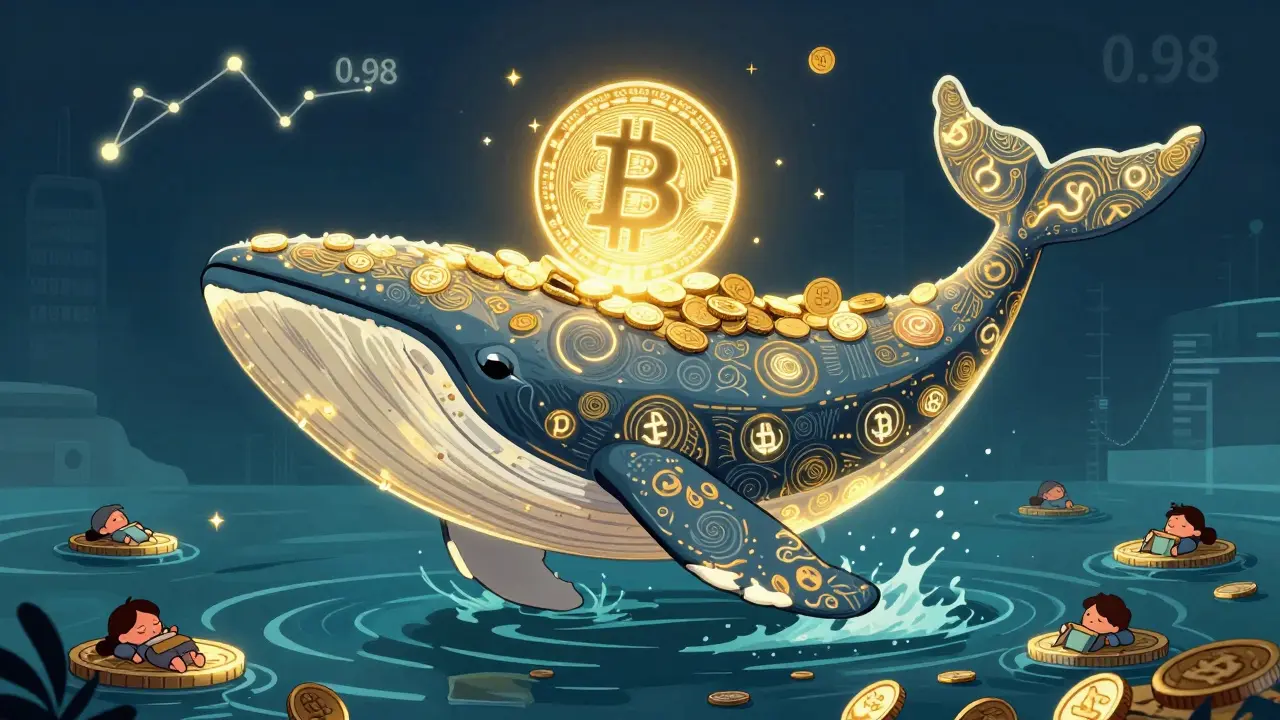

When you see Bitcoin price stall for weeks with little movement, it’s easy to think the market is dead. But behind the scenes, something powerful might be happening - whale accumulation. On the flip side, when retail investors are celebrating a new all-time high, the real money might already be walking away - that’s whale distribution. These aren’t just buzzwords. They’re the hidden engine behind most major crypto price moves.
What Exactly Are Crypto Whales?
Crypto whales aren’t mythical creatures. They’re real wallets holding massive amounts of cryptocurrency. For Bitcoin, that means addresses with 100 to 10,000 BTC. For Ethereum, it’s wallets with over 5,000 ETH. On smaller altcoins, a whale might hold just 1-5% of the total supply - but that’s still enough to move markets.These aren’t random individuals. Many are hedge funds, family offices, or early investors who bought Bitcoin at $100 or Ethereum at $10. They don’t trade like you or me. They don’t click ‘buy’ on Coinbase when the price spikes. They move slowly, quietly, and strategically - often using over-the-counter (OTC) desks to avoid triggering price swings.
There are even subcategories: dolphins (1K-100K tokens), sharks (100K-1M), and true whales (>1M). Only about 3,753 wallets hold over 1 million tokens across all major cryptos. Yet, these wallets control a disproportionate share of liquidity and supply.
Whale Accumulation: The Quiet Build-Up
Accumulation is when whales are quietly buying. This usually happens during sideways markets, after a crash, or when the broader market is pessimistic. You won’t see big price spikes. Trading volume stays low. Retail traders get bored. They think, “Nothing’s happening. Time to quit.”
But whales are working. They’re consolidating UTXOs - merging small Bitcoin chunks into larger ones - to reduce future transaction fees and make future selling easier. They’re buying from exchanges in small batches, avoiding detection. They’re using OTC trades with private counterparties so their buying doesn’t show up on public order books.
Here’s how you spot it:
- Supply per Whale (Glassnode): If the average amount of Bitcoin held per whale address is rising, they’re accumulating.
- Accumulation Trend Score: A score near 1 means whales are buying aggressively. In late 2023, Bitcoin’s score hit 0.98 - one of the highest in years.
- Exchange outflows: When whales move coins off exchanges (like Coinbase or Binance), they’re likely storing them in cold wallets - a classic accumulation sign.
One trader on Reddit tracked Bitcoin’s March 2023 rally by watching Glassnode’s data. In February, Supply per Whale rose steadily while price hovered around $22,000. He bought. By March, Bitcoin hit $28,000. He didn’t guess. He followed the whales.
Whale Distribution: The Slow Exit
Distribution is the opposite. It’s when whales start selling - but not all at once. They know if they dump 10,000 BTC in one day, the price crashes. So they spread it out over weeks or months. They sell during periods of retail euphoria - when everyone’s posting “to the moon” memes and new investors are FOMOing in.
Here’s what distribution looks like on-chain:
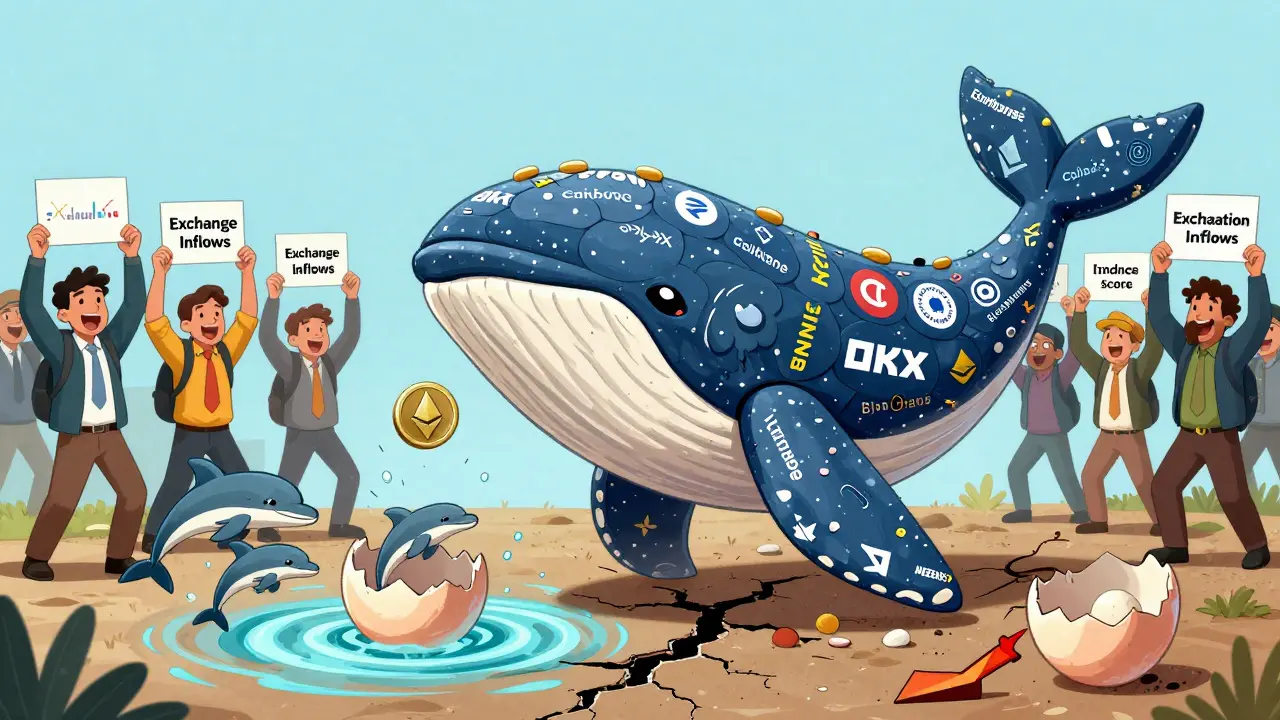
- Exchange inflows: When whales move coins onto exchanges, it often signals they’re preparing to sell. OKX Academy found a strong correlation between whale deposits and short-term price drops.
- Supply per Whale falling: If the average holding size per whale address drops, they’re splitting up their holdings to sell quietly.
- Accumulation Trend Score near 0: A score close to zero means whales are net sellers.
One major red flag? When retail traders are buying aggressively while whales are moving coins to exchanges. That’s a classic top. The Steemit analysis of the Cake/USDT pair showed this pattern clearly: after a long accumulation phase, whales created fake bullish signals (absorption), then started distributing - and the price collapsed.
Why Whale Behavior Matters More Than You Think
Whales don’t just move prices. They shape market psychology. When they accumulate, it signals confidence. When they distribute, it signals doubt. And because they control such a large slice of supply - around 13.5% of all Bitcoin - even small shifts in their behavior ripple through liquidity pools, order books, and margin funding rates.
Think of it like this: if 10 people own 90% of a small town’s water supply, the price of water doesn’t depend on how many people are using it. It depends on what those 10 decide to do. Crypto markets work the same way.
According to Nansen, when a few whales hold a large share of a token, it becomes vulnerable to sharp swings. A single whale moving 500 ETH can trigger cascading liquidations on leveraged positions. That’s why some analysts say: “Whale distribution is the real bear market signal - not macro news or Fed statements.”
Tools to Track Whales (Free and Paid)
You don’t need a $1,500/month subscription to start. Here’s how to begin:
- Free tools: Glassnode’s public charts, Blockchain.com’s Whale Wallet Tracker, and CoinGecko’s on-chain metrics. These show basic trends like exchange inflows/outflows and whale supply changes.
- Advanced tools: Nansen ($999/month) and Glassnode Studio ($1,499/month) let you track wallet types, profitability, and historical behavior. Nansen’s “Smart Money” feature identifies wallets that have consistently made profitable trades - not just big ones.
- Order book analysis: Look for large buy walls (support) or sell walls (resistance). If whales are placing huge limit orders just below the current price, they’re likely accumulating.
Pro tip: Don’t rely on one metric. Combine Supply per Whale with exchange flows and Accumulation Trend Score. If two out of three show accumulation, it’s a stronger signal.
Why Whale Signals Fail - And How to Avoid Getting Tricked
Whale tracking isn’t magic. It’s a tool. And like any tool, it can be misused - or manipulated.
Here are common traps:
- Exchange deposits aren’t always selling. Whales sometimes move coins to exchanges to stake, lend, or use in DeFi - not to sell. Always check the wallet’s history. Has it done this before?
- Multiple whales share one address. A single wallet might belong to a fund with dozens of clients. A withdrawal doesn’t mean one whale is exiting - it could be 10.
- Spoofing. Some whales create fake accumulation signals to lure retail buyers in. Then they dump. Dr. Jane Chen from CryptoSlate warns: “Whales can and do manipulate sentiment.”
- Macro overrides micro. In July 2023, whale accumulation signals appeared as Bitcoin dropped to $25,000. But the Fed’s rate hike crushed the market anyway. Whale behavior matters - but not more than global liquidity.
Experts recommend waiting for three consecutive days of consistent signals across multiple metrics before acting. One day of movement? Noise. Three days? Likely a trend.
The Future of Whale Tracking
Whale tracking is evolving fast. In late 2023, Glassnode launched its Whale Grading System - scoring wallets based on profitability, age, and activity. Nansen introduced Smart Money tracking to identify wallets with a history of alpha. Bitquery now uses machine learning to predict whale moves with 68.3% accuracy.
Institutional adoption is skyrocketing. MarketsandMarkets predicts the blockchain analytics market will hit $1.86 billion by 2027. CoinDesk Research says 78% of institutional crypto portfolios will use whale tracking by 2025.
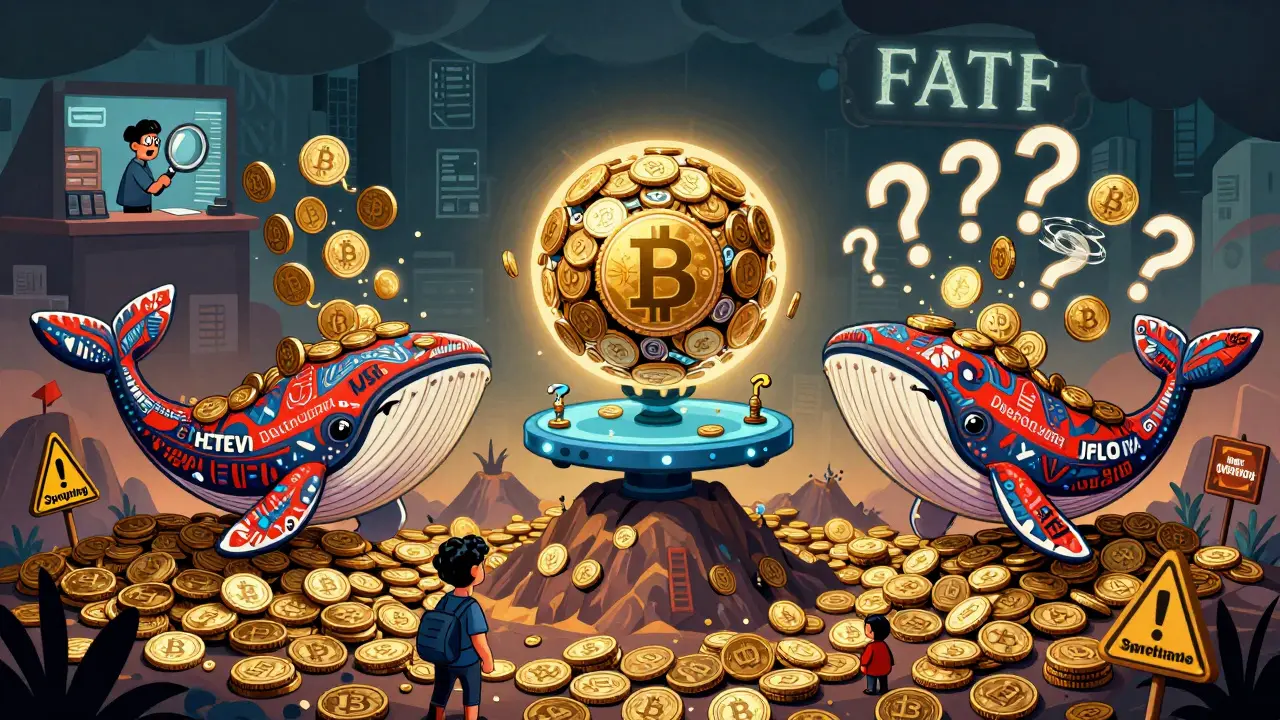
But there’s a shadow. The FATF and EU regulators are considering restricting whale data under privacy laws. If that happens, transparency could shrink. Whales might shift to multi-sig wallets or DeFi protocols to hide activity.
For now, blockchain remains the most transparent financial system ever created. And as long as that’s true, whale accumulation and distribution will continue to be the hidden rhythm behind crypto’s biggest moves.
How do I know if whales are accumulating or distributing in real time?
Use free tools like Glassnode’s public charts to monitor two key metrics: Supply per Whale and the Accumulation Trend Score. If Supply per Whale is rising and the score is above 0.8, whales are accumulating. If it’s falling and near 0, they’re distributing. Combine this with exchange inflows/outflows - consistent outflows mean accumulation, inflows mean distribution.
Can retail traders profit from whale signals?
Yes - but only if you treat them as one piece of a larger puzzle. Whale accumulation often precedes major rallies. Distribution often precedes corrections. But never act on whale data alone. Always check macro trends, volume, and on-chain activity. Many retail traders lose money by buying during whale accumulation because they ignore Fed news or regulatory risks.
Are whale wallets always the same addresses?
No. Whales often split holdings across multiple addresses to avoid detection. They also consolidate UTXOs - combining small amounts into larger ones - to reduce transaction fees. Some use multi-sig wallets or DeFi protocols to hide activity. That’s why tracking behavior (like consistent inflows/outflows) matters more than tracking a single wallet.
Do whales control the entire market?
No, but they control the leverage points. For Bitcoin, the top 1% of wallets hold over 40% of supply. For many altcoins, the top 10 wallets can hold more than 30%. This means even small moves by whales can trigger cascading liquidations or panic buying. They don’t control the market - but they tilt it.
Is whale tracking ethical?
Yes - because it’s based on public blockchain data. Every transaction is visible. Whale tracking doesn’t hack systems or steal data. It’s like watching public stock trades on NASDAQ. The ethical issue comes when people use it to manipulate others - for example, by spreading false whale signals to lure retail traders into bad trades.
Whale accumulation and distribution aren’t about guessing the future. They’re about reading the signs the market leaves behind. The blockchain doesn’t lie. The whales do - but only if you’re not looking closely enough.








11 Comments
WHALES ARE THE REAL MVPs 😤📈 Just watched Supply per Whale spike for 3 days straight while BTC was stuck at $22k... I bought in. Now it's at $28k. No FOMO. Just data. 🤖💎
I appreciate how thorough this is. The distinction between accumulation and distribution is so often misunderstood. I’ve been tracking exchange outflows for months now - it’s not about timing the market, it’s about understanding the rhythm. Small steps, consistent observation. 🌱
There's a lot of noise out there about whale activity. But the real insight is in the consolidation patterns - merging UTXOs isn't just technical, it's strategic. It means they're preparing for a move. Not buying. Not selling. Preparing.
It’s funny how we anthropomorphize whales like they’re chess masters... but they’re just entities reacting to incentives. The blockchain doesn’t care if we call them smart or manipulative. It just records. And if we stop projecting human motives onto addresses, we start seeing the truth. The market is a mirror. What we see is what we bring to it. 🤔
Let’s be real - most retail traders don’t understand UTXOs, OTC desks, or on-chain metrics. They’re just gambling with memes. Whale tracking isn’t a strategy - it’s a survival tool for people who refuse to be prey. If you’re not using Glassnode or Nansen, you’re not trading. You’re donating.
I find it profoundly disturbing that people treat blockchain data as if it’s neutral. It’s not. It’s a weaponized transparency. The very act of tracking whales enables manipulation. And yet, you’re all celebrating it like it’s enlightenment. How naive.
People think whale tracking is about profit... but it’s really about control. Who gets to see what? Who gets to decide what’s 'smart money'? It’s not analysis - it’s a new kind of hierarchy. And we’re all happily signing up for it.
This made me feel so seen 😊 I used to panic when BTC dipped - now I check exchange outflows. If coins are leaving, I breathe. If they’re coming in? I pause. It’s not about being right. It’s about staying calm. Thank you for this 🙏
i just check glassnode once a week and chill. if the line goes up i nod. if it goes down i nod. no stress. crypto is a vibe not a spreadsheet
whales r just rich ppl with too much time on their hands lol
if whales are accumulating why is btc still at 60k? 🤔