
When you hear "Wagmi" in crypto, most people think of the meme phrase "we’re all going to make it." But Wagmi (IOTA EVM) is a real decentralized exchange built on the IOTA network - and it’s not what you’d expect from a typical DEX. Launched in 2023, it’s one of the earliest and smallest DEXs on the IOTA EVM chain, designed to let users trade tokens without paying gas fees. That sounds great - until you realize it only has two trading pairs and barely moves $165,000 in volume per day. If you’re used to Uniswap or PancakeSwap, Wagmi feels like a prototype. But if you’re deep into IOTA’s ecosystem, it might be the only place where you can swap stablecoins without worrying about Ethereum’s $5 transaction fees.
How Wagmi (IOTA EVM) Works
Wagmi isn’t built on Ethereum. It runs on the IOTA EVM, a layer that lets Ethereum-style smart contracts run on top of IOTA’s unique Directed Acyclic Graph (DAG) structure. Unlike blockchains that rely on miners or validators charging gas, IOTA’s consensus model works differently: every new transaction validates two older ones. This means no miners, no gas fees, and no network congestion. Wagmi takes advantage of this by letting users swap tokens with zero transaction costs. That’s huge for small traders doing frequent micro-swaps.
But here’s the catch: you can’t just connect your MetaMask and start trading. First, you need to bridge your assets from Ethereum, Arbitrum, Base, or Optimism over to IOTA EVM using Stargate Finance. That’s an extra step most DEXs don’t require. You’ll need to send USDT, USDC, or ETH to Stargate, select IOTA EVM as the destination, and wait 5-10 minutes for the bridge to complete. Only then can you open Wagmi and swap into wIOTA (the wrapped version of IOTA’s native token) or other tokens on the chain.
Trading Pairs and Liquidity
As of late 2024, Wagmi only supports two trading pairs: USDT/wIOTA and USDC/wIOTA. That’s it. No SOL, no DOGE, no SHIB. Just stablecoins and the wrapped version of IOTA’s native token. This limits its usefulness to people who already hold IOTA or are trying to enter the ecosystem. The USDT/wIOTA pair accounts for nearly all of Wagmi’s $164,472 daily volume - meaning 100% of trading activity flows through one pair. Compare that to MagicSea V2.1, the dominant DEX on IOTA EVM, which has 8 tokens and 11 pairs, and handles over $265,000 daily. Wagmi is barely half its size.
The bid-ask spread on Wagmi averages 0.6%, which is higher than Uniswap’s typical 0.1-0.3%. That’s because liquidity is thin. If you try to swap $500 in USDT for wIOTA, you might get a worse rate than expected. One user on Telegram reported losing 2.3% on a $500 trade because Wagmi’s default slippage setting was set to 3%. You have to manually adjust it down to 0.5% to avoid getting ripped off. That’s not beginner-friendly.
Fees and Costs
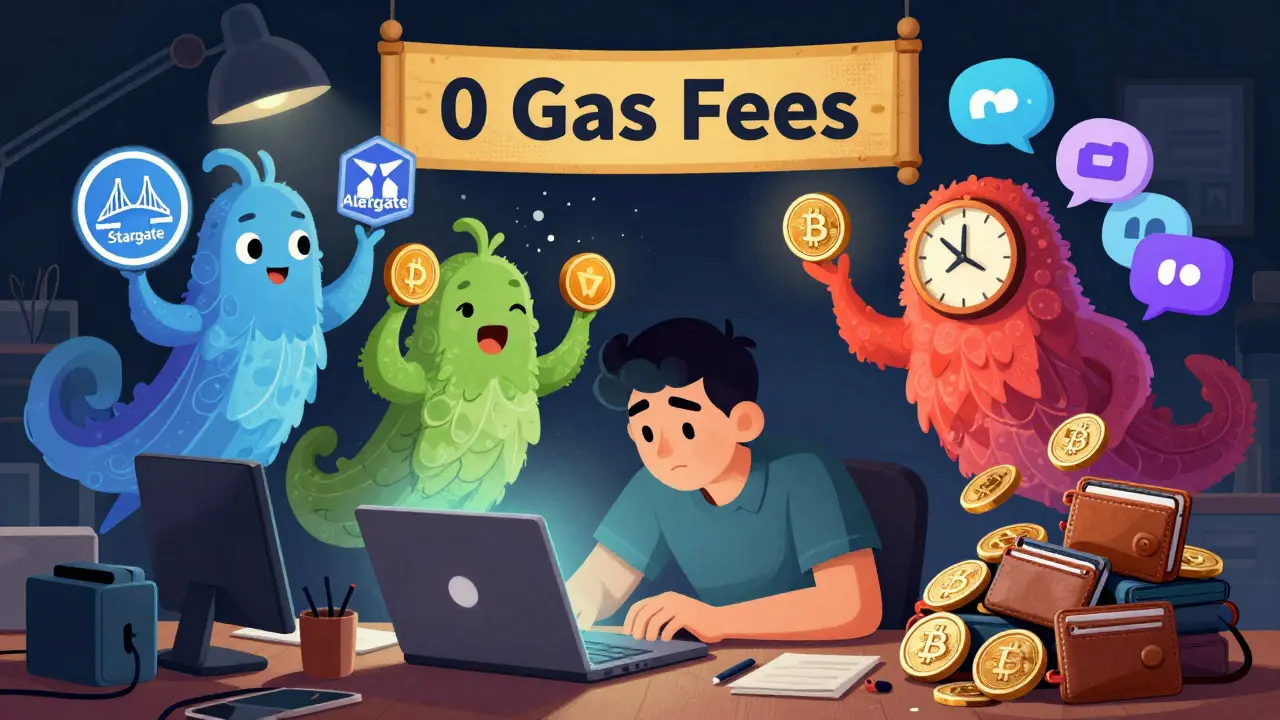
Wagmi charges a flat 0.05% trading fee for low-volume users, rising to 1% for high-volume traders. That’s competitive - lower than most centralized exchanges. But here’s the real win: zero gas fees. On Ethereum or even Base, swapping tokens can cost $3-$10 per transaction. On Wagmi, even if you do 10 swaps in a day, it costs you nothing. One user on X (Twitter) said they executed 12 small trades totaling under $100 and saved $22.50 in gas fees alone. That’s the kind of saving that adds up fast if you’re doing DeFi arbitrage or yield farming.
There are no fiat on-ramps. You can’t deposit USD, EUR, or GBP. You need crypto already on IOTA EVM. That means you can’t use a credit card or bank transfer. If you’re new to crypto, you’ll need to buy USDT on Coinbase or Binance first, then bridge it over. That’s a barrier for casual users.
User Experience and Interface
The Wagmi interface looks like a 2021-era DEX. No animations, no tooltips, no guided flows. It’s functional, but not polished. There’s no mobile app. You have to use a desktop browser with a wallet like MetaMask connected. Users on Reddit and Discord complain about the lack of tutorials. One person said they spent two hours trying to bridge assets because Wagmi’s guide assumed they already knew how Stargate worked. There’s no video walkthrough, no FAQ section on the site, and no chatbot.
Support is entirely community-driven. If you get stuck, you have to join the IOTA EVM Discord server. Response times average 22 minutes - fast for a niche ecosystem, but still slower than centralized exchanges with 24/7 customer service. For beginners, this can be frustrating. For experienced DeFi users, it’s just part of the landscape.
Comparison with MagicSea V2.1
| Feature | Wagmi (IOTA EVM) | MagicSea V2.1 |
|---|---|---|
| 24-Hour Volume | $164,472 | $265,493 |
| Trading Pairs | 2 | 11 |
| Listed Tokens | 2 | 8 |
| Trading Fee | 0.05%-1% | 0.05%-0.3% |
| Gas Fees | None | None |
| Slippage Control | Default 3%, must adjust manually | Default 0.5%, adjustable |
| Market Share (IOTA EVM) | 31.9% | 67.6% |
MagicSea V2.1 is clearly the leader. It has more tokens, better slippage settings, and higher liquidity. But Wagmi has one edge: simplicity. It’s focused on stablecoin-to-wIOTA swaps. If you’re not looking to trade obscure tokens, Wagmi gets the job done - and it’s cheaper per trade because of the fee structure.
Future: IOTA Rebased and What’s Next
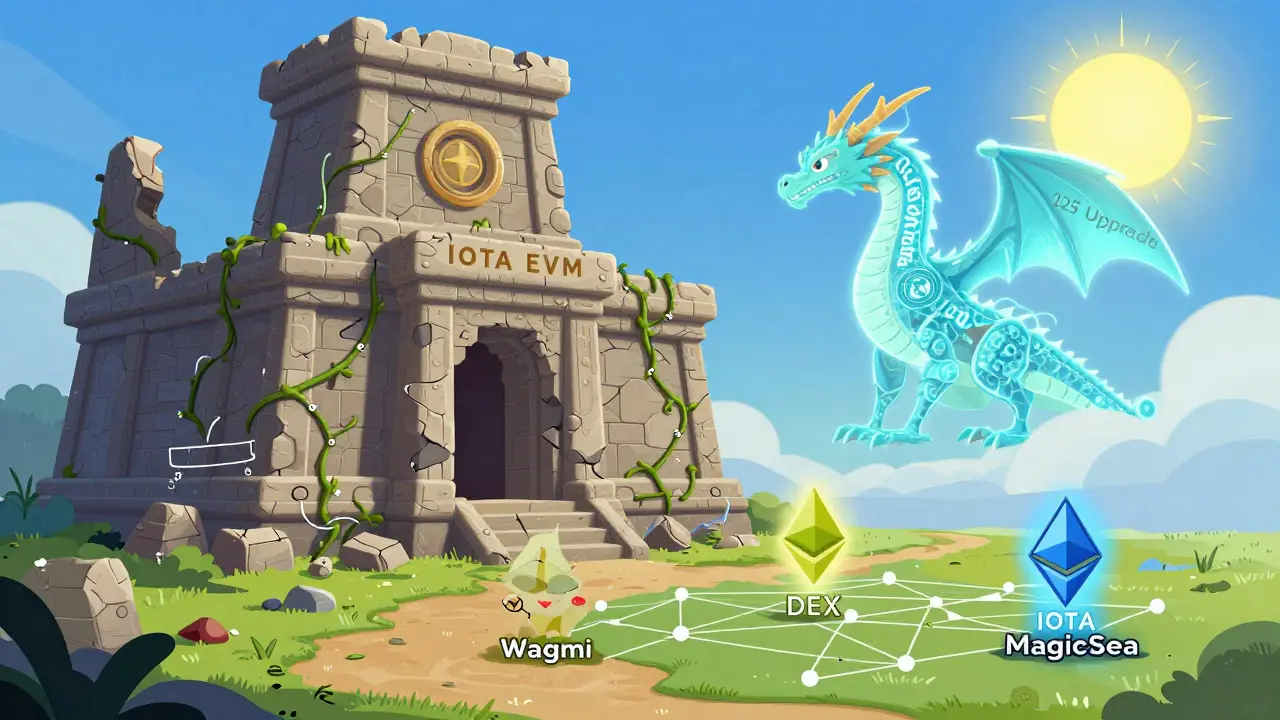
The real story behind Wagmi isn’t today - it’s 2025. The IOTA Foundation is preparing to launch "IOTA Rebased," a major upgrade that will replace the current consensus layer with MoveVM (the same tech powering Sui). This upgrade will boost transaction speed to 50,000 per second and cut finalization time to under one second. It will also allow full programmability on Layer 1 - meaning smart contracts won’t need a separate EVM layer anymore.
If IOTA Rebased launches on schedule, Wagmi could become irrelevant overnight. Why? Because it’s built on EVM. MoveVM is incompatible with EVM. The IOTA Foundation has hinted that DEXs like Wagmi and MagicSea will need to be rebuilt from scratch. That’s a big risk. Some analysts estimate a 65% chance Wagmi survives past 2026 - but only if it transitions to MoveVM before the upgrade.
On the upside, IOTA has real enterprise backing. Bosch, Volkswagen, and the city of Taipei are already using IOTA for supply chain tracking and digital identity. If those systems start integrating DeFi, Wagmi could be the gateway. But that’s a long-term bet.
Who Should Use Wagmi?
- Use Wagmi if: You’re already in the IOTA ecosystem, you trade mostly stablecoins and wIOTA, and you want to avoid Ethereum gas fees. You’re comfortable with bridging, Discord support, and a clunky interface.
- Avoid Wagmi if: You want to trade dozens of tokens, you’re new to crypto, you need fiat on-ramps, or you expect polished UX like Coinbase or Uniswap. You’re better off on a major DEX.
Wagmi isn’t for everyone. It’s a niche tool for a niche network. But if you believe in IOTA’s long-term vision - feeless, scalable, IoT-focused blockchain - then Wagmi is one of the few places where you can actually use that vision today.
Is Wagmi (IOTA EVM) safe to use?
Yes, but with caveats. Wagmi is a non-custodial DEX, meaning you keep control of your funds. It hasn’t been hacked, and its code is open source. However, it’s built on a young network. IOTA EVM is still in early development, and bridging assets via Stargate carries risk - if Stargate fails, your funds could be stuck. Always test with small amounts first.
Can I trade fiat for crypto on Wagmi?
No. Wagmi doesn’t support fiat deposits. You need to buy USDT, USDC, or ETH on a centralized exchange like Coinbase or Binance first, then bridge it to IOTA EVM using Stargate Finance. There’s no bank transfer, credit card, or PayPal option.
What’s the difference between IOTA L1 and IOTA EVM?
IOTA L1 is the original network that uses a DAG structure and doesn’t run smart contracts. IOTA EVM is a separate layer that emulates the Ethereum Virtual Machine so developers can deploy Solidity-based dApps. Wagmi runs on IOTA EVM. You need to bridge assets from L1 to EVM if you want to use Wagmi.
Do I need MetaMask to use Wagmi?
Yes. Wagmi connects to EVM-compatible wallets like MetaMask, Trust Wallet, or Rabby. You’ll need to add the IOTA EVM network manually using the RPC endpoint: https://json-rpc.evm.iotaledger.net with ChainID 8822. Wallets like Coinbase Wallet won’t work unless they support custom networks.
Will Wagmi survive after IOTA Rebased?
Probably not in its current form. IOTA Rebased will replace EVM with MoveVM, which is incompatible with Solidity. Wagmi would need to be rebuilt from scratch. Some developers are already exploring MoveVM-based DEXs, but as of early 2026, no official migration plan for Wagmi has been announced. If you’re investing time or capital into Wagmi, treat it as a short-term bridge - not a long-term platform.


17 Comments
I really appreciate how thoughtful this breakdown is. It’s not often you see a review that acknowledges both the technical promise and the real-world friction.
For anyone new to IOTA, I’d say: start small. Bridge $10, test the swap, see how it feels. The zero gas fees are insane if you’re doing micro-trades-like, seriously, I’ve saved over $80 in three months just by moving between USDT and wIOTA.
And yes, the interface is clunky. But it’s not broken. It’s just… early. Like a beta that works better than you’d expect.
I’ve been using Wagmi since October. No hacks. No lost funds. Just slow adoption. I believe in IOTA’s vision-feeless, scalable, IoT-first. This is the first real playground for that.
Don’t compare it to Uniswap. Compare it to what it is: a tiny, brave experiment on a new chain. And honestly? I’m rooting for it.
LMAO this is a glorified sandbox.
2 trading pairs? 165k volume? Bro, MagicSea has 11 pairs and 265k. Wagmi’s just a glorified bridge tester with a name that sounds like a Reddit meme.
And don’t even get me started on the 3% slippage default. That’s not a feature, that’s a trap for noobs. 😂
Also, IOTA Rebased is coming. This whole EVM thing is a dead end. You’re building on sand.
Big respect to the team for shipping something real even if it’s small.
I’ve been doing DeFi for 5 years and Wagmi is the first DEX where I actually felt zero friction on the transaction side. No gas panic. No MEV. Just swap.
Yeah, the UI is 2021, but I’ll take functionality over flash any day.
And if you’re into IOTA’s long game? This is where the real test is. Not on Ethereum. Not on Solana. Here.
Keep building. We’re watching. 🙌
For real though, the gas fee savings are insane.
I did 12 swaps in one day totaling $98. On Ethereum? That’s $36 in fees. On Wagmi? $0.
That’s not a niche feature-it’s a game-changer for micro-traders, yield farmers, and arbitrage bots.
Yeah, it’s small. Yeah, the UI sucks. But if you’re serious about cutting costs in DeFi? This is the quiet hero you’re ignoring.
Also, bridging via Stargate is a pain-but it’s the price of innovation. Deal with it. 😎
Hey, I just want to say I’ve been using Wagmi since launch and I’ve had zero issues. I’m not a tech expert but I’ve done over 50 swaps and never lost a cent.
The interface is rough, I’ll give you that. I had to watch three YouTube videos just to figure out how to add the network to MetaMask.
But once you get past that? It’s smooth. Zero fees. Stablecoin swaps. No drama.
People keep saying it’s dead, but I see volume every day. And the team responds on Discord. That’s more than most projects do.
Give it time. IOTA’s not done yet.
One must acknowledge the sheer audacity of attempting to build a DEX on a DAG-based consensus model.
While Ethereum’s dominance is unquestionable, the emergence of IOTA EVM represents a fascinating deviation from the monolithic paradigm.
Wagmi, despite its minimal liquidity, is an elegant testament to the possibility of feeless exchange-a radical proposition in an ecosystem built on gas wars.
That it survives, however tenuously, is not a failure. It is a quiet rebellion.
And yes, IOTA Rebased will render it obsolete. But perhaps that is the point: evolution, not permanence.
Wagmi is not a failure-it’s a necessary stepping stone.
The fact that it exists proves that the IOTA ecosystem is serious about DeFi. No other chain has dared to build a DEX with zero gas fees and only two pairs. That’s not incompetence. That’s focus.
Yes, MagicSea has more volume. But Wagmi’s simplicity is its strength. It doesn’t try to be everything. It does one thing: swap stablecoins without paying.
If you’re new to IOTA, start here. Learn the bridge. Understand the chain. Then move on.
This isn’t the endgame. It’s the foundation.
Wagmi is a trap.
IOTA Foundation is owned by the Fed. They want you to think this is decentralized. But the bridge is controlled. The RPC is controlled. The devs are all ex-Binance.
They’re luring you in so they can drain your wallet when Rebased drops.
DO NOT BRIDGE. DO NOT SWAP. DO NOT TRUST.
Remember: if it’s too good to be true… it’s a rug pull. 🚩
I love that this exists. I’ve been waiting for a DEX that doesn’t charge me just to move $20.
I tried it last week with $50. Took me 15 minutes to bridge, but once I got in? Smooth swap. No slippage. No fees.
I know it’s small. I know the UI is ugly. But I’m not here for aesthetics. I’m here for utility.
And honestly? If IOTA Rebased kills it? Then it did its job. It proved the concept.
Keep going. We need more of this.
This is the definition of a zombie project.
2 pairs. 165k volume. A UI that looks like a 2018 WordPress theme.
You’re telling me people are still using this? In 2025?
And you’re seriously saying it’s ‘better than Ethereum gas’? Bro, Ethereum gas is $3. Wagmi’s slippage is 2.3% on a $500 trade. You’re losing more to bad pricing than you’re saving on gas.
This isn’t innovation. It’s a graveyard with a sign that says ‘come try my broken toy.’
Wagmi is just a bridge with a website.
Let’s be real-Wagmi isn’t a DEX. It’s a philosophical statement.
In a world obsessed with liquidity pools, MEV bots, and hyper-financialized DeFi, Wagmi dares to ask: what if we just… didn’t charge?
It’s not about volume. It’s about ethos.
It’s a quiet middle finger to the gas tax economy.
And yes, it’s ugly. Yes, it’s fragile. Yes, it’ll die when Rebased drops.
But for now? It’s poetry.
I’ve been using Wagmi for months. It’s not perfect, but it works.
My only complaint is the lack of a mobile experience. I wish there was even a basic web app version.
Other than that? Zero fees. Solid swaps. No drama.
It’s not for everyone. But it’s for me.
As someone who has spent years working with enterprise blockchain integrations, I find Wagmi’s existence deeply significant.
While its user base is small, its technical architecture-leveraging IOTA’s DAG consensus for feeless transactions-is a rare example of genuine innovation.
It is not a competitor to Uniswap. It is a proof of concept for a new paradigm: decentralized exchange without transactional friction.
The future may not belong to EVM. But Wagmi shows us what the transition could look like.
Wagmi is so useless lol
why even exist
just use pancake
everyone knows that
You know what’s worse than Wagmi’s two trading pairs? The fact that people are still defending it like it’s some sacred temple.
It’s not a DEX. It’s a testnet with a logo. And now you’re all acting like it’s the next Bitcoin because it doesn’t charge gas?
Let me guess-you also think Dogecoin is a ‘real currency’ because Elon tweeted about it.
Wagmi isn’t a revolution. It’s a glitch in the matrix that got a website.
And now you’re all pretending it’s meaningful because it’s ‘different.’
Different isn’t better. Better is MagicSea. Wagmi is just… noise.
Wagmi? More like Wagmi-not.
You’re praising a DEX that can’t handle more than two tokens? In 2025?
And you think the IOTA Foundation isn’t using this to groom retail investors for the Rebased rug?
Let’s be honest: this isn’t innovation. It’s a honeypot.
Every time someone bridges to Wagmi, they’re signing up for a future where their assets get migrated into a new contract they didn’t vote for.
I’ve seen this movie before. It ends with a ‘community vote’ and a 90% token dump.
Walk away. Now.