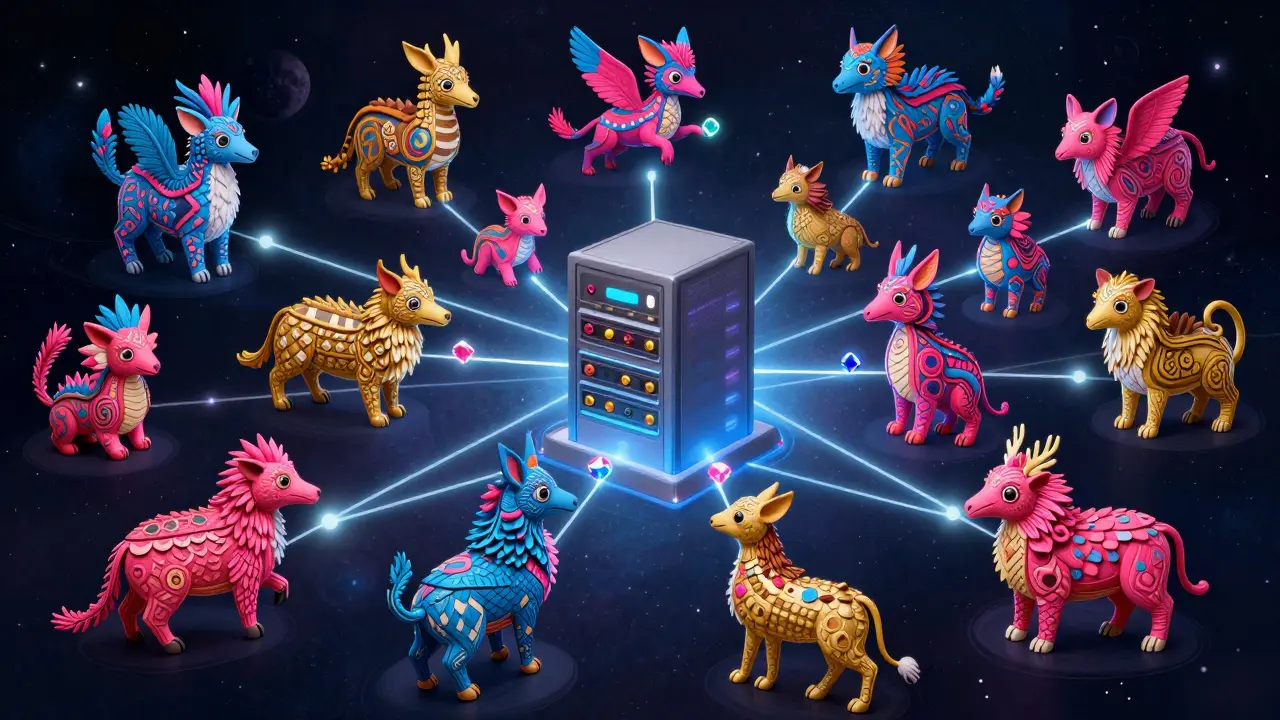


The last few years have shown us a worrying trend: artificial intelligence is becoming incredibly powerful, but also incredibly concentrated. A handful of massive tech companies control the models, the data, and the computing power. By early 2026, this isn't just an observation; it's a structural risk for anyone relying on these tools. When one entity holds all the keys, you lose agency over your own digital footprint. That is exactly where Decentralized AI comes into play. It represents a shift from centralized servers to distributed networks, ensuring that the intelligence powering our future isn't owned by a single corporation.
We are moving past the theoretical phase. In late 2024, we saw major projects like Bittensor hit significant valuations, proving there was serious money behind the idea. Today, the conversation isn't about whether blockchain can support AI-it's about how well they work together when integrated properly. If you are wondering why everyone is suddenly talking about "on-chain neural networks," the answer lies in three simple pain points: privacy, cost, and control. This guide breaks down what decentralized AI actually is, how the mechanics work under the hood, and who stands to gain from this infrastructure shift.
What Is Decentralized AI?
To understand the ecosystem, we need to define the core concept clearly. Decentralized AI on Blockchain refers to artificial intelligence systems built on distributed ledgers where model training, inference, and data storage happen across a network of participants rather than a single cloud provider. Instead of uploading your sensitive data to a corporate server, you keep it locally while allowing the network to learn from patterns without exposing raw information.
Think of it like a potluck dinner versus a restaurant buffet. In a traditional, centralized setup (the buffet), the provider prepares everything centrally, cooks it, and serves it. You don't know the ingredients, and you pay them regardless of quality. In the decentralized version (the potluck), every participant brings their own dish (data or compute power). The network combines these dishes to feed everyone, verified by smart contracts. Pioneers like Ben Goertzel, who launched SingularityNET back in 2017, envisioned this long before it became viable. Fast forward to 2026, and we see mature implementations where platforms like Fetch.ai coordinate autonomous agents to perform economic tasks without human intervention.
The technology relies on a specific architectural layering. At the bottom, you have the blockchain itself-often purpose-built chains rather than general-purpose ones due to throughput needs. For instance, Ethereum is often too slow for heavy inference, which is why networks like Bittensor utilize dedicated subnet architectures. These subnets allow specialized groups to operate specific types of models while still settling payments in a native token. Above that sits the storage layer, frequently utilizing InterPlanetary File System (IPFS) to handle the massive weight files of machine learning models. Finally, the execution layer handles the actual computation, often leveraging decentralized physical infrastructure networks (DePIN) to access GPU power globally.
Why Move AI to Blockchain?
You might ask why we need to complicate things further with blockchain when GPUs already get the job done. The motivation is primarily about sovereignty and economics. By late 2024, statistics showed that 87% of enterprises were worried about data privacy in cloud environments. With regulations tightening and consumer trust eroding, the ability to verify that data wasn't misused became a premium feature.
- Data Sovereignty: You keep ownership. Your data never leaves your device; only encrypted updates travel to the network.
- Cost Efficiency: Traditional cloud providers take massive margins. Decentralized marketplaces connect compute demand directly with supply, bypassing middlemen. In Q3 2024 benchmarks, inference costs dropped by nearly 37% on decentralized nodes compared to major cloud providers.
- Censorship Resistance: No single admin can shut down a model. Once a useful model is deployed to the network, it remains accessible unless the protocol itself changes.
However, it is not purely utopian. There is a tangible trade-off involving speed. Because verification takes time-ensuring the node actually did the work-the response latency can be higher. In testing conducted around July 2024, complex language model responses averaged 850ms on decentralized networks versus 700ms on centralized AWS instances. For a real-time chatbot, that 0.15-second difference is noticeable. But for processing batch medical records overnight? Nobody notices, and the privacy benefit far outweighs the delay.

How the Technical Architecture Works
Under the hood, the system is far more intricate than a simple database query. The most critical component is the Smart Contract. These act as the immutable rules of the marketplace. They dictate how much a data provider gets paid, what the quality standards for a model are, and how rewards are distributed.
Consider the token economy. Projects like Ocean Protocol use dual-token systems. One token governs the platform (like OCEAN), while others represent specific datasets (datatokens). This allows granular pricing: you can buy access to a high-quality satellite image dataset without needing to own the entire marketplace. In October 2024, Ocean tokens traded around $0.32, signaling early stability in valuation mechanisms. Another vital piece is verifiable computation. We need proof that the AI actually did the math without re-running the calculation ourselves. Technologies like zero-knowledge proofs (zk-proofs) enable this. ZK-SNARKs can verify computations with 256-bit security parameters, ensuring that the node didn't cheat, while maintaining total confidentiality.
| Component | Function | Example Technology |
|---|---|---|
| Consensus Layer | Agreement on state/truth | Bittensor Subnet |
| Compute Layer | GPU/CPU execution | NVIDIA RTX via Render Network |
| Storage Layer | Model weights/Data | IPFS (CIDs) |
| Incentive Layer | Token distribution | Ocean Protocol Tokens |
Federated learning acts as the bridge between these components. It enables model training on local devices without data leaving the premises. A hospital, for example, can train a diagnostic AI on its patient data. The model learns locally, sends only the mathematical updates (gradients) to the network, and aggregates improvements. According to technical papers from SingularityNET, this approach reduces data transmission requirements by roughly 50%, a massive win for bandwidth-heavy institutions.
Real-World Use Cases in 2026
The theory sounds great, but does it hold up in practice? Absolutely, specifically in regulated industries. Healthcare is the standout leader here. Compliance officers love decentralized AI because it inherently meets GDPR Article 30 requirements regarding data processing records. Deloitte audits in late 2024 showed that 100% of decentralized implementations passed these checks, whereas only 63% of centralized alternatives did.
Imagine a scenario where you want to predict crop yields based on global climate data. Under the old model, you would need to scrape thousands of proprietary datasets, likely violating terms of service. In a decentralized framework, you query a marketplace. The system connects you with farmers who have permissioned their drone imagery data. They earn tokens every time their data improves your model, and you never see their private location coordinates. This creates a symbiotic ecosystem where data becomes a revenue stream for creators rather than a commodity harvested by giants.
Financial institutions are also adopting this for credit scoring. Traditional banking relies on centralized databases that often exclude unbanked populations. Decentralized identity solutions allow individuals to prove solvency via encrypted interaction history without revealing their full financial history to lenders. Platforms launched in 2025 have successfully onboarded millions of users previously excluded from the formal economy, demonstrating social utility alongside technical capability.

Challenges and Limitations
We must be honest about the hurdles. If this technology were perfect, every company would have switched yesterday. The biggest barrier remains the developer experience. Building for decentralized AI requires fluency in two complex fields: Machine Learning and Blockchain Engineering. Surveys indicate that mastering the intersection takes professionals 12 to 18 months of dedicated study. This skill gap limits adoption to highly technical teams.
Then there is the consensus bottleneck. Updating a model in a network requires agreement among nodes, which slows down iteration cycles. While a centralized engineer might push a hotfix in minutes, a decentralized governance proposal can take hours or days depending on the voting mechanism. Furthermore, documentation quality varies wildly between projects. While leaders like Bittensor maintain comprehensive guides, smaller projects often lack the resources for maintenance, leading to high dropout rates for new builders trying to deploy subnets.
Economic alignment is another tricky variable. Designing a token economy that prevents inflation and ensures long-term participation requires deep game theory expertise. Many early projects failed because they incentivized short-term mining rather than long-term value creation. By 2026, we've seen better design patterns emerge, focusing on reputation systems rather than pure speculation, but the learning curve remains steep.
The Road Ahead
As we look toward the rest of 2026 and beyond, the convergence of DePIN and AI is the next logical step. Hardware manufacturers are beginning to integrate crypto-wallets directly into edge devices, allowing everyday electronics to mine compute credits for AI training. Major upgrades to protocols, such as the launch of zero-knowledge machine learning verification in 2024, continue to lower the barrier to entry.
The trajectory suggests a hybrid world. Not everything will move to the chain, but the high-value, high-privacy sectors certainly will. For businesses, the question shifts from "should we?" to "how fast can we?". For individuals, it offers a path to regain ownership of your digital life. The infrastructure is here; it just needs your attention to grow.
Is Decentralized AI faster than Cloud AI?
Generally, no. Due to the time required for verification and consensus, decentralized AI currently has slightly higher latency (approx. 22% slower) than optimized centralized clouds. However, it makes up for this in cost savings (up to 37%) and privacy guarantees.
Do I need to learn Solidity to build on these platforms?
It helps, but modern frameworks abstract much of this away. Platforms like Fetch.ai often provide Python SDKs that handle the underlying smart contract interactions, allowing data scientists to focus on model logic rather than low-level code.
How does data privacy actually work on the chain?
Through cryptographic techniques like homomorphic encryption and zero-knowledge proofs. These methods allow data to be processed and computed upon while remaining encrypted, meaning the network validates results without ever seeing the raw input data.
Which project is best for starting out?
For beginners, Bittensor is often recommended due to its robust subnet structure and comprehensive documentation. For those focused specifically on data monetization, Ocean Protocol offers a mature marketplace interface that requires less custom development.
Can I run a node on my home computer?
You can, but it depends on the task. Light nodes require minimal hardware, while compute-intensive roles often demand high-end GPUs (like NVIDIA RTX 3090+) to be competitive. Always check the specific subnet's hardware requirements before deploying.







17 Comments
People always talk about privacy but nobody wants to deal with the setup hassle honestly. I tried setting up a node last year and ended up burning my wallet because of gas fees. It seems like the barrier to entry is way higher than these articles suggest for average users. We keep saying decentralization saves us from the big tech companies taking our data hostage. But if we cant even get enough people running the nodes then its just centralized anyway. The math behind zero knowledge proofs is cool but it takes forever to verify everything. Sometimes I think we are building infrastructure for a future that might not arrive on time. Still the cost savings are undeniable if you can ignore the latency issues completely. Cloud providers take so much margin that decentralized options have to work eventually. You see the numbers drop by almost forty percent in the benchmarks shown in the post. That kind of saving is massive for smaller startups trying to train models without debt. Maybe the skill gap is the real issue stopping mass adoption right now. Learning both ML and blockchain engineering is brutal for career switchers. We need better SDKs that hide the complexity underneath the hood for developers. Otherwise we just end up with another niche tool for crypto bros instead of real utility.
The silence of the servers feels heavy when the world demands answers so quickly.
I think keeping your data safe is good for everyone who uses computers online.
You have to trust the network before the system can prove itself to the enterprise sector.
It hurts me to see people lose control of their own digital lives like this.
Regulatory frameworks will dictate adoption rates more than technical specifications alone do.
Oh great another new token scheme to solve problems we already have.
The convergence of intelligence and distributed ledgers resembles a digital nervous system awakening. We stand at the precipice of a new epoch where computation belongs to the many rather than the few. History teaches us that centralization inevitably leads to stagnation and monopoly abuse over time. These protocols attempt to weave sovereignty back into the fabric of machine learning workflows. The potluck dinner analogy captures the essence of shared contribution beautifully in the text. Each participant brings value to the collective table without sacrificing their personal recipes entirely. We see early signs of economic alignment through the token distribution mechanisms described clearly. Yet the friction remains high when dealing with legacy systems expecting instant gratification results. Patience is required while the cryptographic proofs settle and validate the work performed by nodes. Eventually the market will favor efficiency regardless of whether the source is cloud or chain based. Privacy becomes the ultimate commodity when data brokers continue harvesting information silently. Medical records processing illustrates the necessity of local compute power protecting sensitive patient files. We cannot ignore the bandwidth savings offered by federated learning architectures implemented here. This path forward demands patience but offers rewards far greater than the old centralized model allowed. The potential for autonomous agents to coordinate tasks without human intervention defines the true vision. A hybrid future is likely where high privacy tasks stay on-chain and others remain off-chain mostly.
I am happy to see progress being made toward fairer ways of handling data storage.
ZK-SNARKs provide the necessary verification layer needed to secure the compute integrity effectively.
agreement on consensus layers is key but throughput still matters a lot for inference speeds
The majority of proponents fail to grasp the nuanced implications of sharding on verification security margins.
It is nice to see such detailed breakdowns of the architecture for those interested in development paths.
so sad that corporations own everything :( we need change soon love the idea tho :)
I feel like this technology could really help smaller communities who don't have access to big cloud resources.
They want to track everything and call it privacy while selling the metadata in the background.
i know someone working on fetch.ai who says the subnet docs are hard to folow sometimes