
Have you ever felt like your voice doesn't matter in a decentralized organization? You hold the tokens, you read the proposals, but the voting process feels slow, boring, or completely disconnected from real financial outcomes. That is exactly the problem MetaDAO aims to solve. Unlike traditional DAOs that rely on simple majority votes, MetaDAO introduces a concept called "decision markets." This mechanism turns governance into a tradable asset, allowing investors to bet on project outcomes and fund initiatives based on market sentiment rather than just headcounts.
If you are looking at the ticker symbol META, you might be confused by the recent changes. The project underwent a massive restructuring, including a 1:1000 token swap, which created a "new" version of the coin. This guide breaks down what MetaDAO actually is, how its unique decision markets work, and what you need to know about its volatile price history before you consider investing.
What Exactly is MetaDAO?
At its core, MetaDAO is a decentralized autonomous organization (DAO) built on the Ethereum blockchain. It operates as an ERC-20 token, meaning it runs on the same infrastructure as popular assets like USDT or UNI. However, its purpose is distinct. While many DAOs focus on community management or protocol upgrades, MetaDAO positions itself as a bridge between smart investors and innovative early-stage projects.
The platform’s main innovation is replacing traditional voting with decision markets. In a standard DAO, you vote "yes" or "no" on a proposal. In MetaDAO’s model, participants can trade governance outcomes. If you believe a specific project will succeed, you can buy into its funding pool. If it fails, you lose value; if it succeeds, you gain. This creates a financial incentive for informed decision-making. It forces participants to do their homework because they are risking their own capital, not just spending time clicking a button.
This approach attempts to fix two major issues in the crypto space: voter apathy and inefficient capital allocation. By tying governance power directly to market performance, MetaDAO hopes to attract serious capital allocators rather than casual holders who rarely participate in governance.
The 1:1000 Token Swap Explained
One of the most confusing aspects of MetaDAO for new users is the distinction between the "old" and "new" versions. In late 2025, the project executed a significant token swap. Here is why that matters for your wallet:
- Old MetaDAO: Had a total supply of only ~20,880 tokens. Because the supply was so low, each individual token traded at extremely high prices, often exceeding $2,500 USD. This made it difficult for average retail investors to buy meaningful amounts.
- New MetaDAO (META): Increased the total supply by 1,000 times to approximately 20.86 million tokens. Consequently, the price per token dropped proportionally. A single token now trades in the single-digit or low-double-digit range, making it more accessible.
This swap did not change the underlying market capitalization of the project significantly. If you held 1 old token worth $2,500, you would receive 1,000 new tokens worth roughly $2.50 each. The total value remained similar, but the psychology and accessibility changed. Always check the contract address when buying. The new contract ends in vYmeta, while the old one is deprecated. Buying the wrong version could leave you holding an asset with no active liquidity.
How Decision Markets Work
To understand MetaDAO, you have to understand its engine: the decision market. Imagine a startup seeking funding. Instead of pitching to venture capitalists who take months to decide, the project enters a MetaDAO decision market.
- Proposal Creation: A project submits its idea and required funding amount.
- Market Opening: Investors can buy "success shares" or "failure shares" based on their assessment of the project’s viability.
- Funding Execution: If the market reaches a consensus threshold (funding goal), the project receives the capital.
- Outcome Resolution: After a set period, the project’s success is evaluated. Investors who bought "success" shares profit if the project meets its goals; those who bought "failure" shares profit if it does not.
This system aligns incentives. Investors are motivated to support high-quality projects because their financial return depends on those projects succeeding. Projects are motivated to deliver results because failure leads to financial penalties for backers, which damages reputation and future funding prospects. It is essentially prediction markets applied to venture capital.
Tokenomics and Supply Details
Understanding the numbers behind the token is crucial for assessing risk. Here is the current breakdown of MetaDAO’s economic structure:
| Metric | Value |
|---|---|
| Total Supply | 20.86 Million META |
| Circulating Supply | 20.86 Million META (100% released) |
| Token Standard | ERC-20 (Ethereum) |
| Contract Address | METAwk...vYmeta |
| Holder Count | ~417 Addresses |
Note that 100% of the supply is already in circulation. There are no locked tokens for the team or future investors. This means there is no upcoming inflation pressure from token unlocks, which is a positive sign for stability. However, the low holder count of 417 addresses indicates a highly concentrated ownership structure. A small number of "whales" could potentially manipulate the price, especially given the relatively low trading volume compared to larger caps.
Price History and Volatility Warning
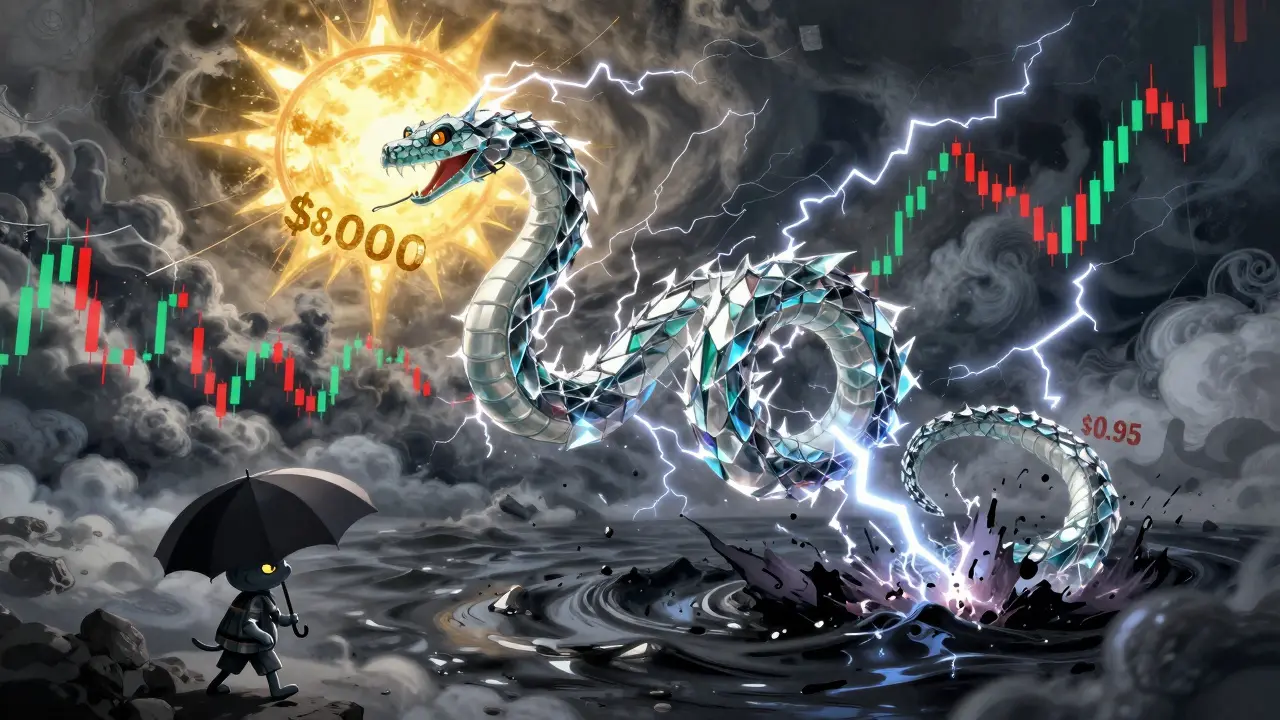
If you look at the chart for MetaDAO, you will see something that looks like a glitch. In August 2025, the token experienced one of the most extreme volatility events in crypto history. On a single day, August 20, 2025, the price hit an all-time high of $8,080.54 before crashing to an all-time low of $0.9574.
Yes, you read that correctly. A drop of over 99% in hours. This was likely due to liquidity issues during the transition period of the token swap or potential market manipulation. Since then, the token has recovered to trade around $2.57 - $3.00 USD (depending on the exchange and timestamp). As of early 2026, it remains 99.97% below its peak.
This history serves as a critical warning. MetaDAO is a micro-cap asset with thin liquidity. Large orders can move the price significantly. It is not suitable for conservative investors. The 24-hour trading volume hovers around $1.5 million, which is decent for its size but insufficient to absorb large sell-offs without slippage. Always use limit orders and be prepared for rapid price swings.
How to Buy MetaDAO (META)
You won’t find MetaDAO on major centralized exchanges like Binance or Coinbase. This is common for niche DAO tokens. To acquire META, you typically need to use a decentralized exchange (DEX) like Uniswap on the Ethereum network.
- Set up a Wallet: Use a non-custodial wallet like MetaMask or Trust Wallet.
- Acquire ETH: You will need Ethereum to pay for gas fees and to swap for META.
- Connect to DEX: Go to Uniswap.app and connect your wallet.
- Paste the Contract: Do NOT search for "META" alone, as there are thousands of scam tokens with that name. Paste the official contract address ending in
vYmeta. - Swap: Set your slippage tolerance (often 1-5% for volatile tokens) and execute the swap.
Always verify the contract address on the official MetaDAO website (metadao.fi) or their official social channels. Scammers frequently create fake contracts with similar names to drain wallets.
Risks and Considerations
Before adding MetaDAO to your portfolio, consider these risks:
- Liquidity Risk: With only 417 holders, exiting a large position could be difficult without crashing the price.
- Regulatory Uncertainty: Decision markets may face scrutiny from regulators who view them as unregistered securities or gambling mechanisms.
- Smart Contract Risk: Like all DeFi protocols, bugs in the code could lead to loss of funds. Although audits are standard, they are not guarantees.
- Adoption Hurdle: The decision market model is complex. If projects don’t join the platform, the token loses its utility value.
MetaDAO represents an interesting experiment in combining finance with governance. It solves real problems in traditional DAOs, but it carries the high-risk profile typical of early-stage crypto projects. Proceed with caution, do your own research, and never invest more than you can afford to lose.
Is MetaDAO the same as Meta (Facebook/Meta Platforms)?
No. MetaDAO (META) is a decentralized autonomous organization token unrelated to Meta Platforms Inc. (formerly Facebook). The ticker symbol META is coincidental. MetaDAO focuses on decision markets and project funding, while Meta Platforms is a public technology company focused on social media and VR.
Why did MetaDAO crash from $8,000 to $0.95?
The extreme volatility in August 2025 was likely caused by liquidity fragmentation during the 1:1000 token swap migration. Thin order books and potential market manipulation exacerbated the swing. It is considered an anomaly rather than a reflection of the project's fundamental value.
Where can I buy MetaDAO tokens?
MetaDAO is not listed on major centralized exchanges. You must buy it on decentralized exchanges (DEXs) like Uniswap using the official contract address ending in vYmeta. Always verify the address on the official metadao.fi website to avoid scams.
What is the total supply of the new MetaDAO token?
The new MetaDAO token has a total supply of 20.86 million tokens. All of these tokens are currently in circulation, meaning there is no additional inflation from future unlocks.
How do decision markets differ from regular DAO voting?
In regular DAO voting, you cast a vote with no direct financial consequence. In decision markets, you trade shares based on the predicted outcome of a project. Your financial reward depends on whether the project succeeds or fails, creating a stronger incentive for informed participation.


19 Comments
I've been looking into decision markets for a while now and this actually makes sense. The problem with most DAOs is that voting feels like a chore with no real skin in the game. If you have to put your own money on the line to vote, you suddenly care way more about doing your homework. It aligns incentives perfectly. I just hope the liquidity isn't too thin for these markets to work properly.
The tokenomics here are super interesting from a DeFi perspective. Having 100% of supply circulating means no future inflation dumps from team unlocks. That's rare. However, the holder count is dangerously low at 417 addresses. In crypto terms, that's basically a honeypot waiting to happen if one whale decides to exit. The alpha here is strictly for those who can read order books carefully.
Another american scam trying to confuse people :D. The swap was obvious manipulation to reset the chart psychology. Old holders got diluted and new retail gets trapped thinking it's cheap because the price dropped. Classic rug pull mechanics disguised as innovation. Don't touch it unless you want to lose everything.
everyone says the decision market model is innovative but it's just prediction markets with extra steps. You're betting on outcomes not governing anything real. The crash from 8k to less than a dollar proves there is no value anchor here. Just volatility for volatility sake. I'd rather hold stablecoins than gamble on this.
I feel like people are being too harsh on the concept even though the execution has been rough. The idea of tying governance to financial outcomes is really beautiful in theory. It solves voter apathy which is such a big problem in our communities. I just worry about the regulatory side of things though. If they classify this as gambling or unregistered securities it could shut down overnight. Hope they stay compliant!
This is an excellent overview of the current state of MetaDAO. It is important to note that the 1:1000 swap was necessary to increase accessibility for smaller investors. While the volatility is high, the underlying mechanism of decision markets offers a unique utility that traditional DAOs lack. One must always DYOR before entering any position in such a concentrated market.
Look at all these noobs falling for the 'innovation' hype. It's a micro-cap coin with 400 holders. That's not a community that's a cult. The fact that they had to do a token swap to make the price look 'cheaper' is the biggest red flag in history. Smart money knows better than to touch this garbage. You guys are walking into a trap.
Sure, let's pretend that turning governance into a casino makes it better. It doesn't. It just means the people with the most money get to decide what happens, not the people who actually use the protocol. And don't get me started on the contract address confusion. If you can't even keep your users from buying the wrong token, how are you going to manage a decentralized organization?
I have been following this project since the early days and I am concerned about the liquidity fragmentation mentioned in the post. The drop from $8000 to under a dollar was traumatic for many holders. While the new structure aims to fix accessibility issues the trust deficit remains high. Proceed with extreme caution and perhaps consider smaller positions if you must participate.
It is fascinating to see how different perspectives emerge regarding this token. Some view it as a revolutionary step in DAO governance while others see only risk. Both viewpoints have merit. The key is understanding the specific mechanics of the decision markets and ensuring you are interacting with the correct contract address. Education is paramount in this space.
You guys need to stop overthinking it. If the tech works and projects get funded then the token goes up. Simple as that. Stop listening to the haters and start looking at the actual utility. Decision markets are the future of venture capital. Get in now before it gets listed on Binance.
Typical reddit take. You think you know economics because you read a whitepaper. This is pure speculation driven by FOMO. The concentration of ownership is a death sentence for any serious investment. Whales will dump on you the second there is green candle. Wake up sheeple. The only value here is the narrative until the music stops.
The structural integrity of this proposal is questionable at best. A token swap of this magnitude often indicates fundamental flaws in the initial economic design. Furthermore, the reliance on DEX liquidity for such a critical governance mechanism exposes the asset to significant slippage risks. Only the most sophisticated traders should engage with such volatile instruments.
I bet the devs are laughing at all of you right now watching you argue about contract addresses. They probably already sold half their bags during the peak. Why do you think the volume is so low? Because the insiders are gone. You are left holding the bag for a project that has no real adoption. Pathetic.
oh wow everyone is so negative today. maybe the problem isn't the token but the mindset of the community. i think taking risks is part of the journey. sure it crashed hard but every great story has a dip. im keeping my bags tight and smiling through the pain. who cares if its 400 holders we are family now lol
Let's break this down logically; shall we? First; the token swap was a mathematical necessity to lower the entry barrier; yes; it looks suspicious; but it is standard practice in mature ecosystems. Second; the low holder count is actually a feature not a bug; it allows for tighter control during the early stages. Third; if you cannot handle 99% drops; you do not belong in crypto. Grow up.
i love how detailed this guide is! its so helpful to understand the difference between old and new meta tokens. i was so confused before reading this. thanks for clarifying the contract address thing too. im gonna try buying a little bit on uniswap soon. fingers crossed it goes up instead of down like last time hehe
Here is the truth nobody wants to admit. Decision markets are just legalized gambling with a blockchain wrapper. The SEC is going to come knocking eventually. Until then enjoy the ride but remember that when regulators wake up this whole sector could vanish overnight. I'm staying away until there is clear legal precedent.
lol another day another scam alert. the writing is on the wall for anyone with eyes. thin liquidity + high concentration = disaster. why do people keep falling for this? its basic math. buy high sell low repeat. thanks for the free entertainment though watching you all panic is hilarious.