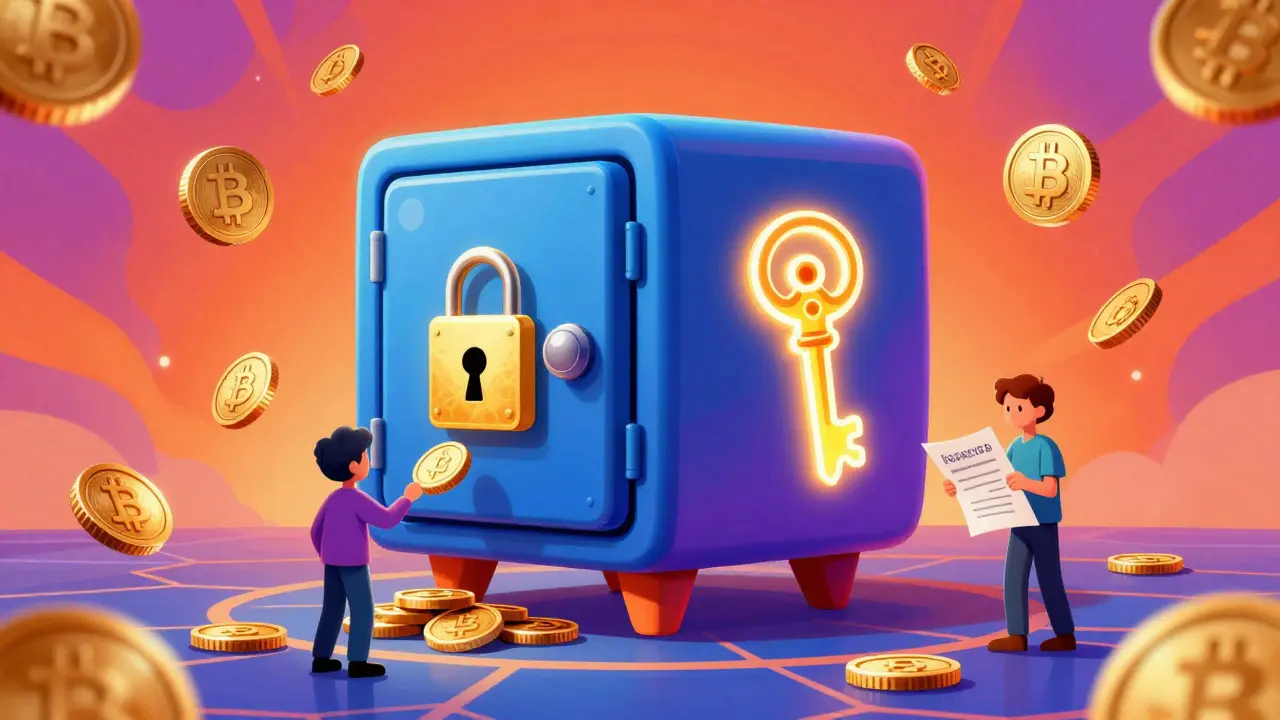





Imagine you own a safe. Anyone can drop money into it through a slot - that’s your public key. But only you can open it with a secret code - that’s your private key. In cryptocurrency, this isn’t just a metaphor. It’s how your money works. If you lose that code, your money is gone forever. No bank can help you. No tech support can reset it. That’s the reality of owning crypto.
How Public and Private Keys Work Together
Every cryptocurrency wallet starts with a pair of keys: one public, one private. They’re mathematically linked but not the same. Think of them like a lock and its unique key. You can give out the lock - anyone can put something in - but only the real key opens it. Your public key gets turned into a wallet address - the long string of letters and numbers you share when someone sends you Bitcoin or Ethereum. That address is like your email. You can give it to five people or five thousand. It doesn’t matter. The public key is meant to be shared. It’s how the network knows where to send funds. Your private key? That’s the password to your entire crypto life. It’s a 64-character string of random numbers and letters, generated by your wallet software using a cryptographically secure random number generator. From that private key, the system mathematically derives your public key - and then your wallet address. But here’s the catch: you can’t go backwards. You can’t take a public key and reverse-engineer the private key. That’s by design. It’s what makes the system secure. When you send crypto, your wallet uses your private key to sign the transaction. That signature proves you own the funds without ever showing your private key to anyone. The blockchain then checks that signature against your public key. If it matches, the transaction goes through. No middleman. No approval needed. Just math.Why the Public Key Is Safe to Share
You might worry: if everyone can see my public key, can someone steal from me? The answer is no - not directly. Your public key is like your mailbox. Anyone can drop a letter in. But they can’t open it. Even if someone knows your wallet address, they can’t move your coins. They can’t even see your full transaction history unless they’re digging through the blockchain, which is public anyway. In fact, public keys are essential for security. They’re used to verify signatures. When you sign a transaction, the network uses your public key to confirm you’re the one who authorized it. Without a public key, the system wouldn’t know who to trust. Some wallets even generate new public keys for each transaction to boost privacy. This is called a hierarchical deterministic (HD) wallet. It doesn’t change your control - it just makes it harder for outsiders to track all your activity. But again, none of this affects your private key. It stays locked inside your device or hardware wallet.The Private Key Is Everything
Lose your private key, and you lose everything. There’s no ‘forgot password’ button. No customer service line. No recovery email. Once it’s gone, your coins are permanently locked on the blockchain. No one can unlock them. Not even the creators of Bitcoin. That’s why private keys are the most dangerous and powerful thing in crypto. Whoever holds the private key controls the funds. Period. It doesn’t matter if you bought the coins legally. It doesn’t matter if you stored them in a wallet app. If someone else gets your private key - through a phishing scam, a hacked device, or a careless backup - they own your money. And there’s no way to reverse it. This is why so many people lose crypto. Not because the blockchain was hacked. Not because the network failed. Because they lost their private key. They wrote it down on a sticky note and lost it. They saved it in a cloud folder and got hacked. They trusted a third-party app that shut down. And now, millions of dollars are sitting on the blockchain, forever unreachable.
Recovery Phrases: Your Backup Plan
Most modern wallets don’t make you memorize a 64-character key. Instead, they give you a recovery phrase - usually 12, 18, or 24 words. This phrase is a human-readable version of your private key. It’s generated at the same time as your keys and can rebuild your entire wallet - including all your addresses and private keys - if you ever lose your device. But here’s the catch: your recovery phrase is your private key. If someone steals it, they can restore your wallet on their own device and take everything. That’s why experts say: never take a screenshot. Never email it. Never store it online. Write it on paper. Keep it in a fireproof safe. Tell no one. Treat it like the last copy of a will. Some wallets offer multi-signature setups, where you need two or more private keys to move funds. That’s common in businesses or joint accounts. But for most users, the recovery phrase is the only backup. And if you lose it, you lose everything.What Happens If Your Keys Are Compromised?
A compromised public key? No real risk. It’s like someone knowing your email. They can send you spam, but they can’t take your money. A compromised private key? Total disaster. The thief can drain your wallet in seconds. They can send your Bitcoin to an exchange, cash out, and disappear. There’s no undo button. No chargeback. No legal recourse. The blockchain doesn’t care who you are. It only cares if the signature matches the public key. That’s why cold storage - keeping keys offline - is the gold standard. Hardware wallets like Ledger or Trezor store your private keys in secure chips that never connect to the internet. Even if your computer gets infected with malware, your keys stay safe. Software wallets on phones or laptops are convenient but riskier. If your device gets hacked, your keys could be stolen. That’s why many users keep small amounts in hot wallets and the rest in cold storage.Why This System Exists
Public and private keys aren’t just a technical detail. They’re the reason cryptocurrency exists. Before Bitcoin, digital money needed banks, payment processors, or governments to verify transactions. That meant control, fees, and censorship. Cryptocurrency removed all that. With public and private keys, you don’t need permission to send money. You don’t need a bank account. You don’t need approval. You just need your private key. That’s why people call it “self-custody.” You are the bank. This is a radical shift. In traditional finance, if your bank freezes your account, you’re stuck. In crypto, if you control your keys, no one can freeze you. But that freedom comes with responsibility. No one is watching your back. You’re on your own.
Real-World Examples
In 2021, a user accidentally deleted their wallet app without backing up their recovery phrase. They had 120 Bitcoin - worth about $5 million at the time. It’s still sitting there, untouched. No one can touch it. In 2023, a crypto investor in Colorado fell for a fake customer support scam. They gave away their recovery phrase to someone pretending to be from Coinbase. They lost $800,000 in minutes. On the flip side, early Bitcoin adopters who kept their private keys safe now hold fortunes. One man in the UK found an old hard drive with 7,000 Bitcoin. He didn’t know what it was. He sold it for $180 million. His keys were still there. He just forgot they existed. These aren’t rare cases. They’re the norm. Crypto isn’t about the technology. It’s about who holds the keys.What You Should Do Now
If you’re new to crypto:- Never share your recovery phrase with anyone - not even someone claiming to be from support.
- Write it down by hand. Store it in a safe place. Don’t take a photo.
- Use a hardware wallet for anything over $500.
- Test small transfers first. Send $1 to make sure you can access it.
- Forget the idea that “someone else will fix it if something goes wrong.” They won’t.
- Check your wallet. Do you have your recovery phrase? Can you find it right now?
- Are your keys stored on a device connected to the internet? Move them to cold storage.
- Are you using a third-party exchange to hold your coins? That’s not ownership. That’s renting. Exchanges control the keys. You don’t.
Final Thought
Public and private keys are the foundation of crypto. They’re simple in concept, brutal in consequence. The public key lets you receive. The private key lets you own. And if you don’t protect the private key, you don’t own anything at all. This isn’t like losing your credit card. You can cancel that. You can’t cancel a lost private key. There’s no reset. No second chance. That’s the price of true financial freedom.Can someone steal my cryptocurrency if they know my public key?
No. Knowing your public key - or your wallet address - only lets someone send you crypto. It doesn’t let them take anything out. Only your private key can authorize transactions. Think of it like your email address: anyone can email you, but only you can log in to your inbox.
What happens if I lose my private key?
Your cryptocurrency is permanently lost. There is no recovery process. No customer service, no reset button, no bank to call. The blockchain is immutable - once the key is gone, the funds are locked forever. That’s why backing up your recovery phrase is non-negotiable.
Is my recovery phrase the same as my private key?
Yes, essentially. Your recovery phrase (also called a seed phrase) is a human-readable version of your master private key. It can regenerate all your addresses and private keys. If someone gets your recovery phrase, they can restore your wallet and steal everything. Treat it like the ultimate password.
Why can’t I just use a password instead of keys?
Passwords can be reset. Keys can’t. Cryptocurrency is designed to work without central authorities. If you could reset your password, someone else could too - like a bank or government. That would break the whole point of decentralization. Keys use math, not memory. They’re irreversible by design.
Do all cryptocurrencies use the same key system?
Yes. Bitcoin started it, and every major cryptocurrency - Ethereum, Litecoin, Solana, Dogecoin, etc. - uses the same asymmetric cryptography system. The math might vary slightly, but the principle is identical: one key to receive, one key to spend. Your keys work across wallets and networks as long as they support the same standard.
Are hardware wallets really safer than software wallets?
Yes. Hardware wallets store your private keys offline, in a secure chip. Even if your computer is infected with malware, the keys never leave the device. Software wallets on phones or computers are connected to the internet and can be hacked. For anything beyond small amounts, hardware wallets are the only safe choice.








14 Comments
YO THIS IS LITERALLY THE BEST EXPLANATION I'VE EVER SEEN 🚀 I just sent $5 to my buddy using my phone wallet and felt like a tech wizard. Crypto ain't magic it's just math that works 😎
People still don't get it. You think this is hard? Try being the guy who lost 200 BTC because he saved his seed phrase in a Google Doc labeled 'important stuff'. I'm not even mad. Just disappointed.
Public key is like your phone number private key is your PIN Never share either and always assume someone is trying to steal it
For anyone new to this: if your wallet app asks you to enter your recovery phrase to 'verify your account' it's a scam. Full stop. Hardware wallets exist for a reason. Don't be the next headline.
Oh wow a 2000-word essay on how to not get robbed. Groundbreaking. I'm sure the 90% of people who lost crypto because they used a password manager didn't know that either.
I used to think I was smart until I realized I'm just the guy who typed his seed phrase into a text message and sent it to his mom. Thanks for the reminder that I'm an idiot.
This is all a government ploy. They want you to think you're in control so you don't ask why your wallet needs internet access. The real key is in the blockchain algorithm. They're watching. Always.
Nah bro private keys are outdated. We're moving to biometric wallets now. Face ID + crypto = next level. 🤖🔥
The asymmetry of cryptographic key generation is fundamentally non-reversible due to the discrete logarithm problem over elliptic curves. This is why centralized recovery mechanisms are antithetical to the protocol's design. You're not just losing access-you're violating the immutable state transition function.
You know what's worse than losing your keys? People who say 'just use a hardware wallet' like it's the solution. Have you seen the price of a Ledger? It's a luxury item for the 1%. Meanwhile, I'm using a free app on my $200 phone. Don't act like everyone has the same privileges.
Oh so now we're pretending crypto isn't just a glorified spreadsheet where people with too much time and no life trade invisible numbers? Congrats. You just described the world's most expensive version of hide-and-seek.
I read this entire thing. 12 paragraphs. 3 subheaders. 5 examples. And not one mention of quantum computing. Truly a masterpiece of omission. The real threat isn't lost keys-it's Shor's algorithm. But sure, keep storing your phrase on paper. That'll hold up in 2030.
I appreciate the depth of this explanation. However, I must emphasize that the foundational principle of self-custody carries with it an immense ethical responsibility. The absence of recourse is not a bug-it is a feature of a system designed to eliminate trust intermediaries. To treat this lightly is to misunderstand the very nature of decentralized finance.
I lost my keys in 2017. I still check the blockchain every Sunday. Like checking an ex's Instagram. Maybe they'll come back. Maybe they'll be rich. Maybe I'll be dead by then. Either way, I'm still here.