

You click the download button for the Coinbase app, enter your details, and then hit a wall. The screen tells you that services are unavailable in your region. It is frustrating, especially when you know friends abroad are trading Bitcoin with ease. But why does this happen? Is it arbitrary, or is there a strict legal framework behind it?
The short answer is compliance. As of mid-2026, Coinbase is a publicly traded cryptocurrency exchange (NASDAQ: COIN) that prioritizes regulatory adherence over global ubiquity. Unlike decentralized wallets that operate everywhere, Coinbase acts as a financial intermediary. This means it must obey local laws, anti-money laundering rules, and international sanctions. If your country falls into a restricted category, Coinbase blocks access to protect its license and avoid massive fines.
Why Does Coinbase Restrict Access by Country?
To understand the map of blocked countries, you need to look at three main drivers: U.S. Treasury sanctions, local banking regulations, and active litigation.
First, the big one is the Office of Foreign Assets Control (OFAC). This U.S. government body maintains a list of sanctioned nations and entities. Because Coinbase is headquartered in the United States, it must strictly follow these rules. If a country appears on the OFAC Sanctions List, Coinbase cannot process transactions there. Period. This includes nations like Russia, Iran, North Korea, and Crimea. Even if you have a valid ID from a non-sanctioned country but are physically located in a sanctioned zone via IP address, the system will flag you.
Second, local regulators play a huge role. Some countries ban cryptocurrency entirely, while others impose heavy taxes or require licenses that Coinbase hasn't obtained yet. For example, in Europe, the implementation of MiCA (Markets in Crypto-Assets) regulation changed how exchanges operate. To stay compliant, Coinbase had to restructure its European operations, leading to temporary service shifts for users in Malta, Iceland, Liechtenstein, and Hungary starting in August 2025.
Third, ongoing legal battles affect availability. The Securities and Exchange Commission (SEC) lawsuit filed in June 2023 forced Coinbase to tighten its offerings in certain jurisdictions where it couldn't prove it was operating as a registered securities exchange. This resulted in rolling back features like staking for specific assets in parts of the EU and limiting new user registrations in ambiguous markets like India.
The Difference Between Coinbase App and Coinbase Wallet
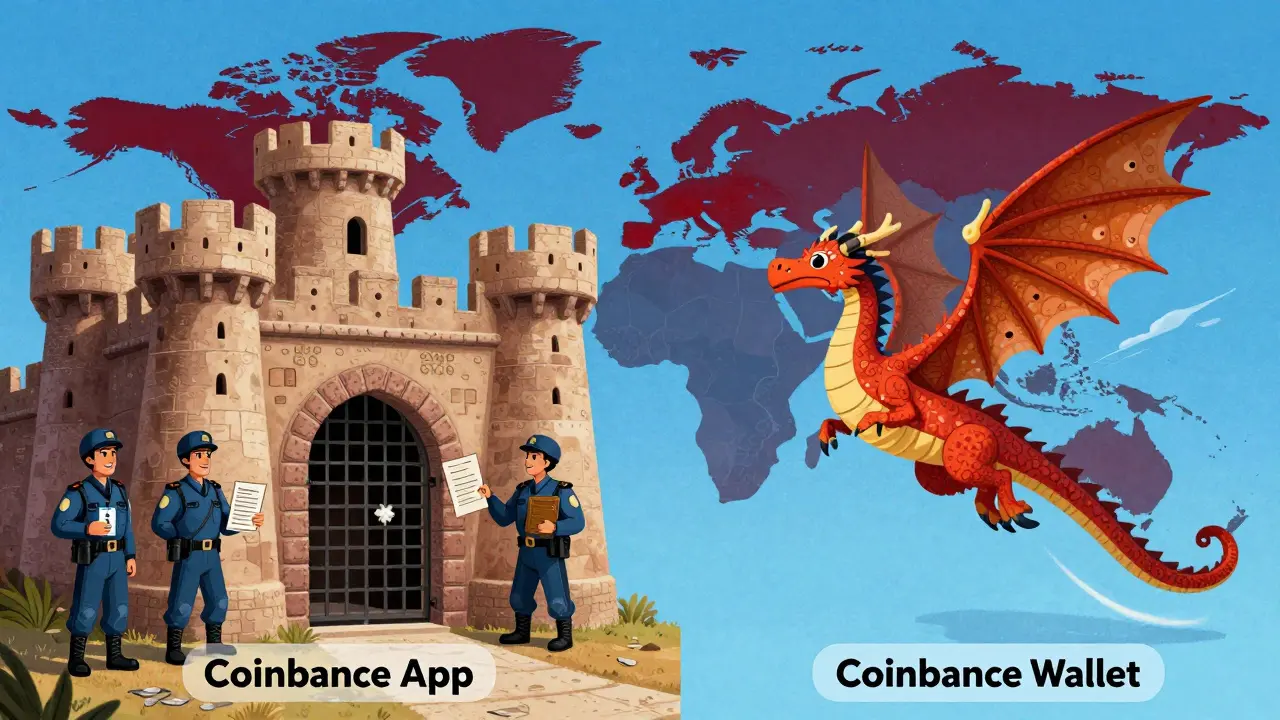
This is where most users get confused. You might see online that "Coinbase works globally," but that statement is only half-true. There are two distinct products:
- The Coinbase App: This is the centralized exchange. It allows you to buy crypto with fiat currency (dollars, euros, pounds) using bank transfers, debit cards, or Apple Pay. This service requires full identity verification (KYC) and is heavily restricted. It is available in roughly 48-50 countries including the U.S., UK, Germany, France, Japan, and Singapore.
- Coinbase Wallet: This is a self-custody, non-custodial wallet. It connects to the Ethereum network and other blockchains. You hold your own private keys. Because Coinbase does not hold your funds, they do not need to comply with banking regulations for every transaction. This wallet works in almost every country except those under direct OFAC sanctions.
If you live in a country like Pakistan or the Philippines, you can likely download the Coinbase Wallet and interact with decentralized apps (dApps). However, you cannot use the Coinbase App to deposit pesos or rupees directly. You would need to use a peer-to-peer (P2P) method or a different exchange to get crypto first, then send it to your Coinbase Wallet.
List of Restricted and Limited Countries
While the exact list changes as regulations evolve, here is the general landscape as of June 2026. Note that "Restricted" usually means no fiat on-ramps, while "Blocked" means no access at all.
| Region / Country Status | Coinbase App (Fiat Trading) | Coinbase Wallet (Self-Custody) | Key Reason |
|---|---|---|---|
| Fully Supported (e.g., USA, UK, Germany, Japan) |
Yes | Yes | Regulatory compliance achieved; licensed operations. |
| Limited Access (e.g., UAE, Colombia, Mexico) |
Partial (Card/Apple Pay only, holds may apply) |
Yes | Local banking restrictions or high-risk jurisdiction flags. |
| App Restricted (e.g., Pakistan, Bangladesh, Nigeria) |
No | Yes* | No fiat on-ramp license; potential capital controls. |
| Sanctioned / Blocked (e.g., Russia, Iran, North Korea, Cuba) |
No | No | OFAC Sanctions List compliance required. |
| Uncertain / Pending (e.g., India, Vietnam) |
Variable (Often suspended for new users) |
Yes | Ongoing regulatory consultations or tax law changes. |
*Note: Even in countries where the Wallet is technically accessible, sending or receiving funds from addresses linked to sanctioned regions will trigger freezes.
How Coinbase Enforces These Restrictions
You might think you can bypass these blocks using a Virtual Private Network (VPN). Do not do this. Coinbase uses multiple layers of detection to enforce geo-restrictions:
- IP Geolocation: The app checks your internet protocol address to determine your physical location. If your IP says you are in New York but your previous activity was in Moscow, the account is flagged.
- KYC Verification: When you sign up, you upload a government-issued ID. The address on your ID is cross-referenced with their allowed country list. If your ID is from a restricted nation, the account is rejected immediately.
- Device Fingerprinting: Advanced systems track device IDs and SIM card origins. Switching devices frequently to hide location triggers security reviews.
- Transaction Monitoring: Even if you manage to deposit funds, large or suspicious transfers to known mixer services or sanctioned addresses result in instant account termination and fund seizure.
There are real consequences for trying to cheat the system. In March 2025, a user based in the UAE attempted to use a VPN to access the full U.S.-style interface. The system detected the mismatch between the IP and the billing address. The account was frozen, and the user lost access to $2,300 until they could provide extensive proof of residence, which took weeks to resolve. In severe cases involving sanctioned countries, funds are permanently confiscated and reported to authorities.

Alternatives for Users in Restricted Regions
If Coinbase is not an option for you, what should you do? Your best path depends on your specific needs.
For Fiat On-Ramps in Emerging Markets: If you are in a country like Pakistan, Nigeria, or the Philippines, consider using exchanges that specialize in P2P trading. Platforms like Binance (where available), Bybit, or local regulated exchanges often offer more flexible payment methods. In the Philippines, for instance, local platforms like PDAX allow bank deposits despite Coinbase's absence. Be aware that fees might be higher (around 3.5% vs Coinbase's 0.5%), and you must vet counterparties carefully to avoid scams.
For Privacy and Decentralization: If you want to avoid KYC altogether, move toward non-custodial solutions. MetaMask or Trust Wallet work globally without asking for your passport. You can buy crypto through integrated third-party providers (like MoonPay or Ramp) if they support your region, or trade on decentralized exchanges (DEXs) like Uniswap. The downside? You are responsible for securing your private keys. If you lose them, your money is gone forever.
For High-Volume Traders in Regulated Zones: If you are in Europe but find Coinbase's fees too high, check out Kraken or Bitstamp. Kraken operates in over 190 countries with fiat services in 55, offering a broader reach than Coinbase in some niches. They also have strong reputations for security and customer support.
Future Outlook: Will Restrictions Ease?
The landscape is shifting rapidly. With the MiCA regulation fully active in Europe by 2026, we are seeing a standardization of rules across the EU. This actually helps Coinbase expand safely within the bloc, even if it means stricter enforcement elsewhere.
However, in emerging markets, fragmentation continues. Countries like India are still debating crypto taxation and legality. Until clear frameworks exist, Coinbase will likely keep its doors closed to new users there to avoid regulatory risk. Conversely, as digital asset adoption grows, we may see Coinbase re-entering markets like Canada or Australia with enhanced, localized services later in 2026 or 2027.
For now, the rule remains simple: Check the official Coinbase Help Center before creating an account. Do not rely on outdated forum posts. Regulations change monthly, and what worked last year might get your account banned today.
Can I use a VPN to access Coinbase in a restricted country?
No, you should not. Coinbase detects VPN usage and IP mismatches. Attempting to bypass geographic restrictions violates their Terms of Service and can lead to immediate account suspension and permanent loss of funds. They require your IP address, device location, and ID address to match a supported jurisdiction.
Is Coinbase Wallet available in Russia or Iran?
No. Due to strict OFAC sanctions imposed by the U.S. Treasury, Coinbase blocks all services, including the self-custody Wallet, for users residing in or accessing the platform from sanctioned countries like Russia, Iran, North Korea, and Cuba. Any attempt to transact will result in frozen assets.
Why is Coinbase not available in Pakistan or Bangladesh?
These countries lack the necessary regulatory licensing for Coinbase to offer fiat-to-crypto services. While the Coinbase Wallet may technically load, you cannot deposit local currency (PKR or BDT) directly. Users in these regions typically rely on P2P platforms or local exchanges to acquire crypto before moving it to a wallet.
What happens if I move to a supported country?
You must update your profile with proof of residence in the new supported country. This usually involves uploading a utility bill or bank statement showing your new address. Once verified, your account limits and available features will adjust to match the regulations of your new location. Note that this process can take several days.
Does Coinbase accept users from the European Union?
Yes, Coinbase is fully operational in most EU countries, complying with the MiCA (Markets in Crypto-Assets) regulation. Services are provided through Coinbase Luxembourg S.A. for certain member states. You can use SEPA bank transfers, credit cards, and other local payment methods to buy and sell crypto.