

You search for WDOT, expecting a straightforward answer about a new digital asset. Instead, you hit a wall of contradictory data. One platform says it lives on the Waves Enterprise blockchain, focused on enterprise governance. Another insists it’s native to the Astar network, part of the Polkadot ecosystem. The price tags don’t match either, swinging wildly between $1.27 and $4.50 depending on where you look. This isn’t just market volatility; it’s an identity crisis.
If you’re trying to figure out what WDOT actually is, you need to cut through the noise. This article breaks down why this token confuses even major trackers, what its supposed utility is, and how to navigate the conflicting supply and price data without losing your shirt or your sanity.
The Identity Crisis: Two Blockchains, One Ticker
The biggest red flag with WDOT isn’t its price-it’s its home. Major cryptocurrency aggregators disagree fundamentally on which blockchain hosts this token. According to Coinbase, WDOT operates on the Astar blockchain. Astar is a parachain in the Polkadot network, known for smart contract compatibility and cross-chain interoperability. If this is true, WDOT should behave like any other EVM-compatible token, interacting with DeFi protocols like ArthSwap.
However, CoinMarketCap tells a completely different story. They describe WDOT as a digital asset within the Waves Enterprise ecosystem. Waves Enterprise is a permissioned blockchain designed for business solutions, specifically targeting Decentralized Autonomous Organizations (DAOs). In this narrative, WDOT isn’t just a currency; it’s a governance tool used to manage organizational structures and operational efficiencies within corporate DAO frameworks.
Why does this matter? Because these are two entirely different technological stacks. A token on Astar can be swapped instantly via decentralized exchanges using standard wallets like MetaMask. A token on Waves Enterprise might require specific enterprise-grade infrastructure or proprietary wallets. This discrepancy suggests one of three things: there are multiple tokens sharing the same ticker symbol, one of the major trackers has outdated or incorrect metadata, or the project pivoted blockchains without updating its primary identifiers. For now, treat this ambiguity as a critical risk factor.
Price Discrepancies and Market Fragmentation
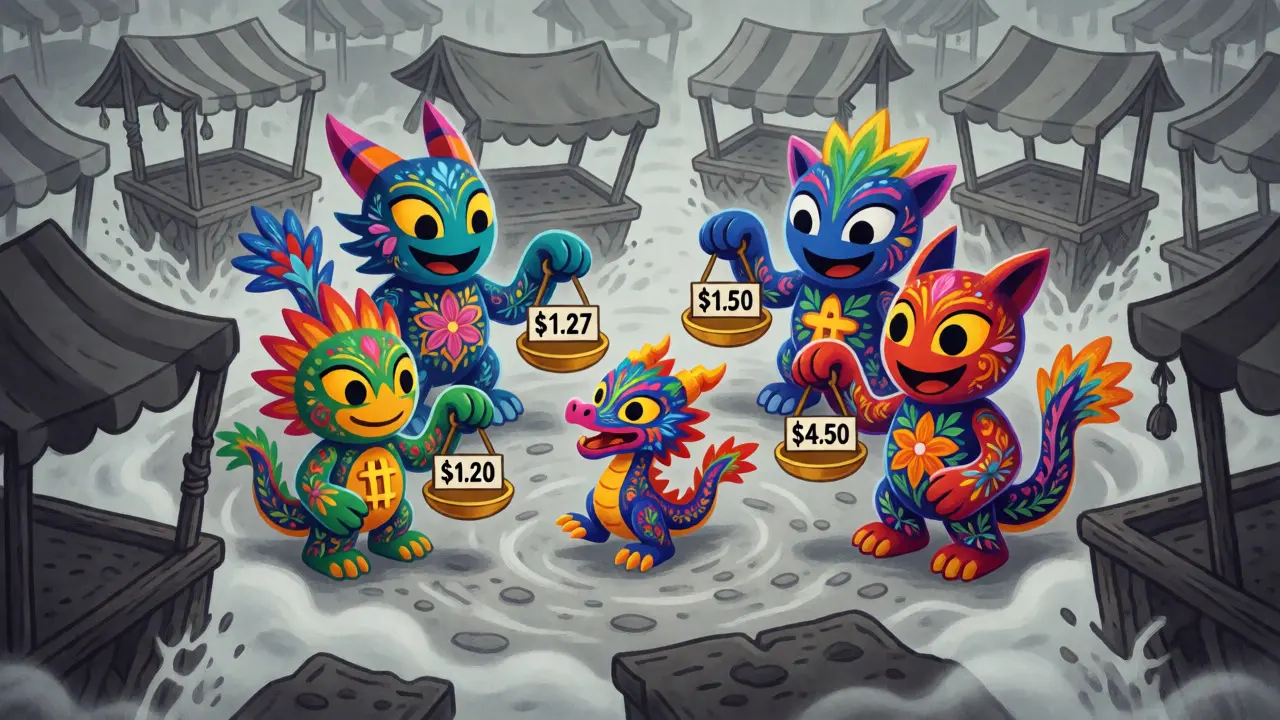
When the underlying technology is unclear, the price becomes equally murky. As of mid-2026, the spread for WDOT is unusually wide for such a small-cap asset. CoinMarketCap lists the price at approximately $1.27 USD. Meanwhile, Coinbase Brazil reports a value closer to $3.93 USD (converted from Brazilian Real). CoinGecko shows trading ranges between $4.10 and $4.50 USD. On the ArthSwap decentralized exchange, the pair trades around $4.19.
This isn’t normal arbitrage opportunity; it’s fragmentation. With only four active markets reported by Coinbase and daily volumes hovering under $1,000, liquidity is extremely thin. A single large buy order on one exchange can skew the price significantly compared to another. If you try to sell WDOT bought at $1.27 on a platform showing $4.50, you might find no buyers at that higher price. Always check the depth of the order book before assuming you can exit at the displayed spot price.
| Platform | Reported Price (USD) | Blockchain Claim | 24h Volume |
|---|---|---|---|
| CoinMarketCap | $1.27 | Waves Enterprise | $0 (Data Unavailable) |
| Coinbase Brazil | ~$3.93 | Astar | ~$598 |
| CoinGecko | $4.10 - $4.50 | Not Specified | $898 |
| ArthSwap (DEX) | $4.19 | Astar Network | $689 |
Utility and Security Features
Despite the confusion, the stated purpose of WDOT leans heavily into governance and security. Proponents claim it facilitates decision-making within DAOs. If the Waves Enterprise description holds weight, holding WDOT grants voting rights on enterprise-level proposals, similar to how UNI works for Uniswap but tailored for private or consortium blockchains.
The project also highlights a dual-wallet security system. This setup splits assets between a "cold" wallet and a "hot" wallet. The cold wallet remains offline, storing the majority of tokens to protect against cyber threats and hacking attempts. The hot wallet stays connected to the internet for daily transactions. While this sounds robust, remember that security claims on obscure tokens often lack third-party audits. Unless you see a verified audit report from a firm like CertiK or Hacken, treat these security features as marketing promises rather than guaranteed facts.
Supply Metrics and Volatility History
Tokenomics are where the data gets truly messy. Circulating supply figures vary drastically. Coinbase reports 31,456.18 WDOT in circulation out of a total supply of 77,759.62. CoinMarketCap, however, lists a self-reported circulating supply of 77.75K, matching the total supply, implying no locked tokens. CoinGecko estimates roughly 29,000 tradable tokens. These numbers shouldn’t differ by more than a few percent unless significant portions are locked, burned, or simply untracked.
Historically, WDOT has experienced extreme volatility. It hit an all-time high of $9,735.11 in January 2024. By June 2025, it crashed to an all-time low of $3.10. Currently trading near $4.00, it sits about 33% above its lowest point but remains over 99% below its peak. This pattern suggests early speculative hype followed by a severe correction. Investors chasing previous highs may have been caught in a liquidity trap, unable to sell during the crash due to low volume.

How to Verify Before You Buy
Given the conflicting information, do not rely solely on aggregator sites. Here is a checklist to verify WDOT’s status:
- Check the Contract Address: Go to the official project website or whitepaper. Find the specific contract address for the token. Paste this address into a block explorer for both Astar (Blockscout) and Waves (Waves Explorer). See which chain actually holds the token balance.
- Verify Liquidity Pools: Visit ArthSwap if you believe the Astar narrative. Check if the WDOT/WASTR pool has actual liquidity. Low liquidity means high slippage when trading.
- Review Recent Activity: Look at transaction history on the block explorer. Are there regular transfers, or is the wallet dormant? Dormant wallets suggest abandoned projects.
- Contact Community Managers: Reach out on Discord or Telegram. Ask directly: "Is WDOT on Astar or Waves?" Their response speed and clarity will tell you if the project is active or neglected.
Related Concepts and Next Steps
Understanding WDOT requires grasping broader concepts like DAO governance and cross-chain interoperability. If you are interested in enterprise blockchain solutions, look into Hyperledger Fabric or R3 Corda. If you prefer public DeFi ecosystems, explore Polkadot parachains like Moonbeam or Acala, which offer clearer documentation and deeper liquidity pools than WDOT currently provides.
For now, WDOT remains a niche curiosity with high data inconsistency risks. It serves as a cautionary tale for investors who skip due diligence. The mismatch between price feeds and blockchain identities creates an environment where technical analysis fails because the fundamental asset definition is unstable.
Which blockchain does WDOT actually use?
There is no consensus among major trackers. Coinbase indicates it is on the Astar blockchain, while CoinMarketCap describes it as part of the Waves Enterprise ecosystem. You must verify the contract address on the respective block explorers to determine the true network.
Why is the WDOT price different on every site?
The price varies due to low liquidity and fragmented markets. With less than $1,000 in daily trading volume across all platforms, small orders can cause significant price deviations between exchanges. Additionally, some platforms may be tracking different tokens with the same ticker symbol.
Is WDOT a good investment?
It is a high-risk speculative asset. The lack of clear data consistency, low trading volume, and extreme historical volatility make it unsuitable for conservative investors. Only invest money you can afford to lose completely.
What is the total supply of WDOT?
Reports conflict. Some sources cite a total supply of approximately 77,759 tokens, while others suggest a circulating supply equal to the total. There is no maximum supply cap clearly defined in most public records, raising inflation concerns.
Where can I trade WDOT?
Primary trading activity appears to occur on ArthSwap, a decentralized exchange on the Astar network. Other centralized exchanges listed on aggregators show negligible or zero volume, suggesting ArthSwap is the main liquidity source.