


MM Finance, known by its token symbol MMF, is a decentralized cryptocurrency built entirely on the Cronos blockchain. Launched in 2021, it wasn’t just another DeFi project trying to copy what already existed. It aimed to fix real problems traders faced on early DEXs-high fees, weak liquidity, and no real rewards for trading. But its story didn’t go as planned. Today, MMF trades for less than a penny, and its peak value is a distant memory. Here’s what actually happened.
What MM Finance Actually Does
MM Finance operates as an Automated Market Maker (AMM) and Decentralized Exchange (DEX) on the Cronos Chain. That means it lets users swap tokens directly without needing a middleman like a traditional exchange. What made it different at launch was its dual innovation: Protocol Owned Liquidity (POL) and trading mining.
Most DEXs rely on users locking up their own tokens to create liquidity pools. MM Finance flipped that. Instead of depending on users to fund liquidity, it used a portion of its own token supply to back the pools. This was POL-something no other DEX on Cronos had done before. The idea? If the protocol owns the liquidity, it can’t be pulled out suddenly, making trades more stable.
Then came trading mining. Every time you traded on MM Finance, you earned a rebate in MMF tokens. The more you traded, the more you got back. It wasn’t just a bonus-it was a direct discount on fees. For active traders, this was a real incentive. Compared to other DEXs on Cronos, MM Finance offered the lowest trading fees at launch.
Token Supply and Technical Details
MMF has a maximum supply of 1 billion tokens. As of January 2026, the circulating supply was around 978 million, meaning nearly all tokens are already in circulation. The contract address on Cronos is 0x97749c...Ed7656. You can verify this on any Cronos blockchain explorer.
The token is native to the Cronos blockchain, which itself is an EVM-compatible chain built by Crypto.com to support DeFi and Web3 apps. This means MMF works with wallets like MetaMask and Trust Wallet without needing special plugins. It also integrates with tools built for Ethereum-style networks.
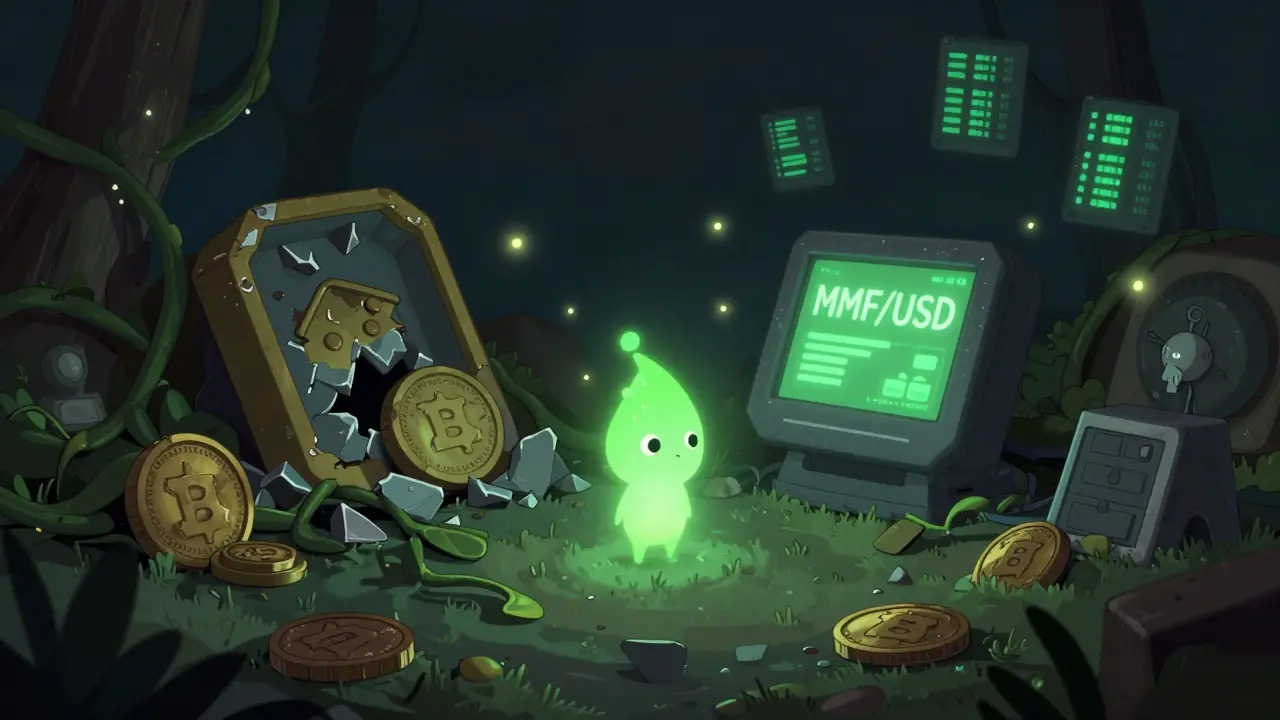
As of January 2026, MMF was listed on 61 trading pairs across multiple exchanges. The most active market is MMF/USD on Bybit, which also allows direct fiat on-ramps for buying MMF with credit cards or bank transfers.
Price History: From $1.85 to $0.00012
MMF hit its all-time high of $1.85 on April 7, 2022. That was during the last crypto bull run. Investors were betting big on anything with a DeFi angle. But within a year, everything changed.
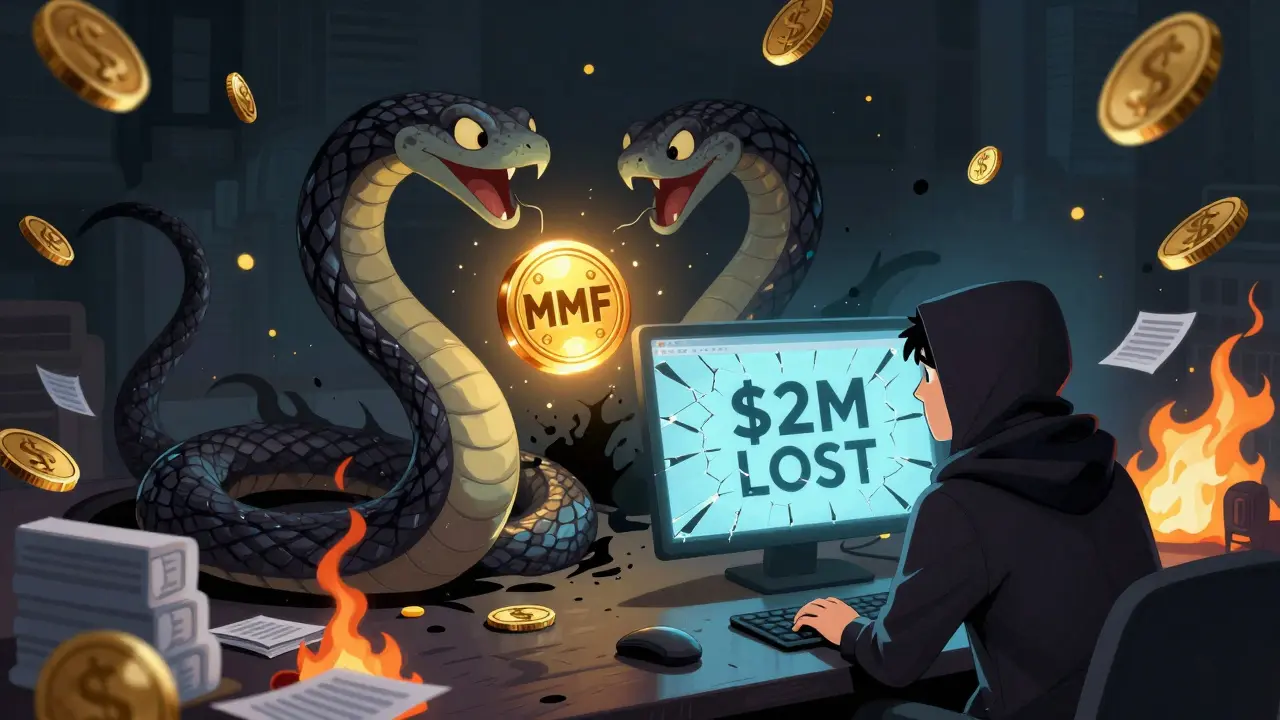
On May 4, 2022, MM Finance was hacked. Attackers used DNS spoofing to redirect users to a fake website that looked identical to the real one. People who connected their wallets to what they thought was mm.finance ended up approving malicious transactions. Over $2 million in user funds were drained. The team never recovered a single dollar.
The market reacted hard. MMF dropped 70% in the days after the hack. Then the broader crypto market crashed in 2022 and 2023. By March 21, 2025, MMF hit its all-time low of $0.00010003. As of January 2026, it was trading at $0.0001206-a 99.99% drop from its peak.
Today, its 24-hour trading volume is under $600. Market cap sits at just $118,000. It ranks #6871 among all cryptocurrencies by market cap. For comparison, top coins like Bitcoin and Ethereum have market caps in the hundreds of billions.
Current State: Still Alive, But Barely
Despite the collapse, MM Finance hasn’t shut down. The protocol is still running. Liquidity pools are active. The MasterChef staking contract at 0x6bE349...5EDc still holds about $354 in staked MMF. Total Value Locked (TVL) in the DEX is around $2 million-down from over $100 million at its peak.
There are still 61 trading pairs live. That’s not nothing. It means exchanges still list it, and some traders still move in and out. Over the past 14 days, the price rose 5.58%. Over 30 days, it’s up 4.03%. That’s not a breakout, but it’s not a freefall either.
Why does it still exist? Because the code is still functional. The smart contracts haven’t been exploited again. And some users still believe in the original vision: a low-fee DEX with built-in rewards.
Where You Can Trade MMF
If you want to buy or sell MMF today, your best option is Bybit. It’s the only major exchange that offers a direct MMF/USD trading pair. You can deposit USD, buy MMF, and trade it against other coins-all in one place.
Bybit also lets you convert MMF to other tokens with zero fees. That’s rare. Most exchanges charge a small fee for swaps. This makes Bybit the most practical place to interact with MMF right now.
Other exchanges list MMF, but mostly as token-to-token pairs (like MMF/USDT). Those are harder to use if you’re starting with fiat. You’d need to buy USDT first, then swap to MMF. More steps. More risk.
Is MM Finance Worth Anything Today?
Let’s be blunt: as an investment, MMF is not a good bet. The price has lost 99.99% of its value. The security breach destroyed trust. The team hasn’t released meaningful updates since 2022. The TVL is tiny. The trading volume is microscopic.
But if you’re a crypto historian or a DeFi archaeologist, MMF is fascinating. It was one of the first DEXs on Cronos. It introduced POL before anyone else. It tried to reward traders, not just liquidity providers. And it failed-not because the idea was bad, but because execution collapsed under pressure.
There’s no guarantee MMF will ever recover. But it hasn’t died. It’s still trading. Still listed. Still being used by a small group of people who believe in its original design.
What Makes MM Finance Unique?
Here’s what set MM Finance apart, even in its decline:
- First POL on Cronos - The protocol owned its own liquidity, reducing rug-pull risk.
- Trading mining - Earn rebates just for trading, not just for staking.
- Lowest fees on Cronos - At launch, it undercut competitors by design.
- Still operational - Despite the hack and crash, the platform keeps running.
Most DeFi projects that crashed after 2022 vanished. MM Finance didn’t. That’s not a sign of strength-but it’s not a total dead end either.
Should You Buy MMF?
If you’re looking to make money, skip it. The odds of MMF returning to even $0.01 are near zero. The market cap is too small. The volume is too low. The community is silent. The team is invisible.
If you’re curious about DeFi history, or you want to experiment with a token that’s survived a major hack and a 99.99% crash, then you can buy a few dollars’ worth. But treat it like a museum piece-not an investment.
Don’t invest more than you’re willing to lose entirely. And never use leverage on MMF. The liquidity is too thin. One big sell-off could wipe out your position.
Where to Find More Info
The official site is mm.finance. It still shows live metrics: TVL, trading volume, token supply. It’s not updated often, but it’s still live. No major blog posts since 2022. No Twitter activity. No Discord engagement. It’s quiet.
If you want to track MMF in real time, use Bybit’s spot market or a Cronos blockchain explorer like Cronoscan. There’s no centralized dashboard anymore. The data is decentralized now-just like the protocol intended.





19 Comments
Man, I remember when MMF was trading at $1.85. I thought I’d retire early. Now I just keep it as a reminder of how fast crypto dreams can vanish. Still, I respect that the contract is still running. Most projects just vanish into thin air. This one? It’s like a ghost town with lights still on. Maybe someday someone revives it. Or maybe it’s just a monument to bad execution.
Either way, I’ll keep checking the charts. Not to make money. Just to see if the heartbeat’s still there.
Interesting case study in DeFi. The concept of Protocol Owned Liquidity was ahead of its time. Most teams were too busy minting tokens and running ads to think about structural sustainability. MM Finance had the right idea, but no security protocol, no community governance, and zero transparency after the hack. That’s what kills projects-not the idea, but the silence.
LMFAO $0.00012??? This is why Americans think crypto is a scam. You people throw money at code written by 19-year-olds in their basement. I’m not even mad. I’m just bored. 😂
The real lesson here is not about MMF. It’s about trusting code over community. Projects that prioritize transparency and user education survive. Those that don’t, become footnotes.
MM Finance’s trading mining model was genuinely innovative. Rewarding traders directly, not just liquidity providers, could have created a self-sustaining ecosystem. The hack was catastrophic, but the underlying design still holds value for future protocols. It’s a blueprint, not a corpse.
I still have a tiny amount of MMF. Not because I think it’ll go up. But because I want to remember what it felt like to believe in something that didn’t betray you… until it did. Sometimes, the most painful assets are the ones that taught you the most.
Wait, so you’re telling me this thing still has $2M in TVL? How? Who’s even using this? Are we talking about bots? Or just people who forgot they bought it in 2021? This is like finding a VHS tape in your attic labeled ‘future wealth’.
As someone who’s been on Cronos since day one, I can say MMF was the first real attempt to make DeFi feel like a utility, not a casino. The POL model? Brilliant. The lack of a security audit? Criminal. The team went silent after the hack. No apology, no update, no nothing. That’s the real death-not the price drop.
Man, I bought MMF at $0.0005 last year just to mess around. Now it’s at $0.00012. I’m down 75%. But hey, I got to learn how to use Cronoscan, interact with smart contracts, and understand liquidity pools. Best $5 I ever spent on crypto education.
Of course this failed. It was built on Cronos-a chain backed by Crypto.com, which is basically a Wall Street front for retail gamblers. Real DeFi isn’t about ‘trading mining.’ It’s about permissionless, censorship-resistant systems. This was a marketing gimmick with a smart contract slapped on. Pathetic.
THE HACK WASN’T A HACK. IT WAS A COORDINATED ASSET STRIP BY THE FED AND THE CRYPTO ELITE. THEY KNEW MMF WAS GONNA DISRUPT THE BIG EXCHANGES. SO THEY TOOK IT OUT. YOU THINK THAT DNS SPOOFING JUST HAPPENED? LOL. THE WHOLE THING WAS A SETUP. CHECK THE BLOCKCHAIN-THEY TRANSFERRED FUNDS TO TERRA LUNA ADDRESSES. THAT’S NOT COINCIDENCE. THAT’S A COVER-UP.
They say ‘don’t invest in dead projects.’ But what if the project’s dead because the system killed it? MMF was too real. Too transparent. Too disruptive. Maybe it wasn’t a failure. Maybe it was a martyr.
It’s wild how one security flaw can erase years of innovation. But I admire that the team didn’t rug. They didn’t abandon the chain. The contracts still run. The liquidity still exists. That’s more than most can say. Maybe this isn’t about returns. Maybe it’s about integrity.
bro i bought mmf when it was 0.0002 and now its 0.00012 lmao i think i just lost my entire life savings 😭
Anyone who still holds MMF is either a masochist or a crypto guru. I’m betting on the latter. This isn’t a coin. It’s a philosophy. And if you understand that, then you already know the price doesn’t matter.
So we’re celebrating a project that got hacked, vanished, and now trades for less than a penny… because it’s ‘still running’? That’s like saying a car is ‘still alive’ because the engine is still cold. The fact that it hasn’t been shut down doesn’t mean it’s functional. It just means no one had the heart to pull the plug.
Bybit is the only place to trade MMF now. Simple. No fluff. If you want to buy, go there. If you want to learn, read the contracts. That’s all that’s left.
I cried when I saw MMF hit $0.0001. Not because I lost money. But because I believed in it. I believed in a world where traders got rewarded. Where liquidity couldn’t be stolen. Where the protocol owned its soul. That world is gone. But I still visit the site every Sunday. Just to say hello.
Just read your comment, Jeannie. I’m sitting here with my coffee, nodding. You’re right. We didn’t just lose a token. We lost a vision. And maybe that’s the saddest part.