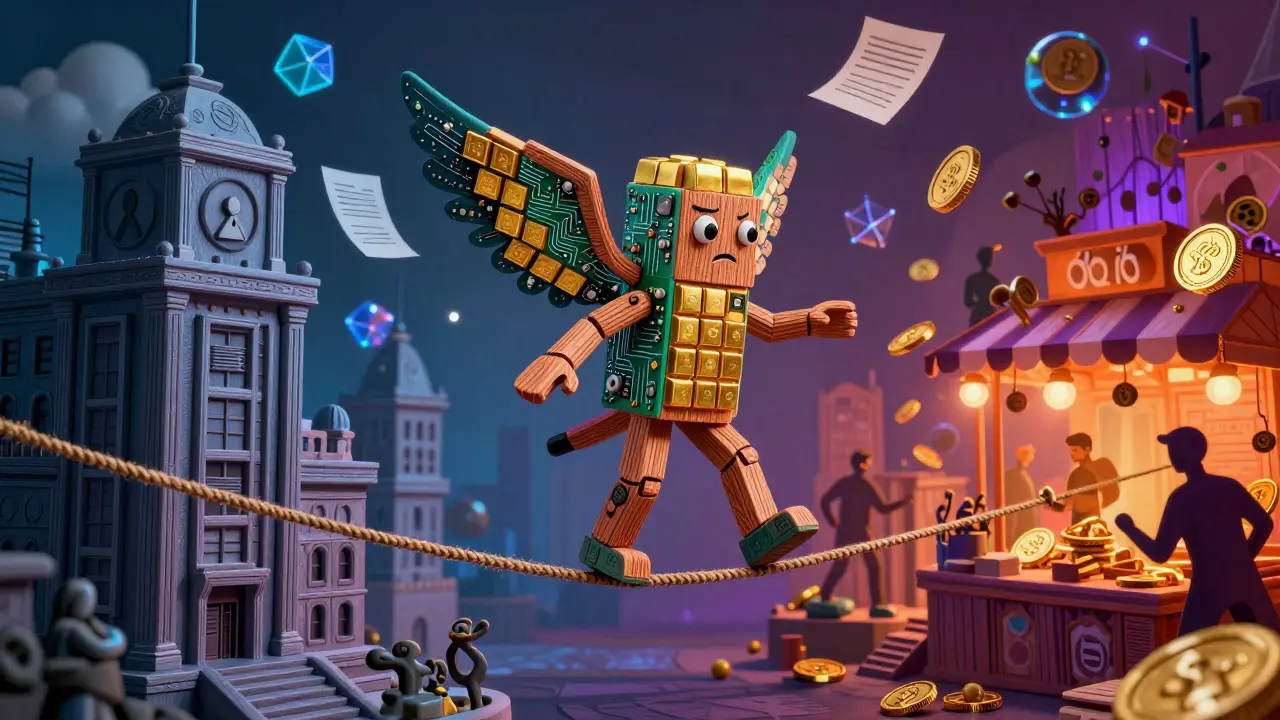

Buying Bitcoin in Skopje feels like walking a tightrope. On one side, you have the National Bank of the Republic of Macedonia (NBRM) holding a sign that says "Prohibited." On the other, thousands of citizens are actively buying, selling, and holding digital assets every single day. This contradiction creates what experts call a regulatory gray area, where the law on paper doesn't match the reality on the ground.
If you are looking to trade crypto in North Macedonia right now, you aren't just dealing with market volatility. You are navigating a complex web of outdated bans, new anti-money laundering laws, and peer-to-peer platforms that operate in the shadows. The question isn't whether people are trading-they definitely are-but how they do it without getting burned by scams or legal trouble.
The Regulatory Paradox: Banned but Not Illegal?
To understand why this market is so weird, you have to look at the history. In 2017, the NBRM issued a strict prohibition on cryptocurrency trading. They classified crypto alongside securities and derivative financial instruments traded on foreign markets. Why? Because of the Stabilisation and Association Agreement with the European Union, which restricted investing in foreign securities during its first phase.
But here is where it gets messy. In 2023, Multilaw’s business guide highlighted a major shift. The NBRM clarified that while trading is prohibited under old rules, "it does not mean that crypto currencies are illegal if they are not regulated." This is a crucial distinction. It means you won’t get arrested for owning Bitcoin, but banks might freeze your account if they see suspicious transfers because they still technically follow the 2017 ban.
Then came February 1, 2022. The government adopted amendments to the Anti-Money Laundering and Countering the Financing of Terrorism (AML/CTF) Draft-Law. These amendments introduced legal definitions for "virtual assets," "virtual asset service providers," and "cryptocurrencies" as property. So, is crypto legal or illegal? It’s neither yet. It’s in a transitional state where the government is preparing to regulate it, likely aligning with the EU’s MiCA framework by 2026-2027, but hasn’t fully lifted the old bans.
| Date | Event | Impact on Traders |
|---|---|---|
| 2017 | NBRM Prohibition Issued | Banks block direct crypto transactions; traders forced off-grid. |
| Feb 2022 | AML/CTF Draft-Law Amendments | Crypto defined as "property"; path toward regulation opens. |
| 2023 | NBRM Clarification | Ownership deemed not illegal, but trading remains restricted. |
| 2025-2027 | Expected MiCA Alignment | Predicted full licensing regime for virtual asset providers. |
How People Actually Trade: The Rise of P2P Platforms
Since you can’t just link your NLB or Stopanska bank account to Binance or Coinbase, Macedonians turned to Peer-to-Peer (P2P) platforms. These sites act as middlemen, connecting buyers and sellers directly. Instead of sending money through a traditional banking channel that might flag the transaction, users often use cash deposits, mobile payments, or specific local transfer methods that fly under the radar.
Two platforms dominate this space in North Macedonia: Symlix and LocalCoinSwap.
Symlix has become a go-to for many locals. It operates as a marketplace where you can filter offers by payment type, currency, and location. The platform uses an escrow system-meaning the seller’s crypto is held safely until the buyer confirms they’ve sent the fiat money. Symlix also generates automatic crypto wallets upon signup, making it easy for beginners. Their support team claims to resolve 85% of disputes within 24 hours, which is vital when trust is low.
LocalCoinSwap works similarly but emphasizes privacy and simplicity. It supports over 300 payment methods globally, including options relevant to Macedonian users. The process is straightforward: Register, Search Offers, Start a Trade. Users appreciate that it doesn’t require extensive KYC (Know Your Customer) verification compared to centralized exchanges, though this comes with higher risk.
There are also international brokers like Swissquote and Interactive Brokers that serve Macedonian clients. BrokerChooser ranked Swissquote as the best option in 2025 due to its solid crypto selection, but users complain about high fees and slow customer service. Interactive Brokers offers lower fees but lacks a native crypto wallet, forcing users to move assets elsewhere.
The Risks: Scams, Frozen Funds, and Legal Whiplash
Trading in a gray area means you don’t have the safety net of consumer protection laws. If you send money to a scammer on a P2P platform and the escrow fails, good luck getting it back. TRT World reported in June 2025 that many investors are drawn in by the promise of fast money but lack understanding of how blockchain works, making them prime targets for fraud.
One common nightmare scenario involves bank freezes. Even if you use a P2P platform, if your local bank sees repeated transfers to individuals labeled as "crypto merchants," they may freeze your account for AML compliance. A user on LocalBitcoins documented having €1,200 frozen for two weeks before resolving the dispute. This is why experienced traders advise using small test transactions first and verifying counterparty identities via video calls.
Then there’s the risk of "regulatory whiplash." The 2017 NBRM ban is still technically on the books. While enforcement has been lax, authorities could decide to crack down tomorrow. Platforms like Symlix and LocalCoinSwap could be blocked from accessing local payment gateways overnight. Unlike Serbia, which has clear (though restrictive) regulations, or Albania, which embraces blockchain development, North Macedonia offers no guarantees.
Who Is Trading and Why?
Despite the risks, the market is growing. BrokerChooser estimates around 42,000 active crypto users in North Macedonia, representing 2.3% of the population. This is lower than the EU average of 5.1%, but LocalCoinSwap reported a 300% year-over-year increase in user activity from 2022 to 2024.
Why are people doing it? Mostly for retail speculation and remittances. With inflation and economic uncertainty, some view Bitcoin as a hedge. Others use it to send money abroad cheaper than Western Union. Enterprise adoption is nearly non-existent; only three registered businesses accepted crypto as payment in May 2025, compared to over 1,200 in neighboring Serbia.
The community is largely self-taught. The largest Telegram group, "MK Crypto," has over 1,200 members sharing trusted trader lists and safe meetup locations. Reddit threads show users constantly asking for advice on "safe ways to buy Bitcoin here," highlighting the knowledge gap. Most successful traders spend 2-3 weeks researching before making their first trade, focusing on learning P2P mechanics and spotting red flags in counterparties.

Best Practices for Safe Underground Trading
If you decide to enter this market, treat it like handling live wires. Here is how to minimize your risk:
- Use Escrow Only: Never release crypto until you have confirmed receipt of funds. Never send funds until you have confirmed the crypto is in escrow. Trust no one.
- Start Small: Do your first few trades with minimal amounts (e.g., $50-$100) to test the platform and the counterparty.
- Verify Identities: Use video calls to confirm the person on the other end matches their profile. Check their trade history and reputation score on the platform.
- Avoid Large Bank Transfers: If possible, use cash deposits or less traceable payment methods to avoid triggering bank alerts. Be aware that this increases your exposure to physical theft or robbery.
- Keep Records: Save all chat logs, transaction IDs, and proof of payment. If a dispute arises, evidence is your only leverage.
- Stay Updated: Follow local news regarding the AML/CTF law and NBRM announcements. The regulatory landscape changes fast.
What Does the Future Hold?
The trend is moving toward clarity, not chaos. The February 2022 AML/CTF amendments were just the beginning. Multilaw predicts that draft legislation creating a licensing regime for virtual asset service providers will emerge in late 2025. This would finally allow legitimate exchanges to operate openly, reducing the need for risky P2P workarounds.
As North Macedonia progresses in its EU association agreements, aligning with the MiCA framework becomes inevitable. This means stricter rules, higher compliance costs for businesses, but greater security for consumers. For now, however, the underground market thrives on convenience and necessity. Until the law catches up with reality, traders will continue to navigate the gray areas, balancing potential profits against significant risks.
Is cryptocurrency illegal in North Macedonia?
Technically, yes and no. The National Bank of the Republic of Macedonia (NBRM) prohibited crypto trading in 2017. However, in 2023, they clarified that ownership is not illegal if unregulated. The 2022 AML/CTF amendments defined crypto as property, suggesting a move toward regulation rather than outright criminalization. Currently, it exists in a legal gray area where trading is restricted but not actively prosecuted for individuals.
Which P2P platforms are popular in North Macedonia?
Symlix and LocalCoinSwap are the most widely used P2P platforms among Macedonian users. Symlix is known for its escrow system and local support, while LocalCoinSwap offers more anonymity and diverse payment methods. International brokers like Swissquote and Interactive Brokers are also used, though they come with higher fees and limited coin selections.
Can I link my local bank account to a crypto exchange?
Generally, no. Most local banks in North Macedonia, such as NLB and Stopanska, block transactions to known crypto exchanges due to the 2017 NBRM prohibition. Attempting to do so may result in frozen accounts or rejected transfers. Users typically rely on P2P platforms with alternative payment methods like cash deposits or mobile transfers.
When will North Macedonia fully regulate crypto?
Experts predict full regulatory clarity between 2026 and 2027. This timeline aligns with the EU’s Markets in Crypto-Assets (MiCA) regulation implementation for candidate countries. The February 2022 AML/CTF amendments laid the groundwork, and further draft legislation is expected in late 2025 to establish a licensing regime for virtual asset service providers.
What are the biggest risks of trading crypto underground?
The primary risks include fraud (scammers taking money without releasing crypto), frozen bank accounts due to AML compliance checks, and sudden regulatory enforcement. Since there is no formal consumer protection, recovering lost funds is difficult. Additionally, the lack of clear laws means legal recourse is limited if disputes arise.