



You might think you can turn a small amount of money into a fortune overnight. That is the promise of Leverage Trading is a financial mechanism that allows traders to control a large position with a relatively small amount of capital by borrowing funds. Also known as Margin Trading, it amplifies your buying power. However, the flip side is just as real. You can lose everything just as fast. In the world of digital assets, leverage is not a shortcut to wealth. It is a high-speed train with no brakes.
Many traders enter the market without understanding the mechanics. They see others making quick profits on social media. They ignore the silent majority who lost their accounts. The reality is stark. A trader named "qwatio" lost $12.5 million in a single week in May 2024. This was not due to bad luck alone. It was overexposure and a failure to manage risk after initial losses. When you borrow money to trade, the exchange owns that money. If the market moves against you, they take it back.
How Leverage Mechanics Actually Work
To understand the risk, you need to understand the math. When you use leverage, you put up a portion of the trade value as collateral. This is called Margin is the initial deposit required to open a leveraged position, serving as collateral for the borrowed funds. For example, if you have $1,000 and use 10x leverage, you control a $10,000 position. Your $1,000 is the margin. The exchange lends you the other $9,000.
This sounds great until the price moves. With 10x leverage, a 10% drop in price wipes out your entire $1,000. You do not just lose your profit. You lose your principal. If you use 50x leverage, a mere 2% move against you liquidates your position. In traditional markets, a 2% move is noise. In cryptocurrency, a 2% move happens in minutes. The volatility makes these borrowed positions incredibly fragile.
Exchanges often offer ratios up to 125x on major coins like Bitcoin is the first and largest cryptocurrency by market capitalization, often used as a benchmark for leveraged trading. Some platforms even push for 500x leverage. This is not a tool for investors. It is a gambling mechanism. Professional traders rarely use more than 5x leverage. Beginners often jump straight to 20x or 50x. This is the fastest way to destroy your account.
The Liquidation Trap
Liquidation is the moment the exchange closes your position automatically. This happens when your margin falls below the minimum requirement. The system does not care about your plans. It does not wait for you to sell. It sells for you. This is the most immediate risk in crypto trading.
Consider the March 2020 crash. When the pandemic hit, global markets panicked. Bitcoin dropped sharply. Over $1 billion in leveraged positions got liquidated across exchanges in a single day. Traders who were long on Bitcoin saw their accounts hit zero. They did not have time to react. The automated liquidation engines executed faster than any human could click a button.
Stop-loss orders do not always save you. During high volatility, the price can skip past your stop-loss level. This is called slippage. You might set a stop-loss at $50,000. The market crashes. The next trade executes at $48,000. You lose more than you planned. In May 2021, a correction saw Bitcoin plummet over 30% in a day. Over $8 billion in leveraged positions vanished. The market gap was too wide for safety orders to function correctly.
| Feature | Traditional Markets | Crypto Markets |
|---|---|---|
| Typical Leverage | 2x to 5x | 10x to 125x |
| Market Hours | Fixed (9:30 AM - 4:00 PM) | 24/7/365 |
| Volatility | Low to Moderate | Extreme (5-15% daily) |
| Liquidation Speed | Minutes to Hours | Seconds |
Volatility and Market Structure
Crypto markets never sleep. This 24/7 nature creates unique risks. In stock markets, you can close your position before the market opens. In crypto, your position stays open while you sleep. A regulatory announcement in Asia can trigger a crash while you are in bed. You wake up to a negative balance.
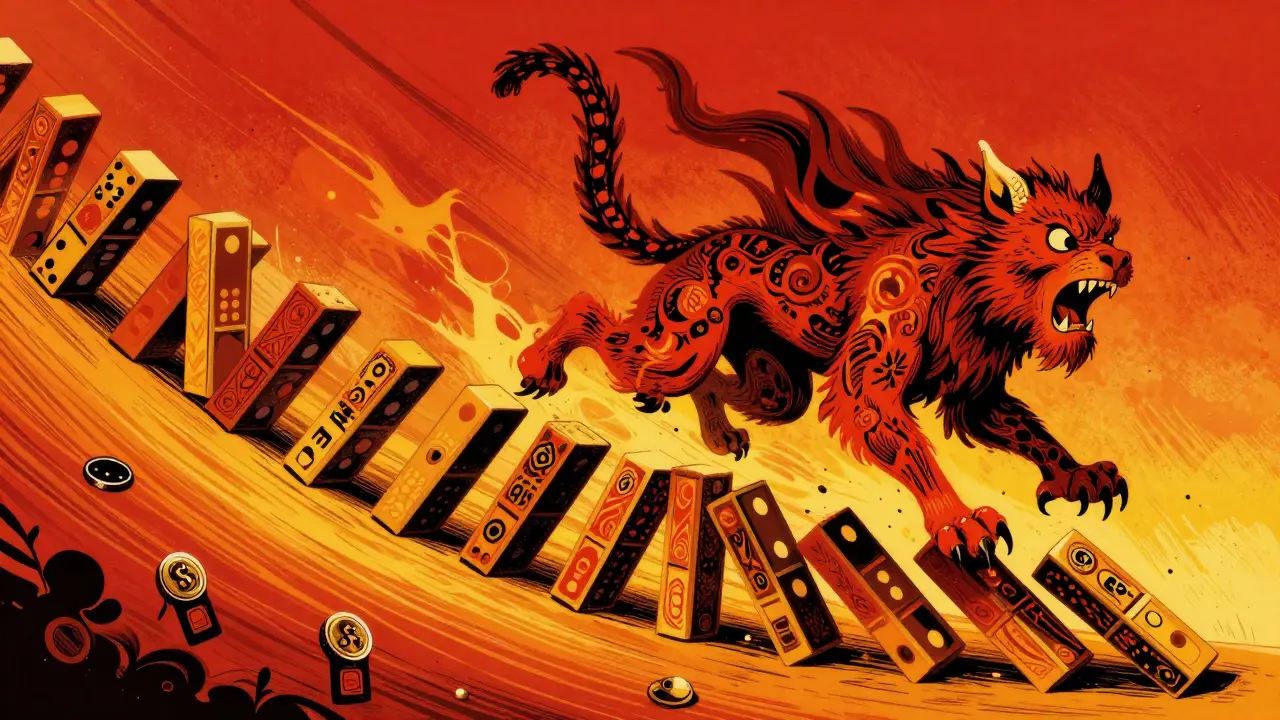
Whale trades also drive volatility. Large institutional investors can move the price significantly. A single large sell order can trigger a cascade of liquidations. When one trader gets liquidated, their sell order pushes the price down further. This triggers the next trader's liquidation. It creates a domino effect. This is known as a liquidation cascade.
News events impact prices instantly. Regulatory bans, exchange hacks, or government statements cause immediate reactions. If you are holding a leveraged position, you are exposed to this risk constantly. There is no safe time to hold a high-leverage trade. The market can gap against you at any moment.
Psychological Impact on Traders
Leverage changes your brain chemistry. It heightens fear and greed. When you are up, you feel invincible. You want to add more risk. When you are down, you panic. You sell at the bottom to stop the pain. This emotional response leads to impulsive decisions.
Many traders describe leverage trading as addictive. The potential for quick profits triggers a dopamine rush. This is similar to gambling. You chase losses. You try to win back what you lost. This behavior is dangerous. It turns trading into a desperate attempt to recover funds rather than a strategic process.
Experienced traders on platforms like BitMEX and Binance Futures warn against this. They say successful trading requires discipline. You must stick to your plan. You must ignore the fear. Most people cannot do this under high leverage. The pressure is too much. The emotional toll affects your ability to think clearly.
Risk Management Strategies
If you choose to trade with leverage, you must protect your capital. Professional traders use strict rules. They never risk more than 1-2% of their total account value on a single trade. This means if you have $10,000, your maximum loss on one trade is $200. This allows you to survive a losing streak.
Position sizing is critical. You need to calculate your entry and exit points before you click buy. Determine where you will stop-loss. Set this order immediately. Do not wait for the trade to move. Use isolated margin instead of cross margin. Isolated margin limits the risk to the specific trade. Cross margin uses your entire account balance as collateral. If one trade goes bad, it can drain your whole account.
Diversification helps too. Do not put all your capital into one position. Spread risk across multiple smaller trades. Take profits regularly. Do not wait for the moon. Lock in gains as the price moves in your favor. Scale out of your position. Sell half at a target price. Let the rest run. This reduces exposure as the trade succeeds.
Common Mistakes to Avoid
Overleveraging is the biggest mistake. Beginners often use 20x or 50x leverage. This is gambling. Start with 2x or 3x. Learn the mechanics. Build your skills. Increase leverage only after you have a proven strategy. Ignoring volatility is another error. Different coins have different risks. Bitcoin is less volatile than a small altcoin. Adjust your leverage based on the asset.
Averaging down on losing positions is dangerous. If you are losing, adding more money increases your risk. It does not fix the trade. You turn a small loss into a massive one. Trading without a strategy is also fatal. If you do not have a plan, you are guessing. Leverage magnifies your guesses. It does not make you smarter.
Counterparty risk is often overlooked. Exchanges can fail. They can have technical outages. They can run out of liquidity. If the exchange collapses, your funds are gone. This happened with several major platforms historically. Always be aware of the platform you use. Check their security and reputation.
Deciding If Leverage Is Right For You
Most retail traders should avoid leverage. The risks outweigh the benefits. You can grow your account without borrowing money. Spot trading is safer. You own the asset. You cannot lose more than you invested. Leverage is for professionals with experience and capital reserves.
Ask yourself if you can handle a 50% loss. Can you sleep at night with a position open 24/7? If the answer is no, stay away from leverage. The market will be there tomorrow. Your capital might not be. Education is key. Understand the tools. Use risk management. Respect the market.
What happens if I get liquidated?
When you get liquidated, the exchange automatically sells your position to cover the borrowed funds. You lose your initial margin. In some cases, if the price gaps significantly, you might owe the exchange more money, resulting in a negative balance.
Is 10x leverage safe?
10x leverage is still very risky. A 10% move against you wipes out your capital. In crypto, 10% moves are common. It is not safe for beginners. Most experts recommend staying below 5x leverage until you have significant experience.
What is the difference between isolated and cross margin?
Isolated margin limits risk to the funds allocated for a specific trade. Cross margin uses your entire account balance as collateral for all open positions. Isolated margin is safer because it prevents one bad trade from draining your whole account.
Can I recover from a liquidation?
Once liquidated, the position is closed and your margin is lost. You cannot recover that specific trade. You can only recover by depositing more funds and trading again. This is why risk management is crucial to prevent liquidation in the first place.
Why is crypto leverage riskier than stock leverage?
Crypto markets trade 24/7 with higher volatility. Stocks have trading hours and circuit breakers. Crypto can gap significantly at any time. The leverage ratios offered in crypto are also much higher, increasing the speed and severity of potential losses.






16 Comments
Another day another dollar lost to the casino.
They tell you it is investment but it feels like a slot machine.
Risk management is key to survival in this market.
Many ignore the stop loss until it is too late.
Loss is part of the journey in life.
Money comes and goes like the wind.
Yeah scary stuff 😅
I almost got wiped out last week.
Liquidation is real when volatility spikes.
Need to watch the margin level closely.
They rig the game against small players.
Exchanges want your money not your success.
The emotional toll of leverage is something most people ignore until it is too late.
You feel a rush when the green candles appear.
That dopamine hits your brain like a drug.
Suddenly you are not trading anymore.
You are chasing a feeling.
The moment the market turns red you panic.
Your heart starts racing in your chest.
You stare at the screen hoping for a miracle.
Logic leaves the building completely.
Fear takes the wheel and drives off a cliff.
I have seen friends lose everything over a single night.
They could not sleep for weeks after the event.
The money was gone but the trauma remained.
Trading should be a business not a thrill ride.
Please understand the cost before you click that button.
Risk is inevitable.
Conspiracy theories are common but math is real.
The risk exists regardless of who runs the exchange.
Interesting view on the psychology of trading.
It changes how you see the charts.
Discipline is key to mastering the charts.
Emotions must be kept in check at all times.
It is true that leverage amplifies everything.
Both the gains and the devastating losses.
I understand the fear of losing capital.
It is a heavy burden to carry alone.
You need to know the mechanics before you start.
Do not gamble your life savings blindly.
That is correct education comes first.
Learn the tools before you use them.
Thanks for sharing this important information.
It helps new traders stay safe.