
You send ETH from Ethereum to Polygon. It takes five minutes. You get your tokens back on the other side. Simple, right? But what actually happened in those five minutes? Did your money just teleport? No. Your assets were locked in a vault on one chain and minted as digital IOUs on another. This mechanism is called a sidechain, and it connects to the main blockchain through a specialized system known as a two-way peg.
If you've ever wondered why gas fees drop from $20 to $0.01 when you switch networks, or why some transactions vanish into thin air during high congestion, understanding this connection is key. We're not talking about magic; we're talking about cryptographic proofs, validator consensus, and smart contracts that act as digital escrow agents. Let's break down exactly how these parallel universes of value talk to each other.
What Is a Sidechain and Why Do We Need One?
A sidechain is an independent blockchain that runs its own consensus mechanism but stays linked to a primary blockchain (the mainchain) via a two-way peg. Think of it like a highway exit ramp. The main highway (Ethereum) is congested and expensive. The exit ramp leads to a local road (Polygon) that’s faster and cheaper. But you can’t just jump off the highway; you need a specific on-ramp and off-ramp structure to ensure you don’t crash.
The concept was formally introduced in 2014 by Adam Back and others in the paper "Enabling Blockchain Innovations with Pegged Sidechains." The goal was simple: solve the blockchain trilemma-the trade-off between security, decentralization, and scalability. By moving heavy transaction loads to a sidechain, the mainchain stays secure and decentralized, while users enjoy low costs. As of late 2023, sidechain adoption grew by over 300% since 2020, largely driven by gaming and DeFi apps needing speed.
The Core Mechanism: How the Two-Way Peg Works
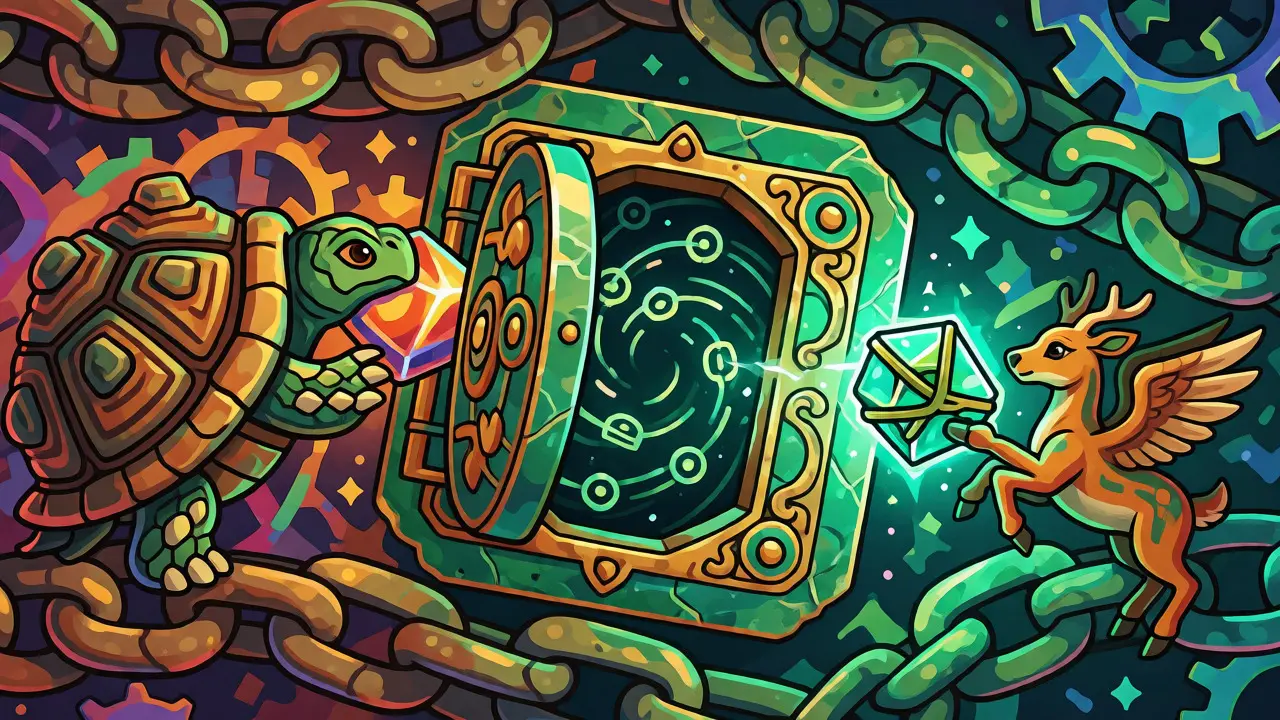
The heart of the connection is the two-way peg. This mechanism allows assets to move bidirectionally between chains while maintaining their total supply across both networks. Here is the step-by-step reality of what happens when you bridge assets:
- Locking on Mainchain: You send your assets (like ETH) to a specific smart contract address on the mainchain. These assets are now "locked" in a vault. They don't disappear; they just sit there, inaccessible to anyone else.
- Verification: A network of validators or nodes watches this lock event. They wait for enough confirmations (usually 100-200 blocks) to ensure the transaction is final and won't reverse.
- Minting on Sidechain: Once verified, the sidechain creates (mints) an equivalent amount of wrapped assets (like WETH on Polygon). You now have spendable tokens on the sidechain.
- Burning and Unlocking: To go back, you burn the wrapped tokens on the sidechain. Validators verify this burn and unlock the original assets on the mainchain.
This process ensures that for every token on the sidechain, there is a corresponding locked token on the mainchain. If this ratio breaks, the system fails.
Types of Bridges: Trustless vs. Federated
Not all connections are created equal. The way validators verify transactions determines your security level. There are three main types of bridge architectures:
| Bridge Type | Security Model | Speed | Trust Assumption |
|---|---|---|---|
| Federated | Requires consensus from a small group of trusted validators (e.g., 9-21 nodes). | Fast (seconds to minutes) | High. You trust the validators not to collude. |
| Proof-of-Stake | Validators stake capital. Malicious behavior results in slashing (losing funds). | Moderate (minutes) | Medium. Economic incentives discourage cheating. |
| Trustless | Uses cryptographic proofs (Merkle trees) verified directly on the mainchain. | Slow (hours to days) | Low. Relies on math, not people. |
Most popular sidechains like Polygon PoS use a hybrid model. They use 100+ validators who must reach 67% consensus to approve transfers. This is faster than pure trustless bridges but less secure than the mainchain itself. Remember the Ronin Bridge hack in 2022? That was a federated bridge where 5 out of 9 validators were compromised, leading to a $625 million loss. Speed often comes at the cost of decentralization.
The Role of Smart Contracts and Validators
Smart contracts are the gatekeepers. On Ethereum, a contract like ERC20Predicate handles the locking logic. It doesn't care who you are; it only cares if the conditions are met. Have you sent the right amount? Is the transaction confirmed? If yes, it emits an event that validators listen for.
Validators are the human (or bot) element. In systems like Polygon, these aren't anonymous miners. They are entities running dedicated hardware. They watch the mainchain, detect lock events, and submit signatures to the sidechain. If a validator lies-say, claiming you sent money when you didn't-they risk losing their staked collateral. This economic penalty is crucial. Without it, validators might as well be centralized servers.
Risks: Why Bridges Get Hacked
Here is the uncomfortable truth: bridges are the weakest link in blockchain infrastructure. According to Chainalysis, 65% of all cross-chain exploits between 2020 and 2023 happened at the bridge layer. Why? Because bridges introduce new attack surfaces.
- Validator Collusion: If enough validators team up, they can fake a transaction. In a federated model with only 9 validators, getting 5 corrupt ones is hard but possible.
- Code Bugs: Smart contracts are code. Code has bugs. The Wormhole bridge hack exploited a signature verification flaw.
- Liquidity Issues: Sometimes, the bridge doesn't have enough liquidity to release your funds immediately, causing delays.
When you use a sidechain, you are accepting a different risk profile. You gain speed and lower costs, but you lose the absolute security guarantee of the mainchain. Vitalik Buterin himself noted that sidechains offer a different risk-reward tradeoff, not equal security.
Practical Example: Moving Assets to Polygon
Let's say you want to buy an NFT on Polygon because Ethereum gas is too high. You use the official Polygon Bridge.
- You connect your wallet to the bridge interface.
- You select ETH and enter the amount. You pay a small gas fee on Ethereum to send the transaction to the bridge contract.
- The transaction appears on Etherscan. Status: Pending.
- After ~12-24 hours (for security reasons), the bridge confirms the deposit. Note: This delay is annoying but necessary to prevent double-spending attacks.
- Your ETH is now visible in your Polygon wallet as "WETH" or native ETH representation.
- You swap it for USDC or buy the NFT. Gas fee? Maybe $0.01.
Notice the time lag. While deposits can sometimes be faster, withdrawals usually require longer confirmation times to ensure the sidechain hasn't forked or reverted.
Future Outlook: Modular Blockchains
The current model is evolving. We are moving toward modular blockchains where data availability layers (like Celestia) separate storage from execution. New protocols like Chainlink CCIP aim to standardize these connections using decentralized oracle networks, reducing reliance on single validator sets.
By 2027, experts predict sidechains will handle the majority of non-financial transactions. But the technology isn't perfect yet. Always check if a bridge is audited. Always test with a small amount first. And remember: if it sounds too good to be true (instant, free, perfectly secure), it probably involves a hidden centralization point.
Are sidechains as secure as the main blockchain?
No, generally not. Sidechains rely on their own consensus mechanisms and validator sets, which are often smaller and more centralized than the mainchain's. While modern implementations achieve 80-90% of mainchain security, they introduce additional risks related to bridge vulnerabilities and validator collusion.
How long does it take to transfer assets between chains?
It depends on the bridge type. Federated bridges can complete transfers in seconds to minutes. Trustless bridges may take hours or even days due to required block confirmations. For example, moving ETH to Polygon typically takes 12-24 hours for full security finality, though user interfaces may show balances sooner.
What happens if a sidechain bridge gets hacked?
If a bridge is hacked, attackers may steal the locked assets on the mainchain or mint fraudulent tokens on the sidechain. Users can lose funds permanently unless the project has insurance or governance mechanisms to compensate victims. The Ronin Bridge hack resulted in $625 million in losses, highlighting this risk.
Can I use any asset on any sidechain?
Only assets supported by the specific bridge. Most bridges support native coins (like BTC or ETH) and common tokens (like ERC-20s). You cannot arbitrarily create a new token on a sidechain without a corresponding mechanism to lock or mint it. Check the bridge's documentation for supported assets.
Why do sidechain transactions cost less?
Sidechains process transactions independently of the mainchain's congestion. They often use lighter consensus algorithms (like Proof-of-Authority or optimized Proof-of-Stake) and have fewer nodes competing for block space. This reduces computational overhead and gas fees significantly compared to the mainnet.