



Imagine holding a digital asset that gets slightly more valuable every year simply because there are fewer of them. Now imagine another one where new units are constantly printed into your wallet, diluting your stake. This is the core tension between deflationary tokens and inflationary ones. It’s not just about price charts; it’s about how you view money itself in the digital age.
The distinction comes down to supply dynamics. Inflationary models increase circulating supply over time through mining or staking rewards. Deflationary models do the opposite: they cap supply permanently or actively burn tokens to reduce what’s available. These mechanics shape everything from user behavior to market volatility. If you’re deciding which type fits your portfolio, understanding these underlying engines is critical.
How Supply Mechanics Work Under the Hood
To grasp the difference, we need to look at the technical architecture driving each model. Inflationary cryptocurrencies rely on continuous issuance. For example, proof-of-stake networks issue tokens to validators to secure the network. Proof-of-work systems create new coins as block rewards for miners. Some projects, like Dogecoin, have no hard cap at all, allowing unlimited token creation since 2014 when the original 100 billion limit was removed.
Deflationary cryptocurrencies use the reverse approach. They implement fixed maximum supplies or active reduction mechanisms. Bitcoin is the classic example here. Its protocol dictates a hard cap of 21 million coins. No more can ever be created. Beyond simple caps, some deflationary protocols use "token burning." This involves permanently destroying a percentage of transaction fees or specific supply amounts, effectively shrinking the total pool of available tokens.
Ethereum offers a fascinating hybrid case. While its proof-of-stake transition introduced inflationary staking rewards, the implementation of EIP-1559 added a deflationary layer by burning a portion of transaction fees. Depending on network activity, Ethereum can shift between net inflationary and net deflationary states. This dynamic adjustment represents a modern evolution in token design.
Economic Philosophy: Spending vs. Holding
These supply models aren't just technical choices; they reflect different economic philosophies about how people should interact with currency.
- Inflationary Models encourage spending. Because the supply keeps growing, holding onto tokens risks seeing their purchasing power erode relative to the total pie. This disincentive to hoard promotes usage as a medium of exchange. It helps build liquidity and transaction volume quickly.
- Deflationary Models promote holding. With a fixed or shrinking supply, scarcity drives value. Holders anticipate appreciation, making these tokens attractive as stores of value. This aligns them with traditional concepts of gold or hard assets that hedge against fiat currency devaluation.
If your goal is to use a token for daily payments or ecosystem incentives, an inflationary structure often makes sense. It funds development and rewards participation without needing external capital. However, if you want a long-term hedge against global monetary expansion, the scarcity premium of a deflationary asset becomes its primary selling point.
Market Dynamics and Volatility Patterns
Supply structure directly impacts price discovery. Inflationary tokens with floating supplies can theoretically smooth out price movements. As demand grows, new supply enters the market to meet it, potentially reducing extreme spikes. This stability makes them suitable for commerce and payment processing where predictable value transfer is essential.
Deflationary tokens face intensified supply-demand pressure. When demand rises but supply remains fixed or decreases, prices must adjust upward to balance the equation. This creates higher volatility. While this can be stressful for traders, it also creates strong momentum during bull markets. The scarcity narrative fuels speculative interest, particularly when combined with active burning mechanisms that visibly reduce circulating supply.
| Feature | Deflationary Tokens | Inflationary Tokens |
|---|---|---|
| Supply Cap | Fixed (e.g., 21M) or Decreasing | Unlimited or Gradually Increasing |
| Primary Use Case | Store of Value, Long-term Investment | Medium of Exchange, Ecosystem Incentives |
| User Behavior Incentive | Holding/Accumulation | Spending/Circulation |
| Volatility Profile | Higher (Scarcity-driven) | Lower (Supply dampens shocks) |
| Risk Factor | Liquidity shortages, Hoarding | Dilution, Devaluation if demand lags |
Real-World Examples: Bitcoin, Ethereum, and Dogecoin
Looking at major assets clarifies these theories. Bitcoin remains the definitive deflationary cryptocurrency. Its halving events, occurring roughly every four years, cut mining rewards in half, systematically slowing the rate of new supply issuance. This engineered scarcity has been central to its identity as "digital gold."
Ethereum, on the other hand, demonstrates the complexity of modern tokenomics. Before its merge to proof-of-stake, it was purely inflationary. Now, it balances staking issuance with fee burning. During periods of high network congestion, the amount burned can exceed the amount issued, creating a net deflationary effect. This adaptability allows Ethereum to serve both utility and value storage roles.
Dogecoin represents the pure inflationary end of the spectrum. With no hard cap and a consistent issuance rate, it prioritizes community engagement and transactional use over long-term scarcity. This design supports its meme-driven culture and lower transaction costs but limits its appeal as a long-term store of value compared to capped assets.
Strategic Considerations for Investors
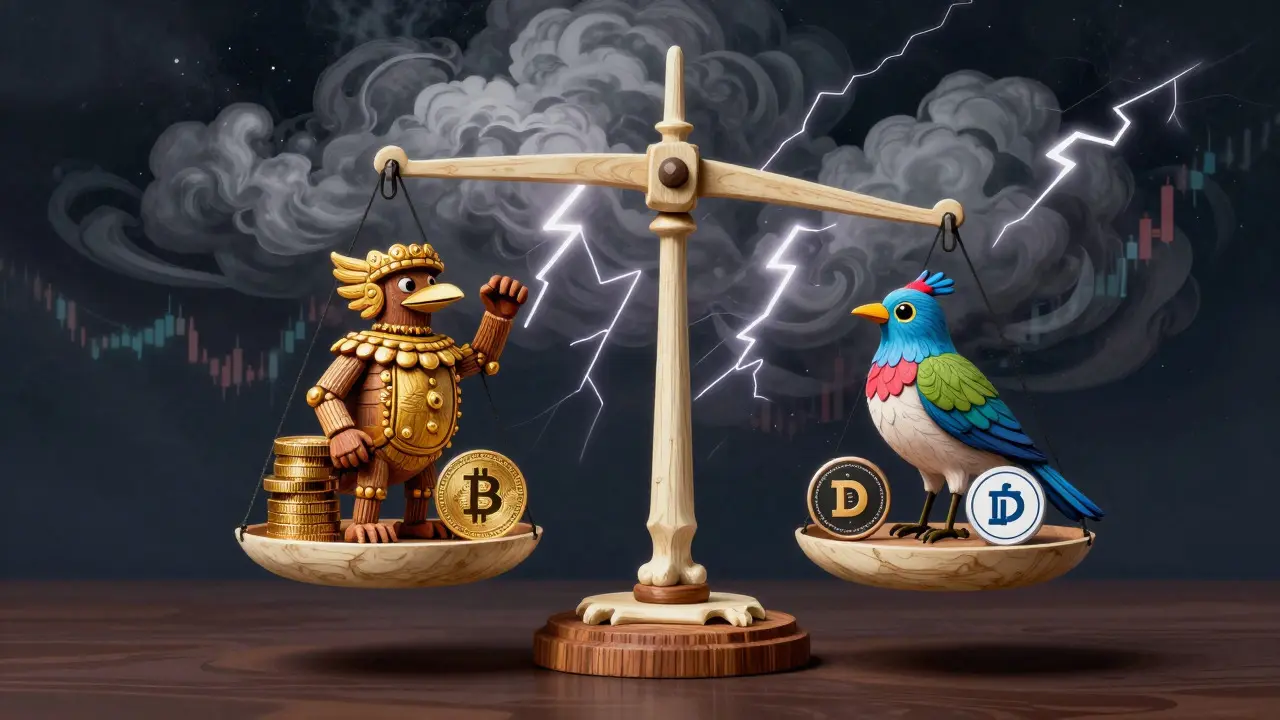
So, which model should you favor? It depends on your objective. Institutional investors often prefer deflationary assets like Bitcoin for treasury holdings, viewing them as a hedge against fiat inflation. Their fixed supply provides a clear, predictable monetary policy.
Conversely, decentralized finance (DeFi) protocols frequently utilize inflationary tokens. These tokens fund liquidity pools, reward stakers, and incentivize early adopters. The continuous supply acts as fuel for ecosystem growth. If you're looking for exposure to active networks with high transaction volumes, inflationary governance tokens might offer better alignment with short-to-medium term utility.
A balanced portfolio might include both. Use deflationary assets for long-term wealth preservation and inflationary assets for capturing growth in emerging ecosystems. Avoid assuming one is inherently superior; context matters. A rigid deflationary model might struggle if the ecosystem needs to fund development, while an unlimited inflationary model could suffer severe dilution if adoption stalls.
Frequently Asked Questions
Are deflationary tokens always a good investment?
Not necessarily. While scarcity supports value, deflationary tokens can suffer from low liquidity if everyone holds and nobody spends. Additionally, if the broader crypto market crashes, even scarce assets will drop in price. Scarcity helps preserve value relative to fiat, but it doesn't guarantee absolute price appreciation in all market conditions.
What happens if an inflationary token's supply grows faster than demand?
The token faces dilution. Each individual holder's share of the total value decreases. If the utility of the token doesn't grow to absorb the new supply, the price per token may fall or stagnate. This is why monitoring the ratio of supply growth to network activity is crucial for inflationary assets.
Can a token switch from inflationary to deflationary?
Yes, through protocol upgrades or governance votes. Ethereum is a prime example, shifting from pure inflation to a hybrid model via EIP-1559. However, changing fundamental supply rules requires broad consensus among developers, validators, and users to avoid disrupting trust in the network.
Why do some projects choose unlimited supply?
Projects with unlimited supply often prioritize ease of access and low barriers to entry. Continuous issuance allows for generous rewards for miners or validators, ensuring network security without relying on high token prices. It also simplifies accounting and distribution for communities focused on social engagement rather than financial speculation.
How does token burning affect price?
Token burning reduces the circulating supply. According to basic supply and demand principles, if demand remains constant or increases while supply decreases, the price per unit tends to rise. Burning creates a visible signal of value extraction from the market, often boosting investor confidence in the asset's long-term potential.






10 Comments
It is truly fascinating how these mechanics mirror the historical shifts in our own monetary systems, isn't it? I often wonder if we are simply recreating the Gold Standard with a digital twist. The idea of scarcity driving value feels very much like a return to classical economic principles. It makes one appreciate the complexity of modern finance so much more deeply.
Sarcastic take: sure, 'scarcity' is the key word here, not 'speculation'.
We all know that Bitcoin's price is mostly driven by Elon tweeting about it and Chinese miners hiding in basements. But hey, let's pretend the math matters more than the memes for a second. At least the article admits Dogecoin is just vibes.
they r lying to u all. its not deflationary its just a psyop by the fed to keep us from buying gold. bitcoin is actually backed by a secret vault under switzerland. i saw a docuementary on youtube last week that proved it. stop being sheep and look at the data before they turn off the internet again.
meh
its cool but idk if it really changes anything for regular people. most of us just buy and hold anyway. the whole burning thing sounds nice on paper but in practice its just marketing hype to get more buyers in. chill out guys its just money either way.
Absurd! Who decided that American innovation should be shackled by such arbitrary supply caps? We need growth! We need unlimited potential! This deflationary nonsense is a relic of European thinking that stifles true entrepreneurial spirit. The US should lead with inflationary models that reward hard work and expansion, not hide behind some pseudo-scientific scarcity theories written by nerds in caves!
i think its actually pretty positive to see this kind of breakdown. it helps new investors understand why their tokens might be moving. the hybrid model of ethereum is particularly interesting because it shows adaptability. which is a good sign for long term stability in the space. looking forward to seeing how other chains implement similar fee mechanisms.
The macroeconomic implications of tokenomics are often overlooked in these shallow discussions. While the article touches on liquidity, it fails to adequately address the impact of staking rewards on effective supply versus circulating supply metrics. It’s a bit lazy to equate simple issuance rates with true inflationary pressure without considering the velocity of money within the specific ecosystem.
Nice summary. I appreciate the balanced view on both sides. It's helpful to see the practical examples like Ethereum's shift. Thanks for sharing this.
actually everyone knows deflation is bad for an economy right? why would you want less money? its just a trick to make rich people richer. the whole concept is flawed and only works because people dont understand basic economics. stop pretending its smart investing its just gambling with extra steps.
Finally! A post that doesn't treat us like children; though, frankly, most crypto enthusiasts act like they have never heard of MMT or Keynesian theory, so perhaps the simplification was necessary for the masses. However, note the critical distinction between nominal and real supply adjustments! One must account for the hyperinflationary nature of fiat currencies when comparing these assets; otherwise, you are merely playing numbers games with no grounding in reality. Do try to read more than just the headlines next time, shall we?