
Remember the rush of trying to snag an early spot in a hot new game? Now imagine that feeling, but with actual financial stakes and a community voting on who gets in. That is essentially what GameZone tried to solve when it launched its Initial DEX Offering (IDO). If you are digging into the history of this platform, you are likely looking for clarity on how the token distribution worked, whether there were traditional airdrops, and where the project stands today.
It is easy to get lost in the noise of crypto marketing terms. So let us cut through the jargon. GameZone isn't just another token; it is a launchpad designed to help regular gamers access Initial Game Offerings (IGOs) without needing to be a venture capitalist. The core question many have is: Did GameZone do a standard airdrop? And how did the IDO actually play out?
The Core Concept: Democratizing GameFi Access
Before we look at the numbers, you need to understand the problem GameZone was solving. In the early days of blockchain gaming, whales and hedge funds dominated the initial sales. Regular players got left behind or paid inflated prices after the hype peaked. GameZone, part of the BlueZilla ecosystem, positioned itself as a metaverse game incubator. Its goal was simple: give everyday enthusiasts fair access to promising projects like Katana Inu or Galactic Quadrant.
The mechanism relied heavily on the native token, GZONE. By staking this token, users gained "pool weight." Think of pool weight like a loyalty card at a coffee shop-the more you stake and hold, the higher your tier, and the better your chances of getting allocated tokens in upcoming game launches. This wasn't just about holding; it was about active participation in the ecosystem.
Anatomy of the GZONE IDO Launch
The Initial DEX Offering (IDO) for GZONE didn't happen overnight. It was a structured, multi-phase event that took place in September 2021. If you are analyzing the capital raise, here is exactly how the money came in:
- Private Sale: Raised $110,000 from early backers and strategic partners.
- Public IDO: Generated an additional $112,500 from retail investors.
- Strategic Funding: Secured a massive $1 million injection to fuel long-term development.
This brought the total capital raised to roughly $1.22 million. For a niche gaming launchpad, that was a solid start. The initial market cap sat around $155,000, which gave early buyers plenty of room to grow. And grow they did-at least initially. The token hit its all-time high of $1.18 on November 18, 2021, just two months after the IDO completion. That represents a significant return for those who caught the wave early.
Airdrops vs. Staking Rewards: What Was Actually Distributed?
Here is where things get tricky for people searching for "GameZone airdrop details." Unlike some projects that blast free tokens to Twitter followers or Discord members, GameZone's approach to distribution was more integrated into its economic model. There wasn't one singular, massive "airdrop" event that everyone remembers. Instead, the distribution happened through continuous mechanisms.
The platform uses a deflationary tokenomics model. Every time someone sells GZONE, a 7% fee is applied. Here is the breakdown:
| Fee Component | Percentage | Purpose |
|---|---|---|
| Burn Mechanism | 2% | Permanently removes tokens from supply to increase scarcity. |
| Staking Rewards | 5% | Distributed to holders who stake their GZONE, acting as a continuous yield or "soft airdrop." |
So, if you were holding and staking during the bull run, you were effectively receiving a steady stream of rewards funded by sellers. This is often more sustainable than a one-time airdrop dump. Additionally, being part of the BlueZilla ecosystem meant GZONE holders sometimes had access to partner project drops, though these weren't always advertised as broad public airdrops.
Tier-Based Allocation: How Your Stake Mattered
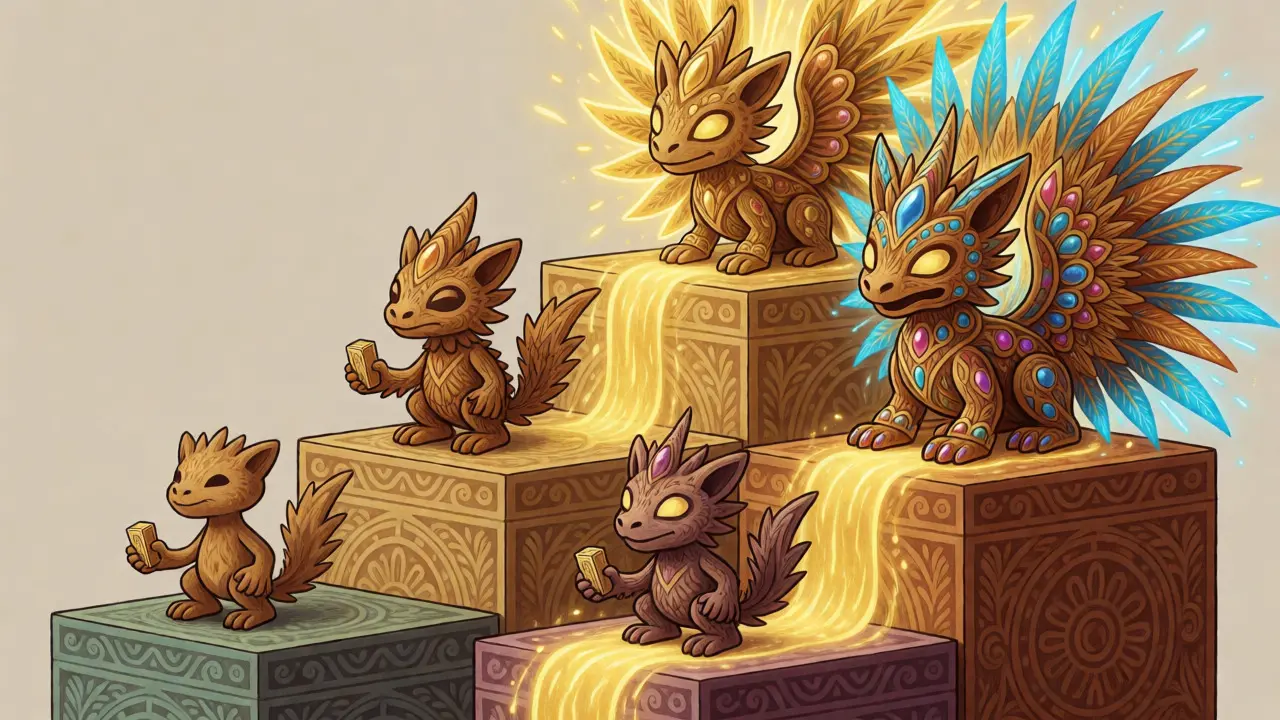
If you participated in the IDO or bought afterward, your experience depended on your tier. GameZone implemented four distinct tiers based on how much GZONE you staked. This system directly influenced your allocation in future IGOs.
Why does this matter now? Because it explains why some users felt left out while others thrived. Higher tiers got priority access to popular games. If you only held a small amount, you might have missed out on the hottest launches like Velhalla. The more you committed, the greater your "pool weight," and consequently, your share of the pie.
Current Market Reality: From Hype to Hard Truths
Fast forward to September 2026. The crypto market has been brutal for many altcoins, and GZONE is no exception. The token currently trades around $0.00274, a far cry from its $1.18 peak. With a market cap hovering near $1.15 million, it is clear that the initial hype has cooled significantly.
Technical indicators suggest the asset is oversold. The 14-Day RSI sits at 15.56, indicating extreme fear among traders. Only 8 out of the last 30 days showed positive price action, with volatility staying high at 13.21%. This bearish sentiment reflects broader market conditions rather than a failure of the platform's technology alone.
However, the fundamental infrastructure remains intact. GameZone continues to support multiple blockchains, including Polygon, Binance Smart Chain, Solana, and Ethereum. Their marketplace allows users to trade NFTs with competitive fees, providing utility beyond just speculation. The partnership with BlueZilla also provides ongoing access to resources and networks that smaller projects lack.
Future Outlook and Price Predictions
What does the future hold? Analysts are split. Some projections suggest a potential average price of $2.50 by late 2026, driven by renewed interest in GameFi and enhanced gaming features. Others predict continued correction periods into 2027 and 2028, with averages dropping to $1.85 or lower.
The key driver for recovery will likely be the success of the games launching on the platform. If GameZone can incubate another breakout hit similar to Axie Infinity or The Sandbox, demand for GZONE could spike again. Until then, patience is required. The deflationary burn rate helps, but it needs buying pressure to truly move the needle.
Key Takeaways for Investors and Gamers
If you are considering entering the GameZone ecosystem today, keep these points in mind:
- No Traditional Airdrop: Don't expect a sudden windfall from a forgotten snapshot. Value comes from staking rewards and IGO access.
- Stake to Win: Holding alone isn't enough. You must stake to gain tier benefits and future allocations.
- Volatility Warning: GZONE is highly volatile. Recent lows show it can drop quickly, so manage your risk accordingly.
- Ecosystem Play: The value proposition relies on the success of partnered games. Keep an eye on their pipeline.
GameZone attempted to fix a real problem in blockchain gaming: accessibility. While the token price has suffered, the platform's structure offers a logical path for engaged users. Whether it recovers depends less on marketing and more on delivering playable, profitable games to its community.
Did GameZone conduct a standard public airdrop?
GameZone did not execute a single, large-scale public airdrop campaign typical of other DeFi protocols. Instead, it utilized a continuous reward distribution model. 5% of the 7% sell tax is redistributed to stakers, creating an ongoing yield mechanism. Additionally, early participants in the private sale and IDO received their allocations directly, which served as the primary token distribution method.
How much capital did GameZone raise during its IDO?
The total capital raised was approximately $1.22 million. This included $110,000 from the private sale, $112,500 from the public IDO, and a subsequent strategic funding round that secured $1 million. This capital was used to develop the launchpad infrastructure and incubate early GameFi projects.
What is the current status of the GZONE token price?
As of September 2026, GZONE trades at approximately $0.00274. This represents a significant decline from its all-time high of $1.18 reached in November 2021. The token has experienced sustained downward pressure, with technical indicators showing oversold conditions and high volatility.
How does the tier-based system work for GZONE holders?
Users stake GZONE tokens to determine their tier level. There are four distinct tiers. Higher stakes result in greater "pool weight," which increases the user's allocation probability in Initial Game Offerings (IGOs). This ensures that committed community members receive preferential access to new game launches.
Is GameZone still active in the blockchain gaming sector?
Yes, GameZone remains active. It continues to operate as a launchpad and incubator for GameFi projects across multiple chains like Polygon, BSC, Solana, and Ethereum. The platform supports services such as legal assistance, marketing, and tokenomics design for selected gaming startups.
17 Comments
Look, I appreciate the attempt to dissect this, but let's be real about the actual mechanics here because the marketing fluff obscures the brutal reality of what happened to GZONE holders who didn't get out in time. The article glosses over the fact that while $1.22 million sounds like a lot for a niche launchpad, it was peanuts compared to the valuation multiples they were trying to justify at an ATH of $1.18, which is basically pure speculation detached from any tangible revenue stream or user acquisition metrics that actually matter in a bear market. You talk about 'democratizing access' as if staking your tokens and waiting for pool weight isn't just another form of capital lockup designed to suppress sell pressure during the initial pump so insiders can exit liquidity onto retail bags. The tier system is brilliant for them, sure, because it gamifies holding, but for the average user who put in $500 expecting a quick flip, getting stuck with illiquid allocations in projects like Katana Inu that never really took off is a harsh lesson in why 'community voting' often just means 'whales deciding where the money goes.' The deflationary model is cute, 7% tax on sells? That’s a penalty fee, not a feature, and it chokes trading volume when you need it most, creating a death spiral where low volume leads to higher slippage which leads to more people exiting via OTC or just giving up entirely. And don’t get me started on the current price of $0.00274; that’s not 'oversold,' that’s the market correctly pricing in the lack of product-market fit after five years of development cycles that yielded nothing comparable to Axie Infinity’s peak utility. If you’re entering now, you’re not investing in technology, you’re gambling on a zombie project hoping for a narrative shift that hasn’t come since 2021, and honestly, the opportunity cost of tying up capital in GZONE versus anything else with active dev commits and user growth is staggering.
Hey there! 👋 Just wanted to say thanks for breaking down the IDO phases so clearly. It helps to see the numbers laid out without all the hype. 😊
I love how you highlighted the human element behind the code, it really reminds us that these platforms are built by people trying to solve genuine accessibility issues for gamers who felt left behind by traditional VC models. 🌟 It’s heartwarming to see the focus on community participation rather than just cold hard cash grabs, even if the financial results have been tough lately. 💖 We should celebrate the effort to create inclusive spaces where everyday enthusiasts can have a voice, because that spirit of collaboration is what keeps the Web3 dream alive despite the volatility. 🌈
Oh please, spare me the 'democratization' fairy tale. This whole thing screams insider job disguised as community governance. Did you notice how the strategic funding was exactly ten times the public raise? Coincidence? I think not. They knew exactly who they were selling to before the public even saw the whitepaper. Typical crypto theater.
Great breakdown! I believe that every setback is just a setup for a comeback. The foundation is strong, and with the right games launching soon, we will see the value reflect back to the holders. Keep pushing!
i wonder if the tier system actually helped small holders or if it just made the whales richer... feels like the math always favors those with more to begin with anyway
You're missing the philosophical underpinning here. GameZone wasn't just a platform; it was an experiment in decentralized meritocracy. The failure isn't in the tech, it's in the collective inability of the masses to understand long-term value accrual versus short-term speculation. Most people simply aren't equipped to grasp the nuance of deflationary tokenomics when they're conditioned to chase pumps. It’s a cognitive dissonance issue, really.
To add to the technical side, the multi-chain support mentioned (Polygon, BSC, Solana, ETH) is crucial for interoperability, but it also fragments liquidity. From an expert perspective, maintaining smart contracts across four different VMs increases audit costs and security risks significantly. If the team isn't transparent about their audit reports for each chain, that's a red flag regardless of the price action.
The RSI of 15.56 is a classic trap for novice traders who mistake oversold conditions for buy signals without considering fundamental decay. Until there is organic daily active user growth independent of incentive programs, GZONE remains a speculative asset with no intrinsic floor. The moral hazard here is that early backers are incentivized to dump on retail, creating a perpetual cycle of loss for latecomers.
Let's go! The potential is still there if they execute on the new roadmap. Don't let the FUD stop you from seeing the bigger picture. Momentum builds slowly, then all at once. Stay bullish!
@2962 Exactly right. The asymmetry of information between the strategic funders and the public IDO participants is the dirty little secret of almost every mid-cap altcoin launch. When you have $1M coming in strategically after a $112k public raise, the strategic partners effectively control the float and the narrative. They can afford to hold through dips because their cost basis is likely lower or hedged elsewhere, whereas the retail investor is exposed to full downside risk. It’s not a conspiracy theory if the cap table structure proves it; it’s just basic market microstructure that retail ignores at their peril. The 'community voting' aspect is largely performative when the voting power is weighted by stake, and since stakes are distributed unevenly, the 'voice' of the community is just the echo chamber of the top 10 wallets. We need to stop pretending that DAO structures automatically lead to equitable outcomes; often, they just formalize plutocracy with extra steps and gas fees.
hey guys, good post. i read through the part about the 7% tax and its pretty high imo. usually 2-3% is standard for burn/reward split. makes it hard to trade actively. hope they fix it eventually.
Hello everyone! As someone who has watched the GameFi space evolve from Ireland, I think the resilience shown by the team is commendable. Many similar launchpads shut down completely during the bear market, but GameZone kept the lights on. That consistency is worth noting, even if the token price doesn't reflect it yet. Let's keep supporting the builders!
Everyone is talking about the price drop, but nobody is asking why the volume dried up. It wasn't just the market; it was the realization that the games weren't fun. If the gameplay loop is boring, no amount of tokenomics will save you. The whales knew this and exited. The rest are just holding bags of dust waiting for a miracle that won't happen because the core product failed to engage users beyond the earning mechanism.
Chilling here reading through the comments. Honestly, the data presentation is solid. For anyone looking at entry points, just remember that liquidity pools on smaller DEXs can be thin, so watch out for slippage if you're moving size. Otherwise, seems like a fair assessment of a struggling but persistent project.
Facts only! 📉 The tier system is definitely pay-to-win lite. 🤷♀️ But hey, at least the burn rate is helping supply shrink. 🔥
It’s sad to see such a promising concept struggle with adoption. I hope the next game launch brings some joy back to the community.