


Wrapped Asset Risk Calculator
Asset Risk Assessment Tool
Enter your asset details to evaluate security risks and trade-offs between wrapped and native assets.
Risk Assessment Results
Risk Score:
Key Recommendations
Imagine you own Bitcoin. You want to earn interest on it, lend it out, or trade it in DeFi - but Bitcoin’s network doesn’t support smart contracts. What do you do? You wrap it. That’s where wrapped assets come in. But here’s the catch: wrapping Bitcoin into WBTC isn’t the same as using Bitcoin itself. It’s a copy. And copies come with trade-offs.
What Are Native Assets?
Native assets are the real deal. They live on their own blockchain, governed by its rules, secured by its consensus, and used for its core functions. Bitcoin (BTC) is native to the Bitcoin network. Ether (ETH) is native to Ethereum. SOL is native to Solana. These assets aren’t replicas. They’re the original code, running on the original network, with the original security. Native assets handle their own transactions, pay their own fees, and participate in their own governance. ETH isn’t just money on Ethereum - it’s the fuel. You need ETH to pay for gas, to stake, to vote on upgrades. BTC isn’t just a store of value on Bitcoin - it’s the only asset that can be mined, the only one that secures the network through proof-of-work. There’s no middleman. No custodian. No smart contract holding your coins. You control your private keys. Your Bitcoin stays on Bitcoin. No one else can freeze it. No one else can mint more of it. That’s the core promise of decentralization.What Are Wrapped Assets?
Wrapped assets are bridges. They let you take an asset from one blockchain and use it on another. The most famous example is Wrapped Bitcoin (WBTC). For every WBTC on Ethereum, there’s one BTC locked in a vault somewhere - usually managed by a group of trusted custodians like BitGo. The process is simple: you send BTC to a custodian. They verify it. Then they mint an equal amount of WBTC on Ethereum. You now have a token that behaves like Bitcoin… but on Ethereum. You can use WBTC in Aave, Uniswap, or Compound. You can earn yield. You can swap it. You can even use it as collateral. Other common wrapped tokens include WETH (Wrapped Ether), wMATIC, wSOL, and renBTC. They all follow the same logic: lock one, mint one. Burn one, get one back. As of late 2023, over $12.5 billion was locked in wrapped assets. WBTC alone made up nearly 80% of that. That’s not small change. It’s a massive flow of capital from one ecosystem to another.Why Do Wrapped Assets Exist?
The answer is simple: Ethereum’s DeFi ecosystem is huge. It has more liquidity, more protocols, more users, and more yield opportunities than any other chain. But Bitcoin’s network doesn’t support DeFi. So if you want to use your Bitcoin in DeFi, you need a wrapper. Wrapped assets solve a real problem: isolation. Blockchains are like islands. Without bridges, you can’t move between them. Wrapped tokens are the boats. They let Bitcoin holders access Ethereum’s $35+ billion DeFi market. They let Solana users participate in Ethereum-based lending. They let stablecoins like USDC move across 14 different chains. Without wrapped assets, Bitcoin would be stuck. So would most other major cryptos. The entire DeFi space would be far smaller. Wrapped assets didn’t just expand access - they unlocked trillions in potential value.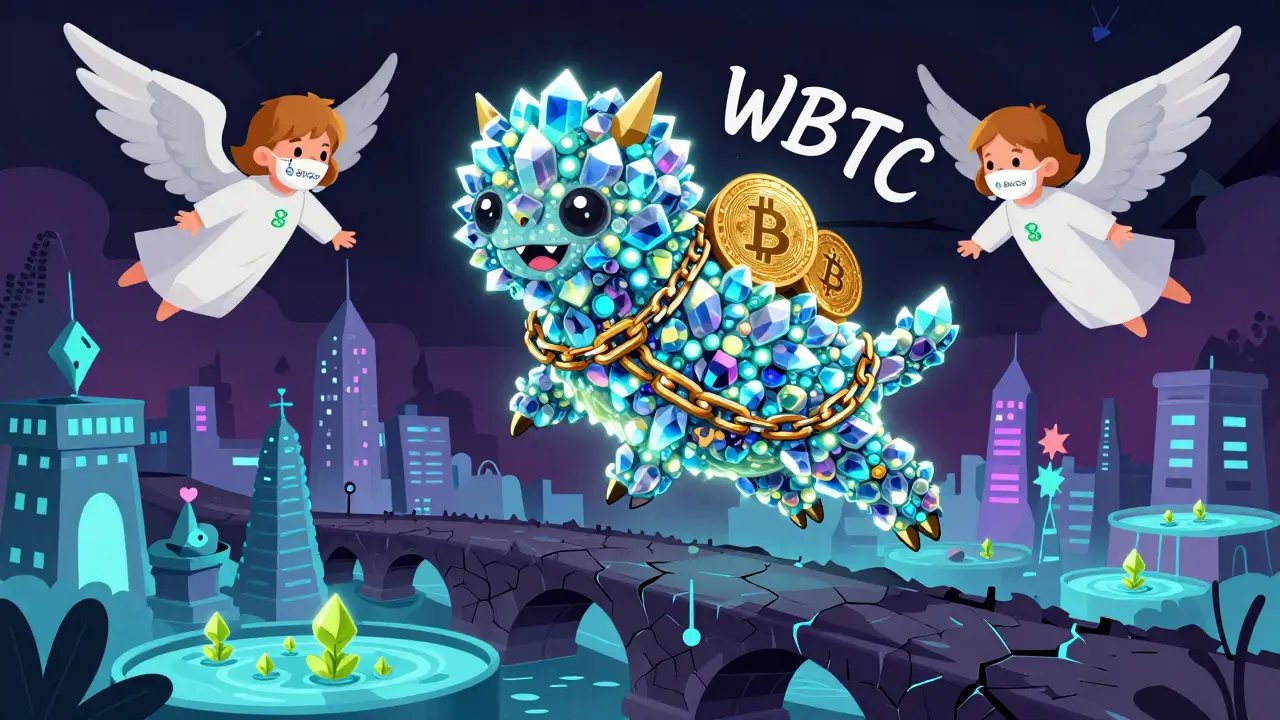
Security: Native vs Wrapped
This is where things get tricky. Native assets are secured by their blockchain’s consensus. Bitcoin’s network has over 300 exahashes of computing power. It’s the most secure network in crypto history. No one can alter its rules without consensus. No one can double-spend without controlling half the network. Wrapped assets? They’re only as secure as their weakest link. WBTC relies on a consortium of 18 merchants and BitGo, a centralized custodian. If BitGo gets hacked, if the multisig keys are compromised, if the custodians collude - your WBTC could vanish. And it’s happened before. In 2022, the Nomad bridge was hacked. $600 million vanished because of a flawed smart contract. That wasn’t a native asset. That was a wrapped asset. The same thing happened with the Ronin Bridge ($625 million lost). These aren’t theoretical risks. They’re real, documented failures. Security researcher Samczsun found that 63% of wrapped token protocols had at least one critical vulnerability. That’s more than half. And that was in 2022. Many are still unpatched. Native assets don’t have this problem. They don’t rely on custodians. They don’t rely on smart contracts to hold your money. They’re just… there. On the chain. Owned by you.Liquidity and Use Cases
Native assets are limited to their own ecosystem. Bitcoin’s DeFi liquidity? Around $500 million. Ethereum’s? Over $35 billion. That’s not a typo. That’s a 70x difference. Wrapped assets fix that. WBTC alone brings billions of Bitcoin-backed liquidity into Ethereum. That’s why you can get 4-6% APY on WBTC in Aave or Compound. You can’t do that with BTC on Bitcoin. But here’s the catch: wrapped assets can’t do everything. WBTC can’t pay Ethereum gas fees. You still need ETH for that. WBTC can’t vote on Ethereum upgrades. It can’t be mined. It can’t be used in Bitcoin’s native Lightning Network. It’s a shadow of the real thing. Think of it like a fake $100 bill that works in some stores but not others. It looks real. It’s backed by real money. But if you try to use it at the Federal Reserve, it’s useless.Trust, Fees, and User Experience
Using wrapped assets means trusting someone else. With WBTC, you’re trusting BitGo and its merchant partners. With renBTC, you’re trusting a decentralized network of nodes. But even decentralized wrappers aren’t fully trustless - they rely on oracles and consensus mechanisms that can fail. Fees are another factor. Minting WBTC costs 0.875%. Burning it back? Another fee. Some platforms charge extra for cross-chain transfers. On Ethereum, gas fees for WBTC transactions can range from $0.50 to $5. That’s low compared to native BTC fees, which can hit $25 during congestion. But you’re paying for convenience - and for someone else’s infrastructure. User experience is mixed. Reddit users love WBTC for earning yield. But they also complain about delays during market crashes. During the FTX collapse, users reported 72+ hour delays withdrawing wrapped assets backed by centralized exchanges. That’s not the decentralized future we were promised. And mistakes are costly. A lot of users accidentally send WBTC to a Bitcoin address. Once it’s gone, it’s gone. Etherscan recorded over $2.1 million in stranded WBTC in 2023. No recovery. No refund. Just gone.
What’s Next? The Future of Wrapped Assets
The industry knows the problems. That’s why new solutions are emerging. Chainlink’s CCIP protocol, in beta as of late 2023, aims to replace custodians with decentralized oracles. Instead of locking BTC in a vault, CCIP uses secure message passing to verify asset transfers across chains - no middleman needed. That’s the holy grail: trust-minimized interoperability. Zero-knowledge proofs are also being tested. Projects like zkSync and StarkNet are building bridges that prove asset ownership without revealing private data. These could eventually replace wrapped tokens entirely. But here’s the reality: for the next 5-7 years, wrapped assets aren’t going away. Institutions like JPMorgan and Fidelity are already using wrapped versions of their own digital coins. They need compatibility. They need liquidity. They don’t care if it’s perfectly decentralized - they care if it works. The market will likely consolidate. Right now, there are 47 different wrapped Bitcoin versions. By 2026, experts predict only 5-7 will survive. WBTC will probably remain dominant. But decentralized alternatives like renBTC and sBTC will gain ground as users demand less trust.Which Should You Use?
If you’re holding Bitcoin and want to earn yield in DeFi? Use WBTC. It’s the most liquid, the most tested, and the most integrated. Just know you’re giving up some decentralization. If you’re building a DeFi app and need to support multiple chains? Use wrapped assets - but prioritize those with decentralized custody or ZK bridges. Avoid anything with a single custodian. If you believe in true decentralization? Stick to native assets. Use Bitcoin on Bitcoin. Use ETH on Ethereum. Wait for native cross-chain solutions to mature. There’s no perfect answer. Only trade-offs.Frequently Asked Questions
Is WBTC the same as Bitcoin?
No. WBTC is a token on Ethereum that represents Bitcoin. For every WBTC, one BTC is locked in a custodial vault. WBTC can be used in Ethereum DeFi, but it can’t be mined, can’t pay Ethereum gas fees, and relies on third parties to hold the underlying Bitcoin. It’s a representation, not the original.
Are wrapped assets safe?
They’re riskier than native assets. Wrapped tokens depend on custodians, smart contracts, and bridges - all of which can be hacked or mismanaged. WBTC has never been hacked, but other wrapped assets like renBTC and sBTC have had vulnerabilities. The Nomad bridge hack lost $600 million in wrapped assets. Always assume wrapped tokens carry more risk than native ones.
Can I convert WBTC back to Bitcoin?
Yes. You can burn WBTC to get back your Bitcoin. But the process requires going through the WBTC custodian (BitGo) and its merchant partners. It’s not instant. During market stress, withdrawals can take 24 to 72 hours. You also pay a 0.875% fee to mint or burn.
Why not just use Bitcoin on Bitcoin for DeFi?
Bitcoin’s blockchain doesn’t support smart contracts. You can’t lend, borrow, or stake Bitcoin directly on its network. Wrapped assets exist because Bitcoin’s design prioritizes security and simplicity over programmability. To access DeFi, you need to move your Bitcoin to a chain that does support contracts - like Ethereum.
Will wrapped assets become obsolete?
Not soon. While projects like Chainlink CCIP and zero-knowledge bridges aim to replace custodial wrappers, they’re still in early stages. For the next 5-7 years, wrapped assets will remain essential for moving value between blockchains - especially for institutions and retail users who need liquidity and compatibility. The future is likely a mix: trust-minimized bridges for tech-savvy users, custodial wrapped assets for institutions.




16 Comments
Okay, but let’s be real-wrapped assets are the reason I even got into DeFi. I had BTC sitting there like a museum piece, and then I found WBTC on Aave and suddenly I was earning 5% just for existing. It’s not perfect, but neither is my job. I’ll take a little centralization for yield any day. 🤷♀️
As someone who’s been in crypto since 2017, I’ve seen this dance before. Remember when everyone thought Omni was the future? Then came RSK, then Liquid, now WBTC. The pattern? People want the utility without the hassle. Wrapped assets aren’t the endgame-they’re the bridge. And bridges get replaced when the highway’s built.
Let me just say this with the gravitas of a Harvard finance professor: the fact that you’re even considering using WBTC over native ETH demonstrates a fundamental misunderstanding of decentralization. You’re not an investor-you’re a rent-seeker. You want the returns of DeFi without the responsibility of owning the underlying infrastructure. This isn’t innovation; it’s financial cosplay. And the 63% vulnerability rate? That’s not a bug-it’s the entire business model.
Native assets = true freedom 🕊️
Wrapped assets = convenience with a side of risk 🚨
But hey-if you’re not taking any risks, are you even living? I’ve lost a few bucks to bridge delays, but I’ve also made more than my rent from WBTC yields. Life’s a trade-off, baby. Keep your keys, but keep your eyes open too! 💪💰
WBTC is just BTC with a side of trust issues and higher fees and if you think this is decentralized you're delusional
Why do Americans always act like Ethereum is the center of the universe? Bitcoin is the original. Bitcoin is the money. Everything else is just digital glitter. You want yield? Mine Bitcoin. Build on Bitcoin. Stop begging Ethereum for scraps. This wrapped nonsense is just Wall Street’s way of turning gold into IOUs.
The real issue isn’t wrapped vs. native-it’s trust minimization. WBTC requires custodians, which are single points of failure. CCIP, ZK bridges, and decentralized oracles represent the next evolutionary step: composability without custodianship. The fact that $12.5B is locked in custodial wrappers is a market signal-not a validation. We’re in the transitional phase of blockchain interoperability, and we’re still using duct tape and prayer.
I just use WBTC because it works and I don’t wanna think about it too hard. I know it’s not perfect but I also don’t have time to run a node or audit every bridge. If it earns me 6% and doesn’t vanish overnight, I’m good. Let the experts worry about the rest.
For new users, wrapped assets are the gateway drug to crypto. I’ve helped my cousin in Delhi get into DeFi using WBTC. He didn’t know what a smart contract was-but he knew he could earn more than his savings account. That’s progress. The tech will improve. The trust models will evolve. But we need to meet people where they are.
I think the real win here is that wrapped assets forced the whole industry to think about interoperability. Without WBTC, we wouldn’t have CCIP or ZK bridges pushing so hard. It’s like the internal combustion engine-messy, imperfect, but it got us moving. Now we’re building the electric car. Give it time.
One thing people overlook: wrapped assets are also a form of financial inclusion. In countries with unstable currencies, WBTC is often the most reliable store of value accessible via smartphone. Yes, there are risks-but the alternative is hyperinflation, capital controls, or no access at all. This isn’t just about DeFi yield; it’s about economic sovereignty for millions.
You’re all so naive. You think you’re earning yield? You’re just lending your assets to a company that could freeze them tomorrow. And you’re proud of it? I’ve watched people lose everything because they trusted ‘the system.’ You’re not an investor-you’re a pawn. And you don’t even realize it.
It’s fascinating how the market prioritizes liquidity over sovereignty. The fact that institutions are adopting wrapped assets en masse suggests a fundamental shift in the definition of ‘ownership.’ We’re not just moving assets-we’re redefining what it means to hold value in a multi-chain world. This isn’t a bug. It’s a feature of the new financial architecture.
Just had a friend send WBTC to a BTC address last week. $8,000 gone. No recovery. No support. Just silence. That’s the real cost of convenience. We talk about security, but we never talk about the human cost of mistakes. These aren’t theoretical risks. They’re daily occurrences.
Let’s be brutally honest: WBTC is a regulatory arbitrage play. It’s Bitcoin disguised as an ERC-20 token to bypass crypto-native compliance. Institutions love it because it’s KYC’d, traceable, and auditable. It’s not about decentralization-it’s about control. The fact that you call this ‘innovation’ is the real tragedy.
Christy, I get it-you’re scared. But I’m not a pawn. I’m a participant. I know the risks. I’ve read the docs. I’ve watched the audits. I choose this. And I’m not ashamed. If you want to hoard BTC in a cold wallet like a monk, that’s your path. Mine’s got yield, liquidity, and a little bit of rebellion. We’re not all living in the same crypto utopia-and that’s okay.