


The landscape for cryptocurrency in Singapore is a global financial hub with one of the most sophisticated regulatory frameworks for digital assets changed dramatically in 2025. If you are planning to operate a crypto business here, or even just serving clients from there while living elsewhere, the rules have tightened significantly. The era of ambiguous guidelines is over. As of mid-2026, the Monetary Authority of Singapore (MAS) enforces strict licensing under the new Financial Services and Markets Act (FSMA). Missing these requirements doesn't just mean fines; it means your operations must cease immediately.
Key Takeaways
- FSMA is now law: Since June 30, 2025, all Digital Token Service Providers (DTSPs) operating from Singapore need a license, regardless of where their customers are located.
- Licensing is extremely difficult: MAS has issued very few licenses under the new regime, often only in "exceptional cases" due to systemic risk concerns.
- Capital requirements vary: You need between SGD 100,000 and SGD 250,000 minimum capital depending on your transaction volume and license type.
- No credit cards allowed: Retail investors cannot use credit cards to buy crypto, limiting leverage and protecting consumers from debt spirals.
- Strict AML rules: The "Travel Rule" requires full transparency of sender and receiver data for every transaction to prevent money laundering.
From PSA to FSMA: The Regulatory Shift
To understand where things stand today, you have to look at how we got here. Before 2025, Singapore relied heavily on the Payment Services Act (PSA), introduced in January 2020. This act brought crypto exchanges under the same roof as traditional payment providers. It defined Bitcoin (Bitcoin is the first decentralized cryptocurrency, recognized by MAS as a digital payment token) and Ethereum (Ethereum is a blockchain platform supporting smart contracts, also classified as a digital payment token in Singapore) as "digital payment tokens" (DPTs). Under the PSA, businesses could get licensed relatively straightforwardly if they met capital and anti-money laundering standards.
However, the regulatory environment evolved. In May 2020, the MAS expanded its reach by bringing public offerings of DPTs under the Securities and Futures Act (SFA). This meant that if a token acted like a security, it was treated as one. But the biggest change came with the implementation of the Financial Services and Markets Act 2022 is comprehensive legislation that consolidated and strengthened financial regulation in Singapore, including crypto. Fully enforced on June 30, 2025, this act replaced many older frameworks and created a dedicated regime for Digital Token Service Providers (DTSPs).
Why did this happen? The MAS wanted to balance innovation with financial stability. While they want Singapore to remain a fintech leader, they are wary of the risks associated with unregulated crypto markets, such as fraud, market manipulation, and money laundering. The FSMA gives them sharper tools to manage these risks without stifling legitimate technological development.
The New Licensing Reality for DTSPs
If you are running a crypto exchange, wallet provider, or trading platform from Singapore, you are likely a Digital Token Service Provider (DTSP). Under the FSMA, this status comes with heavy responsibilities. The most critical thing to know is the extraterritorial scope of the law. Even if your company is incorporated in Singapore but serves only overseas clients, you still need a license. There are no loopholes for "offshore-only" operations based in Singapore.
The MAS has taken a highly restrictive approach to issuing these licenses. Unlike the earlier days when dozens of firms obtained PSA licenses, the new regime sees licenses granted only in exceptional cases. The regulator is concerned about the systemic risks crypto poses to the broader financial system. Consequently, many unlicensed providers were forced to shut down by the June 2025 deadline. For those who do get licensed, the ongoing requirements are rigorous:
- Minimum Capital: You must maintain specific capital thresholds to ensure solvency.
- Local Compliance Officer: You must employ a qualified compliance officer based in Singapore.
- Annual Audits: Regular independent audits are mandatory to verify financial health and compliance.
- Cybersecurity Standards: Robust systems to protect customer assets and data are non-negotiable.
This shift signals that Singapore is not trying to be a "crypto wild west." It is aiming for a high-trust, high-compliance environment similar to traditional banking. If your business model relies on low overhead and minimal regulation, Singapore may no longer be the right fit.
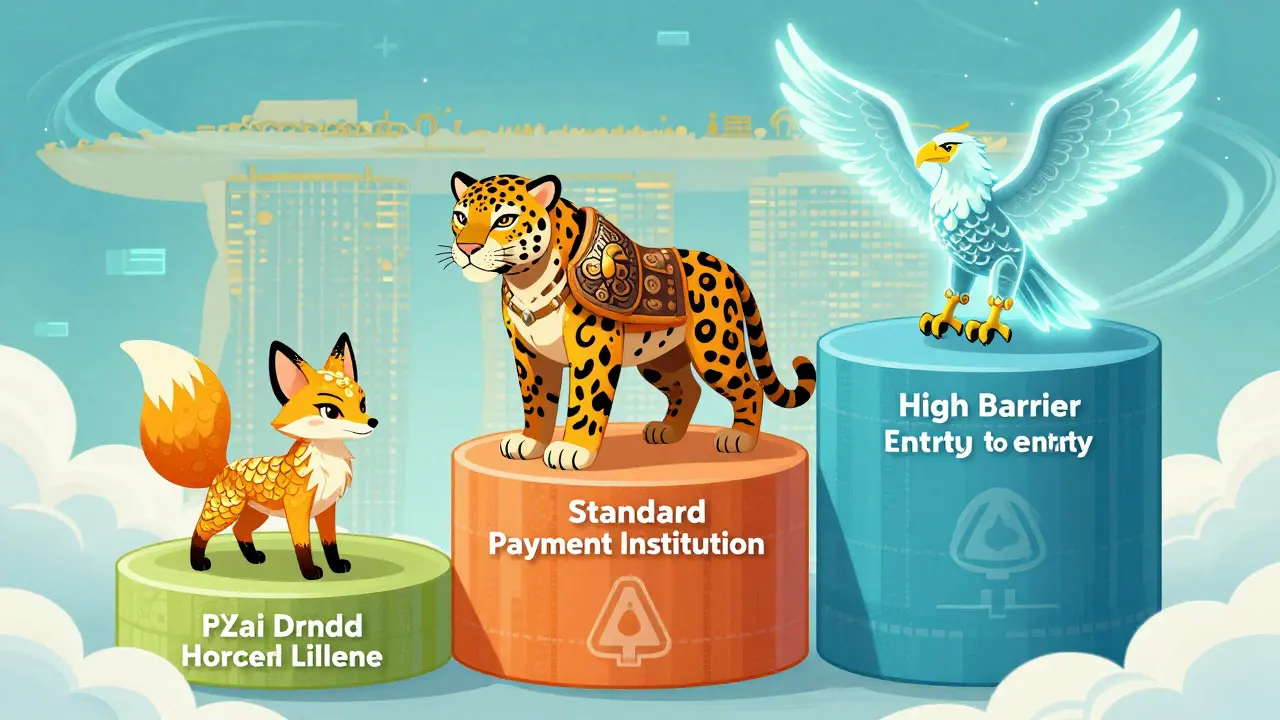
Tiered Licensing Structure Explained
Before the full FSMA rollout, the PSA established a tiered licensing system that still influences how capital requirements are viewed. Understanding these tiers helps you gauge the financial commitment needed. The structure is designed to match the level of oversight with the scale of operations.
| License Type | Monthly Volume Threshold | Minimum Capital Requirement | Target Audience |
|---|---|---|---|
| Standard Payment Institution | Up to SGD 3 million | SGD 100,000 | Small exchanges, wallet providers, startups |
| Major Payment Institution | Above SGD 3 million | SGD 250,000 | Large exchanges, institutional platforms, high-volume traders |
| Exempt Payment Service Provider | Low-risk activities | Varies by activity | Firms with limited scope, requiring notification to MAS |
For most serious players, the Major Payment Institution license is the benchmark. The higher capital requirement ensures that these entities can withstand market volatility and potential losses. Additionally, major institutions face enhanced scrutiny, including more frequent reporting and stricter operational controls. If you are starting small, the Standard license allows you to enter the market, but you will need to upgrade quickly if your volume grows.
Anti-Money Laundering and the Travel Rule
Compliance is not just about getting a license; it's about daily operations. Singapore’s approach to preventing financial crimes is anchored by MAS Notice PSN02 is regulatory guidance detailing Anti-Money Laundering (AML) and Combating the Financing of Terrorism (CFT) requirements for crypto providers, commonly known as the Crypto Travel Rule. This rule requires every crypto platform to share detailed information about the sender and receiver of funds for transactions above certain thresholds.
In practical terms, this means you cannot facilitate anonymous transfers. Your platform must perform comprehensive customer due diligence (CDD). You need to know who your customers are, verify their identities, and monitor their transaction patterns for suspicious activity. If something looks off, you must report it to the authorities. This aligns crypto platforms with traditional banks, ensuring that Singapore’s financial system remains clean and transparent.
The implications for technology infrastructure are significant. You need robust KYC (Know Your Customer) systems, real-time transaction monitoring tools, and secure data storage solutions. Failing to comply with these AML/CFT guidelines can result in severe penalties, including license revocation and criminal charges.

Stablecoins and Capital Markets
Stablecoins have become a crucial part of the crypto ecosystem, and Singapore has responded with a dedicated framework. The MAS recognizes the potential of stablecoins for payments and settlements but is cautious about the risks they pose to monetary policy and financial stability. As a result, issuers of stablecoins must meet strict backing and redemption requirements. They must hold sufficient reserves to ensure that each token can be redeemed at par value at any time.
Furthermore, cryptocurrency exchanges that deal in capital market products need a Capital Market Services (CMS) license. This applies if your platform facilitates trading in tokens that are deemed securities under the SFA. The CMS license imposes additional financial and operational requirements, ensuring that these platforms operate with the same integrity as traditional stock exchanges.
Another notable restriction is the ban on using credit cards for crypto purchases. This measure aims to protect retail investors from taking on excessive debt to speculate in volatile markets. By removing easy access to leverage through credit lines, the MAS hopes to reduce the likelihood of financial distress among individual investors.
How Singapore Compares Globally
When evaluating regulatory environments, it helps to look at peers. Hong Kong has recently introduced its own licensing regimes for crypto exchanges and custody services, but its framework is still evolving. The European Union’s Markets in Crypto-Assets Regulation (MiCAR) provides a broad set of rules, but its implementation has been gradual, creating some transitional uncertainty. In contrast, Singapore’s FSMA offers immediate clarity and operational certainty.
The United States is moving towards a more consultative approach under recent administrations, focusing on rulemaking rather than enforcement actions. However, the lack of a unified federal framework means US companies often face a patchwork of state-level regulations. Singapore’s centralized, clear, and stringent approach makes it an attractive destination for businesses that value predictability and legitimacy.
That said, the high barrier to entry means Singapore is not for everyone. Startups with limited resources may find the compliance costs prohibitive. Established firms with strong governance structures, however, benefit from the trust and credibility that come with operating in a top-tier regulated jurisdiction.
Next Steps for Crypto Businesses
If you are considering entering the Singapore market, start by assessing your business model against the FSMA requirements. Do you qualify as a DTSP? Are you prepared to meet the capital and compliance obligations? Engage with legal experts who specialize in Singaporean financial law early in the process. Trying to navigate this landscape alone is risky and likely to lead to costly mistakes.
Focus on building robust internal controls. Invest in technology that supports AML/CFT compliance, cybersecurity, and transparent reporting. Remember that the MAS values substance over form. Having the right policies on paper is not enough; you must demonstrate effective implementation in practice.
Finally, stay informed. The regulatory landscape continues to evolve. The MAS regularly updates its guidance and issues new notices. Subscribing to official MAS communications and participating in industry consultations can help you stay ahead of changes and adapt your operations accordingly.
Can I operate a crypto exchange in Singapore without a license?
No. Since June 30, 2025, all Digital Token Service Providers (DTSPs) operating from Singapore must obtain a license under the Financial Services and Markets Act (FSMA). Operating without a license is illegal and can result in severe penalties, including fines and imprisonment.
Does the FSMA apply if I only serve overseas clients?
Yes. The FSMA has extraterritorial reach. If your business is incorporated in Singapore or operated from within Singapore, you are subject to the licensing requirements regardless of where your customers are located.
What is the minimum capital required for a crypto license?
The minimum capital depends on the license type. For a Standard Payment Institution license, it is SGD 100,000. For a Major Payment Institution license, which is required for larger operations, the minimum capital is SGD 250,000.
Can retail investors use credit cards to buy crypto in Singapore?
No. The MAS has banned the use of credit cards for cryptocurrency purchases to protect retail investors from excessive leverage and potential debt issues.
How does Singapore’s crypto regulation compare to the EU’s MiCAR?
Singapore’s FSMA provides immediate clarity and a fully implemented framework as of mid-2025. In contrast, the EU’s MiCAR is being rolled out gradually, creating some transitional uncertainty. Singapore’s approach is often seen as more decisive and operationally certain for businesses seeking a clear regulatory path.