

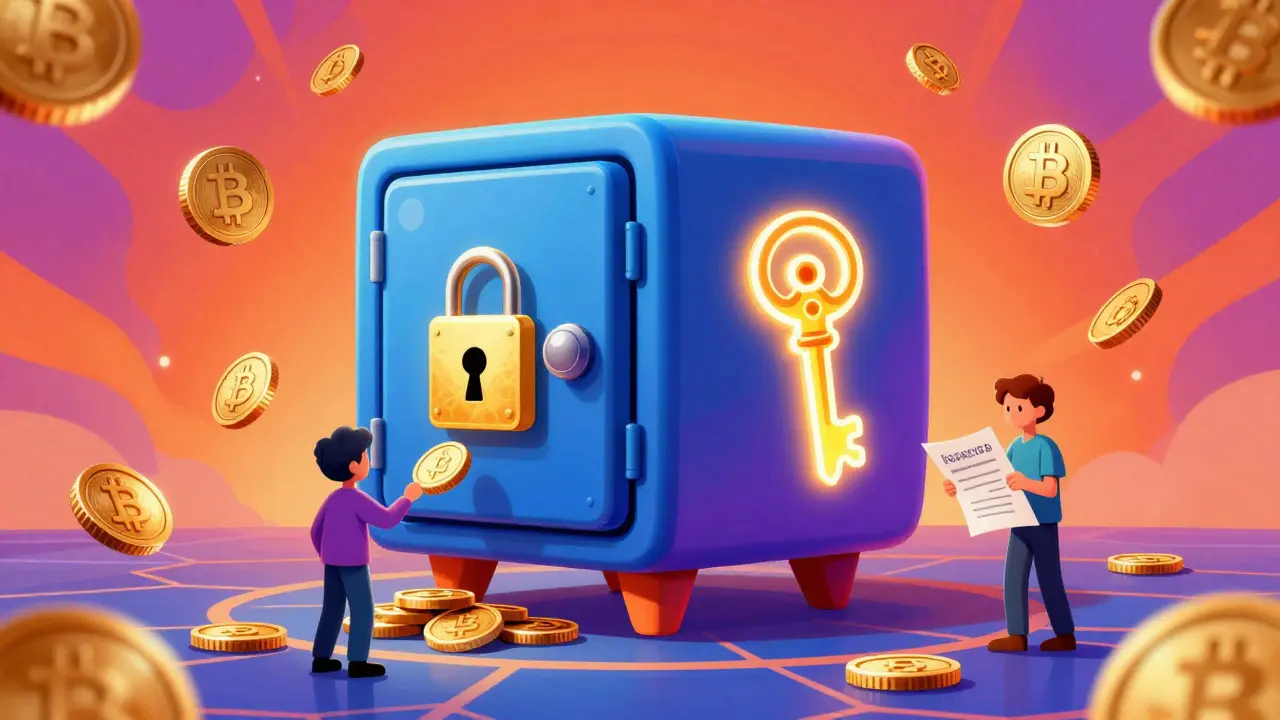
Imagine losing your phone and realizing you have no way to get back into your crypto wallet. No password reset link, no support number, just a cold hard truth: if you lost that private key, the money is gone forever. For years, this was the standard experience for anyone using externally owned accounts (EOAs), the traditional type of blockchain account controlled solely by a private key. But a new approach is changing the game. It’s called account abstraction, a technology that turns your wallet into a programmable smart contract, offering features like social recovery, gas sponsorship, and multi-signature security without needing a hardware device.
This isn’t just a technical tweak; it’s a fundamental shift in how we interact with blockchain. By separating the logic of *who* can spend funds from the simple act of signing a transaction, account abstraction unlocks a level of usability that makes crypto accessible to non-technical users while simultaneously boosting security for power users. If you’ve ever hesitated to enter the crypto space because of the fear of losing a seed phrase, or if you’re a developer looking to improve your dApp’s user retention, understanding the benefits of this technology is crucial.
What Is Account Abstraction?
To understand why account abstraction is such a big deal, you first need to grasp what it replaces. In most blockchains, including Ethereum, there are two main types of accounts: EOAs and smart contract accounts. An EOA is essentially a pair of keys-a public address and a private key. You sign transactions with the private key, and the network verifies the signature. It’s simple, but rigid. There’s no logic inside an EOA. You can’t program it to require two signatures, or to let a friend recover access if you lose your phone, or to pay fees in a token other than ETH.
Account abstraction allows users to use smart contract accounts as their primary identity on-chain, enabling custom validation logic for transactions. Instead of relying on a single private key, your account becomes a piece of code. This code defines the rules for spending. Do you need biometric approval? Does the contract check for a time lock before allowing large withdrawals? Can a trusted contact help you regain access? All of these are possible because the account itself is now programmable.
The most significant implementation of this concept on Ethereum is ERC-4337, a standard introduced in 2021 that enables account abstraction without requiring changes to the core consensus layer of the blockchain. It works by introducing a new type of transaction called a "UserOperation," which is bundled and validated by specialized nodes called bundlers. This architecture allows for all the fancy features mentioned above while remaining compatible with existing infrastructure.
Enhanced Security Through Programmability
Security is often the first thing people think about when they hear "crypto." The scary headlines usually involve lost keys or hacked exchanges. Account abstraction addresses the former directly. With a standard EOA, if you lose your private key, your assets are inaccessible until the end of time. According to data from Ledger Academy, approximately $3.8 billion in cryptocurrency was permanently lost between 2017 and 2022 due to lost or compromised keys. That’s a massive amount of value vanishing not because of a hack, but because of human error or misfortune.
Smart contract wallets solve this through social recovery. Imagine setting up your wallet with three trusted contacts-your brother, your sister, and a close friend. If you lose your phone, you don’t need a 12-word seed phrase. You just ask two of those contacts to approve a recovery transaction. This feature has been implemented in wallets like Argent, which reported a 98.7% success rate in account recovery attempts across over 247,000 cases between 2022 and 2023. For the average user, this eliminates the existential dread of losing a physical device or forgetting a passphrase.
Beyond recovery, account abstraction enables multi-signature (multi-sig) setups for individuals, not just companies. While multi-sig has existed before, integrating it into a personal wallet via account abstraction makes it seamless. You can set rules that require two out of three signatures for any transaction over $1,000. This prevents a single compromised device or stolen key from draining your entire balance. It’s a layer of protection that mimics the security controls used by institutional investors but brings them to the consumer level.
User Experience: Making Crypto Feel Like Web2
Let’s be honest: sending a transaction on Ethereum can feel clunky. You need ETH to pay for gas, even if you’re buying a NFT or swapping tokens. If you only have USDC, you still need to go find some ETH first. This friction is a major barrier to entry. Account abstraction introduces gas abstraction, which decouples the cost of execution from the native currency of the chain.
With gas abstraction, a decentralized application (dApp) can sponsor your transaction fees. Think about it: you download a game, connect your wallet, and start playing. Every move you make costs gas, but you never see it. The game studio pays for it as part of the user acquisition cost. Or, you can pay your gas fees in the very token you’re trading. Wallets like Biconomy support paying gas in over 17 different ERC-20 tokens, removing the need to hold a reserve of native currency.
Another huge UX win is session keys. In traditional DeFi, every interaction requires a signature. If you’re farming yields and need to claim rewards weekly, that’s seven signatures a week. With session keys, your smart contract can grant temporary permission to a specific dApp to interact with your account for a set period, say 24 hours. During that window, you don’t need to sign every single action. One user on Reddit noted that session keys reduced their transaction signing frequency from 15 times per gaming session to just once, saving them nearly 8 minutes per session. For high-frequency interactions, this difference is night and day.

Technical Advantages and Cross-Chain Capabilities
For developers, account abstraction offers more than just pretty UI features. It simplifies the integration of complex security models into dApps. Before ERC-4337, implementing multi-sig or social recovery required building heavy off-chain infrastructure or using complex multi-sig contracts that were difficult to manage. Now, these features are built into the account layer. According to Thirdweb’s developer guides, integrating ERC-4337 typically takes 2-3 weeks, a manageable timeframe for teams looking to modernize their stack.
Cross-chain functionality is another area where account abstraction shines. Managing assets across multiple chains has traditionally meant juggling multiple EOAs, each with its own keys and balances. A smart contract wallet can hold assets on Ethereum, Polygon, and Starknet under a single logical identity. While the underlying bridges still exist, the user experience is unified. Conduit reported that cross-chain transactions managed via AA wallets were 47% faster than traditional bridging methods due to programmed automatic transfers, reducing the cognitive load on users who operate in multi-chain environments.
However, it’s important to note the trade-offs. Initial setup for AA wallets can be more complex. Users might spend 25-45 minutes configuring guardians and settings, compared to 5-10 minutes for a standard MetaMask install. Additionally, deploying a smart contract wallet incurs a one-time gas cost, which can be 15-20% higher than a standard transfer. But for most users, this is a one-time fee paid for a lifetime of better security and convenience.
Comparison: Traditional EOAs vs. Account Abstraction
To visualize the differences, let’s look at how these two account types stack up against each other in practical scenarios.
| Feature | Traditional EOA (e.g., MetaMask) | Account Abstraction (e.g., Argent, Safe) |
|---|---|---|
| Recovery Method | 12-24 word seed phrase (no backup) | Social recovery, multi-sig, or hardware backup |
| Gas Payment | Native token only (e.g., ETH) | Any ERC-20 token or sponsored by dApp |
| Security Model | Single point of failure (private key) | Programmable rules (multi-sig, time locks) |
| Setup Time | 5-10 minutes | 25-45 minutes |
| Complexity | Low (simple key management) | Medium-High (smart contract logic) |
| Best For | Power users, short-term traders | Mainstream users, long-term holders, enterprises |
As the table shows, EOAs are simpler to start with but offer less protection. AA wallets require more upfront effort but provide robust safeguards and smoother ongoing usage. For institutions, the multi-sig capabilities of AA wallets are particularly attractive, as they align with existing corporate governance structures. For individuals, the ability to recover an account without a seed phrase is a game-changer.

Challenges and Considerations
No technology is perfect, and account abstraction has its hurdles. The primary concern is complexity. Smart contracts can have bugs. A vulnerability in an AA wallet implementation could potentially allow unauthorized transactions if the verification logic is flawed. Security researcher Samczsun documented a case in early 2023 where a signature verification bypass in an early AA implementation could have led to fund loss. While rare, this highlights that moving security from a simple key to a complex contract increases the attack surface.
There’s also the issue of network congestion. Because AA transactions are bundled by specialized nodes, they can sometimes face delays during peak network activity. Starknet’s performance metrics showed that AA transactions averaged 12-18 seconds longer than standard transactions during congested periods. For most users, this is negligible, but for high-frequency traders, it might be a factor.
Finally, adoption is still growing. While 8.2% of Ethereum-based wallet activity involved some form of AA in mid-2023, many older dApps haven’t fully integrated the standards yet. If you’re using a legacy DeFi protocol, you might still need to fall back to an EOA. However, with 42% of top 100 DeFi protocols planning or supporting AA integration, this gap is closing rapidly.
Frequently Asked Questions
Is account abstraction safe?
Yes, but it depends on the implementation. Account abstraction moves security from a single private key to a smart contract. If the contract is well-audited and uses established standards like ERC-4337, it is generally safer than an EOA because it allows for multi-sig and recovery options. However, poorly coded contracts can introduce new vulnerabilities, so choosing reputable wallets is essential.
Do I need a hardware wallet for account abstraction?
Not necessarily. One of the main benefits of AA is that it reduces reliance on hardware devices for daily operations. You can use biometrics or social recovery for security. However, many power users still prefer to keep a hardware wallet as a backup signer for their AA wallet, adding an extra layer of security for large transactions.
How does gas sponsorship work?
Gas sponsorship allows a third party, usually a dApp or a service provider, to pay the transaction fees on behalf of the user. The user signs a UserOperation, and a bundler submits it to the network. The sponsor reimburses the bundler. This means the user doesn’t need to hold the native token (like ETH) to interact with the dApp, making the experience seamless.
Can I migrate my existing EOA to an AA wallet?
You can’t technically "convert" an EOA into a smart contract because they are different account types. However, you can create a new AA wallet and transfer your assets from your EOA to the new smart contract address. Once transferred, you can manage everything from the AA wallet. Your old EOA will remain empty but still exists on the blockchain.
Which wallets support account abstraction?
Several popular wallets support AA, including Argent, Ambire, Safe (formerly Gnosis Safe), and Biconomy. MetaMask has also started integrating AA features. When choosing a wallet, look for ones that explicitly mention ERC-4337 support and have a strong track record of audits and community trust.









10 Comments
another overhyped solution to a non problem. we dont need social recovery because if your guardians are compromised you are just as dead. the complexity of smart contract accounts is a liability not a feature. most people will just lose their keys anyway so why bother with the extra gas overhead
Oh, how delightful! Another contrarian take from someone who clearly hasn't read past the abstract!
You say it's a 'non-problem,' yet here we sit, watching billions evaporate into the ether due to simple human error. The attack surface argument is a classic red herring; yes, code can have bugs, but so can humans. At least a smart contract wallet allows for *auditable* logic and multi-sig redundancy, rather than relying on the fallible memory of a user or the security of a single seed phrase written on a piece of paper in a fire-prone house.
The gas overhead? Negligible in the grand scheme of things compared to the existential risk of total loss. We are moving toward a future where UX matters more than raw key management, and clinging to EOA purity is like insisting on using punch cards because they were 'simpler' in the 1960s.
yeah well auditable logic still means trusting the developer who wrote it. i prefer my private key to be mine alone. no middlemen no contracts just me and the math. that is the beauty of crypto
One must acknowledge that the philosophical underpinning of self-sovereignty is indeed paramount, yet one cannot ignore the pragmatic necessity of accessibility for mass adoption. If the average user perceives the blockchain as a high-risk gambling den where a typo equals bankruptcy, the technology will remain niche. Account abstraction bridges this gap by introducing a layer of logical safety without sacrificing the fundamental property of trustlessness, provided the implementation is robust. It is a trade-off between absolute, brittle simplicity and resilient, complex utility.
I think there is a lot of merit in what Shawn said about accessibility. From a cultural perspective, we often forget that crypto was supposed to be permissionless finance for everyone, not just engineers. Making the entry barrier lower doesn't mean making it less secure, it just means making it usable for people who aren't going to spend hours reading whitepapers. I've seen friends get scared off by the whole seed phrase thing, so having a backup plan feels really important to me.
Absolutely! And let's talk about the dApp integration side, which is where the real magic happens for retention. When you remove the friction of needing ETH for gas, you unlock entire use cases like gaming and social apps that were previously clunky. The session key feature mentioned in the post is a game-changer for high-frequency interactions. Imagine a DeFi protocol that lets you set a daily limit and sign once per day instead of every swap. That’s not just UX, that’s scalability for the user experience layer. We need more developers leveraging ERC-4337 to build these seamless flows because it directly correlates to user stickiness.
This is such a great point about session keys! 🚀 I’ve been using an AA wallet for a few months now and the difference in how I interact with DeFi is night and day. No more hunting for small amounts of ETH just to claim rewards. It feels so much more like using a regular banking app, which is exactly what we need for mainstream adoption. Highly recommend checking out Argent if you haven’t already, the setup took me about 20 mins but it’s worth it for the peace of mind 😊
Look, I'm not against the tech, but the jargon around 'UserOperations' and 'Bundlers' is exhausting. Just tell us it's a fancy way to pay fees with other tokens and recover our accounts. The 'Lazy Critic' in me says if it takes 45 minutes to set up, half the people will give up. But yeah, losing $3.8 billion to lost keys is stupid, so maybe it's better than nothing. Just make it easy please.
Ugh, the setup time is honestly the biggest dealbreaker for me too. I tried setting up one of those multi-sig personal wallets last month and felt like I was configuring a rocket ship. My brother got confused and almost added himself as a guardian twice. It’s stressful when you’re trying to protect your money and suddenly you’re doing legal-ish paperwork for your own wallet. Do any of you have tips for keeping the guardian list simple without overcomplicating it?
Sarcastic coach mode: You're worrying about the wrong thing. If you can't figure out adding two trusted contacts, you probably shouldn't be holding significant amounts of crypto in the first place. But seriously, start with just one trusted contact if you're nervous, then add more later. The goal is resilience, not bureaucracy. Don't let perfect be the enemy of good. Just pick two people you actually trust and move on with your life. 😎