

Most people looking for HXRO are probably scrolling through a list of low-cap coins on an exchange app. You see the ticker, you see a price that looks like it has too many zeros after the decimal point, and you wonder: what exactly does this thing do? Is it just another meme coin hoping to pump, or is there actual technology behind it?
The short answer is that HXRO is not just a speculative asset; it’s the fuel for a specific type of financial infrastructure. It powers the Hxro Network, which sits at the intersection of decentralized finance (DeFi) derivatives trading and skill-based crypto gaming. But here is the catch: while the technology aims to be sophisticated-handling futures, options, and betting markets-the token itself remains a small-cap, highly volatile asset with limited liquidity.
If you are considering buying HXRO or just trying to understand why it exists, you need to look past the price chart. You need to understand how it bridges Ethereum and Solana, how it evolved from a gambling platform into a derivatives layer, and whether the current market data supports holding it right now.
The Origin Story: From Gaming to Derivatives
To understand where HXRO is today, you have to look at where it started. The project didn’t begin as a complex financial engine. It launched in late 2018, specifically on December 21, 2018, as an ERC-20 token on the Ethereum blockchain. At that time, the crypto space was obsessed with ICOs and experimental social platforms.
Initially, HXRO was designed as an "app-token" for a crypto gaming and social trading platform. Think of it like a casino chip, but for digital competitions. Users paid entry fees in HXRO to enter timed, player-versus-player contests. These weren't simple games of chance; they were often based on predicting crypto market movements. If you won, you got paid out in HXRO. If you lost, your tokens went to the winner. This created a closed-loop economy where the token had a clear utility: it was the only currency accepted for entry, purchases, and rewards within the ecosystem.
However, the team realized that limiting themselves to a gaming interface capped their potential. By early 2021, the narrative shifted. The platform began rebranding itself as the Hxro Network, focusing less on the "game" aspect and more on the underlying mechanics of risk management and liquidity. They moved significant functionality to the Solana blockchain. Why Solana? Because derivatives trading requires speed. You need lightning-fast transaction confirmations to handle margin calls, settlement, and rapid order matching. Ethereum, while secure, was often too slow and expensive for this high-frequency activity. Solana offered the throughput needed to build a real-time derivatives engine.
How the Hxro Network Actually Works
Today, the Hxro Network describes itself as a distributed liquidity layer. That sounds fancy, but let’s break it down into plain English. A liquidity layer is the plumbing that allows money to move efficiently between traders. Without it, you can’t buy or sell anything because there’s no one on the other side of the trade.
The network provides core protocols for several types of financial products:
- Futures and Swaps: Contracts that allow traders to bet on the future price of an asset without owning it.
- Vanilla and Exotic Options: More complex bets that give you the right, but not the obligation, to buy or sell at a certain price.
- Parimutuel Betting: A system where all bets are pooled together, and the house takes a cut, with winners splitting the remaining pool. This is common in horse racing and sports betting.
In this setup, HXRO serves two main roles. First, it is a utility token. It is used to pay for network fees, provide collateral for trades, and settle outcomes. Second, it acts as a governance token. Holders likely have a say in how the protocol evolves, though specific voting mechanisms aren't heavily publicized in mainstream data feeds.
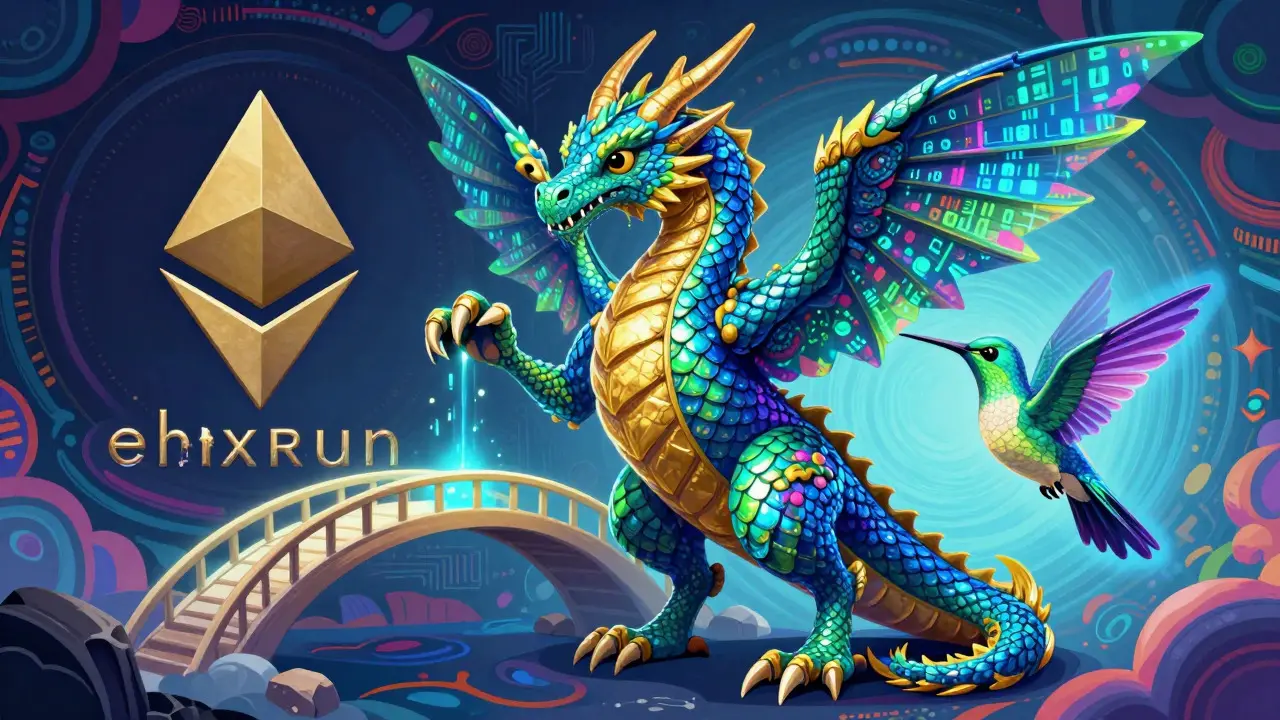
The architecture is hybrid. The token itself was issued on Ethereum as an ERC-20 standard contract. However, to make it usable on Solana for these high-speed trades, it exists as "SPL-wrapped HXRO." This wrapping process is handled via the Wormhole Portal bridge. Essentially, your Ethereum HXRO is locked up, and a corresponding version is minted on Solana that behaves identically but moves at Solana speeds. This cross-chain design is crucial because it ties the original issuance to the modern performance layer.
| Feature | HXRO (Hxro Network) | Typical Governance Token (e.g., UNI, AAVE) |
|---|---|---|
| Primary Utility | Derivatives liquidity, margining, gaming entry fees | Protocol governance, fee sharing |
| Blockchain Base | Ethereum (issuance) + Solana (execution) | Usually single-chain (Ethereum or L2) |
| Market Cap Size | Small-cap (~$1M - $1.4M) | Large-cap ($1B+) |
| User Experience | Gamified, odds-based trading interfaces | Traditional DEX or lending dashboards |
| Liquidity Depth | Low (thinly traded) | High (deep pools) |
Tokenomics: Supply, Circulation, and Scarcity
When evaluating any crypto coin, the numbers matter. For HXRO, the supply metrics are relatively straightforward, but there are some discrepancies in how different data trackers report them.
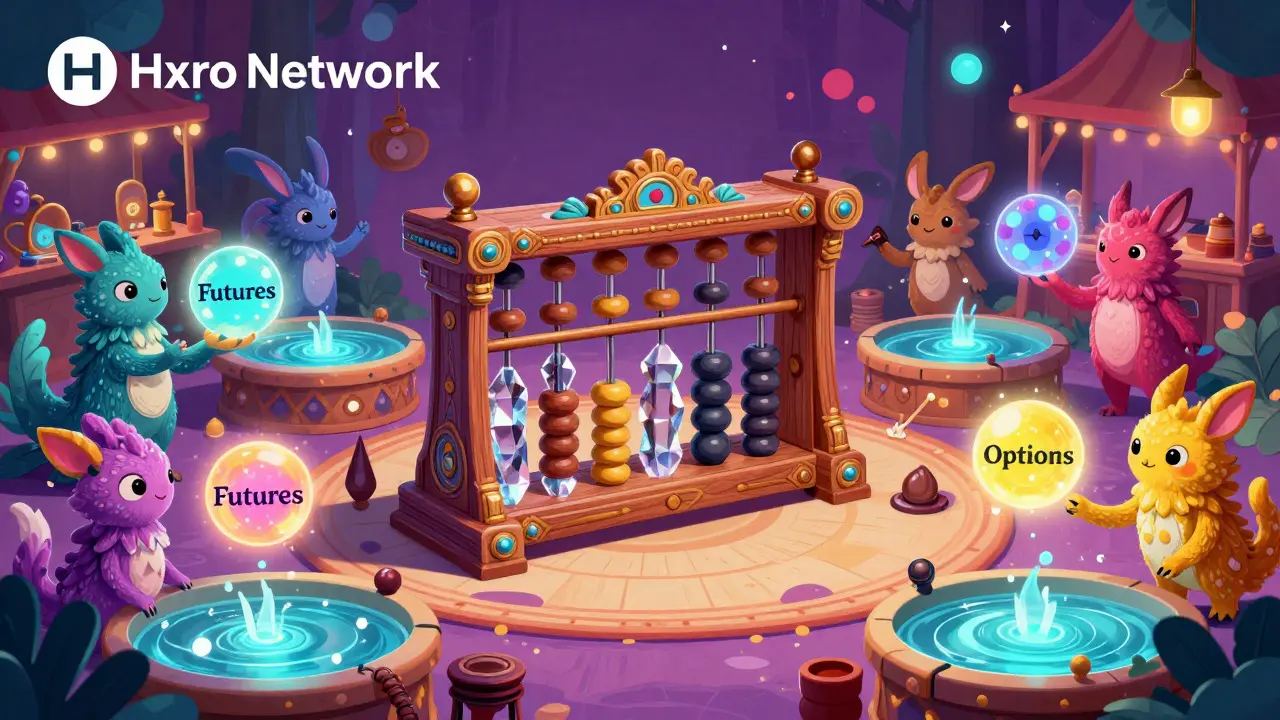
The total supply of HXRO is fixed at exactly 1,000,000,000 (one billion) tokens. There is no inflationary mechanism printing new tokens indefinitely. This hard cap is a key feature for investors who worry about dilution. However, not all of those billion tokens are circulating in the market.
As of mid-2026, estimates for the circulating supply range between 610 million and 620 million tokens. MarketBeat reports a figure around 610,385,617, while Dropstab cites approximately 620.39 million. This variance isn't necessarily a red flag; it’s common for tokens that move across chains via bridges like Wormhole. Tracking exact circulation across multiple ledgers can lead to slight reporting lags.
Here is why this matters: if the total supply is 1 billion and roughly 610 million are in circulation, that means about 390 million tokens are still locked, staked, or held by the team/investors. Over time, as these tokens unlock or enter the market, selling pressure could increase. Always check the latest vesting schedules if you plan to hold long-term.
Because the supply is finite and the market cap is low, even small amounts of buying volume can cause large percentage swings in price. This makes HXRO highly elastic, which is great for short-term traders but risky for passive holders.
Market Reality: Price, Liquidity, and Risk
Let’s talk about the elephant in the room: liquidity. As of July 2026, HXRO is considered a micro-cap or small-cap asset. Depending on the data source, the market capitalization hovers between $1.07 million and $1.4 million USD. To put that in perspective, Bitcoin’s market cap is in the trillions. HXRO represents less than 0.01% of the total cryptocurrency market.
This small size comes with specific characteristics:
- Low Trading Volume: Daily trading volumes are often under $1,000 USD. On quiet days, you might struggle to find enough buyers to sell a large position without crashing the price. MarketBeat recorded a 24-hour volume of just $15.65 on one recent snapshot, which indicates extremely thin order books.
- Price Volatility: With low volume, a single large trade can move the price by double digits in minutes. In June 2026, HXRO saw a weekly drop of over 16%, followed by intraday gains of 2%. This rollercoaster is typical for niche assets.
- Limited Exchange Availability: HXRO is not listed on major tier-1 exchanges like Binance or Coinbase Pro. Data from CoinPaprika shows it trading on only two exchanges with five active markets. This limits accessibility. You likely need to use smaller decentralized exchanges (DEXs) or specialized venues to buy or sell.
The price itself fluctuates in the sub-cent range. Recent snapshots show prices between $0.0018 and $0.0035 USD. While the absolute dollar amount seems tiny, remember that you are dealing with millions of tokens. A change from $0.002 to $0.003 is a 50% gain, but it still feels insignificant unless you hold a massive quantity.
Is HXRO a good investment? That depends entirely on your risk tolerance. If you are looking for stability, this is not it. If you are interested in the niche sector of on-chain derivatives and believe that the Hxro Network will capture a larger share of the Solana DeFi ecosystem, then the low entry price offers high upside potential. But you must accept the possibility that the liquidity could dry up completely.
How to Get Started with HXRO
If you decide you want to participate in the Hxro ecosystem, here is the practical path forward. Since HXRO operates on both Ethereum and Solana, your setup needs to reflect that dual nature.
Step 1: Set Up Your Wallets
You will need a wallet that supports Ethereum for holding native ERC-20 HXRO, and a wallet that supports Solana for interacting with the derivatives network. MetaMask is the standard for Ethereum. For Solana, Phantom or Solflare are popular choices. Make sure you have ETH for gas fees on Ethereum and SOL for transaction fees on Solana.
Step 2: Acquire HXRO
Since HXRO is not on major centralized exchanges, you will likely need to use a decentralized exchange (DEX).
- For Ethereum HXRO: Use Uniswap or SushiSwap. Connect your MetaMask, paste the official HXRO contract address (verify this on the official Hxro documentation to avoid scams), and swap ETH for HXRO.
- For Solana HXRO: Use Jupiter or Raydium. Connect your Solana wallet. If you already have Ethereum HXRO, you can bridge it to Solana using the Wormhole Portal. This locks your ETH-HXRO and mints SPL-HXRO on Solana.
Step 3: Participate in the Ecosystem
Once you have the tokens, you can interact with the Hxro Network applications. This might involve providing liquidity to earn fees, entering prediction markets, or participating in the skill-based gaming competitions. Always start with small amounts to test the interface and understand the slippage costs associated with low liquidity.
Future Outlook and Verdict
The Hxro Network occupies a unique spot in the crypto world. It’s not trying to be the next Bitcoin or even the next Uniswap. It’s aiming to be the infrastructure layer for a very specific type of trading: gamified, fast-paced derivatives on Solana. The fact that the project has survived since 2018 and successfully migrated its core tech to Solana shows resilience. The continued updates to their documentation and tokenomics pages through 2025 and 2026 suggest the team is still active.
However, the lack of widespread adoption is a concern. Major DeFi platforms attract billions in total value locked (TVL). HXRO’s TVL and volume remain microscopic. For the token to appreciate significantly, the network needs to onboard more users, either by improving the user experience of its derivatives tools or by expanding its gaming partnerships.
For the average investor, HXRO should be treated as a speculative satellite holding. It belongs in the "high risk, high reward" corner of your portfolio, not the foundation. Do not invest money you can’t afford to lose, and always verify contract addresses before bridging or swapping. In the world of small-cap altcoins, security is just as important as strategy.
What is the total supply of HXRO tokens?
The total supply of HXRO is fixed at exactly 1,000,000,000 (one billion) tokens. There is no maximum supply cap beyond this, meaning no new tokens can be minted indefinitely. Approximately 610 million to 620 million tokens are currently in circulation.
Is HXRO built on Ethereum or Solana?
HXRO is natively an ERC-20 token on the Ethereum blockchain. However, for its derivatives and gaming applications, it operates primarily on Solana as SPL-wrapped HXRO. Users bridge their tokens between the two chains using the Wormhole Portal to access different features of the Hxro Network.
Where can I buy HXRO crypto?
HXRO is not listed on major centralized exchanges like Binance or Coinbase. It is traded on a few smaller decentralized exchanges (DEXs). You can typically acquire it via Uniswap on Ethereum or Jupiter/Raydium on Solana. Always verify the official contract address from the Hxro website before swapping to avoid counterfeit tokens.
What is the current market cap of HXRO?
As of mid-2026, HXRO has a small market capitalization ranging between $1.07 million and $1.4 million USD. This classifies it as a micro-cap or small-cap cryptocurrency, indicating high volatility and lower liquidity compared to top-tier assets.
What are the risks of investing in HXRO?
The primary risks include low liquidity (difficulty selling large amounts without impacting price), high volatility (rapid price swings), and limited exchange availability. Additionally, as a niche derivatives and gaming token, its value is heavily dependent on the adoption of the Hxro Network protocols, which currently have modest usage metrics.
How does HXRO differ from other DeFi tokens?
Unlike general-purpose governance tokens, HXRO is tied to a specific infrastructure layer for derivatives and parimutuel betting. It combines elements of crypto gaming (skill-based competitions) with financial engineering (futures and options liquidity), making it a hybrid utility token rather than a pure store-of-value or governance asset.