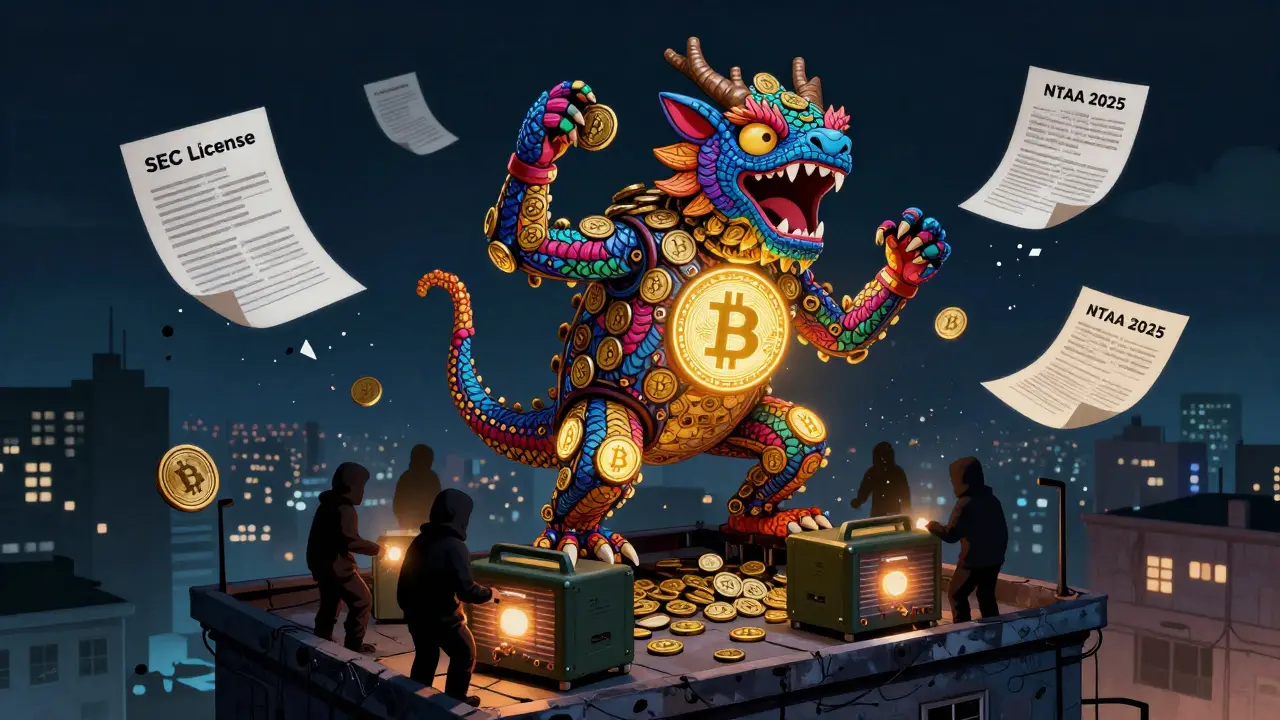

Many people think crypto mining in Nigeria is illegal. That’s not true - but it’s far from simple. As of 2026, you can mine Bitcoin, Ethereum, or any other cryptocurrency in Nigeria without breaking the law. But if you try to do it without following the rules, you could face heavy fines, frozen bank accounts, or even a shutdown. The government didn’t ban mining. It just made it way harder to do without paperwork, licenses, and cash on hand.
It’s Not Illegal - But It’s Heavily Regulated
Nigeria doesn’t have a law that says, "You can’t mine crypto." Instead, the rules hit you from every side. The real problem isn’t mining itself - it’s what you do after you mine. If you sell your Bitcoin, trade it, or offer mining-as-a-service to others, you’re now dealing with the Securities and Exchange Commission (SEC). Since October 2025, the Investments and Securities Act (ISA 2025) is the law that officially classifies all virtual assets - including mined cryptocurrencies - as securities. This means any business that touches crypto, even mining farms that sell their output, must get an SEC license.Before ISA 2025, mining was a gray zone. Now, if you’re running a mining operation and you’re not registered with the SEC, you’re operating illegally - even if you’re just sitting in your garage with a rack of ASICs. The SEC doesn’t care if you’re a hobbyist. If you’re turning mined coins into Naira or sending them to exchanges, you’re a Virtual Asset Service Provider (VASP). And VASPs? They need a license. Period.
The Banking Ban That Still Haunts Miners
In February 2021, the Central Bank of Nigeria (CBN) banned all Nigerian banks from handling cryptocurrency transactions. That was a shock. Miners couldn’t deposit earnings. They couldn’t pay for electricity or hardware. The move seemed like a death sentence for crypto.But Nigerians didn’t quit. They built alternatives. Peer-to-peer (P2P) trading exploded. Platforms like Paxful, Binance P2P, and local apps became lifelines. Between July 2024 and June 2025, Nigerians moved $92.1 billion in crypto - more than any other country in Africa. That’s not just speculation. That’s people using crypto to send money, pay for goods, and even buy food.
Here’s the catch: Even though the CBN lifted its banking ban in late 2023 and now allows banks to work with licensed crypto firms, most miners still can’t access banking services. Why? Because very few mining operations have the SEC license needed to qualify. So, you can’t open a business bank account. You can’t get a loan for more hardware. You’re stuck using cash, mobile money, or P2P - which means higher fees, slower transfers, and more risk.
Licensing: What It Actually Takes to Go Legal
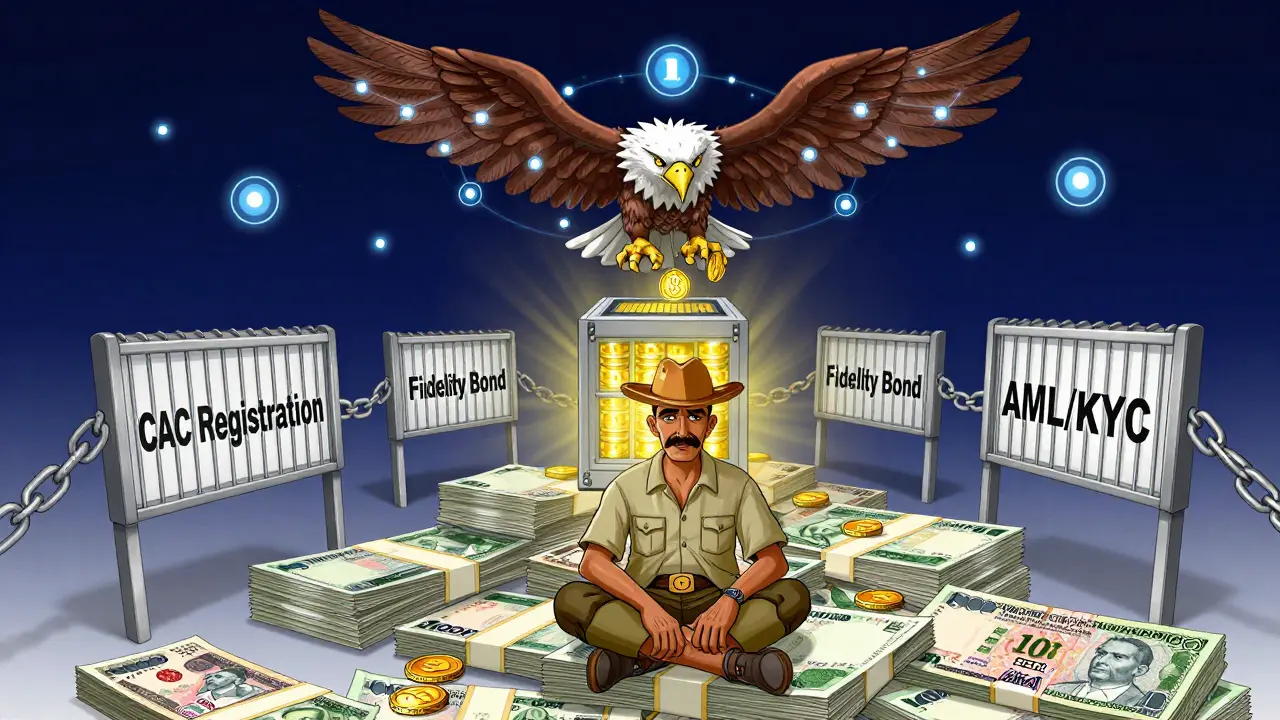
Getting an SEC license isn’t like registering a small business. It’s expensive, slow, and packed with red tape. Here’s what you need:- Minimum paid-up capital: At least ₦50 million ($33,500) - and that’s just the starting point.
- Fidelity bond: A surety bond worth ₦25 million ($16,750) to cover losses from fraud or mismanagement.
- Nigerian corporate registration: Your company must be registered with the Corporate Affairs Commission (CAC).
- Local office and management: You can’t run this from abroad. You need a physical office in Nigeria and local directors.
- AML/KYC systems: You must verify every customer, log every transaction, and report suspicious activity to the NFIU.
Only two companies - Quidax and Busha - got provisional licenses in 2024. Dozens more are waiting. The SEC is taking its time. They’re checking everything: where the money comes from, who owns the servers, whether the team has experience. If you’re a solo miner or a small group, this is almost impossible to do alone.
Taxes: The New Big Stick
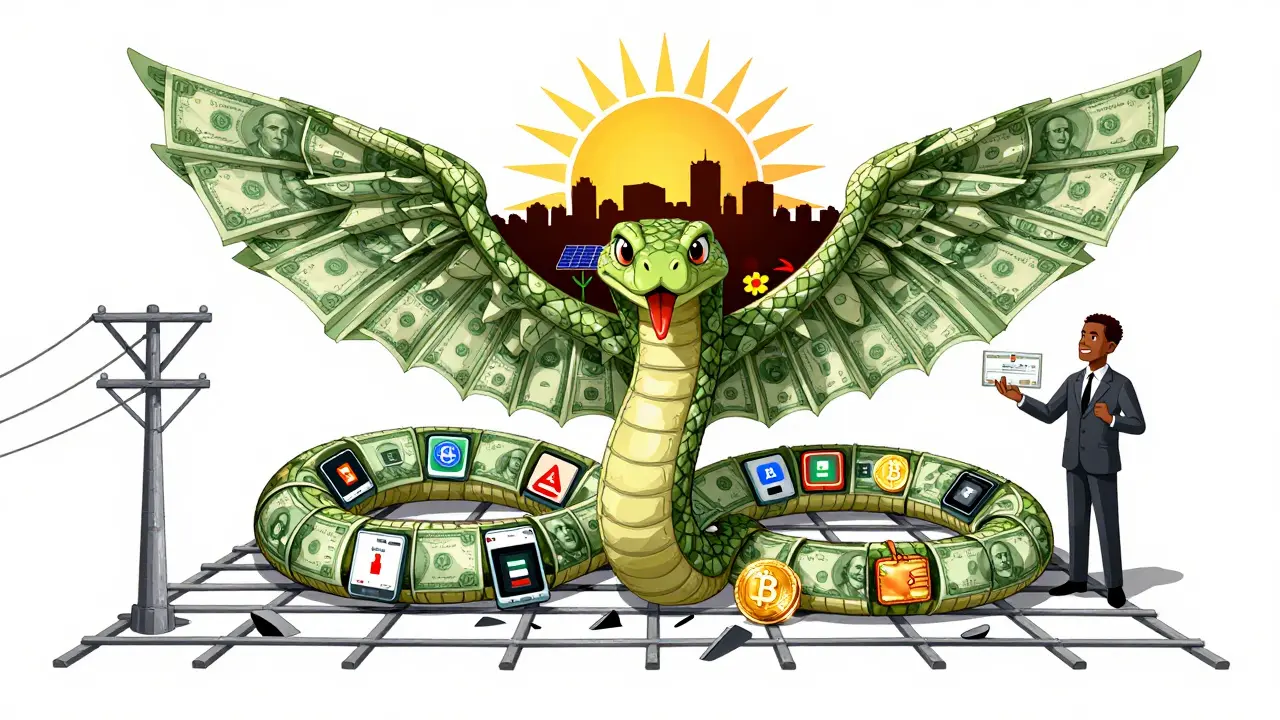
The Nigeria Tax Administration Act (NTAA) 2025 isn’t just about taxes - it’s a warning shot. Signed in June 2025 and taking effect in 2026, this law targets VASPs with brutal penalties:- ₦10 million ($6,693) fine for the first month of non-compliance.
- ₦1 million ($669) extra for every month you stay unregistered.
- SEC can shut you down instantly if you don’t comply.
That’s not a tax. That’s a threat. Even if you’re just mining for yourself and not selling, the government now has the power to track your wallet addresses through telecom data. If they see large, consistent crypto inflows - and you haven’t filed taxes - they can come after you. There’s no grace period. No warning. Just fines and shutdowns.
Infrastructure: The Silent Killer
Let’s be real: even if you get the license, Nigeria’s power grid is a nightmare for mining. Electricity costs between ₦80 and ₦200 per kWh - more than double what it costs in Canada or Kazakhstan. And power outages? They happen daily. A mining rig that runs 24/7 needs stable, cheap power. Most Nigerian miners use generators - which eat up profits fast.Some miners have moved to Ghana, South Africa, or even Georgia, where electricity is cheaper and regulations clearer. Others are turning to solar. A few startups are now building crypto-friendly mini-grids powered by solar and battery banks. But these are still experimental. For now, power costs are the biggest reason most mining operations in Nigeria stay small - or shut down entirely.
Who’s Watching You?
It’s not just the SEC. The Economic and Financial Crimes Commission (EFCC), the Nigerian Financial Intelligence Unit (NFIU), and the CBN are all working together now. They share data. They track transactions. They can subpoena your phone records. If you’re moving large amounts of crypto and not reporting it, you’re on their radar.The law now explicitly bans Ponzi schemes and unlicensed token sales. But it also covers legitimate mining if it’s tied to exchanges or trading platforms. So even if you’re not running a scam, if you’re not registered, you’re still at risk.
What’s Next?
Nigeria isn’t trying to kill crypto. It’s trying to control it. The National Blockchain Policy 2023 encourages blockchain adoption in government, banking, and land records. The goal is to use crypto and blockchain to fix corruption, speed up payments, and attract tech investment.But that only works if businesses play by the rules. The government knows crypto is here to stay. So instead of banning it, they’re building walls around it. The only way to mine crypto legally in Nigeria now is to:
- Register your business with CAC.
- Apply for an SEC license as a VASP.
- Set up full AML/KYC systems.
- Pay your taxes.
- Find a stable, cheap power source.
Most people can’t do all that. And that’s why the majority of mining in Nigeria still happens underground - in homes, garages, and backrooms - without licenses, without bank accounts, and without protection.
Is crypto mining illegal in Nigeria?
No, mining cryptocurrency itself is not illegal in Nigeria. However, any activity that involves selling, trading, or offering mining services to others requires a license from the Securities and Exchange Commission (SEC). Without that license, you’re operating outside the law and risk fines or shutdown.
Can I bank my crypto earnings in Nigeria?
Only if you’re a licensed Virtual Asset Service Provider (VASP). Banks are allowed to work with licensed crypto firms since late 2023, but they won’t touch unlicensed miners. Most miners still rely on peer-to-peer platforms like Paxful or Binance P2P to convert crypto to Naira.
How much does it cost to get a crypto mining license in Nigeria?
There’s no single fee, but you need at least ₦50 million ($33,500) in paid-up capital and a ₦25 million ($16,750) fidelity bond. You also need to register with CAC, set up a physical office, and comply with AML/KYC rules. Total setup costs often exceed ₦100 million ($67,000).
What happens if I mine crypto without a license?
You won’t be arrested, but you’ll be fined. Under the NTAA 2025, you’ll pay ₦10 million ($6,693) in the first month of non-compliance, plus ₦1 million ($669) every month after. The SEC can also freeze your assets, shut down your operation, and report you to the EFCC.
Is crypto mining profitable in Nigeria in 2026?
For most individuals, no. High electricity costs, unreliable power, and the expense of compliance make it hard to profit unless you have access to cheap solar power or industrial-scale energy. Many miners now focus on P2P trading or staking instead of traditional mining.

14 Comments
Let me cut through the noise: Nigeria’s crypto regulatory framework is a textbook case of regulatory capture masquerading as financial innovation. The ISA 2025 isn’t about investor protection-it’s a rent-seeking mechanism designed to funnel capital into the hands of politically connected VASPs. The ₦50M paid-up capital requirement? That’s a de facto barrier to entry for any grassroots operator. The SEC isn’t regulating; they’re gatekeeping. And don’t get me started on the fidelity bond-₦25M is essentially a bribe to the state for the privilege of being exploited. This isn’t governance. It’s feudalism with a blockchain logo.
Meanwhile, the CBN’s half-measures and the NTAA’s punitive fines are just theater. Real crypto adoption doesn’t need licenses-it needs infrastructure, not red tape. The fact that Nigerians moved $92B via P2P despite all this proves the market is already ahead of the regulators. The real crime isn’t unlicensed mining-it’s the state’s refusal to acknowledge that decentralization doesn’t care about your paperwork.
And let’s not pretend the power grid issue is secondary. You can’t regulate a power grid that blackouts twice a day. This whole framework is built on the assumption that Nigeria can be Singapore. It’s not. It’s a country where electricity is a luxury. So stop pretending this is about compliance. It’s about control. And control doesn’t scale.
Bottom line: if you’re mining without a license, you’re not breaking the law-you’re exercising economic sovereignty. The state just doesn’t like that you’re doing it without their cut.
Wow. This is actually one of the most balanced, insightful breakdowns I’ve read on Nigeria’s crypto landscape. I’ve been following this since 2021, and honestly, I thought the banking ban would kill it forever. But the resilience here? Pure genius.
What’s happening in Nigeria isn’t just crypto mining-it’s a grassroots fintech revolution. People aren’t waiting for permission. They’re building systems that work despite the system. P2P trading hitting $92B? That’s not speculation-it’s survival. That’s people feeding their families, sending money home, buying medicine. Crypto isn’t a luxury here. It’s infrastructure.
And yes, the licensing hurdles are insane. But I’ve seen startups in Lagos using solar microgrids to power mining rigs-literally turning sunlight into liquidity. That’s innovation at its purest. The government’s trying to cage a wild horse, but the horse is already galloping across borders.
Let’s not romanticize the struggle, though. The power costs, the risk, the fear of asset freezes… it’s brutal. But if you look at the data, Nigerians are doing more with less than almost any other nation on Earth. That’s not just crypto. That’s human ingenuity.
Maybe the real question isn’t ‘Can you mine legally?’ It’s ‘Why are we still trying to regulate innovation with 20th-century tools?’
I just want to say-this is so real. I’ve got friends in Lagos who mine in their garages with solar panels and fans made from old AC units. They don’t have licenses. They don’t have bank accounts. But they pay rent, feed their kids, and send money to cousins in the UK. And they’re happy.
The government talks about ‘compliance’ like it’s some noble goal. But compliance doesn’t put food on the table. Power doesn’t come from paperwork. It comes from people. And Nigerians? They’re not waiting for permission to build a better life.
Also-solar mini-grids? YES PLEASE. I’ve seen videos of these little setups powering whole neighborhoods. Imagine if we invested in that instead of bureaucracy?
Keep going, Nigeria. You’re doing something right.
Oh, this is *beautiful*… a government that bans banks, then demands licenses, then taxes you for existing, then monitors your wallet because ‘national security’… and somehow, this is ‘economic policy’? 🤡
Let me get this straight: you can’t use your own money, but you can be fined for having too much of it? And the solution is… more paperwork? With a fidelity bond? Like, I’m supposed to pay the state to *let* me mine? That’s not regulation-that’s extortion with a flowchart.
Also, the fact that two companies got licenses? Quidax and Busha? Of course they did. They’re owned by people who went to the same universities as the SEC commissioners. This isn’t a market. It’s a country club. And you? You’re not invited.
Meanwhile, the real miners? They’re out there, sweating under generators, laughing as the SEC files their 17th ‘non-compliance’ notice… and then cashing out on Binance P2P. The joke’s on them. Always has been.
Interesting perspective. The regulatory complexity is undeniable. But I think we’re missing a bigger point: Nigeria’s crypto ecosystem is evolving faster than its institutions can adapt. The fact that P2P volumes surpassed $90B without any official infrastructure speaks volumes.
It’s not about legality. It’s about utility. People aren’t mining for speculation-they’re mining because it’s the only way to preserve value in a currency that loses 30% a year. That’s not a crypto problem. That’s a monetary problem.
The government’s trying to force a Western-style regulatory model onto a system that operates on African realities. It’s like trying to teach a fish to climb trees. Eventually, the fish just swims away.
so like… ugh. the license costs more than my car. and i’m just trying to mine a lil btc on my 3070 😭 the power bill is already eating my rent. and now they want me to have a “fidelity bond”? like… what am i, a bank? 💸🤯 i just want to mine and not get fined. also… who’s tracking my wallet? my phone? 😳
Look. It’s simple. You can’t mine crypto in Nigeria. Not really. The government says you can, but then they slap you with $6k fines every month. They shut down your power. They freeze your money. They don’t even let you bank it.
So what’s the point? You’re not ‘legal’ if you’re always one step from being punished. This isn’t regulation. It’s harassment with a law degree.
And don’t even get me started on the ‘solar mini-grids.’ That’s like saying ‘you can drive a car as long as you push it uphill with your bare hands.’
Just admit it: they don’t want you mining. They want you to give up. And honestly? I’m with them. It’s too much hassle.
I think the real issue here is that the system is designed to exclude people who need it most. The licensing requirements are so high that only corporations can afford them. That means the people who are already struggling to pay for electricity, food, and rent are the ones being pushed further into the shadows. And the government calls this progress?
I don’t think anyone is against regulation. But when regulation becomes a tool of exclusion instead of protection, it stops being about fairness. It becomes about control. And that’s not innovation. That’s oppression dressed up in legal jargon.
Thank you for this comprehensive and thoughtful analysis. It is clear that Nigeria is navigating a complex transition from informal economic practices toward formalized digital financial systems. The challenges are immense, but the intent-to integrate blockchain technology into national infrastructure-is both visionary and necessary.
The licensing framework, while burdensome, is not without precedent. In many developed economies, financial innovation is met with phased regulatory frameworks that prioritize consumer protection, anti-money laundering compliance, and systemic stability. The fact that Nigeria is attempting this at all, given its infrastructure constraints, is commendable.
What is needed now is not resistance, but collaboration. Entrepreneurs, regulators, and international partners must work together to create tiered licensing models, subsidized energy solutions, and educational pathways for small-scale miners to transition into compliant operations. The goal should not be to eliminate underground mining, but to elevate it.
This is not a battle between freedom and control. It is a journey toward inclusion.
Bro. I’ve got a buddy in Abuja who runs a 50-ASIC rig out of his cousin’s spare room. He pays for power in cash. Uses MTN Mobile Money to buy new fans. Got a solar panel on the roof he jury-rigged with a car battery. He’s not licensed. Doesn’t care. Made $12k last month. Just sent $5k to his sister in Ghana.
So yeah, the rules say you need $67k to start. But guess what? The people who are actually mining? They don’t read the rules. They just make it work.
And honestly? The SEC doesn’t even know where half these rigs are. The real power isn’t in the law. It’s in the grid. And the grid? It’s still broken. So they’re just… winging it.
Respect.
ok but like… if i mine and don’t sell, am i still a VASP? 🤔 i’m just sitting here with my 3080 and a fan made of duct tape. i’m not trading. i’m not selling. i’m just… keeping it. like a digital piggy bank. but they say if you have inflows, you’re taxable?? like… what if i just… never touch it? 🥲❄️❄️❄️
This is actually kind of inspiring. People are turning power outages into innovation. They’re building solar rigs and P2P networks with zero support. No subsidies. No grants. Just hustle.
I’ve seen videos of Nigerian miners using wind turbines and old motorcycle batteries. It’s like a Mad Max blockchain movie.
And yeah, the government’s rules are insane. But you know what? They’re not stopping it. They’re just making it harder. And guess what? Harder doesn’t mean impossible. It just means it’s real.
Keep going. The world is watching. And honestly? You’re winning.
they’re tracking your wallet through your phone? 😳 that’s not regulation. that’s surveillance. who gave them that power? what if i mine in my basement and never connect to the internet again? can they still find me? 🤔 they’re not after crypto. they’re after control. this is a trap. they want everyone to register so they can freeze your funds. it’s all a lie. the ‘license’ is just the first step to confiscation.
So… I just want to say-this is beautiful. 🌍✨
People in Nigeria are turning chaos into community. Solar rigs. P2P lifelines. Cash payments. No bank. No paperwork. Just trust. And it’s working.
Meanwhile, the rest of the world is still arguing over ‘regulation’ and ‘compliance.’
Nigeria? They’re just… living.
That’s the real crypto. Not the tech. Not the money. The people.
👏👏👏