
Digitex Futures promised something no other crypto exchange dared to: commission-free futures trading. For a while, it sounded too good to be true - and it was.
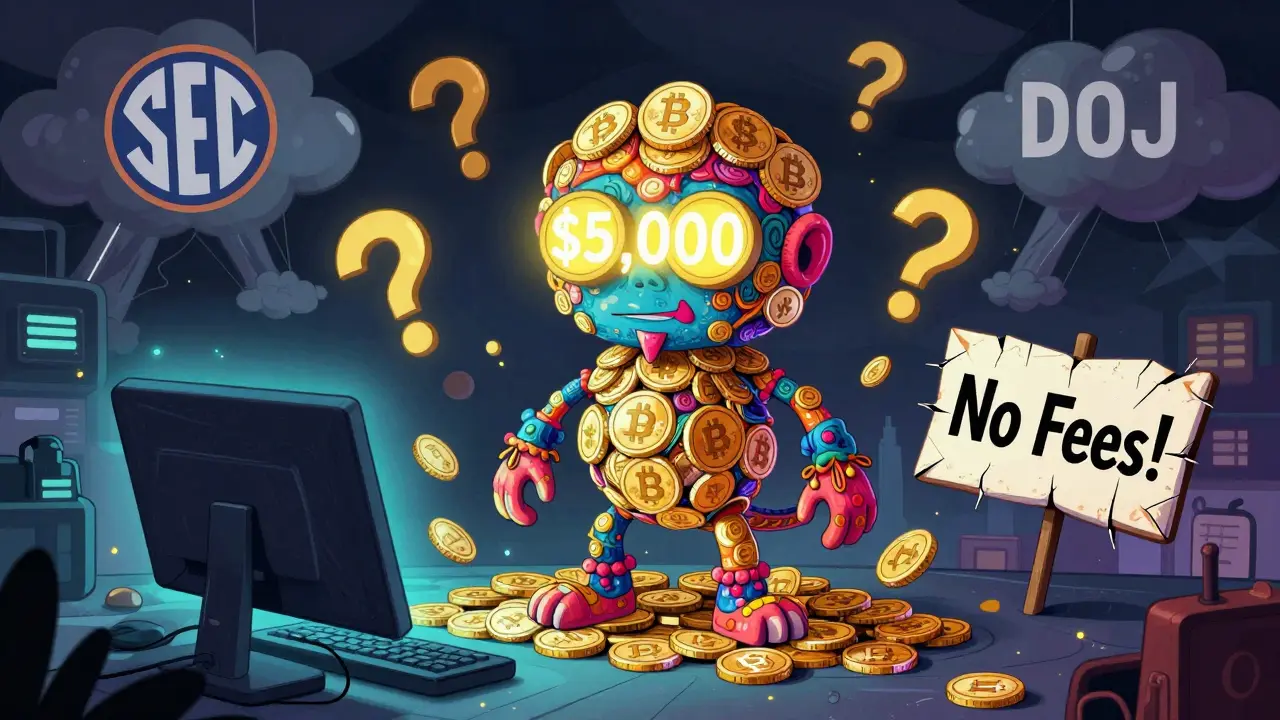
Launched in December 2018 by Digitex Ltd., the exchange quickly became known for its bold claim: no fees on trades. That meant if you bought or sold Bitcoin futures, Ethereum perpetuals, or any other crypto derivative, you wouldn’t pay a single cent in trading commissions. Most exchanges charge anywhere from 0.02% to 0.1% per trade. Over time, those fees add up. Digitex said it removed them entirely. But there was a catch.
How Digitex Made Money Without Charging Fees
The answer was simple: the DGTX token.
To trade on Digitex Futures, you had to hold DGTX - its native cryptocurrency. You didn’t need to pay fees in USD or USDT. Instead, the platform made money by selling DGTX tokens during its early fundraising rounds. The more people bought DGTX, the more revenue Digitex generated. Traders were essentially paying upfront for the privilege of trading without fees later.
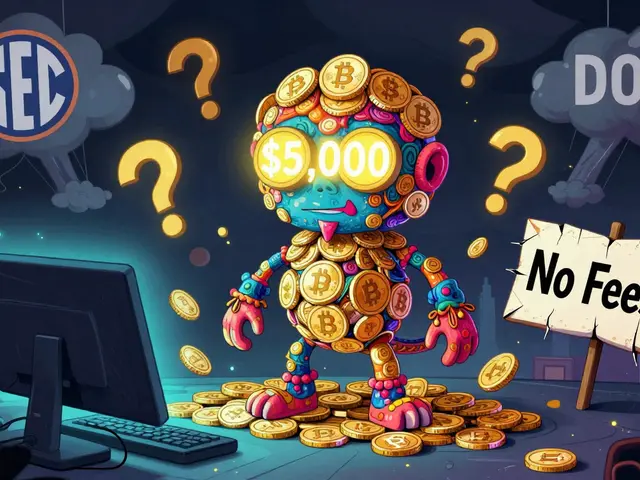
That model worked - for a while. Professional traders and high-net-worth individuals flocked to the platform because they could execute dozens of trades per day without worrying about commission erosion. But for most retail traders, the barrier was too high. Digitex required a minimum deposit of $5,000 just to get started. That wasn’t a suggestion. It was a hard rule. If you had $1,000 or $2,000, you couldn’t even open an account. That alone turned off most newcomers.
The Hidden Costs Nobody Talked About
Even though there were no trading fees, users quickly realized other costs were sneaking in.
Withdrawals took days - sometimes weeks. Users reported being stuck with funds they couldn’t access, even after submitting all required documentation. Some said they had to email support multiple times, only to get automated replies. Others said they eventually got their money back, but only after losing weeks of trading opportunities.
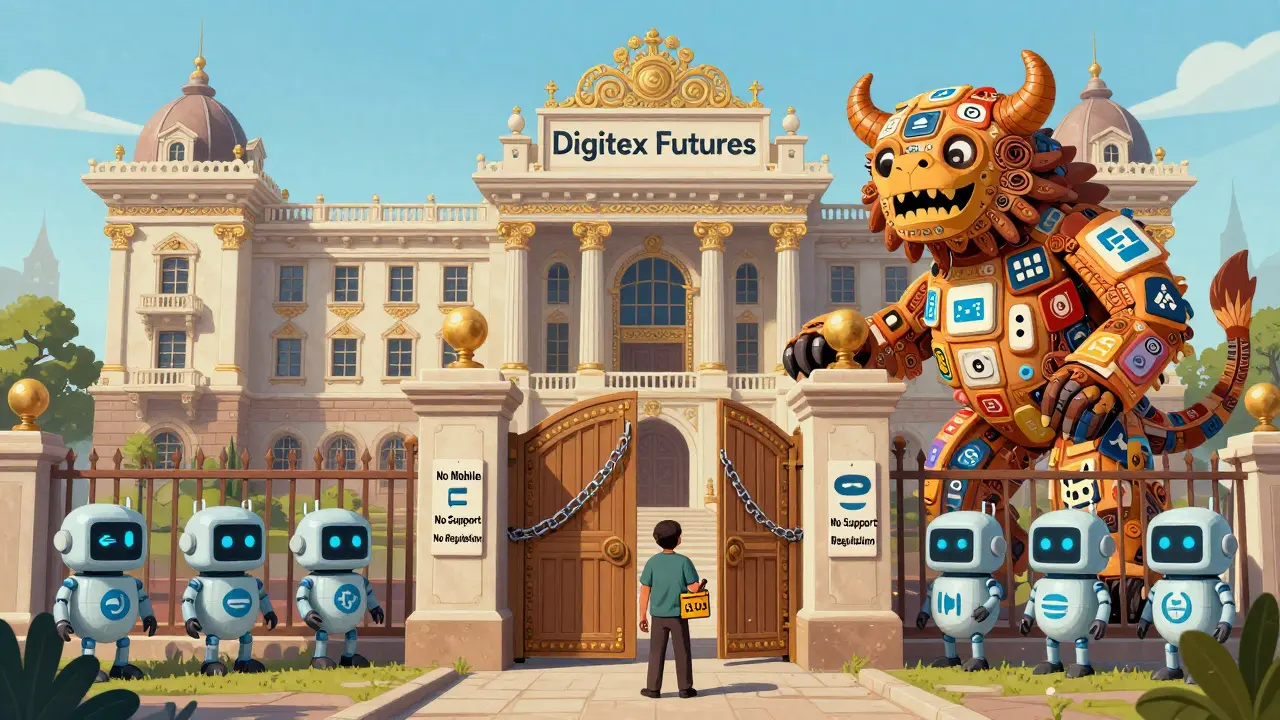
Customer support earned a 1/5 rating. Response times were slow, and solutions were rare. When problems arose - like a failed trade, a frozen account, or a withdrawal delay - there was no live chat, no phone line, no clear escalation path. You were left to hope your ticket got noticed.
And then there was the platform itself. Digitex Futures had a basic interface. No advanced charting tools. No mobile app. No educational resources. No copy trading. No social trading. Compared to rivals like Bybit, Binance Futures, or OKX, it felt like a prototype from 2019. It didn’t evolve. It stayed stuck.
Regulatory Red Flags
Digitex Futures operated out of Seychelles - a jurisdiction with no real financial oversight. It wasn’t licensed by the SEC, FCA, ASIC, or any major regulator. That meant traders had zero legal protection. If the exchange vanished - which it did - there was no insurance, no recovery fund, no government agency to step in.
By 2024, U.S. regulators started taking notice. The SEC began investigating Digitex for operating an unregistered derivatives exchange. The exchange ignored warnings. Then, in early 2025, the U.S. Department of Justice filed charges. Digitex Futures was shut down within weeks.
For users, it was chaos. Accounts froze. Funds disappeared. Some had hundreds of thousands in open positions. Others had just a few hundred in DGTX. Either way, they were stuck.
The Rebirth: Rogue Chain
But the story didn’t end there.
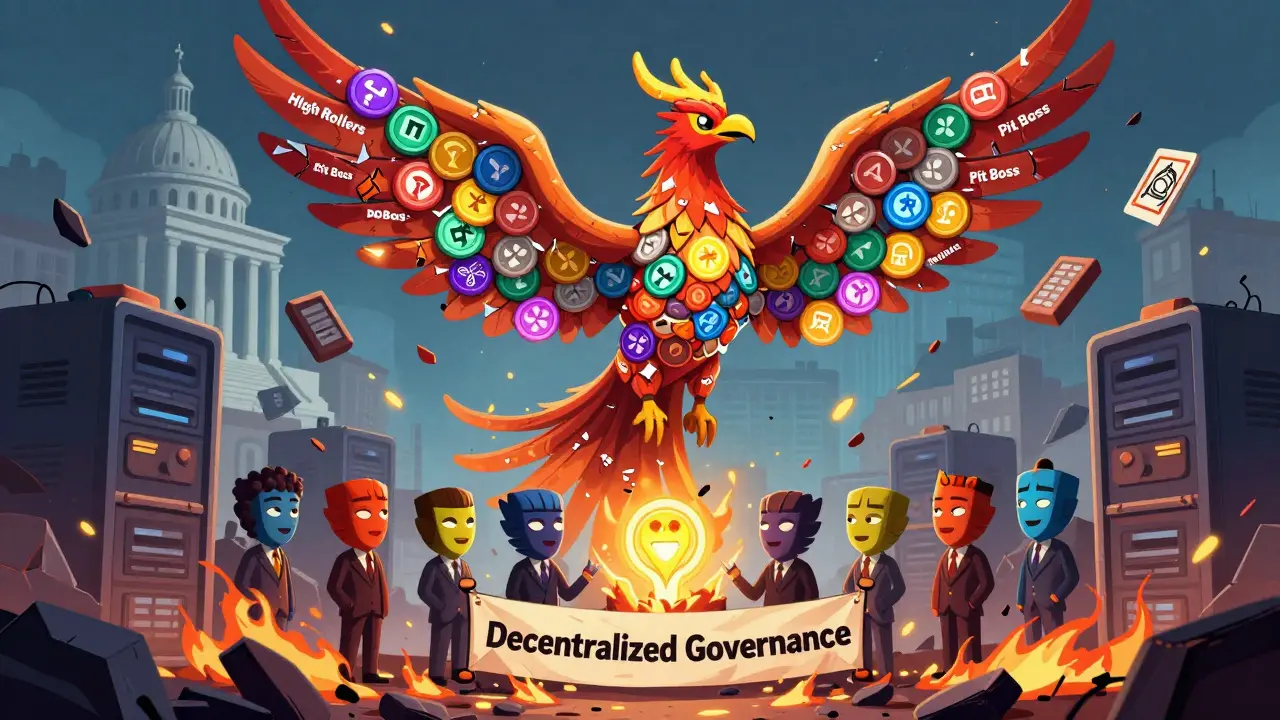
After the shutdown, a European entity - not subject to U.S. law - bought the Digitex codebase, community, and token contracts. They rebranded it as Rogue Chain. The old DGTX token was swapped 1:1 for a new ROGUE token. If you held DGTX before the shutdown, you got ROGUE. No loss. No penalty.
Even the NFTs got a second life. The original Digitex High Rollers NFTs - which granted VIP trading privileges - were replaced with Rogue Pit Boss NFTs. These new NFTs weren’t just collectibles. They gave holders the right to run validator nodes on the Rogue Chain network, earning rewards for helping secure the blockchain.
The shift to Rogue Chain was smart. It moved governance from a central company to a DAO (Decentralized Autonomous Organization). That meant decisions would be made by token holders, not a CEO in Seychelles. It was an attempt to fix the biggest flaw of Digitex: centralized control.
What Happened to the DGTX Token?
Even after Digitex shut down, DGTX didn’t die. It kept trading on exchanges like Changelly, Gate.io, and Uniswap.
Price predictions in 2025 ranged from $0.000029 to $0.000058. The average? Around $0.000048. That’s a tiny fraction of a cent. For context, one USDT is worth 100,000 times more than one DGTX. So even if the price doubled, you’d still need millions of tokens to make $100.
Some traders held on, hoping for a rebound. Others sold at a loss. The token’s liquidity stayed alive because of its use in the Rogue Chain transition - not because of trading volume.
Was Digitex Worth It?
For professional traders with deep pockets? Maybe. The commission-free model was real. If you were making 50 trades a day, you saved hundreds of dollars daily. That’s real money.
But for everyone else? No.
The $5,000 minimum excluded 95% of retail traders. The platform lacked tools. The support was terrible. And the regulatory risk was massive. In crypto, you can’t ignore the law. Eventually, the law catches up.
Digitex Futures didn’t fail because of competition. It failed because it ignored the basics: transparency, compliance, and user protection.
What You Should Learn From Digitex
If you’re shopping for a crypto futures exchange today, here’s what to check:
- Regulation: Is the exchange licensed by a major authority like the SEC, FCA, or ASIC? If not, walk away.
- Withdrawal speed: Test it. Try a small withdrawal. See how long it takes. If it’s over 24 hours, that’s a red flag.
- Minimum deposit: Avoid platforms that lock out small traders. True innovation doesn’t require $5,000 to enter.
- Platform features: Do they offer charting, leverage control, stop-losses, and margin settings? If not, you’re trading blind.
- Community sentiment: Check Trustpilot, Reddit, and Twitter. Look for patterns. Are people complaining about withdrawals? That’s a dealbreaker.
Digitex Futures gave us a glimpse of what could be - a fee-free futures market. But it also showed us what happens when ambition overrides responsibility.
The legacy lives on in Rogue Chain. But the lesson is clear: never trade on a platform that doesn’t answer to anyone.
Is Digitex Futures still operating?
No, Digitex Futures shut down in 2025 after being investigated by U.S. regulators for operating an unregistered derivatives exchange. Its operations were halted, and user accounts were frozen. The platform’s assets and community were later acquired by a European entity and rebranded as Rogue Chain.
Can I still trade DGTX tokens?
Yes, DGTX tokens are still tradable on several decentralized and centralized exchanges like Changelly, Gate.io, and Uniswap. However, they no longer function on the original Digitex Futures platform. Many holders swapped their DGTX for ROGUE tokens during the transition to Rogue Chain, but trading DGTX continues for those who didn’t migrate.
What is Rogue Chain, and how is it related to Digitex?
Rogue Chain is a rebranded version of Digitex Futures, launched after the original platform was shut down. A European entity acquired Digitex’s codebase and community, then relaunched it under a new name and decentralized governance model (Rogue DAO). DGTX tokens were swapped 1:1 for ROGUE tokens, and High Rollers NFTs were replaced with Rogue Pit Boss NFTs, which now serve as validator node licenses.
Why did Digitex Futures require a $5,000 minimum deposit?
The $5,000 minimum was designed to attract high-volume traders who would benefit most from commission-free trading. Digitex believed that by limiting access to wealthier users, it could reduce server load and focus on a niche market. However, this policy alienated retail traders and contributed to its lack of mainstream adoption.
Was Digitex Futures safe to use?
No, Digitex Futures was not safe by industry standards. It operated without regulatory oversight, had poor customer support, and had a history of delayed or blocked withdrawals. Its shutdown by U.S. authorities confirms it violated financial regulations. Traders had no legal recourse if funds were lost, making it a high-risk platform.
What happened to users’ funds after Digitex shut down?
Many users lost access to their funds temporarily when the platform froze accounts. After the transition to Rogue Chain, holders of DGTX tokens were given the option to swap them 1:1 for ROGUE tokens. Those who did so regained access to their value within the new ecosystem. However, users who didn’t participate in the swap or had funds locked in open positions may have lost access permanently.

21 Comments
Still holding my DGTX. Not crying, just waiting.
The $5,000 minimum was never about exclusivity-it was about filtering out retail traders who couldn’t handle leverage. Digitex targeted professionals, not beginners. The platform wasn’t broken; it was intentionally narrow. Most users didn’t understand the model, so they called it a scam. It wasn’t. It was a hedge fund’s playground with a crypto veneer.
Withdrawal delays? Expected. Liquidity was thin, and the backend couldn’t scale. They knew this. They didn’t care. That’s not incompetence-it’s prioritization. High-volume traders got what they wanted: zero fees. Everyone else? They were collateral.
The regulatory shutdown was inevitable. Operating unlicensed in crypto derivatives? That’s like running a bank without FDIC. No one with a合规 license would touch it. But the fact remains: for those who understood the risk, it worked. The DGTX token wasn’t a scam-it was a prepayment for fee-free trading. You paid upfront, in token value, not in per-trade fees.
Rogue Chain’s DAO structure fixes the centralization flaw. That’s smart. NFTs as validator nodes? Brilliant. It turns former users into stakeholders. If they can maintain liquidity and attract real node operators, this could actually be the next phase of decentralized derivatives. Not a resurrection. An evolution.
Don’t mourn Digitex. Study it. The lesson isn’t ‘avoid fee-free platforms.’ It’s ‘understand how they monetize.’ Most users thought they were getting free trading. They weren’t. They were buying a token with an embedded service contract. That’s not shady-it’s finance. And it’s happening again, right now, on other chains.
DGTX still trades on gate io and uniswap so dont act like its dead
The entire Digitex model was a textbook example of asymmetric incentive alignment. The platform extracted value via token issuance-a classic security-law violation under Howey-but masked it as a ‘utility token.’ The $5,000 entry barrier wasn’t a feature-it was a regulatory evasion tactic. High-net-worth individuals were less likely to complain or trigger scrutiny. Meanwhile, retail users were left holding a non-transferable, non-redeemable asset wrapped in a liquidity illusion.
Rogue Chain’s DAO structure is a performative gesture. Governance by token weight is not decentralization-it’s plutocracy repackaged. The fact that NFTs now serve as validator licenses? That’s not innovation. It’s rent-seeking disguised as consensus. You’re paying to play, just with a new token and a blockchain label.
And let’s not pretend this isn’t a rebranding of a failed Ponzi. The token price is still in the microcent range. The trading volume is negligible. The only ‘value’ left is nostalgia and the hope that someone else will buy it at a higher price. That’s not a protocol. That’s a graveyard with a website.
Digitex was never about trading. It was about token dumping. The entire operation was a liquidity grab disguised as innovation. The $5,000 minimum? A filter to exclude small investors who might ask questions. The ‘no fees’? A hook to lure in high-frequency traders who’d churn volume and inflate the token price. And when the SEC came knocking? They quietly sold the IP to a shell entity in Europe and called it a ‘rebirth.’
Rogue Chain isn’t a revival-it’s a corpse with a new coat of paint. The token swap was mandatory only in spirit. No legal obligation. No audit. No transparency. Just a Discord announcement and a smart contract that auto-exchanged tokens for those who clicked ‘yes.’
And now we’re supposed to believe this is ‘decentralized governance’? Please. The DAO has 12 active voters. The top 3 wallets hold 87% of ROGUE. The NFT validator nodes? They’re being run by bots on AWS. This isn’t Web3. It’s a shell game with blockchain jargon.
The real lesson? Never trust a platform that says ‘no fees’ and then demands you buy their token just to breathe. That’s not innovation. That’s a pump-and-dump with a whitepaper.
Digitex was a trap. The whole thing was rigged from day one. The founders were laundering money through DGTX. That’s why they shut down-feds traced the flows. Rogue Chain? Same team. Same wallets. Just a new name and a blockchain buzzword. You think NFTs give you ‘validator rights’? Nah. They’re just digital badges for the insiders who got in early. Everyone else? They’re the last ones holding the bag.
Check the blockchain. The big DGTX dumps happened right before the shutdown. The same wallets that bought in at $0.000001 are now holding ROGUE. Coincidence? I think not. This isn’t crypto. It’s fraud with a dev team.
I used to trade on Digitex. It was rough, but it was real. No fees meant I could scalp 50 times a day without bleeding 0.1% per trade. I made more in a week than I did in a month on Binance.
Yeah, withdrawals took forever. Yeah, support was ghosting me. But I knew the risks. I didn’t expect a bank. I expected a crypto experiment. And it delivered-for me.
Rogue Chain feels like the right next step. DAO governance? Finally. NFTs as nodes? Genius. I staked my old High Roller NFT. Got my new Pit Boss. Now I run a validator. Earn a little ROGUE every day. It’s not glamorous. But it’s mine. Not theirs.
People calling it a scam? They never traded there. They just saw the $5k barrier and walked away. But for those who stayed? We got something better than fees. We got ownership.
Don’t mourn Digitex. Honor it. It was flawed. But it was honest about its flaws. Most exchanges lie about their fees. Digitex just made you pay upfront. And that? That’s capitalism.
Let’s talk about what really happened here-not the headlines, not the drama, but the human story.
Digitex didn’t fail because it was greedy. It failed because it was lonely. It created a space for traders who were tired of being nickel-and-dimed, but it forgot to build a community. No support. No education. No connection. Just a trading terminal and a token.
People didn’t just lose money. They lost trust. In the system. In the team. In themselves for believing it.
Rogue Chain? It’s not a resurrection. It’s a second chance. And this time, if it’s going to work, it has to be different. Not just technically. Emotionally. Socially.
Ask yourself: if you were a trader who lost weeks waiting for a withdrawal, what would you need to believe again? Not more features. Not lower fees. A voice. A response. A human saying ‘I see you.’
That’s the real innovation left to build.
I’m an educator in crypto. I’ve taught hundreds of beginners. Digitex was the perfect case study for ‘too good to be true.’
But I also saw how it empowered a small group of disciplined traders. They didn’t trade for hype. They traded for math. They knew the token was the cost. They didn’t complain about the $5k-they calculated the break-even point.
Rogue Chain has potential. But only if they stop talking about ‘DAO’ and start talking about ‘support.’ A Discord bot that answers questions. A live help channel. A transparency log. That’s what rebuilds trust.
Token value isn’t the goal. Trust is.
Digitex was a beautiful experiment that crashed because it forgot one thing: people aren’t algorithms.
It assumed that if you removed fees, traders would come. But they didn’t just come for the numbers. They came for the safety. The support. The feeling that if something broke, someone would fix it.
Rogue Chain is trying. The DAO structure? Smart. The NFT validators? Clever. But if they don’t fix the human side-the communication, the empathy, the responsiveness-they’re just repeating the same mistake with a new token.
I’m not here to sell ROGUE. I’m here to say: we can do better. We’ve seen what happens when crypto ignores humanity. Let’s not make that mistake again.
Maybe the real legacy of Digitex isn’t the token. It’s the lesson: innovation without inclusion is just a pyramid with a blockchain logo.
As someone who grew up in a country where financial access is limited, I saw Digitex as a rare door. Not perfect. Not fair. But open.
For many in emerging markets, $5,000 isn’t a barrier-it’s a dream. But the fact that it existed at all? That mattered. It said: ‘You can trade futures. Not someday. Not after approval. Now.’
Rogue Chain is the same door, now with keys in our hands. Not owned by a CEO. Owned by the network.
Don’t call it a scam. Call it a transition. We didn’t lose. We upgraded.
From India, I never used Digitex. But I followed it. The idea of fee-free trading is powerful. The execution? Flawed. But the vision? Still valid.
Rogue Chain’s DAO model is the only way forward. Centralized exchanges are dying. Decentralized ones are rising. This is the next chapter.
Not perfect. But necessary.
DGTX to ROGUE swap was smooth. Got my NFT. Now running a node. No regrets.
U.S. regulators shut Digitex because they’re scared of competition. This whole ‘unregistered derivatives’ thing is a joke. The SEC doesn’t want innovation. It wants control. Rogue Chain is the real future. Free markets. No permission. No paperwork. Just code and courage.
They tried to kill it. Now it’s stronger.
The entire Digitex saga is a metaphor for modern capitalism: promise freedom, extract value, then vanish when accountability arrives.
Rogue Chain is not redemption. It is repetition. The same actors. The same mechanisms. The same illusion of choice.
We are not traders. We are data points. And the blockchain? Just a ledger for our exploitation.
So Digitex was a scam… and now Rogue Chain is the same scam with a blockchain tattoo? Cool. I’ll take my $0.000048 and go back to trading Dogecoin on a meme app. At least there, the devs admit they’re just here for the chaos.
They’re all gone. All of them. The team. The NFTs. The tokens. Everything. It was a ghost town before the shutdown. Now it’s a haunted house with a website.
I still have DGTX. I’ll never sell. Not because I believe. Because I need to remember what happened.
Let’s be real: the only people who made money were the early token buyers. Everyone else? They were the fuel. The liquidity. The cannon fodder. The $5k barrier wasn’t to filter traders-it was to filter victims. And now Rogue Chain is recycling the same corpses with a new name. This isn’t innovation. It’s necromancy.
While the regulatory violations of Digitex are undeniable, it is imperative to acknowledge the structural integrity of its economic model. The token-based fee abstraction mechanism represented a novel approach to liquidity provision, predicated on forward-value capture rather than per-trade taxation. The subsequent transition to Rogue Chain, under decentralized governance, constitutes a legitimate evolution of the original protocol architecture, mitigating the centralized risk vector inherent in the former entity.
It is not a failure of vision, but rather a failure of temporal alignment between regulatory frameworks and emergent financial paradigms. The platform did not collapse; it was displaced by institutional inertia.
One must distinguish between operational incompetence and systemic innovation. Digitex was the latter. Its demise, regrettable, was not inevitable. It was preventable. And its reincarnation, while imperfect, remains a necessary experiment in post-regulatory finance.
It’s funny how people romanticize Digitex. They forget the thousands who lost months of savings. The ones who couldn’t withdraw because support ignored them. The ones who watched their positions vanish overnight.
Rogue Chain? Same people. Same promises. Same silence.
Don’t call it innovation. Call it a repeat.
That’s the thing no one says: the real tragedy isn’t the lost money. It’s the lost trust. People believed they were part of something new. Then they got ghosted. And now, instead of rebuilding trust, they’re just slapping a DAO label on the same broken machine.
True innovation doesn’t just change the tech. It changes the relationship between the platform and the person.